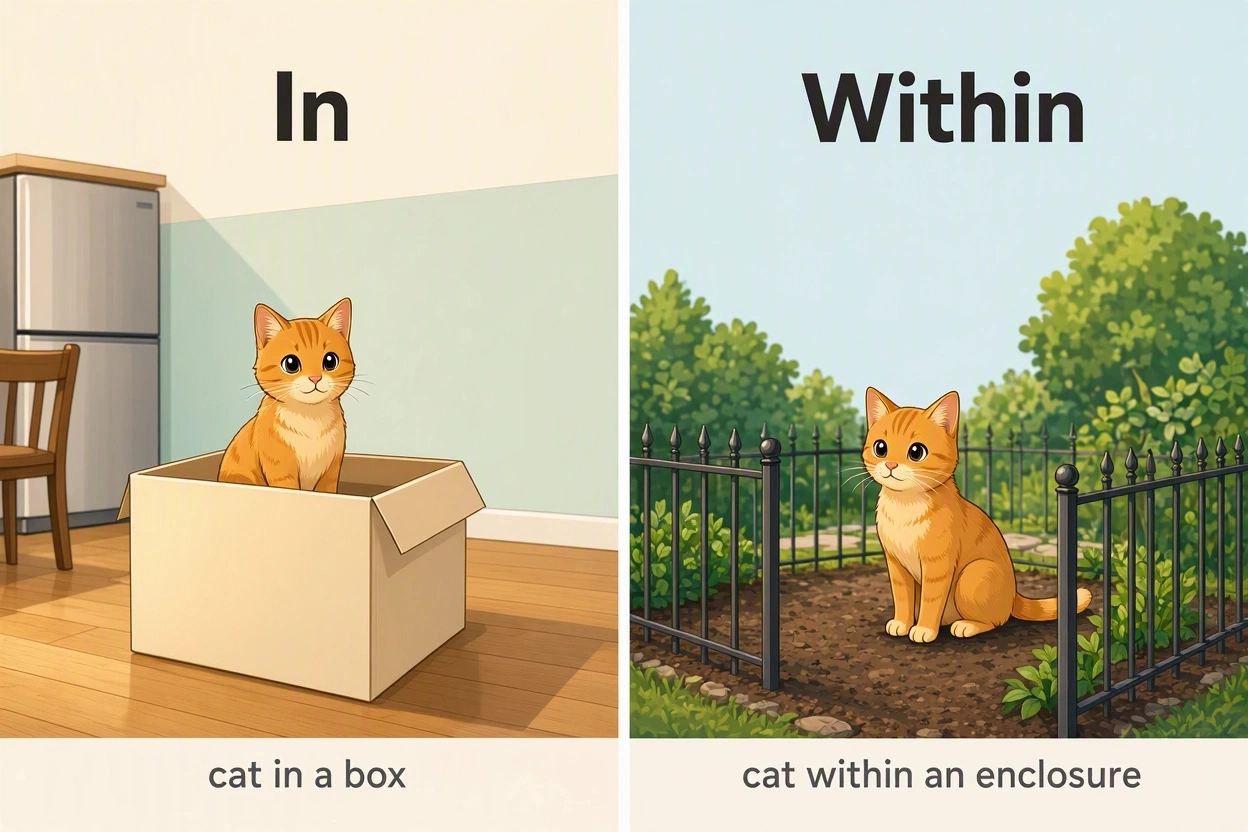
Have you ever wondered whether to use in or within when writing a sentence? These two English prepositions often appear in similar contexts, especially when describing places, periods of time, limits, and boundaries. Although they sometimes communicate the same general idea, they are not always interchangeable. Choosing the right word can make your writing clearer, more natural, and easier to understand.
The main difference is that in commonly describes a location, state, or period of time, while within emphasizes being inside a boundary or staying inside a particular limit. For example, “The keys are in the drawer” describes a location, whereas “Please respond within two days” establishes a deadline. In this guide, you will learn the meanings of in and within, explore practical examples, and discover simple rules for choosing the correct preposition.
Quick Answer: In vs Within
In generally describes being inside a place, situation, or period of time. Within emphasizes being inside a defined boundary or completing something before a time limit expires. For example, “She is in the room” describes location, while “Finish within an hour” sets a deadline.
Why People Confuse In and Within
People often confuse in and within because both words can mean that something is inside a particular place, period, or boundary.
For example, both “The package arrived in three days” and “The package arrived within three days” can be correct. However, the emphasis differs: in three days can describe the time something takes or when it happens, while within three days stresses that the event occurs before a three-day limit expires.
Three common reasons explain the confusion:
- Overlapping meanings: Both words can describe something inside a physical or abstract space.
- Time expressions: Both appear in sentences about minutes, hours, days, and years.
- Different emphasis: In is often neutral, while within highlights boundaries, limits, or an allowed range.
The easiest way to distinguish them is to ask whether you are simply describing a location or period, or emphasizing a specific limit.
1. In: Meaning, Definition, and Examples
In is a preposition used to describe location, time, condition, participation, and other relationships. It is one of the most frequently used words in English.
When referring to location, in usually means that something is inside a space or area. When referring to time, it can identify a month, year, season, or period needed for an activity.
Common Uses of In
1. Describing a physical location
Use in when someone or something is inside a room, container, building, city, or other area.
Examples:
- The children are in the classroom.
- I left my wallet in the car.
- She lives in Lahore.
- There is some water in the bottle.
2. Describing time
Use in with months, years, seasons, and certain periods.
Examples:
- My birthday is in October.
- They moved here in 2024.
- Flowers bloom in spring.
- I will finish the assignment in an hour.
3. Describing a state or condition
Use in to describe a situation, emotional condition, or state of being.
Examples:
- He is in trouble.
- She was in a good mood.
- The company is in financial difficulty.
- The building is in excellent condition.
4. Describing participation or involvement
Examples:
- She works in education.
- He has experience in marketing.
- I am interested in learning English.
- They participated in the competition.
When Should You Use In?
Choose in when you want to describe:
- A location or enclosed space
- A month, year, or season
- A condition or situation
- Participation in an activity or field
- The amount of time something takes, depending on context
For example, “I completed the task in two hours” usually means the task took two hours to complete.
2. Within: Meaning, Definition, and Examples
Within is a preposition that means inside a particular area, boundary, range, or limit. It is especially useful when you want to emphasize that something does not extend beyond a specified limit.
It frequently appears in professional instructions, formal writing, rules, deadlines, and descriptions of physical or abstract boundaries.
Common Uses of Within
1. Describing physical boundaries
Use within when something is located inside a defined area or boundary.
Examples:
- The school is within walking distance of our house.
- Please remain within the marked area.
- The village lies within the national park.
- All visitors must stay within the designated zone.
2. Describing deadlines
Use within when something must happen before a specified period expires.
Examples:
- Please reply within 24 hours.
- The company will contact you within three business days.
- You must submit the form within one week.
- The refund should arrive within ten working days.
3. Describing limits or ranges
Use within when referring to an acceptable range, restriction, or permitted limit.
Examples:
- Keep your spending within the budget.
- The temperature remained within the recommended range.
- The project must stay within the agreed scope.
- The decision falls within the manager’s authority.
4. Describing an internal or abstract scope
Examples:
- There is disagreement within the organization.
- The answer lies within the text.
- She found the strength within herself.
- The policy applies within the department.
When Should You Use Within?
Choose within when you want to emphasize:
- A defined physical boundary
- A deadline or maximum time period
- A permitted range or restriction
- The scope of an organization, system, or subject
- Something that remains inside an established limit
For example, “Please complete the test within 30 minutes” means you must finish before the 30-minute time limit expires.
In vs Within: Comparison Table
| Feature | In | Within |
| Main meaning | Inside a place, period, or condition | Inside a boundary, range, or limit |
| Physical location | In the room | Within the marked area |
| Time | In October | Within two weeks |
| Duration | The job took two hours | Finish within two hours |
| Deadlines | Can describe when something happens | Emphasizes a deadline or time limit |
| Boundaries | General location or inclusion | Highlights defined limits |
| Tone | Common in everyday English | Often more precise or formal |
| Example | She lives in the city | The property lies within city limits |
Remember that the distinction depends on context. Both prepositions can sometimes describe the same situation, but within often places greater emphasis on a boundary or limit.
When to Use Each: In vs Within
Choosing between in and within becomes easier when you consider the meaning of your sentence.
Use In for General Location
When you simply want to say where something is, in is usually the natural choice.
- The books are in the cupboard.
- My friend lives in London.
- The students are in the library.
You are describing a location without necessarily emphasizing a boundary.
Use Within for Defined Boundaries
Choose within when the boundaries of a place matter.
- The building is within the university campus.
- Visitors must stay within the safety zone.
- The village lies within the protected area.
Here, the emphasis is on remaining inside a particular area.
Use In for Time Taken
When describing how long an activity takes, in is often appropriate.
- I finished the report in two hours.
- She learned the basics in a week.
- The train journey takes six hours.
These sentences focus on the amount of time needed to complete something.
Use Within for Time Limits
Choose within when something must happen before a deadline expires.
- Submit the report within two hours.
- The office will respond within five working days.
- You must register within one month.
These sentences emphasize a maximum permitted period.
Can In and Within Be Interchanged?
Sometimes, yes. Consider these examples:
- “The package arrived in three days.”
- “The package arrived within three days.”
Both can be correct, but the first may describe the time taken, while the second emphasizes that the package arrived before the three-day limit ended.
The best choice depends on whether you want to describe duration or emphasize a deadline.
Examples of In vs Within in Sentences
Here are 16 practical examples showing how these prepositions work in everyday and professional English.
- In: The keys are in my bag.
Meaning: The keys are inside the bag. - Within: Please stay within the marked lines.
Meaning: Do not go beyond the boundaries. - In: She was born in 2001.
Meaning: The event happened during a particular year. - Within: You must pay the bill within seven days.
Meaning: Payment must be made before the deadline expires. - In: He finished the exam in 45 minutes.
Meaning: The exam took 45 minutes to complete. - Within: Complete the exam within 45 minutes.
Meaning: Do not exceed the 45-minute limit. - In: My parents live in a small town.
Meaning: The town is their place of residence. - Within: The hotel is within walking distance of the station.
Meaning: The station is close enough to reach on foot. - In: She works in the finance department.
Meaning: She is employed in that department. - Within: The decision is within the director’s authority.
Meaning: The director has the authority to make the decision. - In: The flowers bloom in spring.
Meaning: Spring is the season when they bloom. - Within: The company expects to launch the product within six months.
Meaning: The launch is expected before six months have passed. - In: He is in a difficult situation.
Meaning: He is experiencing a challenging circumstance. - Within: The answer can be found within the first chapter.
Meaning: The answer appears inside the chapter’s content. - In: The temperature dropped in a few hours.
Meaning: The change happened over that period. - Within: The temperature must remain within the safe range.
Meaning: It must not exceed the permitted limits.
These examples demonstrate that in often provides general information, while within frequently highlights a limit or defined scope.
Common Mistakes When Using In and Within
Even proficient English speakers sometimes use these prepositions incorrectly. Here are some common mistakes and how to correct them.
1. Confusing Duration With a Deadline
Incorrect for a deadline: Please submit the application in five days.
Clearer: Please submit the application within five days.
The first sentence may be interpreted as referring to when the submission should occur. The second clearly establishes a deadline.
2. Using Within for Every Location
Less natural: My phone is within my pocket.
Natural: My phone is in my pocket.
Use in for ordinary descriptions of enclosed spaces. Use within when a boundary or limit is particularly relevant.
3. Forgetting That In Can Describe Duration
Incorrect: I completed the assignment within two hours, when you specifically mean that the task took exactly two hours.
Clearer: I completed the assignment in two hours.
Within two hours normally means no later than two hours after the relevant starting point, not necessarily that the task took exactly two hours.
4. Treating Within as More Correct in Every Situation
Incorrect assumption: Within is always more formal and therefore always better.
Natural: She lives in Karachi.
Awkward: She lives within Karachi, unless the sentence specifically emphasizes a boundary or defined area.
Choose the word that communicates your intended meaning naturally.
5. Confusing In Time With Within Time
The expression in time commonly means early enough for something or before it is too late.
Example: “We arrived in time for the meeting.”
Within the time limit means before the permitted period expires.
Example: “She completed the test within the time limit.”
These expressions are related, but they do not mean exactly the same thing.
Memory Trick: How to Remember In vs Within
Use this simple memory trick:
- In = Inside or during. Think of being in a room, in a city, or in October.
- Within = Inside the limits. Think of boundaries, deadlines, budgets, and permitted ranges.
Try remembering these two sentences:
- “I finished the work in two hours.” The focus is on the time taken.
- “Finish the work within two hours.” The focus is on the deadline.
A quick test can also help: if your sentence emphasizes a maximum limit that must not be exceeded, within is often the better choice. If you are simply describing a place, state, or period, in is usually more natural.
American vs British English
The general rules for in and within are the same in American and British English. Both varieties use these prepositions to describe locations, periods, boundaries, and time limits.
| Context | American English | British English |
| Location | The documents are in the office. | The documents are in the office. |
| Deadline | Respond within two days. | Respond within two days. |
| Duration | I finished in an hour. | I finished in an hour. |
| Physical boundary | Stay within the designated area. | Stay within the designated area. |
| Formal instructions | Submit the form within seven days. | Submit the form within seven days. |
There is no major regional difference in the basic meanings of these two words. Differences are more likely to arise from individual writing styles, institutional rules, or the context in which a sentence appears.
For international business communication, academic writing, and SEO content, the same practical distinction works well in both varieties.
Similar Words: Inside, During, By, and No Later Than
Understanding related prepositions can make your English more accurate.
1. In vs Inside
Both words can describe something located in an enclosed space.
- The cat is in the box.
- The cat is inside the box.
Inside often emphasizes the interior, while in is more versatile and commonly used.
2. Within vs Inside
Within often emphasizes limits or boundaries, while inside usually refers to an interior space.
- The children are inside the house.
- The house is within the protected area.
3. In vs During
Both words can refer to time, but their grammatical patterns differ.
- I was born in July.
- I fell asleep during the movie.
Use in with months, years, and certain periods. Use during to describe something happening over the course of an event or period.
4. Within vs By
Both can be used when discussing deadlines, but the emphasis differs.
- Submit the application by Friday.
- Submit the application within three days.
By Friday identifies a specific deadline. Within three days establishes a time limit measured from a relevant starting point.
5. Within vs No Later Than
These expressions can communicate similar deadline meanings.
- Please respond within 24 hours.
- Please respond no later than tomorrow at noon.
The first sets a period, while the second identifies a specific latest time.
Frequently Asked Questions
1. What is the main difference between in and within?
In generally describes location, time, or a state. Within emphasizes being inside a defined boundary, range, or time limit. The correct choice depends on the context and intended meaning.
2. Is it correct to say within two days?
Yes. “Within two days” means that something should happen before two days have passed from the relevant starting point. For example, “The company will respond within two days.”
3. Should I use in or within for deadlines?
Use within when emphasizing that something must happen before a time limit expires. For example, “Submit the documents within five working days.” Use by when specifying a particular deadline, such as “Submit the documents by Friday.”
4. Can in and within mean the same thing?
Sometimes. For example, “The package arrived in three days” and “The package arrived within three days” can both be correct. However, within more explicitly emphasizes a maximum time limit.
5. Is within more formal than in?
Within often sounds more precise or formal when discussing boundaries, rules, and deadlines. However, neither word is universally more formal. Both are appropriate in professional and everyday English.
6. Is it in an hour or within an hour?
Both expressions are correct, but they can communicate different meanings. “I finished in an hour” usually describes how long the task took. “Finish within an hour” instructs someone to complete it before the hour expires.
7. What does within mean in a sentence?
Within means inside a boundary, range, or limit. In “The school is within walking distance,” it indicates that the school is close enough to reach on foot.
8. What is another word for within?
Depending on context, alternatives include inside, inside the limits of, no more than, or before the deadline. These expressions are not interchangeable in every sentence, so choose the one that preserves the intended meaning.
Final Verdict:
The difference between in and within is mainly a matter of meaning and emphasis. In is a versatile preposition used to describe locations, periods, conditions, and participation. Within is especially useful when a sentence refers to a defined boundary, permitted range, or deadline. For example, “She completed the work in two hours” describes the time taken, while “Complete the work within two hours” sets a time limit.
To use these words correctly, consider what your sentence needs to communicate. Choose in for ordinary descriptions of places, periods, and situations. Choose within when you want to emphasize limits or boundaries. Although the two words sometimes overlap, understanding this distinction will help you write clearer emails, more accurate academic assignments, and more natural English sentences.
Conclusion
Learning how to use in vs within correctly is a valuable step toward improving English grammar and writing skills. Both words can refer to something being inside a place or period, but they often serve different purposes. In is generally the natural choice for everyday location and time expressions, while within is particularly useful for deadlines, restrictions, boundaries, and defined ranges.
The most effective way to master the difference is to practice with real sentences. Ask yourself whether you are simply describing where or when something happens, or whether you are emphasizing a limit that must not be exceeded. With regular practice, you will become more confident choosing the correct preposition in conversations, emails, school assignments, and professional writing.
Remember This
- In: Describes a location, period, condition, or amount of time taken.
- Within: Emphasizes an interior boundary, a permitted range, or a deadline.
- In two hours: Often describes how long something takes.
- Within two hours: Means before the two-hour limit expires.
- Best tip: Use in for general descriptions and within when limits matter.

I’m Micah Wheeler, a passionate author who enjoys exploring matching words, grammar, and language. I create clear, helpful content to make word choices and grammar easier for everyone.


