Have you ever hesitated between writing “there has been” and “there have been”? Both expressions are grammatically correct, but they are used in different situations. The difference depends on whether the noun you are talking about is singular or plural. Understanding this simple grammar rule can help you write clearer sentences, avoid common English mistakes, and sound more natural in everyday conversations.
The phrases “there has been” and “there have been” are commonly used when discussing events, experiences, changes, and situations that began or occurred in the past and remain relevant to the present. You might use them when describing a recent problem, reporting several developments, or talking about something that has happened over time. Although the difference may seem small, choosing the correct phrase matters in academic writing, professional emails, and everyday English. In this guide, you will learn the definitions, grammatical rules, sentence examples, and practical tricks that make choosing between these two expressions much easier.
Quick Answer: There Has Been vs There Have Been
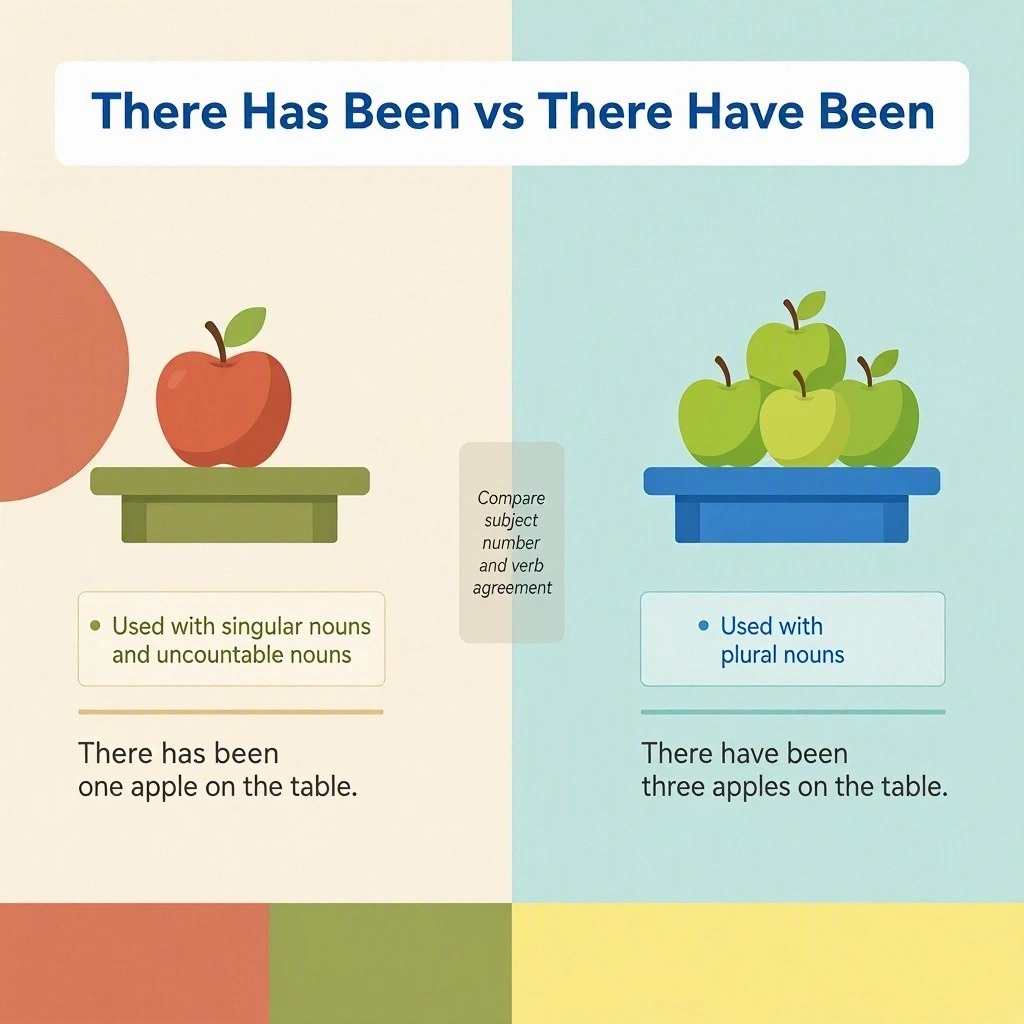
Use “there has been” with a singular countable noun or an uncountable noun. Use “there have been” with a plural noun. For example, “There has been a problem” is correct, while “There have been several problems” is correct.
Why People Confuse It
Many English learners confuse “there has been” and “there have been” because both phrases describe events or situations connected to the past. They also begin with the same words, making the difference easy to overlook.
The key is understanding that has and have depend on the grammatical number of the noun that follows the phrase.
Consider these examples:
- There has been a mistake.
- There have been several mistakes.
In the first sentence, “a mistake” is singular, so we use has been. In the second, “several mistakes” is plural, so we use have been.
Another reason for confusion is that the word there can function as an introductory word rather than the subject that determines agreement. In existential sentences, the verb generally agrees with the noun phrase that follows it.
Once you identify that noun, selecting the correct expression becomes much easier.
1. There Has Been: Meaning, Definition, and Usage
“There has been” is used to introduce the existence or occurrence of a singular event, situation, or uncountable thing. It combines there, the singular auxiliary verb has, and the past participle been.
This construction commonly appears in the present perfect tense, which connects a past event or situation to the present.
When to Use There Has Been
Use “there has been” when the noun that follows is:
- A singular countable noun: There has been a delay.
- An uncountable noun: There has been progress.
- A singular event or situation: There has been an accident.
- A singular problem or change: There has been a misunderstanding.
Examples of There Has Been
- There has been a significant improvement in her writing.
- There has been an accident on the main road.
- There has been a change in the meeting schedule.
- There has been a misunderstanding between the two colleagues.
- There has been considerable progress on the project.
- There has been a lot of rain this week.
- There has been an increase in the cost of living.
- There has been enough time to complete the assignment.
- There has been a problem with the internet connection.
- There has been an unexpected development in the case.
Notice that rain, progress, and time are uncountable in these contexts. They take “there has been” because they are treated as grammatically singular.
Negative and Question Forms
You can also use “there has been” in negative sentences and questions.
Negative examples:
- There has not been any progress today.
- There hasn’t been a response from the manager.
- There has not been enough evidence to support the claim.
Question examples:
- Has there been a change in the plan?
- Has there been any progress on your application?
- Has there been a problem with the payment?
In questions, has moves before there.
2. There Have Been: Meaning, Definition, and Usage
“There have been” introduces the existence or occurrence of plural events, situations, people, or things. It uses have because the noun phrase that follows is plural.
Like “there has been,” this expression commonly uses the present perfect tense to connect past events with the present.
When to Use There Have Been
Use “there have been” when the noun that follows is plural.
Common examples include:
- Several mistakes
- Many changes
- Three meetings
- Two accidents
- Numerous opportunities
- A few complaints
Examples of There Have Been
- There have been several changes to the schedule.
- There have been many complaints about the service.
- There have been three meetings this week.
- There have been significant improvements in his performance.
- There have been two accidents on this road recently.
- There have been numerous opportunities to discuss the issue.
- There have been several delays in delivering the order.
- There have been many questions about the new policy.
- There have been a few mistakes in the final report.
- There have been important developments since our last meeting.
In each sentence, the noun is plural, so have been is the correct choice.
Negative and Question Forms
Negative examples:
- There have not been any updates.
- There haven’t been enough volunteers.
- There have not been many opportunities to practice.
Question examples:
- Have there been any changes?
- Have there been complaints about the new system?
- Have there been any updates since yesterday?
Use have in the question because the noun phrase remains plural.
Comparison Table: There Has Been vs There Have Been
| Feature | There Has Been | There Have Been |
| Main use | Singular events or uncountable nouns | Plural events or things |
| Auxiliary verb | Has | Have |
| Common noun type | Singular countable or uncountable | Plural countable |
| Example | There has been a delay. | There have been several delays. |
| Negative form | There hasn’t been a delay. | There haven’t been any delays. |
| Question form | Has there been a delay? | Have there been any delays? |
| Present perfect structure | Has + been | Have + been |
When to Use Each Expression
Choosing between these expressions is easier when you follow a simple process.
Step 1: Identify the Noun
Find the noun phrase that comes after “there has been” or “there have been.”
Examples:
- There has been a problem.
- There have been several problems.
Step 2: Check Whether It Is Singular or Plural
A singular countable noun refers to one person, place, thing, or event. A plural noun refers to more than one.
- One mistake → There has been a mistake.
- Five mistakes → There have been five mistakes.
Step 3: Check Whether the Noun Is Uncountable
Uncountable nouns generally take the singular verb form in this construction.
Examples:
- There has been enough water.
- There has been considerable growth.
- There has been little information about the incident.
Although these nouns may refer to large amounts, they are grammatically singular in these examples.
Step 4: Do Not Let the Nearest Word Mislead You
Sometimes a sentence contains additional words between the verb and the main noun phrase.
For example:
- There has been a series of unexpected events.
- There have been several unexpected events.
In the first sentence, the main noun is “series,” which is singular. The phrase “of unexpected events” does not make the subject plural.
In the second sentence, “events” is the main noun, so have been is correct.
Examples: There Has Been vs There Have Been in Everyday English
Here are 15 paired examples showing how the choice changes when the noun changes.
- Singular: There has been a delay.
Plural: There have been several delays. - Singular: There has been a mistake in the report.
Plural: There have been mistakes in the reports. - Singular: There has been a meeting this morning.
Plural: There have been three meetings this morning. - Singular: There has been an improvement in sales.
Plural: There have been improvements in sales. - Singular: There has been a complaint from a customer.
Plural: There have been complaints from customers. - Singular: There has been an accident near the school.
Plural: There have been several accidents near the school. - Singular: There has been a change in the policy.
Plural: There have been changes in the policy. - Singular: There has been enough food for everyone.
Plural: There have been enough meals for everyone. - Singular: There has been a question about the instructions.
Plural: There have been questions about the instructions. - Singular: There has been a new development in the case.
Plural: There have been new developments in the case. - Singular: There has been progress on the assignment.
Plural: There have been several advances in the research. - Singular: There has been a problem with the website.
Plural: There have been problems with the website. - Singular: There has been a visitor today.
Plural: There have been several visitors today. - Singular: There has been an opportunity to learn.
Plural: There have been many opportunities to learn. - Singular: There has been a lot of discussion about the proposal.
Plural: There have been many discussions about the proposal.
These examples show that the noun’s grammatical number determines the choice, not whether the situation seems important, recent, or complicated.
Common Mistakes to Avoid
Even advanced English learners sometimes make errors with these phrases. Here are some common problems and their corrections.
1. Using Has With a Plural Noun
Incorrect: There has been many changes.
Correct: There have been many changes.
Why? “Changes” is plural, so it requires have been.
2. Using Have With a Singular Noun
Incorrect: There have been a problem.
Correct: There has been a problem.
Why? “A problem” is singular, so it requires has been.
3. Treating Uncountable Nouns as Plural
Incorrect: There have been much progress.
Correct: There has been much progress.
Why? “Progress” is normally uncountable in this meaning and takes singular agreement.
4. Confusing Present Perfect With Simple Past
Compare:
- There has been a power outage today.
- There was a power outage yesterday.
The present perfect often connects a past event with the present. The simple past describes an event in a completed past time frame.
However, the correct tense depends on the intended meaning and context.
5. Choosing the Verb Based on a Nearby Noun
Incorrect: There have been a series of delays.
Correct: There has been a series of delays.
Why? The main noun is “series,” which is singular. The plural noun “delays” appears inside the phrase “of delays,” but it does not determine agreement.
Memory Trick: How to Remember the Difference
Use this simple rule:
Has = one or uncountable. Have = plural.
Think of the noun immediately following the expression:
- One problem → There has been a problem.
- Several problems → There have been several problems.
- Information → There has been information about the case.
You can also ask yourself, “Would I say a problem has or problems have?” The answer will usually point you toward the correct phrase.
Remember that uncountable nouns such as water, progress, information, and advice generally use “there has been” when they are used in their ordinary uncountable senses.
American vs British English
The distinction between “there has been” and “there have been” is essentially the same in American and British English. Both varieties follow the standard subject–verb agreement rule in ordinary usage.
| Context | American English | British English |
| One event | There has been an accident. | There has been an accident. |
| Multiple events | There have been several accidents. | There have been several accidents. |
| Uncountable noun | There has been some progress. | There has been some progress. |
| Question about plural events | Have there been any changes? | Have there been any changes? |
There may be differences in pronunciation, vocabulary, or regional preferences elsewhere in English, but these two grammatical constructions follow the same basic rule in both varieties.
For school assignments, professional emails, and formal articles, use has been with singular or uncountable nouns and have been with plural nouns.
Similar Words and Expressions
Several related expressions can help you describe events and situations more naturally.
1. There Was vs There Were
These expressions usually use the simple past tense.
- There was a problem yesterday.
- There were several problems yesterday.
Use was with singular or uncountable nouns and were with plural nouns.
2. There Has Been vs There Had Been
“There has been” connects a past event to the present. “There had been” usually describes something that existed or happened before another past event.
- There has been a change in the schedule.
- There had been a change before we arrived.
3. There Is vs There Are
These expressions generally describe present existence.
- There is a book on the table.
- There are several books on the table.
The same singular-versus-plural principle applies.
4. There Will Be
Use “there will be” to describe something expected or planned in the future.
- There will be a meeting tomorrow.
- There will be several meetings next week.
The expression will be does not change according to whether the noun is singular or plural.
5. There Has Been vs It Has Been
These expressions have different grammatical functions.
- There has been a delay. — Introduces the existence or occurrence of a delay.
- It has been a difficult day. — Describes the day.
Do not treat there and it as interchangeable in every sentence.
Frequently Asked Questions
1. Is it “there has been” or “there have been”?
Both are correct. Use “there has been” with a singular countable noun or an uncountable noun, and “there have been” with a plural noun.
2. Is “there has been many” grammatically correct?
No, not in standard English when “many” refers to a plural countable noun. Say “there have been many,” as in “There have been many changes.”
3. Is “there have been a lot” correct?
It depends on the noun that follows. “There have been a lot of problems” is correct because “problems” is plural. However, “There has been a lot of progress” is correct because “progress” is uncountable.
4. Do uncountable nouns use “there has been”?
Yes. Uncountable nouns generally take “there has been” in this construction. For example, “There has been enough rain” and “There has been little information.”
5. Can I start a question with “has there been”?
Yes. Use “Has there been” when asking about a singular event or an uncountable thing. For example, “Has there been a change?” For plural nouns, use “Have there been any changes?”
6. What is the difference between “there has been” and “there was”?
“There has been” is the present perfect form and often connects a past event to the present. “There was” is the simple past form and describes something in the past. The appropriate choice depends on the time reference and context.
7. Is “there have been” used in British English?
Yes. “There have been” is standard in both British and American English when the noun phrase is plural.
8. Which is correct: “there has been a number of” or “there have been a number of”?
In standard usage, “there have been a number of problems” is generally preferred because “a number of” means several and takes plural agreement. By contrast, “there has been the number of problems we expected” can be correct when the singular noun “number” itself is the subject of the phrase.
Final Verdict: There Has Been vs There Have Been
The difference between “there has been” and “there have been” comes down to subject–verb agreement. Use “there has been” for singular countable nouns and uncountable nouns, such as “a delay,” “an accident,” or “progress.” Use “there have been” for plural nouns, such as “several delays,” “two accidents,” or “many changes.”
The most reliable strategy is to identify the main noun phrase rather than focusing on the word there or a nearby noun. Once you recognize whether the noun is singular, plural, or uncountable, the correct expression becomes much easier to choose. With regular practice, you can use both forms naturally in conversations, emails, essays, and professional writing.
Conclusion
Learning when to use “there has been” and “there have been” is an important step toward more accurate English grammar. Although the expressions look almost identical, the verb changes according to the noun that follows. Singular and uncountable nouns take has been, while plural nouns take have been. This rule applies to everyday speech as well as formal writing.
Whenever you are unsure, look at the noun phrase and ask whether it refers to one item, multiple items, or an uncountable substance or concept. Practicing with examples such as “There has been a problem” and “There have been several problems” will help you recognize the pattern quickly. A little attention to subject–verb agreement can make your writing clearer and more professional.
Remember This
- There has been: Singular countable nouns and uncountable nouns.
- There have been: Plural nouns.
- There has been a mistake. Correct.
- There have been several mistakes. Correct.
- Best grammar tip: Identify the main noun phrase before choosing has or have.

I’m Elliot Pierce, Administrator at Grammetics, dedicated to improving word matching and grammar. I help maintain useful content, support readers, and make language learning simple, clear, accurate, and engaging.