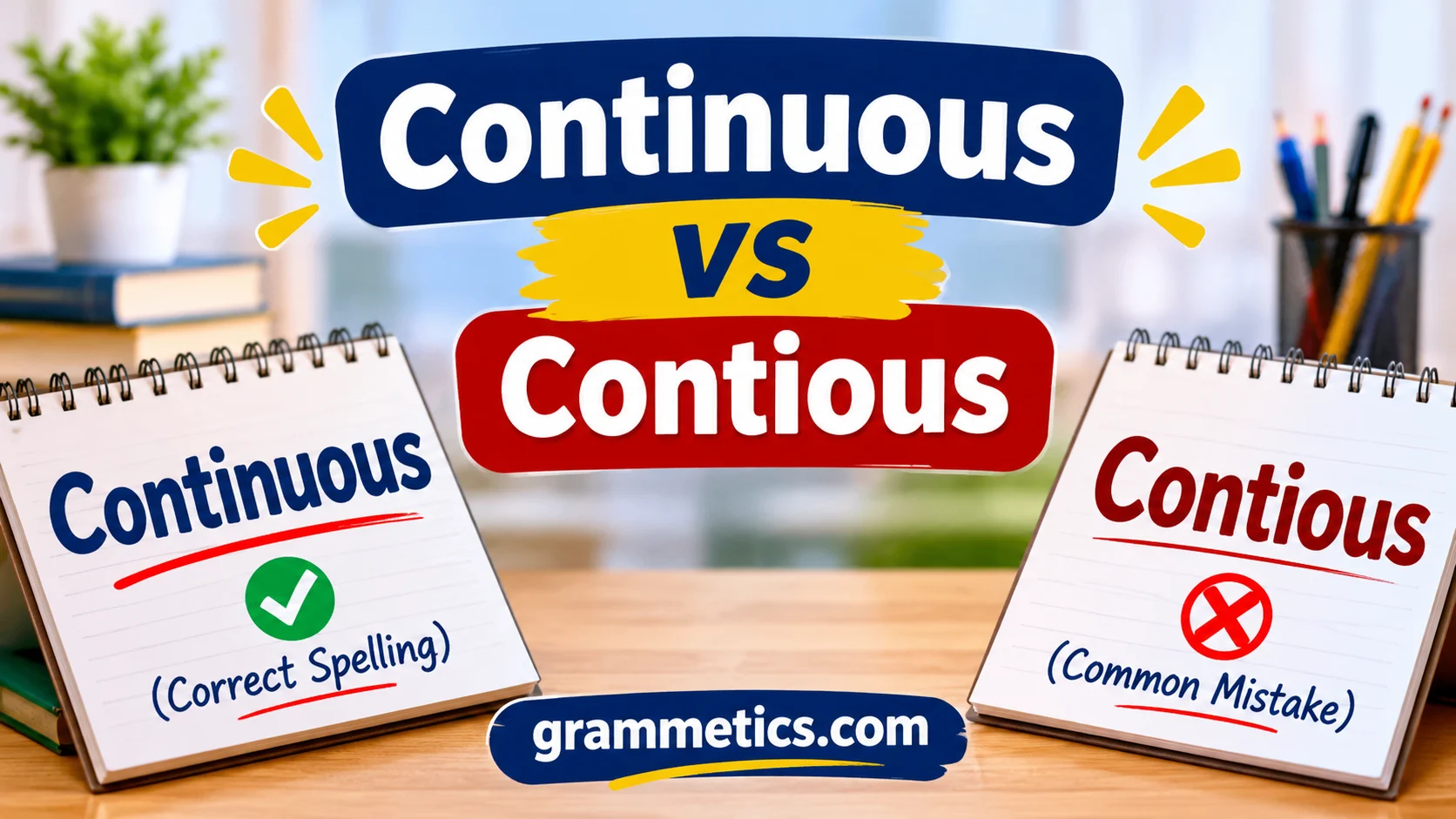
Have you ever wondered whether the correct spelling is continuous or contious? These two spellings may look similar, especially when typing quickly, but only one is recognized as a standard English word. Many people accidentally write “contious” because they pronounce continuous quickly or overlook a few letters in the middle. This common spelling confusion can appear in emails, school assignments, professional documents, and everyday conversations.
Understanding the difference is simple once you learn the correct spelling and meaning. The word continuous describes something that continues without stopping, interruption, or a significant break. On the other hand, contious is not a standard English word and should not be used in formal or informal writing.
In this guide, you’ll learn the correct spelling, definition, pronunciation, practical examples, common mistakes, and useful memory tricks to help you write continuous confidently.
Quick Answer
Continuous is the correct English spelling. It means happening without interruption or continuing over a period of time. Contious is a misspelling and is not recognized as a standard English word. Always use continuous when describing something ongoing or uninterrupted.
Why People Confuse It
People often confuse continuous and contious because the two spellings look almost identical. When writing quickly, it is easy to leave out the letters “nu” from continuous.
There are several reasons behind this spelling mistake:
- Pronunciation: In everyday speech, continuous may sound shorter than it looks.
- Typing errors: People sometimes skip letters while typing quickly.
- Unfamiliar spelling: The middle portion of continuous can be difficult to remember.
- Autocorrect habits: Some writers rely too heavily on spelling suggestions.
- Repeated mistakes: Seeing an incorrect spelling online can make it appear acceptable.
The easiest solution is to remember that continuous contains the complete sequence of letters: C-O-N-T-I-N-U-O-U-S.
Continuous
Continuous is the correct spelling and a commonly used English adjective.
It describes something that happens without stopping, interruption, or a noticeable break. It can also refer to something that continues over time.
Definition:
Continuous means continuing without interruption or happening repeatedly over a period.
Examples:
- The continuous rain flooded several streets.
- Our company needs continuous improvement.
- She listened to continuous music while studying.
- The machine operates continuously throughout the day.
- Continuous practice helps students improve their English.
Synonyms of Continuous:
- Constant
- Uninterrupted
- Ongoing
- Ceaseless
- Steady
- Persistent
- Continuous-flowing
When to Use Continuous
Use continuous when describing:
- An activity that does not stop.
- An uninterrupted process.
- Something that continues over time.
- An ongoing situation or condition.
- Regular development or improvement.
For example:
“The hospital provides continuous medical care to its patients.”
Here, continuous explains that medical care is available without interruption.
Contious
Contious is an incorrect spelling of continuous. It does not have an established meaning in standard English dictionaries.
Although some people use it accidentally in online conversations, messages, or written documents, it should not be considered a correct English word.
Incorrect: The company provides contious support.
Correct: The company provides continuous support.
Incorrect: We need contious improvement in our work.
Correct: We need continuous improvement in our work.
Why Should You Avoid Contious?
Avoid this spelling because:
- It is not a standard English word.
- It may reduce the professionalism of your writing.
- It can create confusion for readers.
- Grammar and spelling checkers may flag it as an error.
- It is unsuitable for academic and professional writing.
Whenever you intend to describe something ongoing or uninterrupted, choose continuous.
Continuous vs Contious: Comparison Table
| Feature | Continuous | Contious |
| Spelling | Correct | Incorrect |
| Word status | Standard English word | Nonstandard misspelling |
| Part of speech | Adjective | Not recognized |
| Meaning | Without interruption | No established meaning |
| Dictionary usage | Recognized | Not standard |
| Formal writing | Acceptable | Avoid |
| Example | Continuous learning | Contious learning |
The main difference is that continuous is the correct spelling, while contious is simply a spelling mistake.
When to Use Each
Knowing when to use continuous is important for writing clearly and professionally.
Use Continuous When:
1. Describing uninterrupted activities:
The factory requires continuous electricity to operate.
2. Talking about ongoing processes:
Continuous development is important for business growth.
3. Describing repeated sounds:
The continuous noise made it difficult to concentrate.
4. Discussing education:
Continuous learning helps people develop new skills.
5. Explaining improvement:
The organization focuses on continuous improvement.
Use Contious When:
You should not use contious in standard English writing because it is an incorrect spelling.
Instead, replace it with continuous whenever that is the word you intend.
Examples of Continuous vs Contious in Sentences
Here are 12 practical examples to help you understand the correct spelling.
1. Correct: Continuous exercise can improve your overall fitness.
Incorrect: Contious exercise can improve your overall fitness.
2. Correct: The baby cried continuously throughout the night.
Incorrect: The baby cried contiously throughout the night.
3. Correct: Our teacher encourages continuous learning.
Incorrect: Our teacher encourages contious learning.
4. Correct: The machine needs continuous maintenance.
Incorrect: The machine needs contious maintenance.
5. Correct: Continuous rainfall caused several problems.
Incorrect: Contious rainfall caused several problems.
6. Correct: The internet connection remained continuous during the meeting.
Incorrect: The internet connection remained contious during the meeting.
7. Correct: Success requires continuous effort and dedication.
Incorrect: Success requires contious effort and dedication.
8. Correct: The company introduced continuous training programs.
Incorrect: The company introduced contious training programs.
9. Correct: Continuous improvement makes a business more competitive.
Incorrect: Contious improvement makes a business more competitive.
10. Correct: The patient received continuous medical attention.
Incorrect: The patient received contious medical attention.
11. Correct: The river provides a continuous supply of water.
Incorrect: The river provides a contious supply of water.
12. Correct: She made continuous progress in her English studies.
Incorrect: She made contious progress in her English studies.
These examples demonstrate why continuous is the only appropriate spelling in standard English.
Common Mistakes
Even experienced writers sometimes make spelling mistakes. Here are some common errors involving continuous.
1. Writing Contious Instead of Continuous
Incorrect: We need contious support.
Correct: We need continuous support.
2. Removing the Middle Letters
Some people forget the letters “nu” when writing continuous.
Remember the correct spelling: C-O-N-T-I-N-U-O-U-S.
3. Confusing Continuous and Continuously
These words are related but serve different grammatical purposes.
- Continuous is an adjective.
- Continuously is an adverb.
Example:
- The continuous noise disturbed everyone.
- The alarm rang continuously.
4. Using Continuous When Constant Is More Appropriate
Although continuous and constant can have similar meanings, they are not always interchangeable.
Example:
“The machine runs continuously.”
This emphasizes that the machine operates without stopping.
Memory Trick: How to Remember Continuous
A simple memory trick can help you avoid writing contious again.
Remember this:
CONTINUOUS = CONTINUE + OUS
Think of the word continue when spelling continuous. Both words share the letters C-O-N-T-I-N-U.
You can also break the spelling into smaller parts:
CON + TIN + U + OUS
Practice writing it several times:
- Continuous
- Continuous improvement
- Continuous learning
- Continuous support
- Continuous development
The more you practice, the easier the correct spelling becomes.
American vs British English
Is there any difference between continuous and contious in American and British English?
No. Both American and British English use continuous as the correct spelling.
Unlike words such as color/colour or organize/organise, continuous does not have a different standard spelling between these English varieties.
| English Variety | Correct Spelling |
| American English | Continuous |
| British English | Continuous |
| Canadian English | Continuous |
| Australian English | Continuous |
Therefore, you can confidently use continuous regardless of which English variety you follow.
Similar Words
Several English words are related to continuous in meaning or usage. Learning these words can improve your vocabulary.
| Word | Meaning | Example |
| Constant | Happening regularly or consistently | He needs constant attention. |
| Ongoing | Still happening | The project is ongoing. |
| Uninterrupted | Without a break | We enjoyed uninterrupted sleep. |
| Persistent | Continuing despite difficulties | She showed persistent effort. |
| Steady | Consistent and regular | The company experienced steady growth. |
| Ceaseless | Never stopping | The ceaseless noise annoyed us. |
| Continual | Happening repeatedly | Continual interruptions disturbed the class. |
Continuous vs Continual
These two words are particularly easy to confuse.
- Continuous generally means happening without interruption.
- Continual usually means happening repeatedly, often with breaks in between.
Example:
- Continuous rain fell throughout the afternoon.
- Continual interruptions made the meeting difficult.
Final Verdict
The correct spelling is continuous, not contious.
Continuous is an established English adjective meaning uninterrupted, ongoing, or continuing over time. It is commonly used in education, business, technology, healthcare, and everyday communication.
Contious is simply a misspelling and should be avoided in standard English writing.
Whenever you are unsure, remember that continuous contains the letters “nu” after “ti.” This small spelling detail can help you avoid a common mistake.
Frequently Asked Questions (FAQs)
1. Is it continuous or contious?
Continuous is correct. Contious is a misspelling and is not recognized as a standard English word.
2. What does continuous mean?
Continuous means happening without interruption or continuing over a period of time.
Example: The machine requires a continuous power supply.
3. Is contious a real English word?
No. Contious is not an accepted standard English word. It is generally a spelling mistake for continuous.
4. How do you spell continuous correctly?
The correct spelling is C-O-N-T-I-N-U-O-U-S.
A helpful way to remember it is to connect continuous with the word continue.
5. What is the difference between continuous and continuously?
Continuous is an adjective, while continuously is an adverb.
Example:
- Continuous noise disturbed the students.
- The machine operated continuously.
6. Is continuous the same in American and British English?
Yes. Both American and British English use the spelling continuous. There is no standard spelling difference between them.
7. What are some synonyms for continuous?
Common synonyms include constant, uninterrupted, ongoing, persistent, steady, and ceaseless. The best choice depends on the context.
Conclusion
Understanding the difference between continuous and contious is easy once you recognize that only continuous is a standard English word. It describes something that happens without interruption or continues over time. Contious, despite looking similar, is simply an incorrect spelling that should be avoided in everyday, academic, and professional writing.
To improve your spelling, practice using continuous in different sentences and remember its connection with continue. Whether you are writing about continuous learning, continuous improvement, or continuous support, choosing the correct spelling makes your communication clearer and more professional.

I’m Aria White, a passionate word enthusiast who enjoys exploring grammar, vocabulary, and meaningful word connections. I create simple, helpful content that makes matching words easier, clearer, and enjoyable.


