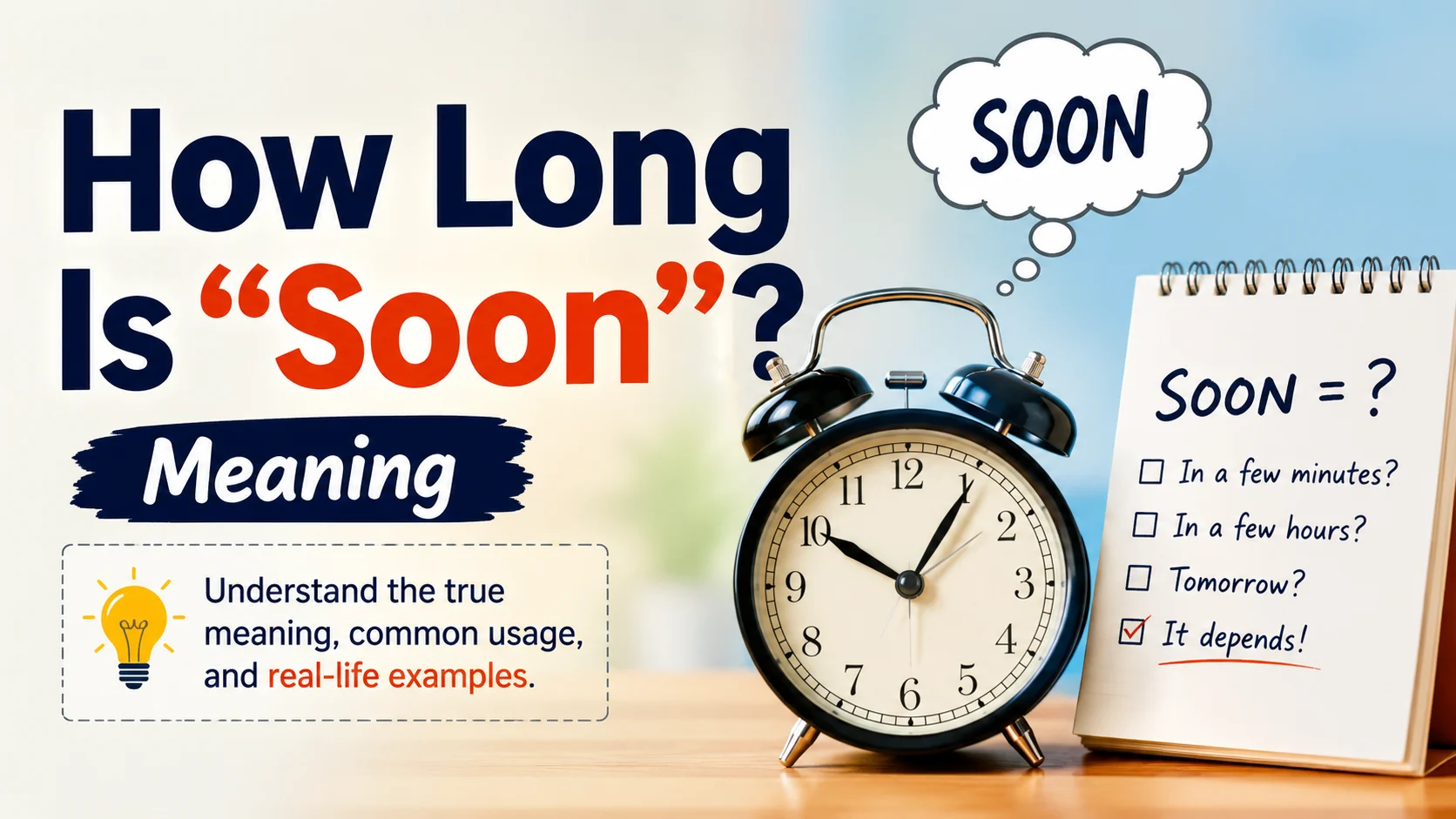
When someone says “I’ll do it soon,” you may naturally wonder: How soon is soon? The word soon sounds specific, but it actually describes a flexible period of time. It generally means in a short time, before long, or sometime in the near future. However, the exact amount of time depends heavily on the situation, the speaker, and what is being discussed.
Understanding the meaning of soon can help you interpret everyday conversations, emails, text messages, workplace communication, and promises more accurately. Someone saying “I’ll call you soon” might mean in a few minutes, while “The project will be finished soon” could mean within several days or weeks. In this guide, we’ll explain how long “soon” usually means, how native speakers use it, common mistakes, similar expressions, and the difference between American and British English.
Quick Answer: How Long Is “Soon”?
Soon means in a short time or in the near future, but it does not specify an exact duration. Depending on the context, “soon” can mean minutes, hours, days, or even weeks. The situation and speaker’s expectations determine its actual meaning.
Why People Confuse “Soon”
People often expect soon to represent a fixed amount of time, but English does not use it that way.
For example:
- “I’ll be there soon.” → Possibly a few minutes.
- “I’ll call you soon.” → Maybe within an hour or later that day.
- “The results will be available soon.” → Perhaps within days.
- “The new product is coming soon.” → It could mean weeks or months.
The key is context.
If your friend is waiting outside, “I’ll be there soon” probably means relatively quickly. If a company announces that a new product is “coming soon,” the waiting period may be considerably longer.
The First Word: “How Long”
How long is used to ask about the duration of something.
Examples:
- “How long will you be away?”
- “How long does delivery take?”
- “How long have you lived here?”
- “How long is soon?”
In the question “How long is soon?”, the speaker is asking what period of time the word soon represents in a particular situation.
It is often a slightly humorous or impatient way to ask for a more precise deadline.
“You said you would send the report soon. How long is soon?”
Here, the person wants a specific time rather than a vague promise.
The Second Word: “Soon”
Soon is an adverb meaning in or after a short period of time or in the near future.
Examples:
- “See you soon.”
- “Please reply soon.”
- “She will arrive soon.”
- “The meeting will start soon.”
- “We hope to announce the results soon.”
Unlike expressions such as “in 10 minutes” or “tomorrow at 3 p.m.”, soon does not give an exact deadline.
Its meaning is relative.
How Long Is “Soon”? Comparison Table
| Expression | Typical meaning | Exact time? | Example |
| Right away | Immediately | No | “I’ll do it right away.” |
| Immediately | With virtually no delay | No | “Please respond immediately.” |
| In a few minutes | A short number of minutes | Fairly specific | “I’ll arrive in a few minutes.” |
| Soon | In the near future | No | “I’ll call you soon.” |
| Before long | Not much later | No | “You’ll hear from us before long.” |
| Later | At a subsequent time | No | “I’ll call you later.” |
| Shortly | Soon, often formally | No | “The train will arrive shortly.” |
| Eventually | At some future point | No | “She eventually agreed.” |
When to Use Each
Use “Soon” for a Flexible Near-Future Time
Use soon when the exact time is not important or is not yet known.
“I’ll send you the details soon.”
This tells the listener that the action is expected in the near future.
Use a Specific Time When Precision Matters
If someone needs to plan around your action, give an exact timeframe.
Instead of:
“I’ll finish it soon.”
Say:
“I’ll finish it within two hours.”
This is especially useful in professional communication.
Use “Right Away” for Immediate Action
If you mean now or without delay, “right away” is stronger than “soon.”
“I’ll fix it right away.”
This suggests that you will start immediately.
Use “Eventually” for a Much Longer or Uncertain Period
Eventually does not mean soon.
“I’ll finish the book eventually.”
This means the person expects to finish at some point, but not necessarily in the near future.
Examples: How Native Speakers Use “Soon”
Here are more than 10 practical examples:
- “I’ll call you soon.”
The speaker plans to call in the near future. - “See you soon!”
The speaker expects to see you relatively soon, although no exact time is given. - “Dinner will be ready soon.”
Usually means the food will be ready after a short wait. - “She’ll be here soon.”
She is expected to arrive in the near future. - “Please reply soon.”
The speaker wants a response without unnecessary delay. - “The movie will start soon.”
The movie is expected to begin shortly. - “We’ll announce the winner soon.”
The announcement is expected in the near future, but the exact time is unspecified. - “I hope to visit you soon.”
The speaker wants to visit in the near future. - “The weather should improve soon.”
Conditions are expected to improve relatively shortly. - “I’ll get back to you soon.”
The speaker intends to respond later, probably within a reasonable period. - “The store will open soon.”
The opening is expected relatively shortly. - “Things will get better soon.”
The speaker expects improvement in the near future. - “He left soon after lunch.”
Here, soon after means a short time after lunch. - “She arrived soon afterward.”
She arrived a short time later. - “We will know soon enough.”
We will find out in due course, likely without a very long wait.
Common Mistakes
Mistake 1: Thinking “Soon” Has a Fixed Number of Minutes
There is no universal rule that says soon = 10 minutes or soon = 30 minutes.
Its meaning changes according to context.
Mistake 2: Treating “Soon” and “Immediately” as Identical
They are not exactly the same.
- Immediately = without delay
- Soon = in the near future
“I’ll answer immediately.”
is stronger than:
“I’ll answer soon.”
Mistake 3: Assuming “Soon” Always Means Today
Not necessarily.
A company may say:
“Our new service is coming soon.”
That could mean next week or potentially a longer period, depending on the context.
Mistake 4: Confusing “Soon” With “Eventually”
These words have very different implications.
Soon suggests the near future.
Eventually simply means at some point in the future.
Memory Trick
Think of SOON = SHORT WAIT.
If someone says something will happen soon, imagine a relatively short distance into the future, but not a stopwatch.
A simple rule:
Soon = near future, not exact future.
If you need an exact deadline, ask:
“When exactly?”
or
“How soon?”
American vs. British English
The basic meaning of soon is essentially the same in both American and British English.
Americans and Britons commonly use it to mean in the near future or after a short period.
Examples:
- American: “I’ll see you soon.”
- British: “I’ll see you soon.”
The difference is usually not the dictionary meaning but the context and expectations surrounding the word.
In formal British English, shortly may sometimes sound more natural in certain announcements:
“The train will arrive shortly.”
American English uses this expression as well, particularly in formal or public contexts.
Similar Words
Several words and phrases are close in meaning to soon, but they are not interchangeable in every situation.
Shortly
Means soon or in a short time.
“The meeting will begin shortly.”
It can sound somewhat more formal than “soon.”
In a Little While
Means after a short period.
“I’ll come over in a little while.”
This can be conversational and slightly less urgent than “immediately.”
Before Long
Means soon or after not much time has passed.
“You’ll understand it before long.”
In the Near Future
Means sometime relatively soon, but it can be broader than everyday “soon.”
“The company plans to expand in the near future.”
Later
Means at a subsequent time, but it does not necessarily imply that the wait will be short.
“I’ll talk to you later.”
Eventually
Means at some point in the future, often after a longer or uncertain period.
“Eventually, they reached an agreement.”
Final Verdict
So, how long is soon? There is no exact answer. Soon is a relative time expression that generally means in a short time or in the near future. Its precise meaning depends on the circumstances.
If a friend says “I’ll be there soon,” think minutes or perhaps a short while. If a business says “coming soon,” the timeframe may be much broader. When timing really matters, do not rely on the word alone—ask for a specific estimate or deadline.
FAQs
1. Does “soon” mean within an hour?
Not necessarily. In casual situations, it may mean within minutes or an hour, but there is no fixed definition.
2. Does “soon” mean today?
Not always. It usually suggests the near future, but the timeframe depends on context.
3. Is “soon” sooner than “later”?
Generally, yes. Soon normally suggests a relatively near time, while later can refer to any subsequent time.
4. What does “see you soon” mean?
“See you soon” means the speaker expects to see you again in the relatively near future. It does not specify an exact date or time.
5. What does “coming soon” mean?
“Coming soon” means something is expected to become available, happen, or arrive in the near future. The actual timeframe depends on the context.
6. Is “soon” the same as “shortly”?
They are very similar. Shortly often sounds slightly more formal, while soon is extremely common in everyday conversation.
7. How can I ask someone what “soon” means?
You can politely ask:
“When do you mean by soon?”
Or, for greater precision:
“Could you give me an approximate time?”
Remember This
SOON does not equal a fixed amount of time.
It means:
- in a short time
- in the near future
- before long
The exact timeframe depends on context, expectations, and the situation. If the timing is important, replace “soon” with a specific estimate such as “in 20 minutes,” “by this evening,” or “within two days.”
Conclusion
The phrase “how long is soon?” highlights an important feature of English: many time expressions are relative rather than precise. Soon tells us that something is expected relatively near in the future, but it does not tell us exactly when. Its interpretation can range from a few minutes to several days or longer, especially when used by businesses or organizations.
For everyday English, the best way to understand soon is to consider the situation. A friend waiting for you probably means a short wait, while a company announcing something “coming soon” may have a much broader timeframe. When precision matters, always ask for a specific time or deadline rather than relying on “soon.”

I am Chase Larson, an author at Grammetics, passionate about grammar and matching words. I create clear, useful content that helps readers improve vocabulary, writing, and communication.