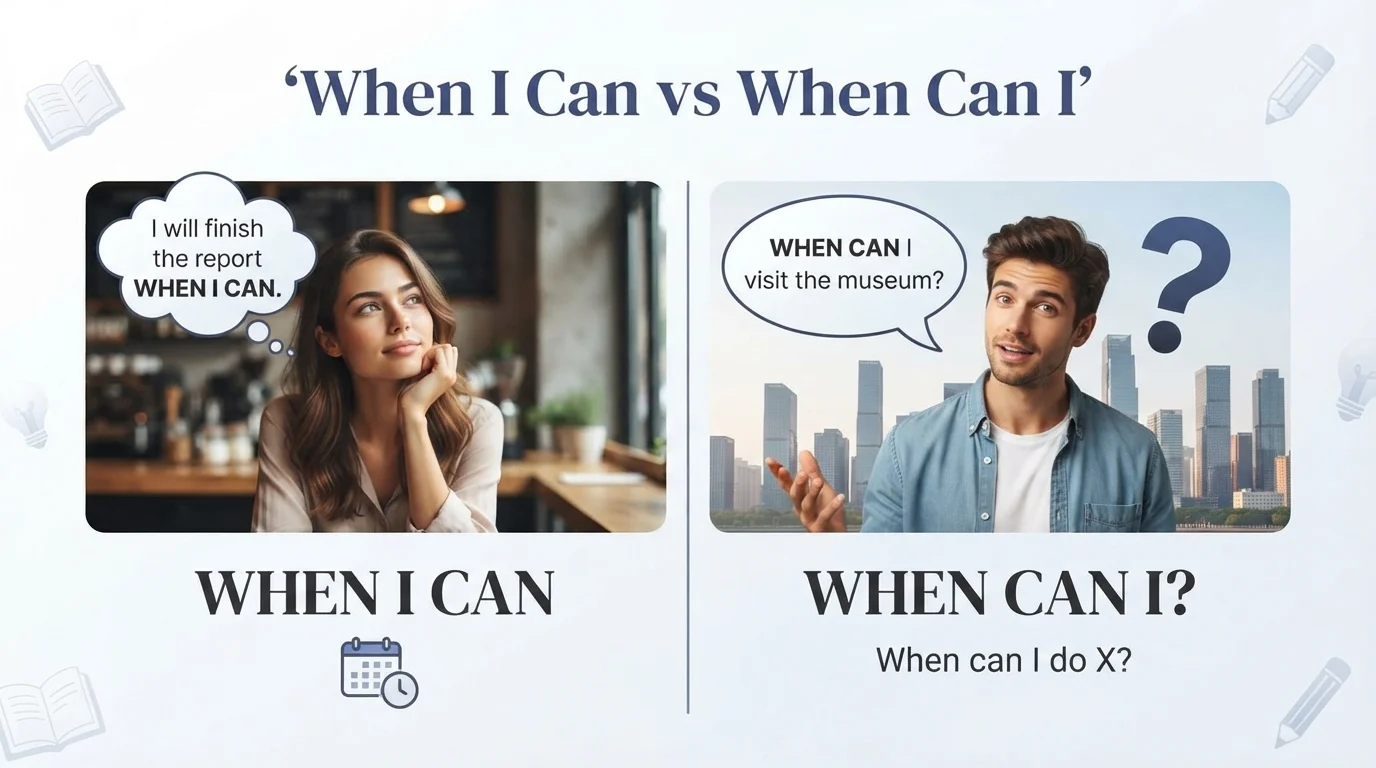
English learners often get confused by “when I can” and “when can I” because both expressions contain the same words but have different grammatical structures. The key difference is whether you are making a statement about a time or asking a direct question. Understanding this small change in word order can make your English sound much more natural and accurate.
In everyday English, “when can I” is usually used to ask a question, such as “When can I call you?” On the other hand, “when I can” commonly appears inside a statement or an indirect question, such as “Please tell me when I can call you.” Although the two phrases look almost identical, their grammatical roles are different. This guide explains the difference with simple rules, examples, common mistakes, and an easy memory trick.
Quick Answer
Use “when can I” when asking a direct question: “When can I leave?” Use “when I can” when making a statement or asking an indirect question: “Tell me when I can leave.” The difference comes from English question word order.
Why People Confuse It
The confusion happens because both phrases contain:
- when
- I
- can
However, English changes the word order when forming a direct question.
Compare:
When can I start?
Tell me when I can start.
The first sentence is a direct question, so can comes before I.
The second sentence contains an indirect question. Inside that clause, the normal statement order is used: I can.
This is a common issue for English learners because many languages form questions differently. Learning the basic word-order rule makes the difference much easier to remember.
First Word: “When I Can”
“When I can” is a grammatical phrase that normally appears inside a larger sentence.
It follows normal subject-verb word order:
I + can
For example:
- I can help.
- I can come tomorrow.
- I can call you later.
- Let me know when I can help.
In “when I can,” the word when introduces a time-related clause.
Examples of “When I Can”
- Let me know when I can visit.
- Please tell me when I can apply.
- I will come when I can.
- I’ll finish it when I can.
- She asked when I can start.
Notice that I can remains together rather than changing to can I.
Second Word: “When Can I”
“When can I” is normally used to begin a direct question.
The structure is:
When + can + subject
For example:
When can I leave?
Here, when is the question word, can is the modal auxiliary, and I is the subject.
More examples include:
- When can I call you?
- When can I apply?
- When can I start?
- When can I visit?
- When can I expect an answer?
This word order is standard in direct questions using the modal verb can.
Comparison Table
| Expression | Main Use | Word Order | Example |
| When I can | Statement or indirect question | When + I + can | Tell me when I can start. |
| When can I | Direct question | When + can + I | When can I start? |
| when I can | Time clause | When + I + can | I’ll call when I can. |
| When can I…? | Asking for permission/opportunity/time | When + can + I | When can I leave? |
The simplest distinction is this: direct question = “when can I,” embedded/indirect clause = “when I can.”
When to Use Each
Use “When Can I” for Direct Questions
Use “when can I” when you are directly asking someone about a possible time.
Examples:
- When can I come?
- When can I see you?
- When can I submit the form?
- When can I start working?
- When can I get my results?
These sentences expect an answer.
For example:
“When can I submit the application?”
Possible answer:
“You can submit it next Monday.”
Use “When I Can” in Statements
Use “when I can” when it is part of a larger statement.
Examples:
- I’ll call you when I can.
- I’ll help you when I can.
- Let me know when I can come.
- She asked when I can start.
- I’ll visit you when I can.
Use “When I Can” in Indirect Questions
This is particularly important.
Direct question:
When can I speak to the manager?
Indirect question:
Could you tell me when I can speak to the manager?
The meaning is closely related, but the grammar changes because the second sentence contains an indirect question.
Examples of “When I Can” and “When Can I”
Here are more examples to make the difference clear:
- When can I call you?
This is a direct question. - Tell me when I can call you.
This is an indirect question. - When can I visit your office?
You are directly asking about the appropriate time. - Please let me know when I can visit your office.
The question is embedded in a statement. - When can I submit my assignment?
Direct question. - I need to know when I can submit my assignment.
Indirect question. - When can I start the course?
Directly asking about the starting time. - Could you tell me when I can start the course?
Indirect question. - I’ll come when I can.
Here, “when I can” means at whatever time is possible or convenient. - When can I meet you?
Direct question about availability. - Let me know when I can meet you.
Indirect question. - I’ll finish the work when I can.
Here, “when I can” functions as a time clause. - When can I get my certificate?
Direct question. - Do you know when I can get my certificate?
Indirect question.
Common Mistakes
Mistake 1: Using “Can I” Inside an Indirect Question
Incorrect:
❌ Do you know when can I leave?
Correct:
✅ Do you know when I can leave?
After phrases such as “Do you know…”, “Can you tell me…”, and “I wonder…”, use normal statement word order.
Mistake 2: Using “When I Can” as a Direct Question
Incorrect:
❌ When I can leave?
Correct:
✅ When can I leave?
A direct question requires the auxiliary/modal verb to come before the subject.
Mistake 3: Thinking “When I Can” Is Always Wrong
It is not wrong.
For example:
I’ll call you when I can.
This is perfectly grammatical.
The phrase simply has a different function from “when can I?”
Mistake 4: Forgetting the Difference Between Direct and Indirect Questions
Compare:
When can I apply?
and:
Could you tell me when I can apply?
Both are grammatical. The first is direct; the second is indirect.
Memory Trick
Use this simple trick:
Direct question → CAN comes before I
When CAN I…?
Indirect question or statement → I comes before CAN
when I CAN…
Think of it as:
Question: When CAN I?
Embedded clause: when I CAN
This one rule will help you choose the correct form in most situations.
American vs British English
There is no major American-versus-British English difference in the basic grammar of these expressions.
Both American and British English use:
When can I…?
for direct questions and:
when I can…
for statements and indirect questions.
For example, both varieties commonly use:
- When can I start?
- Can you tell me when I can start?
- I’ll start when I can.
Differences between American and British English may appear in vocabulary, pronunciation, or some usage preferences, but the basic word order here remains the same.
Similar Words and Structures
Several related structures follow the same direct-question versus indirect-question pattern.
“Where Can I” vs “Where I Can”
- Where can I park?
- Tell me where I can park.
“How Can I” vs “How I Can”
- How can I improve my English?
- Show me how I can improve my English.
“What Can I” vs “What I Can”
- What can I do?
- I don’t know what I can do.
“Why Can I” vs “Why I Can”
- Why can I not access the account?
- I don’t understand why I can not access the account.
The same basic principle applies: direct questions use question word order, while embedded questions generally use statement word order.
Final Verdict
“When can I” and “when I can” are both correct, but they are used in different grammatical situations.
Use “when can I” when asking a direct question:
When can I leave?
Use “when I can” when the phrase appears inside a statement, time clause, or indirect question:
Tell me when I can leave.
The most important thing to remember is the word order. In a direct question, can comes before I. In an indirect question or statement, I comes before can.
FAQs
1. Is “when can I” grammatically correct?
Yes. “When can I” is correct when it introduces a direct question, such as “When can I start?”
2. Is “when I can” grammatically correct?
Yes. “When I can” is correct when used in a statement, time clause, or indirect question, such as “Tell me when I can start.”
3. Should I say “When can I go?” or “When I can go?”
Use “When can I go?” as a direct question. Use “when I can go” when it is part of a larger sentence, such as “Let me know when I can go.”
4. Which is correct: “Do you know when can I come?” or “Do you know when I can come?”
The correct form is “Do you know when I can come?” Because it is an indirect question, the clause uses normal statement word order.
5. Is “I will go when I can” correct?
Yes. “When I can” is a time clause meaning roughly “when it is possible for me to do so.”
6. Why does “can” come before “I” in questions?
English commonly places a modal or auxiliary verb before the subject when forming direct questions: “Can I…?”, “When can I…?”, and “How can I…?”
7. Can “when I can” start a sentence?
Yes, although its meaning depends on context. For example: “When I can, I’ll help you.” This means that the speaker will help whenever it is possible.
Conclusion
The difference between “when I can” and “when can I” is mainly about sentence structure and word order. “When can I” is used for direct questions, while “when I can” appears in statements, time clauses, and indirect questions. Once you identify whether you are asking a direct question or embedding the question inside another sentence, the correct form becomes much easier to choose.
Remember that both expressions are grammatical; neither one is universally correct or incorrect. Compare “When can I apply?” with “Please tell me when I can apply.” The meaning is related, but the grammatical structure is different. Learning this distinction will also help you with similar patterns such as “where can I” vs “where I can” and “how can I” vs “how I can.”
Remember This
Direct question:
👉 When CAN I…?
Indirect question / statement:
👉 when I CAN…
Easy rule: If you are directly asking, use “When can I?” If the question is inside another sentence, use “when I can.”

I’m Elliot Pierce, Administrator at Grammetics, dedicated to improving word matching and grammar. I help maintain useful content, support readers, and make language learning simple, clear, accurate, and engaging.