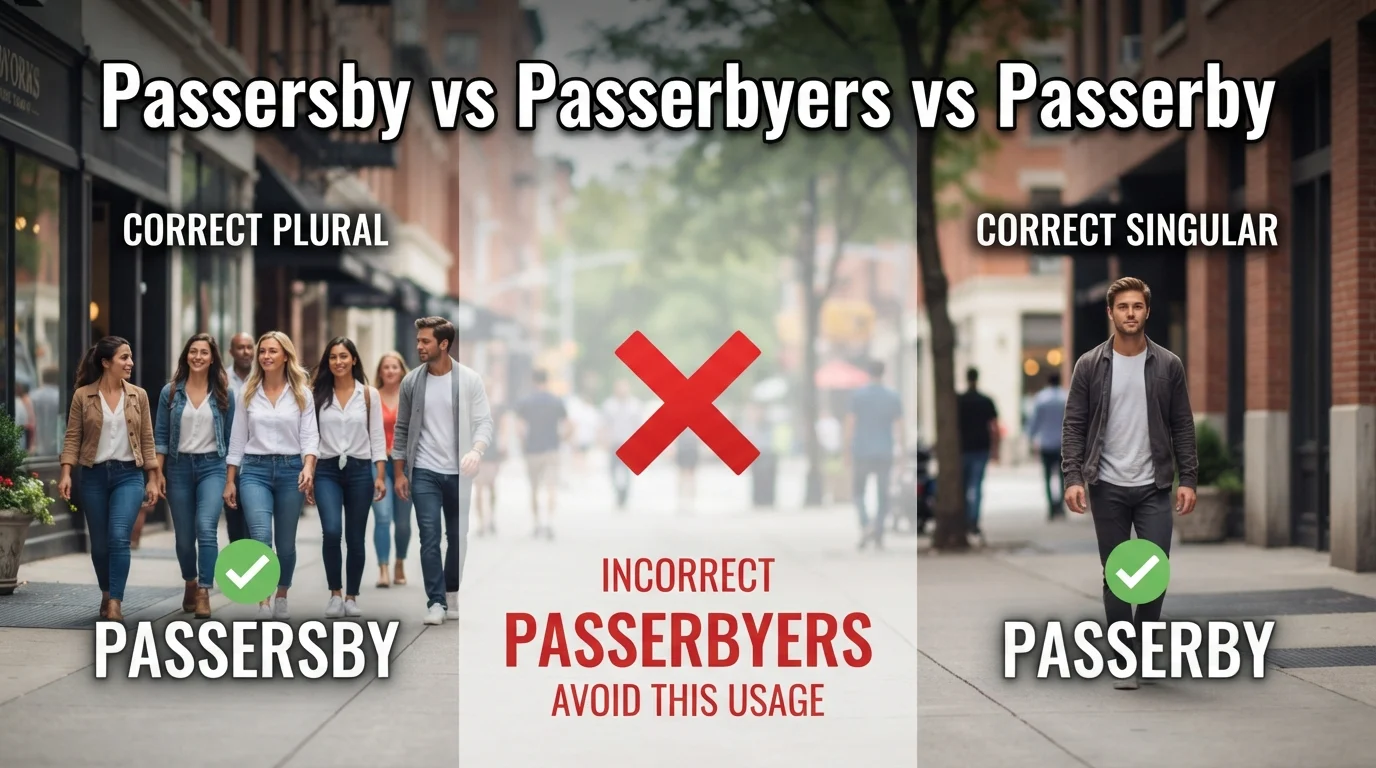
If you have ever wondered whether the plural of passerby is passersby or passerbyers, you are not alone. The word can look unusual because its plural form does not follow the common English pattern of simply adding -s. As a result, people sometimes write passerbyers when they mean more than one person walking or traveling past a particular place. However, standard English has a clear answer: passerby is the singular form, while passersby is the standard plural.
Understanding this distinction is useful when writing descriptions, news reports, stories, essays, or everyday messages. The word passerby refers to someone who happens to pass a particular person or place, while passersby refers to two or more such people. Passerbyers is not considered a standard English plural and should generally be avoided in formal and professional writing. In this guide, we will explain the difference, show you how to use each form correctly, and provide plenty of examples.
Quick Answer
Passerby is the singular form, and passersby is the standard plural form. Passerbyers is not standard English and should be avoided. Say “a passerby” for one person and “several passersby” for more than one person.
Why People Confuse It
The confusion comes mainly from the unusual structure of the word passerby.
Many English nouns form their plural simply by adding -s:
- passer → passers
- worker → workers
- player → players
- runner → runners
So it may seem logical to turn passerby into passerbyers. But that is not how this compound noun works.
The word passerby is made from passer and by. Historically, it means someone who passes by. When pluralized, the main noun element changes:
- one passerby
- two passersby
This is similar to other compound nouns where the important noun is pluralized rather than adding an ending to the entire expression.
First Word: Passersby
Passersby is the correct standard plural of passerby.
It refers to two or more people who happen to pass a particular person, place, or event.
For example:
Several passersby stopped to help the injured cyclist.
Here, passersby means several people who were passing the area.
Is “passersby” singular or plural?
Passersby is plural.
Compare:
- A passerby called the police.
- Several passersby called the police.
You would not normally say:
A passersby called the police.
Instead, use the singular passerby.
Possessive form
The plural possessive is usually written:
passersby’s
Example:
The passersby’s attention was drawn to the loud noise.
However, if you are talking about separate possessions belonging to different passersby, context may require a different construction.
Second Word: Passerbyers
Passerbyers is not the standard plural form of passerby.
Although someone might create the word by treating passerby as though it were an ordinary noun and adding -ers, standard dictionaries and conventional English usage use passersby instead.
For formal writing, academic work, journalism, business communication, and professional content, avoid passerbyers.
Instead, write:
Several passersby witnessed the accident.
Not:
Several passerbyers witnessed the accident.
Why does “passerbyers” sound wrong?
The word already contains passer, which refers to someone who passes. Adding -ers to the entire word creates an unnecessary formation.
Think of it this way:
passer + by → passerby
Plural:
passers + by → passersby
So the plural marker belongs with passer, producing passersby.
Comparison Table
| Word | Correct? | Number | Meaning | Example |
| Passerby | Yes | Singular | One person passing by | A passerby helped the child. |
| Passersby | Yes | Plural | Two or more people passing by | Several passersby stopped. |
| Passerbyers | No in standard English | Intended plural | People passing by | Avoid this form. |
The easiest rule
One = passerby
More than one = passersby
Not standard = passerbyers
When to Use Each
Use “passerby” for one person
Use passerby when you are referring to a single person who happens to pass by.
Examples:
- A passerby noticed the broken window.
- The passerby called for help.
- One passerby offered directions.
- A passerby found the lost wallet.
Use “passersby” for multiple people
Use passersby when referring to more than one person.
Examples:
- Several passersby watched the performance.
- The noise attracted many passersby.
- Passersby gathered outside the building.
- Two passersby helped move the fallen branch.
Avoid “passerbyers”
Even though the form may seem grammatically logical, passerbyers is not the accepted standard plural.
If you see it in informal online writing, understand what the writer probably means, but do not copy it into polished English.
Examples: 12+ Sentences With Passerby and Passersby
Here are practical examples showing how these words work in real sentences.
- A passerby noticed that the child was crying.
- Several passersby stopped to watch the street performer.
- The police asked a passerby whether he had seen the accident.
- Many passersby ignored the unusual noise.
- A helpful passerby gave me directions to the train station.
- Two passersby helped push the stalled car.
- The photograph captured several passersby walking along the sidewalk.
- A passerby discovered the wallet near the entrance.
- The loud explosion startled nearby passersby.
- A passerby called emergency services after seeing the crash.
- Passersby gathered around the musician in the town square.
- The old man smiled at every passerby.
- Several passersby stopped when they heard the street announcement.
- A passerby offered the lost tourist some assistance.
- The colorful display caught the attention of many passersby.
Incorrect example
Several passerbyers stopped to watch.
Correct version
Several passersby stopped to watch.
Common Mistakes
1. Using “passerbyers” as the plural
❌ The passerbyers were curious.
✅ The passersby were curious.
2. Using “passersby” with a singular verb
❌ The passersby was waiting outside.
✅ The passersby were waiting outside.
Because passersby is plural, it normally takes a plural verb.
3. Treating “passerby” as plural
❌ There were five passerby near the store.
✅ There were five passersby near the store.
4. Adding “s” to the end of passerby
❌ Passerbys
✅ Passersby
The standard plural is not formed by simply attaching -s to the final letter.
5. Confusing the word with “bystander”
A passerby is someone who happens to be passing a location. A bystander is someone who is present and observes an event, often without participating.
The meanings can overlap, but they are not always interchangeable.
Memory Trick
Here is an easy way to remember the plural:
A person passes by → a passerby.
Several people pass by → passersby.
Think of the word as two parts:
PASSERS + BY = PASSERSBY
The -s goes after passer, not after the complete word.
Quick memory formula
1 = passerby
2+ = passersby
Never = passerbyers
If you remember this three-part formula, you will rarely make the mistake again.
American vs British English
The distinction between passerby and passersby is generally the same in both American and British English.
Both varieties use:
- passerby for one person
- passersby for multiple people
For example:
American English:
A passerby called the police.
British English:
A passerby called the police.
Likewise:
American English:
Several passersby witnessed the incident.
British English:
Several passersby witnessed the incident.
There is no major American-versus-British difference that makes passerbyers acceptable in standard usage.
Similar Words
Several words have meanings related to passerby.
Bystander
A bystander is someone who is present at an event but is not directly involved.
Several bystanders watched the argument.
Pedestrian
A pedestrian is a person traveling on foot, especially in a street or public area.
The driver stopped for a pedestrian.
Onlooker
An onlooker is someone who watches an event or activity.
Curious onlookers gathered around the performers.
Spectator
A spectator is someone who watches an event, competition, or performance.
Thousands of spectators watched the game.
Stranger
A stranger is someone you do not know personally.
A stranger helped me find the correct address.
These words can sometimes describe the same person, but their meanings are not identical.
Final Verdict
The correct standard forms are straightforward:
- Passerby = one person who passes by
- Passersby = more than one person who passes by
- Passerbyers = nonstandard and best avoided
The unusual plural passersby may seem strange at first, but it follows the structure of the compound word. The plural marker is attached to passer, giving us passersby.
If you are writing an article, email, essay, report, story, or professional document, choose passerby for singular and passersby for plural.
Frequently Asked Questions
Is “passersby” the correct plural of “passerby”?
Yes. Passersby is the standard plural form of passerby.
Is “passerbyers” a word?
You may occasionally encounter passerbyers, but it is not the standard English plural of passerby. In polished writing, use passersby.
Is “passerbys” correct?
No. The standard plural is passersby, not passerbys.
What is the singular of “passersby”?
The singular form is passerby.
One passerby noticed the problem.
Should I say “a passerby” or “a passersby”?
Say a passerby because a refers to one person.
What is the difference between a passerby and a bystander?
A passerby is someone passing through an area, while a bystander is someone present at an event who is not directly involved. A person can be both.
Does British English use “passersby”?
Yes. Passersby is standard in both British and American English.
How do you pronounce “passersby”?
It is generally pronounced like PASS-ers-BY, with the final part sounding like the word by.
Conclusion
The words passerby and passersby are easy to understand once you see how the compound word is formed. Use passerby when you mean one person who happens to pass a place, and use passersby when you mean two or more people. Although passerbyers may look like a logical plural, it is not the standard form used in careful English.
The best choice for clear and professional writing is therefore simple: passerby for singular and passersby for plural. Whether you are describing pedestrians on a busy street, people witnessing an accident, or strangers stopping to watch an event, these two forms will cover the situation correctly.
Remember This
One person = passerby
Two or more people = passersby
Passerbyers = avoid it
Passerbyers may look tempting, but passersby is the standard plural you should use in formal and everyday English.

I’m Micah Wheeler, a passionate author who enjoys exploring matching words, grammar, and language. I create clear, helpful content to make word choices and grammar easier for everyone.