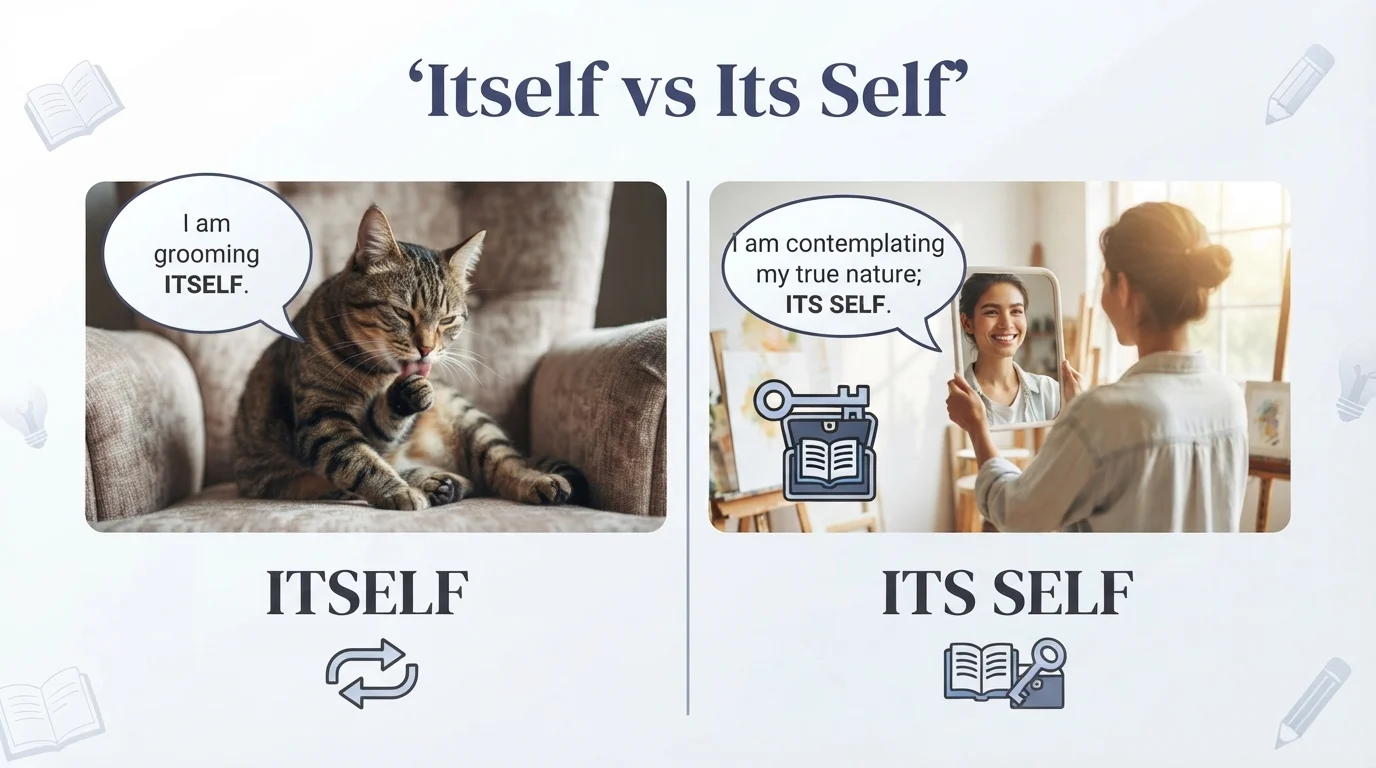
The difference between itself and its self may look tiny, but the space between the words changes how the expression works. In modern English, itself is the standard and widely accepted reflexive pronoun used when referring back to a thing, animal, organization, or situation. For example, “The machine turned itself off” is completely natural English. On the other hand, its self is not normally used as a simple alternative to itself. When the words are separated, self becomes a regular noun, while its remains a possessive determiner.
The key is to ask what you mean: are you using a reflexive pronoun, or are you literally talking about something’s self or inner nature? This guide explains itself vs its self, with clear definitions, examples, common mistakes, and an easy memory trick.
Quick Answer
Itself is the standard reflexive pronoun and is used in sentences such as “The door opened itself.” Its self is grammatically possible only when self is being used as a separate noun, usually in a philosophical, literary, or highly specific context. In ordinary English, use itself.
Why People Confuse It
People often confuse itself and its self because both contain the same two words: it and self.
The main difference is grammatical:
- Itself = one word and a reflexive pronoun.
- Its self = two separate words: possessive its + noun self.
- In normal everyday English, itself is almost always the expression you need.
- Its self can occur when self is deliberately treated as a noun.
Compare:
The computer restarted itself.
Here, itself refers back to the computer.
But:
The robot’s programming changed its self.
This is a much more specialized construction, because self is being treated as something belonging to the robot.
Itself
Itself is the reflexive form of the pronoun it.
It is used when the subject and the object or emphasis refer to the same thing.
Examples
- The cat cleaned itself.
- The machine turned itself off.
- The door closed by itself.
- The company defended itself against the accusations.
- The software updated itself automatically.
Itself can also be used for emphasis:
The building itself is beautiful.
Here, itself emphasizes the building.
Common uses of “itself”
You will commonly see itself used:
- As a reflexive pronoun
- The dog hurt itself.
- For emphasis
- The idea itself is interesting.
- After a preposition
- The system corrected the error by itself.
- In expressions such as “in itself”
- The rule is not difficult in itself.
Its Self
Its self consists of two separate words:
- its = possessive determiner
- self = noun
The construction is grammatically possible when self is being treated as a separate noun meaning something like a being’s identity, nature, or inner character.
For example:
The creature seemed to recognize its self in the reflection.
This construction is unusual in ordinary conversation. Writers may use it in philosophical, psychological, literary, or highly specialized contexts when they intentionally want to distinguish an entity from its self.
A more natural modern-English sentence would often use itself or another construction:
The creature recognized itself in the reflection.
Therefore, don’t replace itself with its self simply because you think the words should be separated.
Comparison Table
| Feature | Itself | Its self |
| Spelling | One word | Two words |
| Grammar | Reflexive pronoun | Possessive determiner + noun |
| Commonness | Very common | Rare |
| Everyday English | Standard | Usually unnatural |
| Example | The machine fixed itself. | The machine discovered its self. |
| Main purpose | Refers back to it | Refers to a particular “self” belonging to something |
| Best choice in normal writing | Yes | Only in special contexts |
When to Use Each
Use “itself” when:
You are referring back to a thing, animal, organization, or situation.
The dog injured itself.
The phone restarted itself.
The company introduced itself to the audience.
You can also use itself for emphasis:
The decision itself was controversial.
Use “its self” when:
You intentionally mean the self belonging to something and self is functioning as a noun.
This is uncommon and usually appears in philosophical, literary, psychological, or specialized writing.
For most everyday sentences, itself will be the correct choice.
Examples of Itself vs Its Self
Here are practical examples to make the distinction clearer:
- The cat washed itself.
Correct and natural. - The machine repaired itself.
Correct and natural. - The company introduced itself.
Correct and natural. - The door opened itself.
Grammatically possible, although “The door opened by itself” may sound more natural depending on the intended meaning. - The computer shut itself down.
Correct. - The animal protected itself.
Correct. - The organization described itself as independent.
Correct. - The problem itself is not difficult.
Correct; itself adds emphasis. - The concept in itself is simple.
Correct. - The machine operated by itself.
Correct. - The philosopher wrote about the relationship between the person and its self.
Grammatically possible in a specialized context, but unusual. - The artificial system was designed to examine its self.
Possible in a technical or philosophical discussion, but itself would usually be more natural if the intended meaning is reflexive.
Common Mistakes
Mistake 1: Writing “its self” instead of “itself”
Incorrect for ordinary reflexive use:
The dog cleaned its self.
Correct:
The dog cleaned itself.
Mistake 2: Assuming “its self” is the possessive version of “itself”
It isn’t.
The possessive form of it is its, while itself is the reflexive form.
- its = possession
- itself = reflexive/emphatic pronoun
Mistake 3: Confusing “its” with “it’s”
Remember:
- its = belonging to it
- it’s = it is / it has
- itself = reflexive form of it
Examples:
The company changed its policy.
It’s a useful policy.
The company changed itself.
Mistake 4: Using a space because “it + self” looks logical
English reflexive pronouns are normally written as single words:
- myself
- yourself
- himself
- herself
- itself
- ourselves
- yourselves
- themselves
So itself follows the same pattern.
Memory Trick
Use this simple rule:
If “it” is doing something to itself, write “itself” as one word.
Think:
it → itself
Just as:
I → myself
you → yourself
he → himself
she → herself
they → themselves
If you are simply using the reflexive pronoun, don’t add a space.
American vs British English
There is no major American-versus-British spelling difference between itself and its self.
Both American English and British English normally use itself as the reflexive pronoun.
For example:
- American English: “The system updated itself.”
- British English: “The system updated itself.”
The rare expression its self is not a standard British-versus-American alternative. Its use depends more on context and intended meaning than on regional variety.
Similar Words
Understanding related words makes itself easier to remember.
It
It is a pronoun used for a thing, animal, situation, or other non-human referent.
The phone is new. It works well.
Its
Its shows possession.
The phone lost its connection.
It’s
It’s is a contraction of it is or it has.
It’s working well.
Itself
Itself is the reflexive or emphatic form.
The phone restarted itself.
Self
Self is a noun referring to an individual identity or being.
She wanted to understand her self better.
In ordinary English, however, possessive forms such as himself, herself, and itself are generally written as single words.
Final Verdict
For almost all normal English sentences, itself is the correct choice. It is the standard reflexive pronoun corresponding to it, and it is used naturally in everyday, academic, professional, and formal English.
Its self is a separate grammatical construction and is much less common. It can be appropriate when self is deliberately being used as a noun, especially in philosophical, literary, or specialized writing. If you simply mean that something is acting upon or referring back to itself, choose itself.
FAQs
Is “its self” grammatically correct?
It can be grammatically possible when its functions as a possessive determiner and self is used as a separate noun. However, this construction is uncommon. In normal reflexive sentences, use itself.
Is “itself” one word?
Yes. Itself is normally written as one word.
What is the difference between “itself” and “its”?
Its shows possession, while itself is a reflexive or emphatic pronoun.
The company changed its policy.
The company defended itself.
Is “its self” the same as “itself”?
No. Itself is a standard reflexive pronoun. Its self consists of two separate grammatical elements and has a more specialized meaning.
Should I write “the machine fixed its self”?
No, not if you mean that the machine fixed itself. The natural sentence is:
The machine fixed itself.
Is “itself” used in British English?
Yes. Itself is standard in both British and American English.
What is the reflexive pronoun for “it”?
The reflexive pronoun for it is itself.
Conclusion
The choice between itself and its self becomes straightforward once you understand their grammatical roles. Itself is the normal reflexive pronoun and should be used when something refers back to itself. It is by far the more common form in everyday and formal English.
Its self has a different structure and is reserved for situations where self is intentionally functioning as a noun. In most writing, replacing itself with its self will make the sentence look unnatural or incorrect. When in doubt, remember the reflexive-pronoun pattern: myself, yourself, himself, herself, itself, ourselves, yourselves, themselves.
Remember This
Itself = standard reflexive pronoun.
Its self = possessive “its” + noun “self,” used only in specialized contexts.
If you mean “it + itself,” use one word: itself.

I’m Aria White, a passionate word enthusiast who enjoys exploring grammar, vocabulary, and meaningful word connections. I create simple, helpful content that makes matching words easier, clearer, and enjoyable.