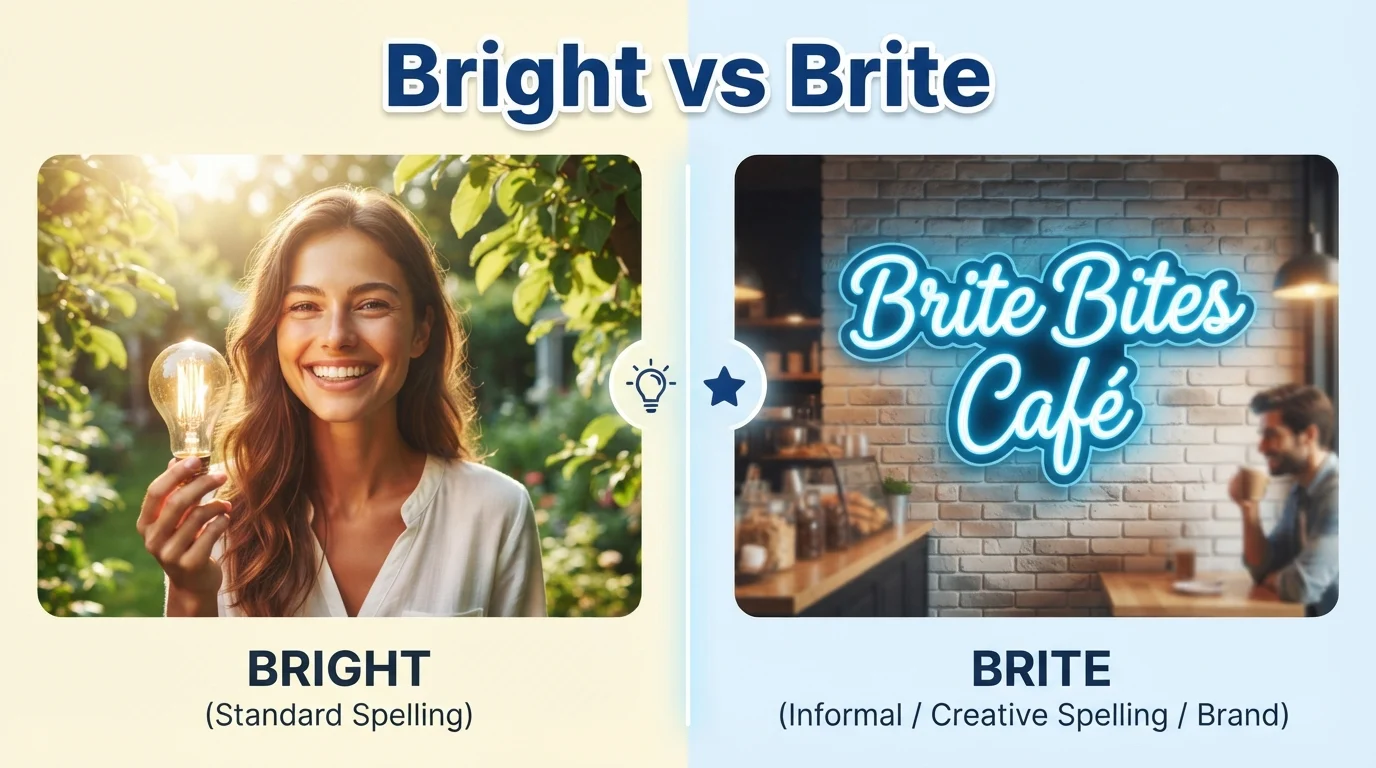
When you see bright and brite, it is easy to wonder whether they are simply two spellings of the same word. After all, both look similar, and “brite” appears in product names, signs, advertisements, and informal writing. However, there is an important difference between the two: bright is the standard English spelling, while brite is generally a nonstandard or specialized spelling used in certain names, brands, labels, and informal contexts.
Understanding the difference can help you avoid spelling mistakes in school, professional writing, emails, articles, and everyday communication. If you are trying to describe something full of light, intelligent, vivid, or cheerful, bright is almost always the word you want. Brite, on the other hand, should usually be treated as a special spelling rather than a standard replacement for bright. Let’s look at exactly when each form is appropriate.
Quick Answer
Bright is the standard and correct spelling in normal English. It can describe light, color, intelligence, or cheerfulness. Brite is usually a stylized or nonstandard spelling found in brand names, product names, signs, or informal contexts. Use bright in formal and everyday writing.
Why People Confuse It
The confusion between bright vs brite mainly comes from pronunciation.
Both words are commonly pronounced like “brite”, so when people hear the word rather than see it written, they may not know which spelling to choose.
There are several reasons this causes problems:
- Bright and brite sound essentially the same.
- Some businesses and products intentionally use Brite as a shorter or more eye-catching spelling.
- Advertising often uses creative spellings.
- English contains many words whose pronunciation does not perfectly reveal their spelling.
- People may assume that brite is an accepted alternative spelling of bright.
The key point is simple: sound does not determine spelling. In standard English, the normal spelling is bright.
First Word: Bright
Bright is the standard English word.
It is an adjective with several meanings, including:
- Giving off or reflecting a lot of light.
- Having a strong or vivid color.
- Intelligent or quick to learn.
- Cheerful, hopeful, or positive.
- Promising or likely to be successful.
Examples of “Bright”
- The bright sunlight woke me up early.
- She wore a bright yellow dress.
- He is a bright student.
- The future looks bright for the young company.
- Her room has bright blue walls.
- The stars were bright in the clear night sky.
The word can describe both physical things and abstract ideas.
For example:
“The lamp is bright.”
Here, bright refers to the amount of light.
But:
“She is a bright student.”
Here, bright means intelligent.
Second Word: Brite
Brite is generally not the standard spelling of the adjective bright.
Instead, Brite is often used as a stylized spelling in:
- Brand names
- Product names
- Business names
- Advertising
- Signs
- Informal or creative writing
- Trade names
For example, a company might deliberately call a product Brite because the shorter spelling looks distinctive or fits its branding.
This does not mean that brite has become the standard spelling of bright.
Important Point
If you are writing a normal sentence, choose bright.
If Brite appears as part of an official name, product, company, or trademark, keep the spelling exactly as it is officially written.
For example:
- The room was bright. ✅
- The room was brite. ❌
- I bought a product called Brite. ✅ (if that is the product’s official name)
Bright vs Brite: Comparison Table
| Feature | Bright | Brite |
| Standard English spelling | Yes | No |
| Common dictionary word | Yes | Generally not as the standard spelling of bright |
| Meaning related to light | Yes | Only when used as a stylized name or label |
| Describes intelligence | Yes | No |
| Describes vivid colors | Yes | No |
| Used in formal writing | Yes | Usually no |
| Used in brand names | Sometimes | Commonly as a stylized spelling |
| Used in advertising | Yes | Yes |
| Pronunciation | Usually /braɪt/ | Usually intended to sound like /braɪt/ |
| Best choice in ordinary writing | Bright | Usually avoid |
When to Use Each
Use “Bright” in Normal English
Choose bright when you are writing an ordinary sentence.
Use it when discussing:
- Light
- Colors
- Intelligence
- Cheerfulness
- Hope
- Promising futures
- Shiny or illuminated objects
Examples:
- The bright light hurt my eyes.
- She has a bright personality.
- He is a bright child.
- We painted the kitchen a bright color.
- They have a bright future.
Use “Brite” for a Proper or Stylized Name
Use Brite when it is intentionally part of a specific name.
For example:
- A company called “Brite Solutions”
- A product called “Brite Clean”
- A business using “Brite” in its official branding
In these cases, changing Brite to Bright could actually change the official name.
Rule of thumb: If you are not referring to a specific name or brand, spell it bright.
Examples of Bright vs Brite
Here are more examples to make the difference easy to remember:
- The sun was bright this morning. ✅
- She bought a bright red jacket. ✅
- He is a very bright student. ✅
- The future looks bright for the team. ✅
- Turn off the bright light before going to bed. ✅
- The flowers have bright colors. ✅
- She has a bright and cheerful personality. ✅
- The stars looked bright against the dark sky. ✅
- The advertisement used the word Brite as part of its product name. ✅
- The company officially brands its service as Brite. ✅
- The classroom was bright and comfortable. ✅
- He gave us a bright smile. ✅
- The designer chose a bright orange color. ✅
- She has a bright idea for the project. ✅
Notice that ordinary descriptions use bright, while Brite is appropriate mainly when it is a deliberate name or stylized spelling.
Common Mistakes
Mistake 1: Treating “Brite” as a Standard Alternative
Some writers assume that brite is simply a shorter version of bright.
Incorrect:
The room is very brite.
Correct:
The room is very bright.
Mistake 2: Using “Brite” in Formal Writing
Creative spellings may work in marketing, but they generally do not belong in academic or professional writing unless they are part of a proper name.
Incorrect:
The future is looking brite.
Correct:
The future is looking bright.
Mistake 3: Changing an Official Name
The opposite mistake is also possible.
If a company or product officially uses Brite, do not automatically “correct” it to bright.
For example:
The company is called Brite Solutions.
If that is its official name, Brite should remain unchanged.
Mistake 4: Choosing Spelling Based Only on Pronunciation
Because bright and brite can sound the same, listening alone will not tell you which spelling to use.
When in doubt, remember the standard spelling: bright.
Memory Trick
Here is an easy way to remember bright vs brite:
BRIGHT = standard English
Think of the GH in bright as part of the normal spelling.
You can also remember:
Bright is right for regular writing.
If you see Brite, ask yourself:
“Is this a brand, product, or special name?”
- If no → use bright.
- If yes → preserve Brite if that is the official spelling.
American vs British English
There is no major American-versus-British spelling difference between bright and brite.
Both American English and British English normally use:
bright
For example:
- American English: “The room is bright.”
- British English: “The room is bright.”
The spelling brite is not a standard British alternative to bright, nor is it the standard American spelling.
Its appearance is more closely associated with stylized language, branding, commercial names, and informal creative spelling than with a regional English difference.
Similar Words
Several words are related to the meaning of bright:
Light
Refers to illumination or the absence of darkness.
The room needs more light.
Brilliant
Can mean extremely bright, impressive, or highly intelligent.
She had a brilliant idea.
Vivid
Usually describes strong, intense colors or impressions.
He chose a vivid blue.
Radiant
Often describes something shining or glowing, especially a person’s appearance or expression.
She looked radiant.
Shiny
Describes a surface that reflects light.
The new car has a shiny finish.
Intelligent
Describes someone who has strong mental ability.
He is an intelligent student.
Unlike these words, brite is generally not a standard synonym for bright.
FAQs About Bright vs Brite
Is “brite” a correct spelling of “bright”?
Usually, no. Bright is the standard spelling in English. Brite may be used as a stylized spelling in brand names, product names, and other special contexts.
Is “brite” a word in English?
Brite can appear as a proper name, brand, or stylized spelling, but it is not normally used as the standard spelling of the adjective bright.
Should I write “bright” or “brite”?
Use bright in normal writing. Use Brite only when you are reproducing an official name, brand, product, or other intentionally stylized spelling.
Do bright and brite sound the same?
They are generally intended to have the same pronunciation: /braɪt/.
Is “brite” acceptable in formal writing?
Generally, no. In formal writing, use bright unless Brite is part of an official name or title.
Is Brite an American spelling?
No. Brite is not the standard American spelling of bright. American English normally uses bright.
Can “brite” be used in advertising?
Yes. Advertising and branding sometimes use creative spellings such as Brite to make a product or business name distinctive.
Final Verdict
The choice between bright vs brite is straightforward once you separate standard English from creative spelling.
Bright is the correct standard spelling. It can describe something that gives off light, has an intense color, reflects intelligence, or suggests happiness and promise.
Brite is generally a stylized spelling. You may encounter it in company names, product names, advertising, and branding, but you should not use it as a casual replacement for bright.
Remember This
BRIGHT = standard English spelling.
BRITE = usually a stylized name or branding spelling.
So, if you are writing a sentence such as “The room is bright,” always choose bright.
If a company officially calls its product Brite, keep Brite because proper names follow their own spelling conventions.
Conclusion
Understanding bright vs brite is mainly a matter of recognizing the difference between standard spelling and stylized spelling. Bright is the form you should use when describing light, colors, intelligence, cheerfulness, or a promising situation. It is appropriate for everyday, academic, professional, and formal English.
Brite may look like a spelling mistake, but it can be intentional when used in a brand, product, business, or other proper name. The easiest rule is to use bright for ordinary English and reserve Brite for official names that specifically use that spelling. Once you remember this distinction, you will rarely have trouble choosing the right form.

I am Chase Larson, an author at Grammetics, passionate about grammar and matching words. I create clear, useful content that helps readers improve vocabulary, writing, and communication.