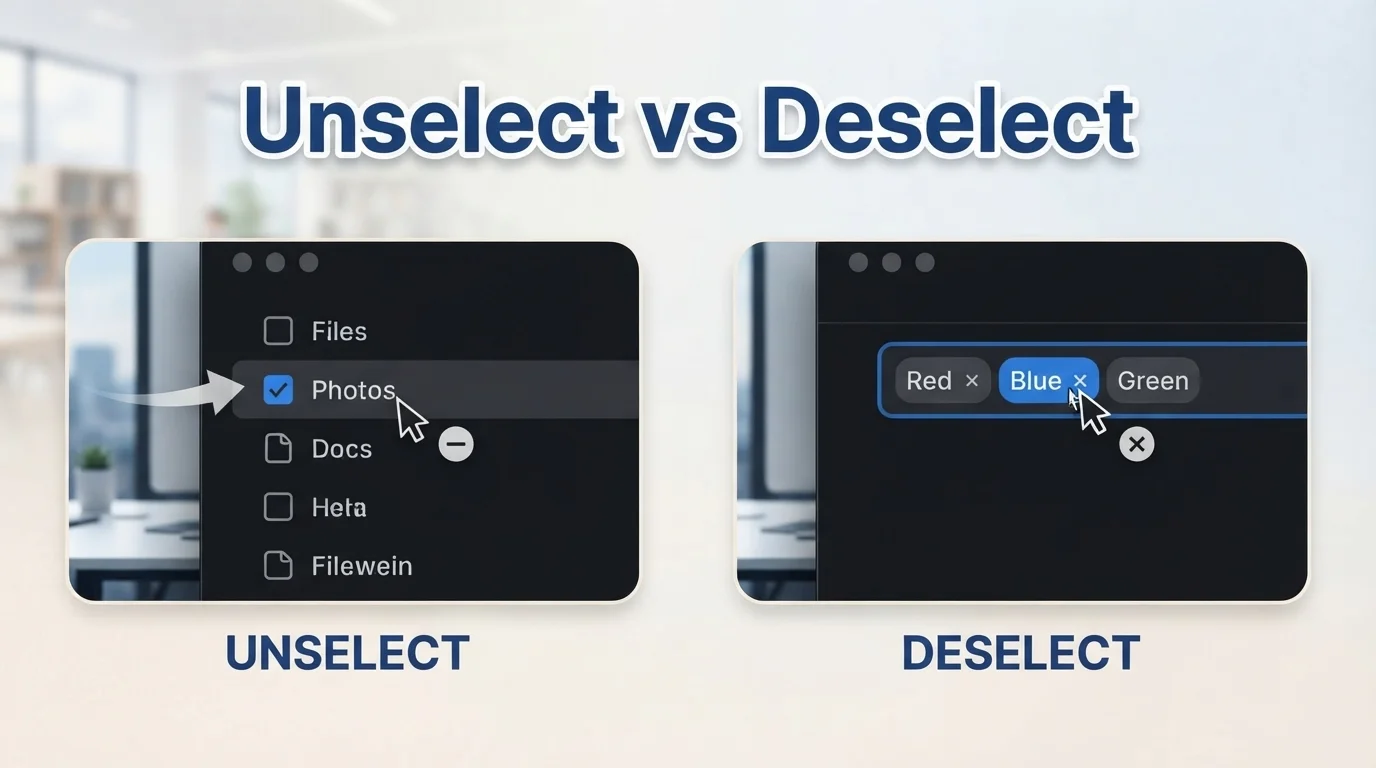
When talking about buttons, checkboxes, options, or items that have already been selected, you may come across both “unselect” and “deselect.” They appear to have the same basic meaning: removing a selection. However, they are not equally common or equally natural in standard English. Choosing the right word can make your writing sound clearer and more professional, especially in software instructions, user interfaces, technical documentation, and everyday communication.
The main issue is that “deselect” is the established and widely preferred term for removing a selection. “Unselect” is understandable and is sometimes used, particularly in informal or technical contexts, but many style guides and software interfaces favor “deselect.” Understanding this small distinction is useful when writing instructions such as “Deselect the checkbox,” “Select or deselect an option,” or “Remove the selected item.” This guide explains unselect vs deselect, their meanings, usage, examples, common mistakes, and related terms so you can confidently choose the right expression.
Quick Answer
Deselect is generally the better and more standard choice when you mean to remove a selection. Unselect is understandable but less common and can sound less natural. In software instructions, forms, menus, and technical writing, use deselect when possible.
Why People Confuse It
The confusion comes from the prefixes un- and de-.
The prefix un- can mean reversing an action:
- unlock = reverse locking
- untie = reverse tying
- unpack = reverse packing
So, logically, unselect seems to mean “reverse selecting.”
The prefix de-, however, is also commonly used to indicate removal or reversal:
- deactivate
- disconnect
- defrost
- deactivate
- deselect
Because both words can communicate the idea of reversing a selection, speakers sometimes use them interchangeably.
In modern English, however, deselect is the more established choice for removing a selection from a list, checkbox, menu, or interface.
First Word: Unselect
Unselect means to remove something from a group of selected items or to reverse a previous selection.
For example:
Unselect the items you don’t want.
The meaning is easy to understand, particularly in software and technology contexts.
However, unselect is less common than deselect. It may appear in user interfaces, technical discussions, or informal instructions, but it is generally not the first choice for polished English.
Examples of “Unselect”
- Please unselect the incorrect option.
- You can unselect any item before submitting the form.
- Click the box again to unselect it.
- I accidentally selected the wrong file, so I had to unselect it.
- Unselect the option if you don’t want notifications.
Although these sentences are understandable, deselect would usually sound more natural in formal technical writing.
Second Word: Deselect
Deselect means to remove a selection or to stop an item from being selected.
It is especially common in:
- computer software
- websites
- mobile applications
- checkboxes
- menus
- forms
- graphic-design programs
- technical documentation
For example:
Deselect the checkbox if you don’t want to receive emails.
This is a natural and standard instruction.
Examples of “Deselect”
- Deselect the option you don’t need.
- Please deselect all unnecessary files.
- Deselect the checkbox before continuing.
- Click the selected item again to deselect it.
- You can deselect multiple options at any time.
- Deselect the filter to view all results.
In most situations involving a selection, deselect is the safer word to use.
Comparison Table
| Feature | Unselect | Deselect |
| Meaning | Remove a selection | Remove a selection |
| Grammar | Verb | Verb |
| Understandable? | Yes | Yes |
| Commonness | Less common | More common |
| Technical writing | Sometimes used | Widely preferred |
| Software instructions | Possible | Standard choice |
| Formal writing | Less preferred | Preferred |
| Best general choice | Usually no | Usually yes |
When to Use Each
Use “Deselect” When:
Use deselect when writing clear, professional instructions about removing a selection.
Common situations include:
- Checkbox instructions
- Website interfaces
- Software documentation
- App instructions
- Online forms
- File selection
- Search filters
- Graphic-design tools
Example:
Deselect “Include archived files” to hide old results.
Use “Unselect” When:
Unselect can be used when the meaning is obvious and the context is informal or when a particular software interface uses that wording.
For example:
Select the products you want, then unselect any products you don’t need.
The sentence is understandable, but deselect would generally be the more polished option.
Examples: Unselect vs Deselect
Here are practical examples showing how the two words work.
- Deselect the checkbox before saving your changes.
- You can deselect any option you don’t want.
- Unselect the wrong file before uploading the documents.
- Please deselect all unnecessary filters.
- Click the selected button again to deselect it.
- You can unselect an item by clicking it again.
- Deselect the email notification option.
- I accidentally selected the wrong category and had to deselect it.
- Deselect the images you don’t want to download.
- The user can unselect individual items from the list.
- Deselect the checkbox if you want to disable this setting.
- Select all the required files and deselect anything unnecessary.
Which Examples Sound More Natural?
Compare:
Unselect the checkbox.
with:
Deselect the checkbox.
Both are understandable, but “Deselect the checkbox” is the more conventional wording for a professional software instruction.
Common Mistakes
1. Assuming “Unselect” Is Always Wrong
Unselect is not meaningless. Readers can understand it, and it does occur in English.
The issue is mainly usage and preference, not basic comprehensibility.
2. Using “Deselect” for Physical Objects
Deselect normally relates to something that has been selected as an option or choice.
For a physical object, alternatives may be more appropriate:
- remove
- put back
- take off
- set aside
3. Confusing “Deselect” With “Delete”
These words have very different meanings.
- Deselect = remove an item from the current selection.
- Delete = remove the item itself.
For example:
Deselect the file.
The file remains on the computer.
Delete the file.
The file itself is removed.
4. Using “Unselect” in Formal Documentation
While understandable, unselect can make polished technical instructions sound less conventional. Deselect is usually the clearer choice.
Memory Trick
Think:
Select → Deselect
The two words form a natural pair.
Select = choose it
Deselect = stop choosing it
So if you’re writing software instructions, remember:
Select it → Deselect it.
This simple pair will help you choose the more standard term quickly.
American vs British English
There is no major American-English vs British-English distinction that makes “unselect” standard in one variety and “deselect” standard in the other.
Both varieties use deselect, particularly in computing and technical contexts.
You may encounter unselect in both American and British English, but deselect is generally the more established term for reversing a selection.
Therefore, if you’re writing for an international audience, deselect is a practical choice.
Similar Words
Several words are related to deselect, but they are not always interchangeable.
Select
To choose something.
Select your preferred language.
Deselect
To remove something from the current selection.
Deselect the language you don’t want.
Remove
To take something away.
Remove the selected item from the list.
Delete
To permanently or deliberately remove data or an object.
Delete the file from your computer.
Uncheck
To remove the check mark from a checkbox.
Uncheck the box if you don’t want updates.
Clear
To remove selected information, entries, or settings depending on context.
Clear the selected filters.
These words describe related actions, but deselect is particularly useful when the focus is on changing the selection state.
Final Verdict
When choosing between unselect vs deselect, deselect is generally the preferred and more established term. It clearly describes the action of removing an item from a current selection and is especially common in software, websites, forms, and technical documentation.
Unselect is understandable and sometimes used, but it is less conventional. If you’re writing professional instructions or want the wording most readers will recognize immediately, deselect is usually the better choice.
FAQs
Is “unselect” a correct word?
Yes, unselect is an understandable English verb and is used in some contexts. However, deselect is generally more established and preferred when referring to removing a selection.
Is “deselect” the opposite of “select”?
Yes. In interface and computing contexts, select means choosing an item, while deselect means removing that item from the current selection.
Should I say “unselect” or “deselect”?
In most professional, technical, and software-related writing, deselect is the safer choice.
Can I say “unselect a checkbox”?
You can, and the meaning will normally be understood. However, “deselect a checkbox” or, depending on the interface, “uncheck the checkbox” may sound more natural.
What is the difference between deselect and delete?
Deselect changes an item’s selection status without necessarily removing it. Delete removes the item or data itself.
Is “deselect” used in British English?
Yes. Deselect is used in British English as well as American English, particularly in computing and technical contexts.
Is “unselect” more informal than “deselect”?
Generally, unselect is less conventional and may sound less polished in formal technical writing. Deselect is the more established term.
Conclusion
The choice between unselect and deselect is mostly about conventional usage rather than a completely different meaning. Both can communicate the idea of reversing a selection, but deselect is the more widely established term, especially for software interfaces, online forms, checkboxes, menus, and technical instructions. When clarity and standard usage matter, “deselect” is usually the better option.
That said, “unselect” is understandable and does appear in real-world English. If you encounter it, the meaning is normally clear from context. For your own writing, however, remembering the simple pair select → deselect can help you consistently choose the conventional term.
Remember This
Select = choose something.
Deselect = remove it from the selection.
Unselect = understandable, but less conventional.
👉 For professional and technical writing, “deselect” is usually the best word to use.

I am Chase Larson, an author at Grammetics, passionate about grammar and matching words. I create clear, useful content that helps readers improve vocabulary, writing, and communication.