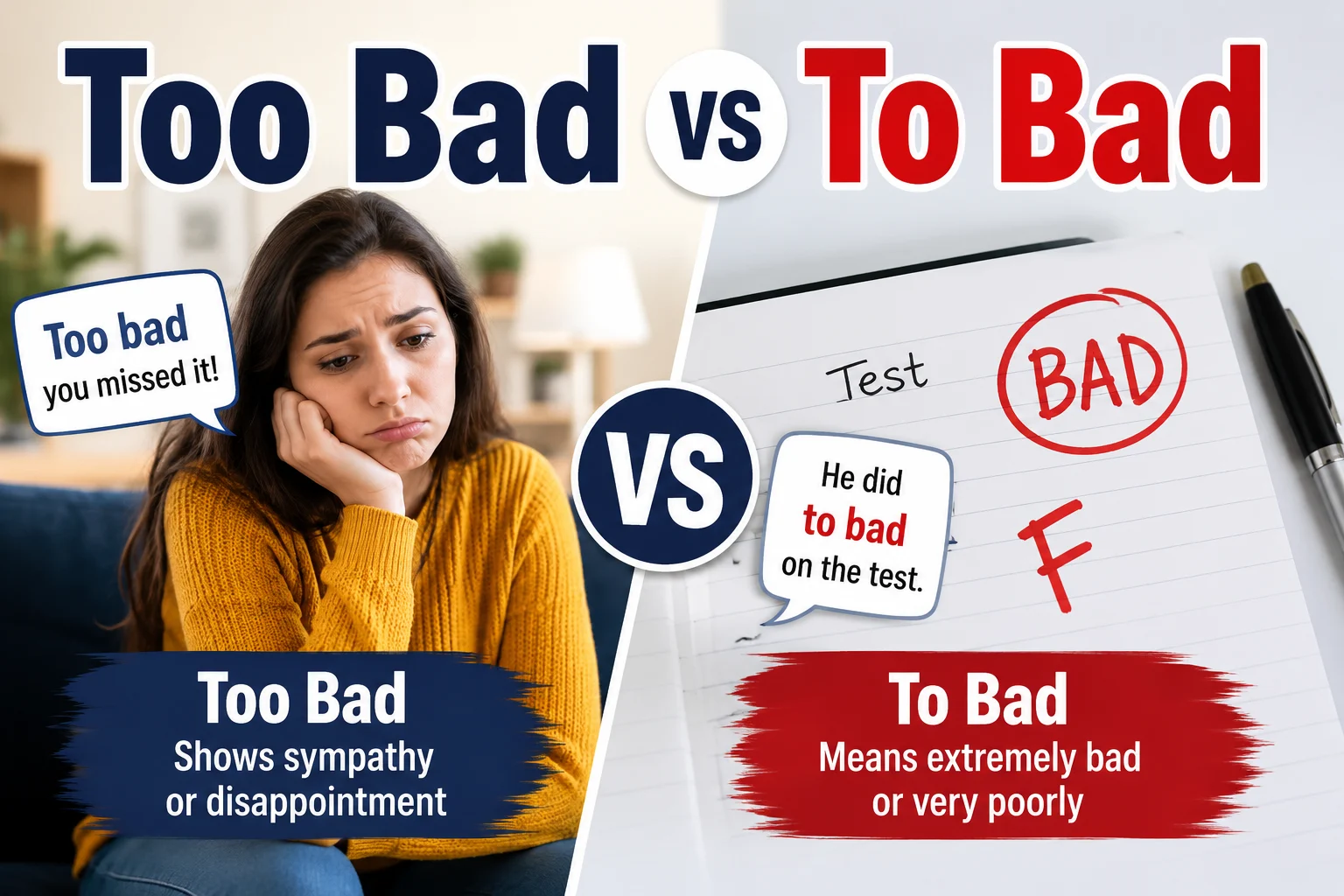
If you have ever wondered whether the correct phrase is “too bad” or “to bad,” you are not alone. These two combinations can sound almost identical when spoken, but they are very different in writing. In standard English, “too bad” is the correct expression when you mean something is unfortunate, disappointing, or regrettable. For example, “It’s too bad you missed the concert” means it is unfortunate that you missed it.
The confusion usually comes from the fact that too and to are both extremely common English words and are pronounced similarly in many sentences. However, they have completely different grammatical jobs. Understanding the difference between too bad vs to bad will help you avoid a common spelling mistake and make your writing more accurate. In this guide, you will learn the meanings, grammar rules, examples, common mistakes, and an easy memory trick to remember which form to use.
Quick Answer
“Too bad” is the correct phrase when you mean unfortunate, regrettable, disappointing, or excessive in a particular context. “To bad” is usually incorrect because to is a preposition or infinitive marker, while too can mean “also” or “more than necessary.” In everyday English, use “too bad.”
Why People Confuse It
The main reason people confuse too bad and to bad is pronunciation.
In many accents, to and too sound the same or very similar. When people hear the expression rather than see it written, it is easy to choose the wrong spelling.
There is also a grammatical reason for the confusion:
- To is commonly used before a verb: to go, to eat, to learn.
- Too can mean “also” or “excessively/more than necessary.”
- Bad is an adjective meaning something is poor, unpleasant, harmful, or unfortunate.
So when someone says:
“That’s too bad.”
they are using too as part of a standard expression meaning “That’s unfortunate.”
First Word: Too
Too has several uses in English, but two are especially important.
1. Too = excessively or more than necessary
Examples:
- The coffee is too hot.
- This bag is too heavy.
- The music is too loud.
- It is too bad to ignore.
Here, too indicates an excessive degree.
2. Too = also
Examples:
- I want to come too.
- She likes chocolate too.
- He is coming too.
In “too bad,” however, the phrase usually has a different meaning: unfortunate or regrettable.
What Does “Too Bad” Mean?
Too bad commonly means:
- unfortunate
- regrettable
- disappointing
- unfortunate that something happened
For example:
“It’s too bad that you couldn’t stay.”
This means:
“It’s unfortunate that you couldn’t stay.”
It can also be used sarcastically or dismissively:
“Too bad! You should have arrived earlier.”
The exact tone depends on context and the speaker’s intention.
Second Word: To
To is one of the most frequently used words in English.
It commonly works as:
1. An infinitive marker
It comes before the base form of a verb:
- to run
- to write
- to study
- to sleep
- to improve
Examples:
I want to study English.
She decided to leave early.
2. A preposition
It can indicate direction, movement, relationship, or connection:
- Go to school.
- Give it to Sarah.
- We traveled to London.
- I spoke to my teacher.
Because bad is an adjective, “to bad” does not normally form a standard English expression.
That is why writing “to bad” when you mean “unfortunate” is incorrect.
Too Bad vs To Bad: Comparison Table
| Expression | Correct? | Meaning | Example |
| too bad | ✅ Yes | Unfortunate or regrettable | It’s too bad you missed the show. |
| to bad | ❌ Usually no | Not normally a standard phrase | ❌ It’s to bad you missed it. |
| too | ✅ Yes | Also / excessively | I want to come too. |
| to | ✅ Yes | Direction / infinitive marker | I want to go. |
The simple rule
If you mean “unfortunate” or “regrettable,” use too bad.
When to Use Each
Use “Too Bad” When Something Is Unfortunate
This is the most common situation.
It’s too bad that the game was canceled.
Meaning: The cancellation is unfortunate.
Use “Too Bad” to Express Disappointment
Too bad we couldn’t get tickets.
This expresses disappointment about something that did not happen.
Use “Too Bad” as a Reaction
“I missed the last bus.”
“Too bad.”
Depending on the tone, this can sound sympathetic, neutral, sarcastic, or dismissive.
Use “To” Before a Verb
Use to when it introduces an infinitive:
I want to learn English.
She needs to leave.
They decided to stay.
Important Point
You generally don’t choose between too bad and to bad based simply on sound. Look at the meaning and grammatical function.
Examples: Too Bad vs To Bad
Here are more than 10 examples to make the difference clear.
- It’s too bad you missed the meeting.
→ It is unfortunate that you missed it. - Too bad the restaurant was closed.
→ It was unfortunate that it was closed. - That’s too bad.
→ That’s unfortunate. - It’s too bad we arrived late.
→ Our late arrival was unfortunate. - Too bad you couldn’t join us.
→ It is unfortunate that you couldn’t join us. - It’s too bad about the weather.
→ The weather situation is unfortunate. - I feel bad that you’re leaving, but it’s too bad we can’t stay longer.
- Too bad! We already sold the tickets.
- It was too bad that the event had to be canceled.
- It’s too bad she couldn’t attend the wedding.
- I wanted to go too.
→ Here, too means “also.” - I need to go home.
→ Here, to introduces the verb “go.” - He went to the store.
→ Here, to indicates direction. - The soup is too hot to eat.
→ Here, too means excessively. - She wants to improve her writing.
→ Here, to introduces the verb “improve.”
Notice that “to bad” does not work in the examples where the intended meaning is “unfortunate.”
Common Mistakes
Mistake 1: Writing “to bad”
❌ It’s to bad that you left.
✅ It’s too bad that you left.
When too bad means “unfortunate,” always spell it with two o’s.
Mistake 2: Assuming “too” always means “excessively”
Some learners only associate too with excessive amounts.
For example:
The box is too heavy.
That’s correct, but too has other uses. In “too bad,” it can form an idiomatic expression meaning “unfortunate.”
Mistake 3: Confusing “too bad” with “very bad”
These phrases are not always interchangeable.
Very bad generally describes a high degree of badness:
The movie was very bad.
Too bad can mean “unfortunate”:
It’s too bad you missed the movie.
The second sentence does not necessarily say that the movie itself was bad.
Mistake 4: Choosing the spelling by pronunciation
Because to and too often sound alike, pronunciation alone cannot tell you which spelling to use.
Instead, ask what the word is doing in the sentence.
Memory Trick
Here is an easy way to remember it:
Too has two O’s → think “more” or “also.”
When you say:
“That’s too bad.”
you are using the established expression too bad.
You can remember:
Two O’s = Too bad!
Another quick test:
Does the sentence mean “unfortunate”?
If yes → too bad ✅
If you’re using to before a verb → to ✅
For example:
- too bad = unfortunate
- to go = infinitive
- to school = direction
- too much = excessive
- me too = also
American vs British English
There is no major American vs British spelling difference between too bad and to bad.
Both American English and British English use too bad when the meaning is “unfortunate” or “regrettable.”
For example:
American English:
It’s too bad you missed the train.
British English:
It’s too bad you missed the train.
The spelling remains the same.
What can differ is tone, frequency, and context. In some situations, British speakers may use expressions such as “what a shame” or “such a shame,” while American speakers commonly use “too bad.” However, too bad is understood in both varieties.
Similar Words and Expressions
If you’re learning the difference between too bad vs to bad, it can help to compare related expressions.
Too Good
The offer is too good to refuse.
Here, too means excessively or to an extent that creates a particular result.
Very Bad
The weather was very bad yesterday.
Very bad describes the severity of something.
What a Shame
What a shame you couldn’t come.
This is similar to “It’s too bad you couldn’t come.”
Unfortunately
Unfortunately, we missed the train.
This directly expresses that something unfortunate happened.
Too Much
There is too much sugar in this tea.
Here, too means more than necessary.
Me Too
I like this song too.
Here, too means also.
Frequently Asked Questions
1. Is “too bad” or “to bad” correct?
Too bad is correct when you mean “unfortunate,” “regrettable,” or “disappointing.” To bad is generally incorrect in this expression.
2. What does “too bad” mean?
Too bad commonly means that something is unfortunate, regrettable, or disappointing. For example, “It’s too bad you missed the party” means “It’s unfortunate that you missed the party.”
3. Is “to bad” ever correct?
The exact sequence “to bad” is generally not a standard phrase. However, to can appear near the word bad when the sentence has another grammatical structure, such as “to feel bad” or “to be bad.”
4. Why do people write “to bad”?
The mistake usually happens because to and too sound similar in spoken English. Writers may choose the shorter spelling automatically without considering the meaning.
5. Does “too bad” mean “very bad”?
Not necessarily. Too bad often means “unfortunate” or “regrettable.” In other contexts, too can indicate excess, but the meaning depends on the sentence.
6. Is “too bad” informal?
Too bad is common in everyday English and is generally conversational. It can be perfectly natural in speech and informal writing. More formal writing may use words such as unfortunate or regrettable, depending on the context.
7. Can “too bad” sound rude?
Yes, depending on tone and context. A sympathetic “That’s too bad” can show concern, while a sharp “Too bad!” can sound dismissive or sarcastic.
Final Verdict
When comparing too bad vs to bad, the answer is straightforward: “too bad” is the correct expression when you mean something is unfortunate, regrettable, or disappointing. The spelling “to bad” is generally a mistake when used with this meaning.
Remember that to and too have different grammatical roles even though they can sound alike. To is commonly used for direction or before a verb, while too can mean “also” or “more than necessary” and appears in the expression “too bad.”
Remember This
Too bad = unfortunate or regrettable. ✅
To = usually direction or an infinitive marker. ✅
So write:
It’s too bad you couldn’t come. ✅
Not:
It’s to bad you couldn’t come. ❌
The easiest memory trick is: “Too bad” has two O’s—just like “too” can mean “more” or “also.”
Conclusion
The difference between too bad and to bad is small in spelling but important in correct English usage. If you’re expressing disappointment, regret, or an unfortunate situation, too bad is the form you want. This phrase is natural in both American and British English and appears frequently in everyday conversations.
The word to, meanwhile, has its own important grammatical functions, especially before verbs and when showing direction or relationships. Once you focus on the meaning rather than pronunciation, the distinction becomes much easier. When in doubt, remember: “It’s too bad” = “It’s unfortunate.”

I am Chase Larson, an author at Grammetics, passionate about grammar and matching words. I create clear, useful content that helps readers improve vocabulary, writing, and communication.