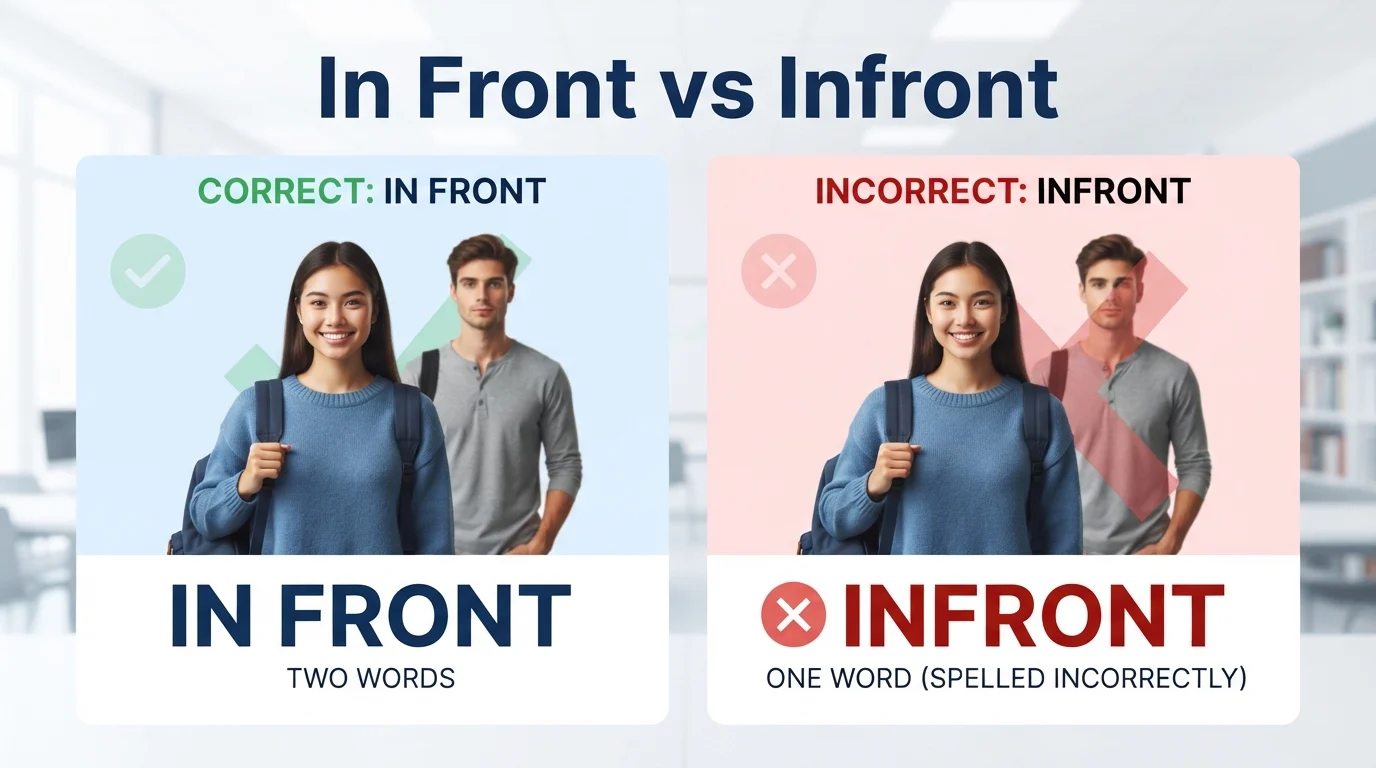
If you have ever stopped while writing and wondered whether “in front” should be written as two words or “infront” as one, you are not alone. This is a small spelling question, but it appears frequently in emails, essays, social media posts, messages, and everyday English. The good news is that the rule is straightforward: “in front” is the correct standard form, while “infront” is a misspelling.
The phrase “in front of” is commonly used to describe the position of a person or thing ahead of another person or thing. It can also mean being in someone’s presence, such as speaking “in front of an audience.” Cambridge Dictionary identifies in front of as a prepositional expression meaning close to the front of something or someone.
Quick Answer
“In front” is correct; “infront” is incorrect in standard English. Always write in front as two words. The phrase describes a position ahead of someone or something and commonly appears as “in front of.” This spelling is used in both American and British English.
Why People Confuse It
The confusion mainly comes from pronunciation and fast typing.
When people say “in front of” quickly, the words can sound almost connected. This can make writers assume that they should also be joined in writing.
English also contains many words that began as separate expressions and later became single words, such as:
- into
- inside
- anytime
- everywhere
However, in front has not become one word in standard English.
Another reason is simple typing. In casual messages, people sometimes write infront without noticing the missing space. Its appearance online does not make it grammatically standard.
First Word: In Front
In front is the correct form.
It consists of two separate words:
- in — a preposition
- front — a noun
Together, they form a phrase that can describe position or location.
For example:
The car is in front of the house.
Here, the car is positioned ahead of the house.
The expression can also refer to being before or ahead of someone:
She was in front of me in the line.
The related phrase “in front of” is especially common when identifying what or whom something is ahead of. Cambridge describes it as a prepositional expression and gives behind as its opposite.
Second Word: Infront
Infront is not the standard spelling.
It is usually a spelling mistake created by combining in and front into one word.
❌ The bus stopped infront of the school.
✅ The bus stopped in front of the school.
You may encounter infront in text messages, comments, social media, or other informal online writing. However, you should avoid it in:
- Academic writing
- Business emails
- Resumes
- Articles
- Essays
- Reports
- Professional communication
- Formal documents
When in doubt, use in front.
Comparison Table
| Form | Correct? | Word Type | Example |
| in front | ✅ Yes | Phrase | She stood in front of me. |
| infront | ❌ No | Misspelling | She stood infront of me. |
| in front of | ✅ Yes | Prepositional phrase | The car is in front of the house. |
| in the front | ✅ Yes | Prepositional phrase | We sat in the front of the bus. |
Notice that “in front” and “in the front” can both be correct, but they are not always used in exactly the same way.
When to Use Each
Use “in front” when describing relative position
Use in front when something or someone is ahead of another person or object.
The teacher stood in front of the class.
My car is parked in front of your house.
Use “in front” for public presence
The phrase can also describe doing something while another person or group is present.
She was nervous about speaking in front of everyone.
Don’t argue in front of the children.
Dictionary sources recognize this meaning as being in someone’s presence or view.
Never use “infront”
If you mean the standard English phrase, don’t combine the two words.
❌ infront
✅ in front
Examples: 15 Correct Sentences
Here are practical examples showing how in front works in everyday English.
- The teacher is standing in front of the students.
- My house is in front of the park.
- She parked her car in front of the office.
- A large tree stands in front of our window.
- He was sitting in front of me at the cinema.
- Please wait in front of the building.
- The dog ran in front of the moving car.
- There was a long line in front of the ticket counter.
- Don’t speak loudly in front of the guests.
- She gave a speech in front of hundreds of people.
- The children were playing in front of the house.
- He stepped in front of the camera.
- The bus stopped in front of the school.
- I don’t like talking in front of large groups.
- A motorcycle was parked in front of the store.
Common Mistakes
1. Writing “infront”
❌ The teacher stood infront of the class.
✅ The teacher stood in front of the class.
2. Forgetting “of”
When referring to the position relative to a particular person or thing, in front of is normally required.
❌ The car is in front the house.
✅ The car is in front of the house.
3. Confusing “in front” with “before”
These expressions can overlap in certain contexts, but they are not interchangeable in every situation.
For physical location, in front of is generally the natural choice:
The man was standing in front of me.
For time, use before:
I arrived before 8 o’clock.
4. Confusing “in front” with “in the front”
Compare:
She is sitting in front of me.
This means she is ahead of me.
But:
She is sitting in the front of the bus.
This refers to the front section of the bus.
Memory Trick
Here’s an easy way to remember the spelling:
“In front” needs a space because it describes a position, not a single object.
Think:
IN + FRONT = two words
You can also remember this sentence:
“I am in front, not infront.”
Whenever you’re tempted to write infront, pause and mentally separate in from front.
American vs British English
There is no American-versus-British spelling difference here.
Both American English and British English use:
✅ in front
and:
❌ infront
The phrase is standard in both varieties of English. Cambridge’s grammar guidance also uses in front of as a standard English prepositional expression.
So whether you’re writing for an American audience, a British audience, or an international English audience, choose in front.
Similar Words and Expressions
Depending on the context, several expressions can have a similar meaning to in front of.
Ahead of
The blue car is ahead of us.
This often emphasizes relative position or progress.
Before
She arrived before me.
Before is especially common when talking about time, although it has other uses.
At the front of
We sat at the front of the classroom.
This emphasizes a location at the front part of something.
In the presence of
He apologized in the presence of his colleagues.
This can replace in front of when the meaning is about someone’s presence rather than physical position.
Facing
The hotel is facing the river.
This can describe orientation rather than simply being ahead of something.
FAQs
Is “infront” one word?
No. Infront is not the standard spelling. The correct form is in front, written as two words.
Is “in front of” grammatically correct?
Yes. In front of is a standard prepositional expression used to describe position, location, or someone’s presence.
Which is correct: “in front” or “infront”?
In front is correct. Infront is a misspelling in standard English.
Should I write “infront of me”?
No. Write:
in front of me
For example:
The man was standing in front of me.
Is “in front” used in American English?
Yes. American English uses in front as two words.
Is “in front” used in British English?
Yes. British English also uses in front as two words.
What is the opposite of “in front of”?
The usual opposite is behind.
The car is in front of the house.
The garage is behind the house.
Cambridge specifically identifies behind as the opposite of in front of.
Can “in front of” mean “in someone’s presence”?
Yes. For example:
Don’t argue in front of the children.
Here, it means while the children are present or watching.
Final Verdict
The choice between in front and infront is simple: always use “in front” as two words in standard English. It is the established form for describing something positioned ahead of another person or thing, and it is also used when referring to someone’s presence.
Infront may appear in casual online writing, but it should be treated as a spelling error rather than an alternative spelling. Whether you’re writing an essay, email, blog post, application, or everyday message, in front is the safe and correct choice.
Remember This
✅ IN FRONT = CORRECT
❌ INFRONT = INCORRECT
If you’re describing something that is ahead of another person or object, use in front of:
“The car is parked in front of the house.”
That’s the rule—simple, consistent, and the same in both American and British English.
Conclusion
The in front vs infront confusion comes down to one small but important space. In front is a two-word phrase, while infront is not the standard spelling. Learning to recognize the phrase as in + front makes the correct form much easier to remember.
Once you get used to writing in front of, the mistake becomes easy to avoid. Keep the words separate in your essays, emails, professional documents, and everyday writing, and your English will look cleaner and more polished.

I’m Elliot Pierce, Administrator at Grammetics, dedicated to improving word matching and grammar. I help maintain useful content, support readers, and make language learning simple, clear, accurate, and engaging.