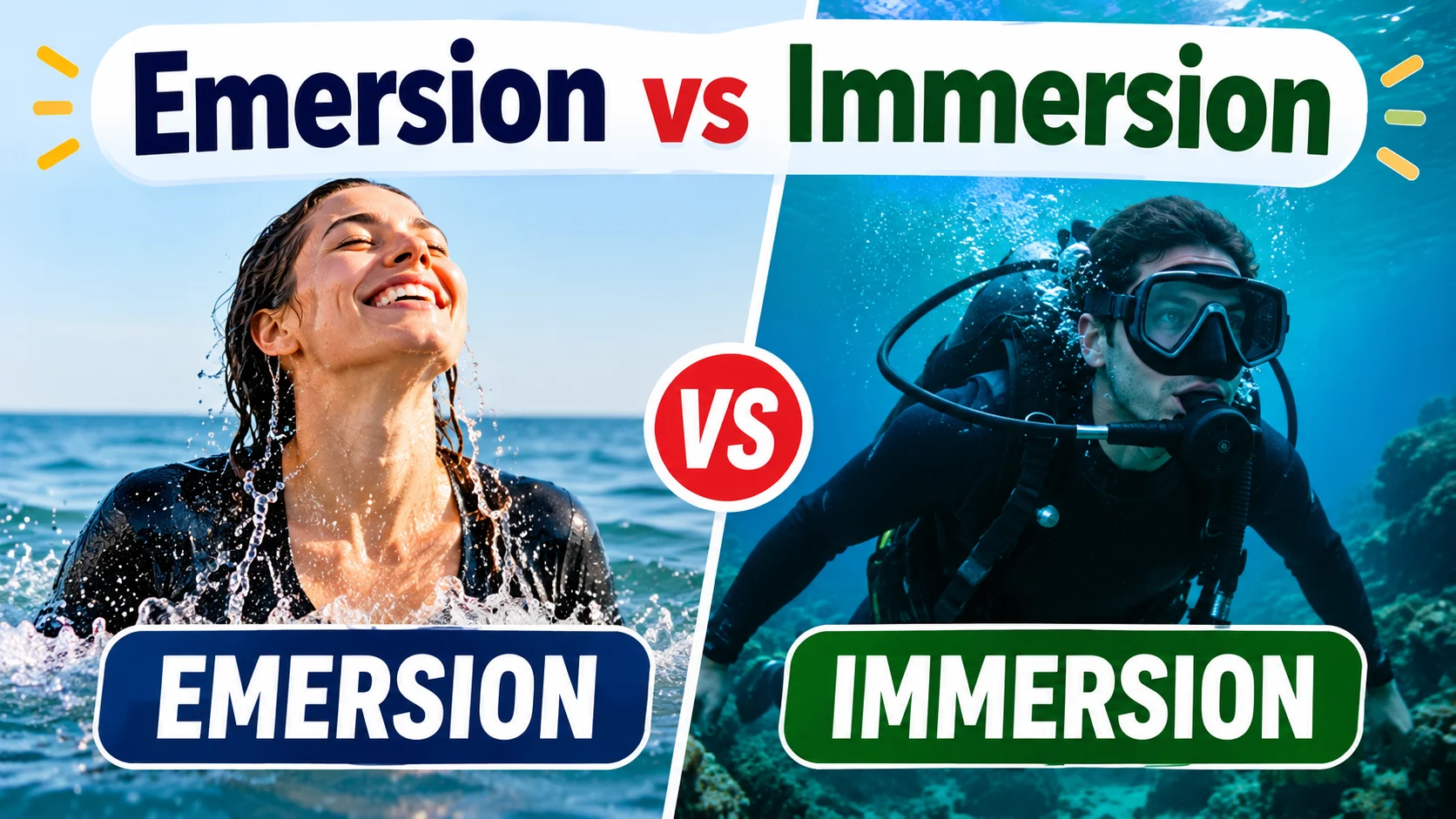
If you have ever wondered whether the correct word is emersion or immersion, you are not alone. These two words look and sound remarkably similar, but they describe very different ideas. The confusion becomes especially common when discussing language learning, education, water, science, or something emerging from a hidden position. Knowing the difference can help you choose the right word confidently in both everyday and professional English.
The key is simple: immersion generally means being completely surrounded by or deeply involved in something, while emersion refers to the act or process of emerging or coming out. Although immersion is common in modern English, emersion is relatively uncommon and appears more often in specialized or formal contexts. This guide explains their meanings, usage, pronunciation, common mistakes, examples, and an easy memory trick so you can remember the distinction.
Quick Answer
Immersion means being deeply involved in something or completely surrounded by it, such as water or a language. Emersion means emerging or coming out from something, especially in scientific or technical contexts. For most everyday situations, immersion is the word you are likely looking for.
Why People Confuse It
The words emersion and immersion share the same Latin root associated with going into or coming out of something. They also look nearly identical, with only one important difference at the beginning: e- versus im-.
The problem is made worse because both words can relate to physical movement involving water or another surrounding substance.
For example:
- A swimmer experiences immersion when going underwater.
- A person or object can experience emersion when coming out of water.
However, immersion has developed many broader meanings. We commonly use it for:
- Language learning
- Education
- Technology
- Entertainment
- Cultural experiences
- Deep involvement in an activity
Emersion, on the other hand, is much less common in everyday English.
First Word: Emersion
Emersion is a noun meaning the act or process of emerging, appearing, or coming out from something.
It is often used in scientific, astronomical, or technical writing.
For example, when an astronomical object becomes visible after being hidden by another object, scientists may describe its appearance as an emersion.
Simple meaning
Emersion = coming out or emerging
Think of something moving from a hidden or covered position into view.
Examples of emersion
- The emersion of the satellite from behind the planet was observed carefully.
- Scientists recorded the moon’s emersion from the shadow.
- The bird’s emersion from the water was surprisingly quick.
- The experiment measured the object’s emersion from the liquid.
Because emersion is relatively specialized, you probably will not need it frequently in casual conversation.
Second Word: Immersion
Immersion is a noun with several common meanings. At its most basic level, it means placing something completely into a substance, especially a liquid.
It can also mean becoming deeply involved in an activity, environment, culture, or subject.
Simple meaning
Immersion = going deeply into or becoming completely involved in something
For example:
- The immersion of the object in water changed its temperature.
- Language immersion can help students develop fluency.
- The museum provides an immersive cultural experience.
Today, immersion is especially common in education and language learning.
Immersion in language learning
Language immersion means learning and using a language extensively in an environment where that language is spoken.
For example:
She improved her Spanish through complete language immersion.
This does not mean she simply studied Spanish for an hour every day. It suggests that Spanish became a major part of her communication environment.
Comparison Table
| Word | Meaning | Common Context | Example |
| Emersion | Coming out or emerging | Scientific, technical, formal | The object’s emersion was recorded. |
| Immersion | Being completely surrounded or deeply involved | Everyday, education, science, culture | Language immersion improved his fluency. |
| Emerge | Come out or become visible | General English | The bird emerged from the water. |
| Immerse | Put into or deeply involve | General English | She immersed herself in French. |
When to Use Each
Use “emersion” when something comes out
Choose emersion when you specifically mean the process of emerging, becoming visible, or coming out from something.
This word is particularly appropriate in specialized scientific contexts.
Example:
Researchers observed the emersion of the object from the planet’s shadow.
In ordinary conversation, however, emergence or emerging may sound more natural.
Use “immersion” when something goes in or becomes deeply involved
Use immersion when talking about:
- Being submerged in water
- Becoming deeply involved in an activity
- Learning through direct experience
- Becoming surrounded by a language or culture
- Technology that creates a highly engaging experience
Examples:
The immersion of the device in water caused damage.
Her immersion in Japanese culture accelerated her language learning.
A useful distinction
If something is coming out, think emersion.
If something is going in or becoming deeply involved, think immersion.
Examples: Emersion vs Immersion in Sentences
Here are more than ten examples to make the difference clear.
- The swimmer’s immersion in the cold water lasted only a few minutes.
- The scientist observed the emersion of the object from the liquid.
- Language immersion is an effective way to practice everyday communication.
- The telescope captured the moon’s emersion from the shadow.
- The complete immersion of the equipment in water caused corrosion.
- The student’s immersion in French helped improve her pronunciation.
- The emersion of the spacecraft from the shadow was carefully monitored.
- Virtual reality can create a powerful sense of immersion.
- The researcher documented the emersion of the organism from the water.
- He chose an immersion program to develop his English skills.
- The emersion became visible through the telescope.
- The teacher uses cultural immersion to help students understand Spanish-speaking communities.
- The object remained underwater until its eventual emersion.
- The game is designed to provide players with a highly immersive experience.
Common Mistakes
Mistake 1: Using “emersion” for language learning
Incorrect:
I am studying English through emersion.
Better:
I am studying English through immersion.
Language learning involves deep exposure and involvement, so immersion is the correct choice.
Mistake 2: Assuming “emersion” is simply another spelling of immersion
They are not interchangeable.
Emersion describes emerging or coming out, while immersion commonly describes entering, being surrounded, or becoming deeply involved.
Mistake 3: Using “immersion” when you mean “emergence”
If you mean something becomes visible or comes out, emergence may be the more natural word.
For example:
The emergence of the insect was unexpected.
This is usually more natural in general English than:
The emersion of the insect was unexpected.
Mistake 4: Forgetting the broader meaning of immersion
Immersion is not limited to water.
You can be immersed in:
- A book
- A language
- A culture
- A video game
- A subject
- A project
- An experience
Memory Trick
Here is an easy way to remember the difference:
IM = IN
Think:
Immersion = IN
Something goes in, gets surrounded, or becomes deeply involved.
EM = EMERGE
Think:
Emersion = EMERGE
Something comes out or becomes visible.
One-line memory rule
Immersion goes in; emersion comes out.
This simple association can help you distinguish the two words quickly.
American vs British English
There is no major American-versus-British spelling difference between immersion and emersion.
Both varieties of English recognize the two words.
The bigger difference is frequency and context. Immersion is widely used in both American and British English, particularly in education, language learning, technology, and everyday descriptions of deep involvement.
Emersion is much less common in ordinary speech and writing in both varieties. It tends to appear in specialized scientific, astronomical, or technical contexts.
So whether you are writing for an American or British audience, the basic distinction remains the same.
Similar Words
Several related words can make this topic easier to understand.
Immersive
Immersive is an adjective describing something that completely involves or surrounds you.
The game offers an immersive experience.
Immerse
Immerse is the verb form of immersion.
She immersed herself in the language.
Emergence
Emergence means the process of becoming visible, known, or developed.
The emergence of new technology changed the industry.
Emerge
Emerge means to come out or become visible.
The sun emerged from behind the clouds.
Submersion
Submersion means being completely covered by or placed under a substance, especially water.
The vehicle suffered damage after submersion in floodwater.
Final Verdict
If you are trying to decide between emersion vs immersion, remember that immersion is the much more common word.
Use immersion for being submerged, becoming deeply involved, language learning, cultural exposure, or an engaging experience.
Use emersion when referring to the act of emerging or coming out, particularly in technical or scientific contexts.
For everyday writing, if you mean “coming out,” emergence or emerging may often be more natural than emersion.
The simplest rule is:
Immersion = in. Emersion = emerging out.
Once you connect the first letters with these meanings, the difference becomes much easier to remember.
FAQs
1. Is “emersion” a real word?
Yes. Emersion is a legitimate English noun. It means the act or process of emerging or coming out, and it is particularly associated with specialized or technical contexts.
2. Is it “immersion” or “emersion”?
Both are correct words, but they have different meanings. Immersion usually means going into, being surrounded by, or becoming deeply involved in something. Emersion means emerging or coming out.
3. Is language immersion correct?
Yes. Language immersion is the standard expression for learning a language through extensive exposure and practical use.
4. What is the opposite of immersion?
Depending on the context, possible opposites include emersion, emergence, or simply coming out. The best choice depends on exactly what you are describing.
5. What does immersion mean in education?
In education, immersion generally means learning through extensive exposure to the subject or language. A language immersion program, for example, uses the target language extensively during instruction and communication.
6. Is “emersion” commonly used?
No. Emersion is relatively uncommon compared with immersion. It is more likely to appear in scientific, astronomical, or technical writing.
7. What is the easiest way to remember immersion and emersion?
Remember IM = IN and EM = EMERGE. Immersion involves going in or becoming deeply involved, while emersion involves coming out or becoming visible.
Remember This
IMMERSION = IN + DEEP INVOLVEMENT
EMERSION = EMERGE + COMING OUT
When you mean language learning, cultural exposure, being underwater, or becoming deeply involved, choose immersion. When you mean something emerging or becoming visible after being hidden, emersion may be appropriate.
Conclusion
The difference between emersion and immersion is small in spelling but significant in meaning. Immersion is the common word and describes entering, being surrounded by something, or becoming deeply involved in an experience. It is especially useful when talking about language immersion, education, water, culture, and technology.
Emersion refers to emerging or coming out and is much less common in everyday English. When writing naturally for a general audience, consider whether emergence or emerging expresses your meaning more clearly. Keep the memory trick in mind—immersion goes in, while emersion means emerging out—and you will be able to choose the right word with confidence.

I am Chase Larson, an author at Grammetics, passionate about grammar and matching words. I create clear, useful content that helps readers improve vocabulary, writing, and communication.