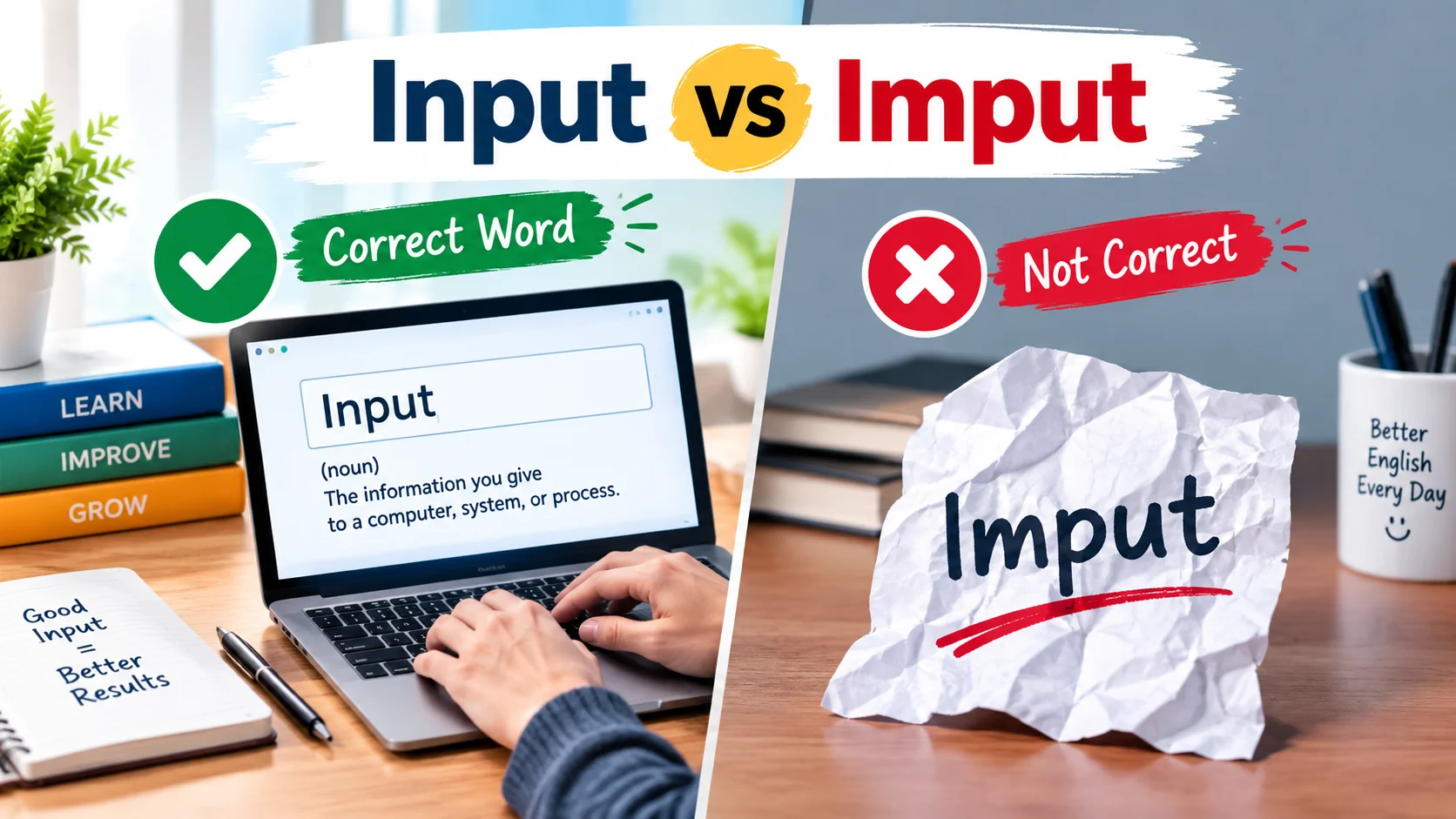
If you have ever typed “imput” instead of “input,” you are not alone. These two spellings look remarkably similar, and the pronunciation of input can sometimes make the incorrect spelling feel natural. However, in standard English, input is the correct spelling. Imput is generally considered a misspelling and should be avoided in formal writing, academic work, business communication, and professional documents.
The word input is extremely common in modern English. It can refer to information entered into a computer, data supplied to a system, or someone’s ideas, advice, or contribution. Understanding the difference between input and imput can help you write more accurately and confidently. In this guide, we’ll explain the correct spelling, meaning, pronunciation, grammatical use, common mistakes, examples, and a simple memory trick so you never have to wonder whether to write input or imput again.
Quick Answer
Input is the correct English spelling. Imput is a common spelling mistake, not a standard alternative. Input can mean information entered into a system or someone’s advice, opinion, or contribution. For correct English, always write input.
Why People Confuse It
The confusion between input vs imput usually comes from pronunciation.
When people say input quickly, the n sound can be less noticeable, making the word sound somewhat like “imput.” This can lead people to spell it according to how they hear it.
Another reason is that English has many words beginning with im-, such as:
- important
- impossible
- improve
- immediate
- imagine
Because of this familiar spelling pattern, imput may look believable.
However, the standard spelling is always input.
Input = correct
Imput = misspelling
First Word: Input
Input is the correct spelling.
It is used as both a noun and a verb.
Input as a noun
As a noun, input can mean information, data, advice, or a contribution provided to something.
Examples:
- We need your input before making a decision.
- Please enter your input into the system.
- Her input helped improve the project.
- The computer processes the user’s input.
Input as a verb
As a verb, input means to enter information or data into a computer or system.
Examples:
- Please input your password.
- The employee input the data into the database.
- You can input the information manually.
The verb input has a somewhat unusual past-tense pattern. Both input and inputted can be found, although input is commonly used, especially in technical contexts.
For example:
She input the information yesterday.
Second Word: Imput
Imput is generally a misspelling of input.
It does not function as a standard English spelling for the word meaning information, data, advice, or contribution.
If you write:
Please send me your imput.
the intended word is almost certainly:
Please send me your input.
The spelling imput may appear in informal online writing, messages, comments, or user-generated content, but its appearance does not make it a standard spelling.
For formal or professional English, use input.
Comparison Table
| Feature | Input | Imput |
| Correct spelling | Yes | No |
| Standard English word | Yes | No, as a spelling of this meaning |
| Meaning | Information, data, advice, contribution | Usually intended to mean “input” |
| Part of speech | Noun and verb | Misspelling |
| Common usage | Very common | Common spelling error |
| Example | “We need your input.” | “We need your imput.” ❌ |
When to Use Each
Use “input” when talking about information
Enter your input into the form.
Use “input” when asking for an opinion
I would appreciate your input on this matter.
Use “input” when describing someone’s contribution
Her input was valuable during the meeting.
Do not use “imput”
If you mean information, advice, data, or contribution, imput should be corrected to input.
Examples of Input vs Imput
Here are more examples to make the difference clear:
- Correct: We need your input before we finalize the plan.
- Incorrect: We need your imput before we finalize the plan.
- Correct: Please input your username and password.
- Incorrect: Please imput your username and password.
- Correct: Her input made the presentation much better.
- Incorrect: Her imput made the presentation much better.
- Correct: The software requires user input.
- Incorrect: The software requires user imput.
- Correct: Can you give me your input on this proposal?
- Incorrect: Can you give me your imput on this proposal?
- Correct: The technician input the information into the system.
- Incorrect: The technician imput the information into the system.
- Correct: Customer input is important when developing a new product.
- Incorrect: Customer imput is important when developing a new product.
- Correct: The form allows users to input their personal information.
- Incorrect: The form allows users to imput their personal information.
Common Mistakes
1. Writing “imput” because of pronunciation
The pronunciation can make the spelling confusing.
Wrong: Imput
Correct: Input
2. Using “imput” in professional writing
Emails, reports, essays, applications, and business documents should use the standard spelling input.
3. Assuming “imput” is a different word
It is generally not a separate standard word in the sense intended here. Most often, it is simply a spelling error.
4. Confusing input with output
These words describe different sides of a system:
- Input = information or material going into a system
- Output = information or result coming out of a system
For example:
Keyboard typing is input, while the information displayed on the screen is output.
Memory Trick
Here’s an easy way to remember the correct spelling:
IN goes INTO the system → INPUT
Think of the word as:
IN + PUT = INPUT
Information is put in, so remember IN + PUT.
You can also remember:
Input has “in” at the beginning because information goes in.
This simple association makes it much easier to avoid writing imput.
American vs British English
There is no standard American-versus-British spelling difference between input and imput.
Both American English and British English use:
Input
For example:
- American English: “We need your input.”
- British English: “We need your input.”
Imput is not the standard British alternative to input, nor is it the standard American alternative.
Similar Words
Understanding related terms can make the meaning of input even clearer.
Input vs Output
Input is something supplied to a system.
Output is the result produced by that system.
Input → Processing → Output
Input vs Information
Information is knowledge or data. Input is information supplied to a person, process, machine, or system.
Input vs Feedback
Feedback usually refers to comments or responses about something, while input can refer more broadly to opinions, suggestions, data, or contributions.
The manager asked for employee input and later provided feedback.
Input vs Advice
Advice specifically involves recommendations or guidance. Input has a broader meaning and can include opinions, ideas, data, and suggestions.
Final Verdict
When choosing between input and imput, the correct spelling is straightforward: input.
Use input when referring to information entered into a computer or system, or when talking about someone’s opinion, advice, ideas, or contribution. Imput is generally a spelling mistake and should not be used in standard English.
The easiest way to remember it is IN + PUT = INPUT. If you’re writing an email, essay, report, website, or professional document, choosing input will keep your spelling accurate and your writing clear.
Frequently Asked Questions
Is “imput” a correct word?
No, imput is generally considered a misspelling when someone intends to write input. The standard spelling is input.
Is it input or imput?
The correct spelling is input. For example: “We need your input.”
What does input mean?
Input can mean information, data, ideas, advice, or a contribution supplied to a person, process, or system.
Is input a noun or a verb?
Input can be both a noun and a verb. As a noun, it can mean information or contribution. As a verb, it means to enter information into a system.
Why do people spell input as imput?
The mistake often happens because of pronunciation. When input is spoken quickly, the n sound may be less noticeable, leading some people to spell it as imput.
Is “imput” acceptable in informal English?
It may appear in casual online writing or messages, but it is still generally a spelling error when the intended word is input. Standard writing should use input.
Is “input” the same in American and British English?
Yes. Input is the standard spelling in both American English and British English.
Conclusion
The input vs imput question has a simple answer: input is the correct spelling, while imput is generally a misspelling. Although pronunciation can make the incorrect version seem reasonable, the standard written form remains input. The word is widely used in technology, education, business, communication, and everyday English.
Remember that input can describe both information entered into a system and a person’s ideas, opinions, advice, or contribution. Whenever you’re unsure, think IN + PUT: something is being put in. That small memory trick can help you consistently choose the correct spelling in emails, essays, reports, and professional communication.
Remember This
Input ✅ = correct spelling
Imput ❌ = common misspelling
Memory trick: IN + PUT = INPUT

I’m Micah Wheeler, a passionate author who enjoys exploring matching words, grammar, and language. I create clear, helpful content to make word choices and grammar easier for everyone.