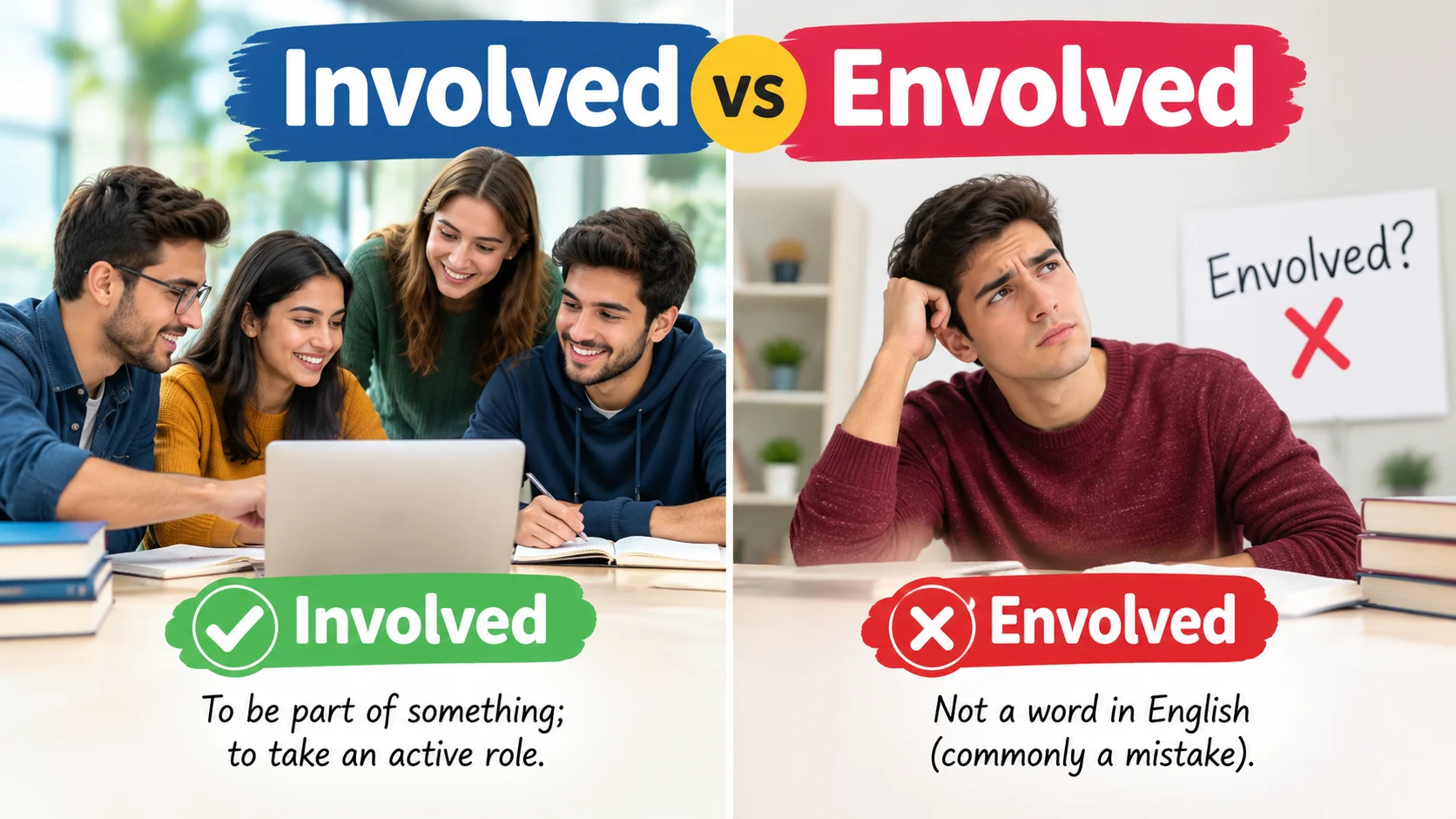
When writing or speaking English, small spelling differences can create big confusion. “Involved” and “envolved” look similar, and because both seem like they could be related to the verb involve, it is easy to wonder which one is correct. If you have ever written “envolved” in a message, essay, email, or professional document, you are not alone.
The good news is that the answer is straightforward: involved is the correct standard English spelling. It is the past tense and past participle of involve, and it can describe participation, connection, complexity, or personal engagement. Envolved is generally considered a misspelling and should not be used in standard English. In this guide, we will explain the difference between involved and envolved, show you how to use involved correctly, and provide practical examples so you can avoid this common spelling mistake.
Quick Answer
Involved is the correct spelling. It is the past tense and past participle of involve, meaning participating in something, being connected to it, or making something complicated. Envolved is not the standard English spelling and should generally be treated as an error.
Why People Confuse It
The confusion between involved vs envolved usually comes from pronunciation and spelling patterns.
The word involved is pronounced roughly like “in-VOLVD.” When people hear it quickly, the first syllable may sound less distinct, which can lead to the incorrect spelling envolved.
Another reason is that English has many words beginning with en-, such as:
- encouraged
- engaged
- enlarged
- enriched
- enclosed
Because of this pattern, envolved can look believable even though it is incorrect.
The important point is simple: the verb is involve, not envolve.
First Word: Involved
Involved is the correct English word.
It is the past tense and past participle of involve.
Meanings of Involved
Depending on the context, involved can mean:
- Participating in something
- She was involved in the school project.
- Connected with something
- Several companies were involved in the agreement.
- Having a personal interest or emotional connection
- He became deeply involved in the community.
- Complicated or difficult
- The investigation was more involved than expected.
- Requiring many steps or details
- The process is quite involved.
Examples
- I was involved in organizing the event.
- She is involved with several community projects.
- They were involved in the discussion.
- He became involved in the business.
- The repair was more involved than we expected.
Second Word: Envolved
Envolved is generally not a standard English word.
If you want to express participation, connection, engagement, or complexity, use involved.
Incorrect
She was envolved in the project.
Correct
She was involved in the project.
Why Is “Envolved” Wrong?
The standard English verb is involve:
involve → involved
There is no standard verb envolve that produces envolved in ordinary modern English.
So, if your intended meaning is “participated in” or “connected with,” involved is the correct choice.
Comparison Table
| Word | Correct? | Meaning | Example |
| Involved | ✅ Yes | Participating or connected | She was involved in the project. |
| Envolved | ❌ No | Usually a misspelling of involved | She was envolved in the project. |
The safest rule is: Use involved, not envolved.
When to Use Each
Use “Involved”
Use involved when you mean:
- participating in an activity
- connected to an event or situation
- emotionally engaged
- associated with a person or organization
- complicated or detailed
For example:
Many students were involved in the competition.
Or:
The legal case became very involved.
Use “Envolved”
In standard English writing, you should not use envolved when you mean involved.
If your spell checker highlights envolved, replace it with involved.
Examples of Involved
Here are more examples showing how involved works in everyday English.
- She was involved in the charity event.
- I became involved in the project last month.
- Several employees were involved in the decision.
- He is actively involved in local community work.
- Were you involved in organizing the meeting?
- The police interviewed everyone involved in the incident.
- Parents should be involved in their children’s education.
- The process is more involved than it first appeared.
- She became emotionally involved with the organization.
- Many different departments were involved in the project.
- He was directly involved in the negotiations.
- The repair requires an involved technical procedure.
Notice that the same word can describe both participation and complexity, depending on context.
Common Mistakes
1. Writing “Envolved”
❌ He was envolved in the project.
✅ He was involved in the project.
This is the most common mistake involving these two spellings.
2. Assuming “Envolve” Is the Base Verb
The correct base verb is:
involve
Not:
envolve
Therefore:
involve → involved
3. Confusing “Involved” With “Evolved”
Another possible source of confusion is evolved.
These are completely different words:
- involved = participated or was connected
- evolved = developed or changed gradually
For example:
She was involved in the project.
But:
The technology has evolved rapidly.
4. Using “Involved” Without “In”
When talking about participation, English commonly uses involved in.
✅ He is involved in the project.
Not:
❌ He is involved on the project.
Depending on the intended meaning, other prepositions can sometimes occur, but involved in is the standard construction for participation.
Memory Trick
Here is an easy way to remember the spelling:
IN + VOLVE = INVOLVE
Then add -D:
INVOLVE → INVOLVED
Think:
I am IN the project → I am INVOLVED in the project.
If you are tempted to write envolved, remember that the original verb is involve.
Involve → Involved ✅
Envolve → Envolved ❌
American vs British English
There is no meaningful American vs British spelling difference between these words.
Both American English and British English use:
involved
For example:
American English:
She was involved in the project.
British English:
She was involved in the project.
The spelling envolved is not an accepted alternative spelling simply because of regional English differences.
Similar Words
Several English words can be confused with involved, but they have different meanings.
Involved vs Evolved
Involved = participated or was connected.
She was involved in the campaign.
Evolved = developed or changed over time.
The plan evolved over several months.
Involved vs Engaged
Involved can mean participating or connected.
Engaged can mean participating, interested, occupied, or committed.
The students were involved in the activity.
The students were highly engaged during the lesson.
Involved vs Included
Included means something or someone was part of a group, set, or arrangement.
The price included breakfast.
Involved often emphasizes participation or connection.
She was involved in planning the event.
Involved vs Complicated
Involved can sometimes mean complicated or requiring considerable detail.
The procedure was extremely involved.
However, complicated is usually the more direct word when you simply mean difficult or complex.
FAQs About Involved vs Envolved
Is “envolved” a correct English word?
No. Envolved is generally a misspelling when someone intends to write involved. The standard word is involved.
Is it “involved” or “envolved”?
The correct spelling is involved.
Correct: She was involved in the project.
What is the past tense of involve?
The past tense of involve is involved.
Present: They involve the community.
Past: They involved the community.
What does involved mean?
Involved can mean participating in something, connected with something, emotionally engaged, or complicated, depending on the context.
Why do people spell involved as envolved?
The mistake may happen because of pronunciation or because English has many words beginning with en-. However, the correct base verb is involve.
Is involved used in American English?
Yes. Involved is standard in both American and British English.
What is the difference between involved and evolved?
Involved means participating or being connected, while evolved means developing or changing gradually.
Final Verdict
When choosing between involved vs envolved, there is no real contest: involved is the correct standard English spelling.
Remember that the base verb is involve, so its past tense and past participle are involved. Envolved should generally be treated as a spelling error.
Conclusion
The difference between involved and envolved is primarily a matter of correct spelling. Involved is the standard English word and can describe participation, connection, emotional engagement, or something that is complicated and detailed. You will see it frequently in everyday conversations, academic writing, business communication, and professional English.
If you are unsure which spelling to choose, go back to the base verb: involve. Once you remember involve → involved, the correct spelling becomes much easier to recognize. Avoid envolved in formal and informal English, and use involved instead.
Remember This
Involve → Involved ✅
Envolve → Envolved ❌
Correct sentence: She was involved in the project.

I’m Aria White, a passionate word enthusiast who enjoys exploring grammar, vocabulary, and meaningful word connections. I create simple, helpful content that makes matching words easier, clearer, and enjoyable.