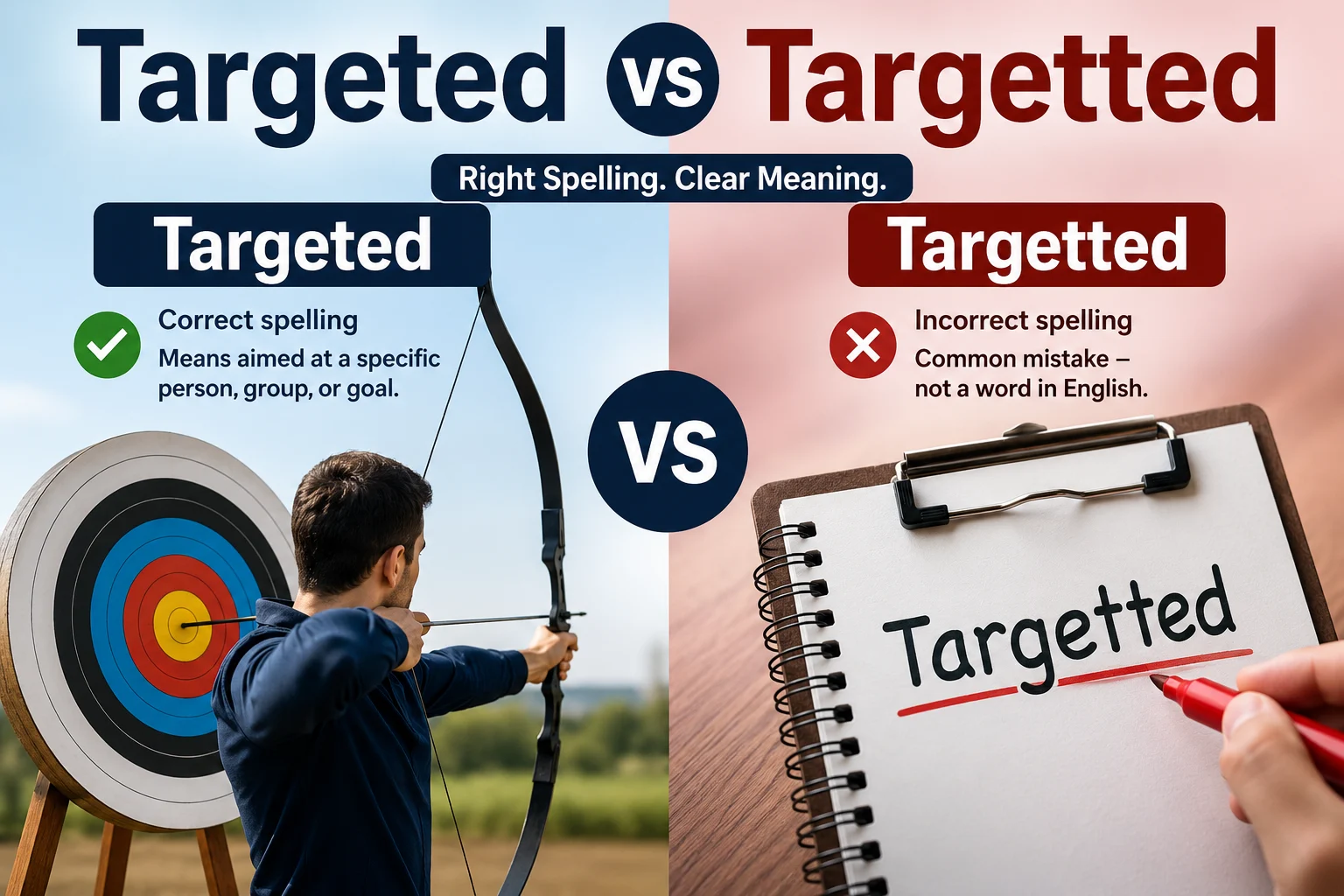
If you have ever wondered whether the correct spelling is targeted or targetted, you are not alone. The confusion usually comes from the spelling patterns of words such as travelled, labelled, and cancelled, especially in British English. However, when it comes to target, the standard spelling is much simpler: targeted.
Targeted is the correct and widely accepted spelling in both American and British English. It is the past tense and past participle of the verb target, meaning to direct something toward a particular person, group, place, or goal. Targetted, with two ts in the middle, is generally considered a misspelling. Understanding this small spelling difference can help you write more accurately in emails, academic work, business content, marketing copy, and everyday English. In this guide, we will explain why the confusion happens, when to use targeted, and how to remember the correct spelling.
Quick Answer
Targeted is the correct spelling. Targetted is generally incorrect and should be avoided in standard English. Use targeted in American and British English when describing something directed toward a specific person, group, audience, goal, or location.
Why People Confuse It
The confusion comes mainly from the way English handles verbs ending in a consonant before -ed.
Some words double their final consonant when forming the past tense:
- stop → stopped
- plan → planned
- refer → referred
- prefer → preferred
Because target ends in t, it may seem logical to write targetted. But English spelling rules do not simply say, “Double the final consonant.”
The pronunciation and stress pattern matter too. In target, the stress falls on the first syllable: TAR-get. Therefore, the final t is not doubled when -ed is added.
The correct form is:
target → targeted
Not:
target → targetted
The First Word: Targeted
Targeted is the standard and correct spelling.
It is the past tense and past participle of target.
What does targeted mean?
Targeted means directed at a particular person, group, object, place, or objective.
For example:
The company launched a targeted advertising campaign.
Here, targeted tells us that the advertising campaign was designed for a specific audience.
Other examples include:
- targeted marketing
- targeted advertising
- targeted treatment
- targeted research
- targeted campaign
- targeted audience
- targeted approach
- targeted assistance
Examples of targeted in a sentence
- The advertisement was targeted at young adults.
- The campaign targeted first-time customers.
- The police investigation targeted several suspects.
- The company developed a targeted marketing strategy.
- The program provides targeted support to small businesses.
The Second Word: Targetted
Targetted is generally considered an incorrect spelling in standard modern English.
Although you may occasionally encounter it online, in user-generated content, or in poorly edited material, it is not the standard spelling you should use.
The correct spelling is:
targeted ✅
The incorrect/nonstandard spelling is:
targetted ❌
If you are writing an article, essay, report, email, advertisement, resume, or academic assignment, choose targeted.
Targeted vs Targetted: Comparison Table
| Word | Correct? | Meaning | Example |
| Targeted | ✅ Yes | Directed toward a particular person, group, or goal | The company used targeted advertising. |
| Targetted | ❌ Generally incorrect | Intended as the past form of target | Avoid this spelling in standard English. |
When to Use Each
Use “targeted”
Use targeted whenever you need the past tense or past participle of target.
For example:
The campaign targeted local customers.
Or:
We created a targeted campaign for local customers.
It can describe actions, strategies, services, advertisements, research, communication, and many other things.
Do not use “targetted”
Avoid targetted in standard English writing.
If your spell-checker marks targetted as incorrect, it is usually right. Replace it with targeted.
Examples: Targeted in Sentences
Here are more than ten examples showing how targeted works in different contexts:
- The company created a targeted advertising campaign.
- The email was targeted at existing customers.
- The researchers developed a targeted approach to the problem.
- The government introduced targeted financial assistance.
- The marketing team targeted younger consumers.
- The advertisement was specifically targeted toward parents.
- The organization provided targeted support to new employees.
- The campaign targeted people living in urban areas.
- We need a more targeted strategy to reach our ideal audience.
- The researchers targeted specific groups for the survey.
- The website uses targeted content to improve engagement.
- The company sent targeted emails to potential customers.
- The training program offers targeted instruction for beginners.
- The new policy provides targeted assistance to small businesses.
- The campaign was carefully targeted toward its intended audience.
Notice that targeted can function as both a past-tense verb form and an adjective.
Common Mistakes
Mistake 1: Adding an extra “t”
❌ The advertisement was targetted at teenagers.
✅ The advertisement was targeted at teenagers.
Mistake 2: Assuming every final “t” is doubled
English spelling is not based on a simple rule that doubles every final consonant.
Compare:
- stop → stopped
- plan → planned
- target → targeted
- visit → visited
The spelling depends on the structure and stress pattern of the original word.
Mistake 3: Confusing targeted with target
These forms have different grammatical functions:
- target = present/base form
- targeted = past tense/past participle
- targeting = present participle/gerund
For example:
We target new customers.
We targeted new customers last month.
We are targeting new customers this year.
Memory Trick
Here is a simple way to remember the spelling:
TARGET + ED = TARGETED
Think of the word as:
TARGET + ED
Do not insert another T.
A useful memory sentence is:
“Target gets one T before -ed.”
So when you see targetted, pause and remember:
target → targeted
One t is enough.
American vs British English
Unlike some spelling differences between American and British English, targeted is the standard spelling in both varieties.
American English uses:
targeted ✅
British English uses:
targeted ✅
You may be familiar with British spellings such as:
- travelled
- cancelled
- labelled
These examples can make targetted look reasonable, but the spelling of targeted does not follow the same pattern.
Therefore, you should not change targeted to targetted simply because you are writing British English.
Similar Words
Several English words can cause similar spelling confusion.
Target
Target is the base verb or noun.
The company identified its target audience.
Targeted
Targeted is the past tense and past participle.
The company targeted young professionals.
Targeting
Targeting is the present participle or gerund.
The company is targeting young professionals.
Targetable
Targetable means capable of being targeted.
The audience is highly targetable through social media.
Untargeted
Untargeted means not specifically directed toward a particular target.
The campaign used untargeted advertising.
FAQs
Is “targetted” a correct spelling?
No. Targetted is generally considered a misspelling in standard English. The correct spelling is targeted.
Is “targeted” correct in British English?
Yes. Targeted is the standard spelling in British English as well as American English.
Why isn’t the “t” doubled in targeted?
The final t in target is not doubled when -ed is added because target does not meet the spelling conditions that require final-consonant doubling.
What is the past tense of target?
The past tense of target is targeted.
The company targeted new customers.
Is “targeted” an adjective?
Yes. Targeted can function as an adjective.
We need a targeted marketing strategy.
What is the difference between target and targeted?
Target is the base form, while targeted is the past tense, past participle, or adjective.
They target students.
They targeted students.
They created a targeted campaign.
Should I use “targetted” in formal writing?
No. Use targeted in formal, professional, academic, and business writing.
Final Verdict
The answer is straightforward: targeted is the correct spelling, while targetted should generally be avoided.
Whether you are writing American or British English, the standard form remains targeted. The word can describe something directed toward a particular audience, objective, group, or location, making it especially common in marketing, business, education, research, and everyday communication.
Remember This
Targeted = correct ✅
Targetted = incorrect/nonstandard ❌
The easiest rule to remember is:
TARGET + ED = TARGETED
Do not double the final t. When in doubt, choose targeted.
Conclusion
Choosing between targeted and targetted is easier once you understand that English does not double a final consonant automatically. Although words such as planned and stopped contain doubled consonants, target follows a different spelling pattern. Therefore, targeted is the standard form.
For essays, websites, business communication, marketing materials, academic writing, and everyday English, stick with targeted. It is clear, correct, and accepted in both American and British English. If you remember “target + ed = targeted,” you will be unlikely to make this spelling mistake again.

I’m Elliot Pierce, Administrator at Grammetics, dedicated to improving word matching and grammar. I help maintain useful content, support readers, and make language learning simple, clear, accurate, and engaging.