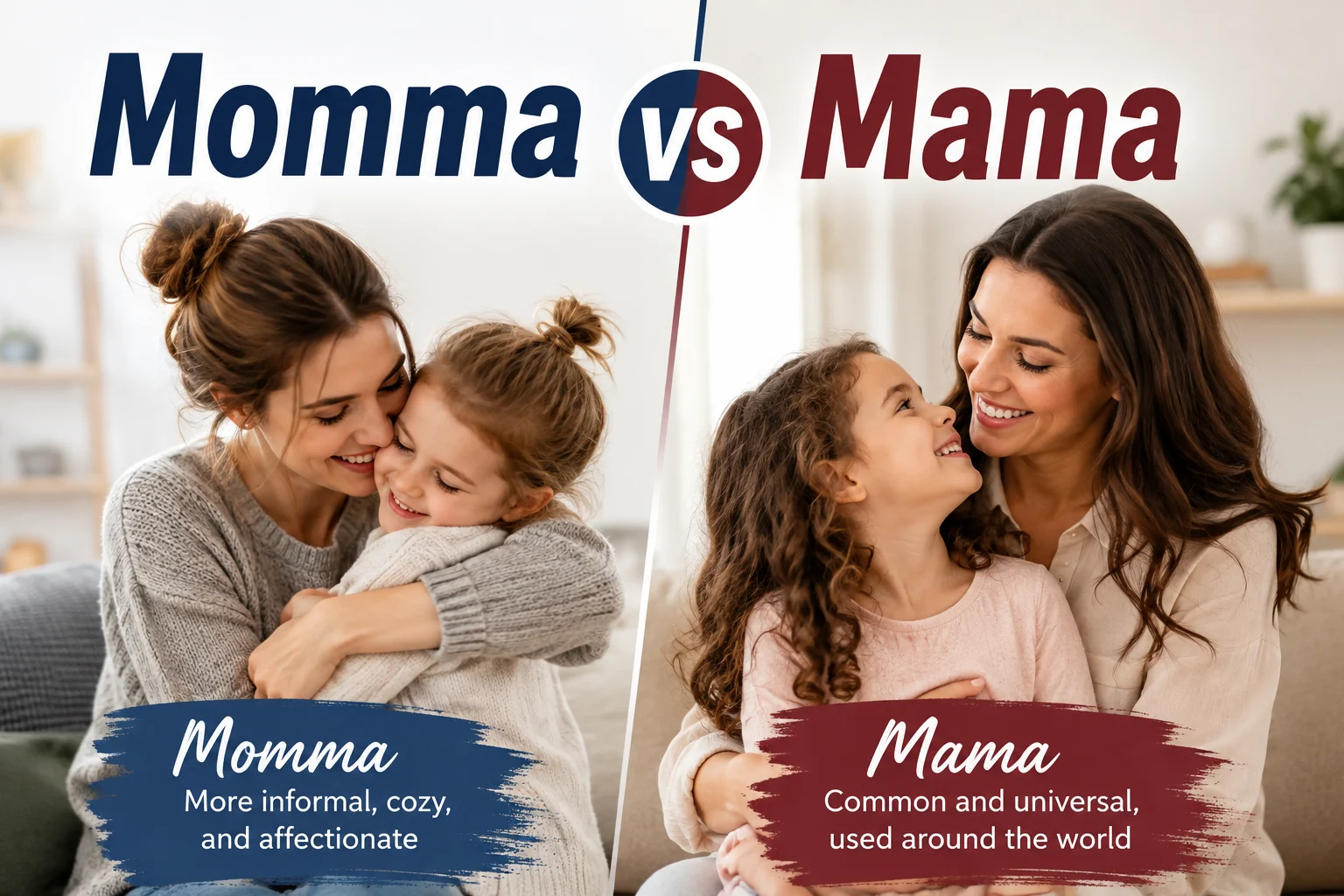
When people talk about their mothers, they often use affectionate words such as momma and mama. At first glance, these words may seem interchangeable, and in many situations, they are. Both are informal terms for mother, but they can carry slightly different feelings, pronunciations, spellings, and cultural associations. Understanding these differences can help you choose the word that best fits your sentence, audience, or writing style.
The confusion usually comes from the fact that neither word is the standard formal term for a mother. Instead, both belong to informal or familiar English. Mama is especially common across many regions and languages, while momma is strongly associated with American English and can sound more folksy, affectionate, or childlike. Neither spelling is automatically “wrong.” The best choice depends on context, dialect, personal preference, and the tone you want to create.
Quick Answer
Mama and momma both mean “mother” and are informal, affectionate terms. Mama is more widely used internationally, while momma is particularly associated with American English and can sound more folksy or endearing. Choose the spelling that matches your dialect, audience, and intended tone.
Why People Confuse It
People confuse momma vs mama because both words refer to the same person: a mother.
They can also be pronounced similarly, although pronunciation varies by region and speaker. In casual conversation, listeners may not even notice which spelling is being used.
Another reason is that terms for parents often develop naturally from childhood speech. Sounds such as ma, mama, mom, and momma are easy for young children to produce, which explains why similar forms appear in many languages.
The main differences involve:
- Spelling
- Regional preference
- Pronunciation
- Emotional tone
- Cultural associations
- Personal or family preference
So, if you’re wondering whether momma or mama is correct, the answer is: both can be correct in the right context.
First Word: Momma
Momma is an informal word meaning mother.
It is particularly associated with American English, especially in informal, affectionate, Southern, rural, or folksy speech and writing.
For example:
“My momma always told me to be honest.”
Here, momma gives the sentence a warm, personal, conversational quality.
What does “momma” mean?
Momma = mother, usually with an affectionate or familiar tone.
It can be used by children, adults, or writers who intentionally want to create a particular voice.
Examples of “momma”
- “My momma makes the best biscuits.”
- “I called my momma after work.”
- “Momma, can you help me?”
- “Her momma taught her how to cook.”
- “That little boy ran straight to his momma.”
The spelling momma can sometimes feel more expressive than the simpler mom.
Second Word: Mama
Mama is also an informal and affectionate word for mother.
Unlike momma, mama is not limited to one English-speaking region. It appears in many cultures and languages and is widely recognized internationally.
For example:
“Mama, I’m home!”
The word can sound affectionate, intimate, traditional, or childlike depending on the context.
What does “mama” mean?
Mama = mother, especially as a familiar or affectionate form of address.
It can be used when speaking directly to one’s mother:
“Mama, look what I made!”
It can also appear in storytelling:
“Her mama was waiting at the door.”
Examples of “mama”
- “My mama taught me to read.”
- “I miss my mama.”
- “Mama always knows when something is wrong.”
- “The child reached for her mama.”
- “Her mama gave her some good advice.”
Momma vs Mama: Comparison Table
| Feature | Momma | Mama |
| Meaning | Mother | Mother |
| Formality | Informal | Informal |
| Tone | Affectionate, folksy, familiar | Affectionate, familiar, traditional |
| Common association | American English | Widely used internationally |
| Standard formal word? | No | No |
| Used for direct address? | Yes | Yes |
| Used by children? | Yes | Yes |
| Used by adults? | Yes | Yes |
| Spelling variants | Momma | Mama |
| Best formal alternative | Mother | Mother |
When to Use Each
There is no universal rule saying you must always use mama instead of momma or vice versa.
Use “momma” when:
- You want an affectionate American-English feel.
- You’re writing dialogue with a folksy or Southern voice.
- A character naturally uses momma.
- You’re referring to your mother in an informal way.
- The spelling matches your family’s preference.
Example:
“My momma raised me to work hard.”
Use “mama” when:
- You want a widely recognized term for mother.
- You’re writing for an international audience.
- You prefer the simpler spelling.
- You’re describing affectionate family relationships.
- The word fits the cultural or personal context.
Example:
“Her mama was waiting outside.”
What about formal writing?
For academic, professional, or official writing, mother is usually the better choice.
Instead of:
“My momma influenced my career.”
A formal essay might say:
“My mother influenced my career.”
Likewise:
“My mama is a teacher.”
can become:
“My mother is a teacher.”
The informal forms aren’t necessarily incorrect; they’re simply less formal.
Examples of Momma vs Mama
Here are examples showing how both words work naturally in sentences.
- My momma always encouraged me to follow my dreams.
- My mama taught me how to make this recipe.
- The little girl called for her momma.
- His mama was proud of his achievement.
- “Momma, can I go outside?” the child asked.
- “Mama, I need your help,” she said.
- She learned that recipe from her momma.
- Her mama gave her some excellent advice.
- He said his momma had always supported him.
- The boy ran toward his mama.
- My momma used to tell me that patience matters.
- Everyone in the family loves their mama.
Notice that replacing momma with mama in many of these sentences doesn’t change the basic meaning. The difference is primarily one of style, voice, dialect, and personal preference.
Common Mistakes
1. Thinking one spelling is always wrong
A common misconception is that either momma or mama is an incorrect spelling.
Both are established informal terms for a mother.
2. Using them in formal writing unnecessarily
Although both words are legitimate, they may sound too casual in an academic essay, business document, or formal report.
Use mother when a formal tone is required.
3. Assuming “momma” and “mama” have completely different meanings
They generally don’t.
Both words refer to a mother. Their differences are mostly related to regional usage, personal preference, and tone.
4. Ignoring the writer’s intended voice
If you’re writing dialogue, spelling matters because it can help communicate a character’s personality or regional speech.
Changing momma to mother may make a character sound much more formal than intended.
5. Assuming pronunciation is identical everywhere
English pronunciation varies considerably by region. Don’t assume every speaker pronounces these terms exactly the same way.
Memory Trick
Here’s an easy way to remember the difference:
Mama = the broader, widely recognized form.
Momma = an American-style spelling that emphasizes the “mom” sound.
Think:
MOM + MA = MOMMA
If you want a simple, internationally familiar word, mama is usually the safer choice.
If you want an affectionate American or folksy feel, momma may fit better.
American vs British English
The distinction becomes more interesting when comparing American and British English.
In American English, mom is the most common everyday term for one’s mother. Momma can appear in affectionate, informal, regional, or folksy contexts.
In British English, mum is generally the standard informal term. Mummy is also common in certain family contexts, particularly when referring to a mother from a child’s perspective.
However, mama is also understood by British English speakers, particularly because it occurs across cultures and in literature.
So, a rough comparison is:
- American English: mom, momma, mama
- British English: mum, mummy, mama
- Formal English: mother
These aren’t rigid rules. Family vocabulary varies from person to person.
Similar Words
English has many informal terms for mother.
Mom
The most common everyday American English term.
“My mom is coming home soon.”
Mum
The common British English equivalent of mom.
“My mum lives in London.”
Mommy
An affectionate or child-oriented American English term.
“Mommy, can you read me a story?”
Mummy
Commonly used by children in British English.
“Mummy, where are my shoes?”
Mother
The standard neutral and formal term.
“My mother works at a university.”
Ma
A short, informal form that can sound old-fashioned, regional, or affectionate.
“Ma, dinner is ready!”
FAQs About Momma vs Mama
Is “momma” a correct word?
Yes. Momma is an established informal term for mother, particularly common in American English. It can sound affectionate, familiar, folksy, or childlike depending on the speaker and context.
Is “mama” or “momma” more common?
Mama is widely used across different cultures and languages, while momma has a stronger association with American English. Exact frequency depends on the region, context, and type of writing.
Are “mama” and “momma” pronounced the same?
They can be pronounced similarly, but pronunciation varies among speakers and dialects. Spelling does not guarantee exactly the same pronunciation.
Is “momma” American English?
It is strongly associated with American English, especially informal and regional speech. However, it isn’t exclusively American.
Should I use “mama” or “momma” in an essay?
For a formal academic essay, mother is usually the best choice. Use mama or momma if you’re discussing a quotation, writing dialogue, or intentionally using an informal voice.
Is “mama” a formal word?
No. Mama is generally an informal or affectionate term for mother. Mother is the more formal and neutral choice.
Which is better: “I love my mama” or “I love my momma”?
Both are grammatically acceptable. “I love my mama” is more broadly familiar, while “I love my momma” may sound more distinctly American, affectionate, or folksy.
Final Verdict
Momma and mama both mean “mother,” and neither is inherently wrong. The main difference is not meaning but usage and tone. Mama is broadly recognized and used in many cultures, while momma is particularly associated with American English and may carry a warmer, more folksy or regional feeling.
If you’re writing formally, choose mother. For casual conversation, personal writing, family dialogue, or affectionate language, either mama or momma can work. Ultimately, the best spelling is the one that fits your audience, dialect, and intended voice.
Remember This
Mama = widely recognized informal term for mother.
Momma = affectionate American-style variant of the same basic word.
Mother = formal and neutral choice.
When in doubt, remember: the meaning is essentially the same; the difference is mostly in style, culture, and personal preference.
Conclusion
The difference between momma vs mama is subtle but useful to understand. Both words express affection for or refer to one’s mother, and both are perfectly understandable in everyday English. Mama has broad international and cultural usage, whereas momma often creates a distinctly American, informal, or folksy impression.
There is no need to worry about choosing the “correct” word in casual writing. Think about the voice you want to create. If you’re writing a formal document, use mother; if you’re writing naturally and affectionately, choose mama or momma according to your preferred dialect and style.

I’m Aria White, a passionate word enthusiast who enjoys exploring grammar, vocabulary, and meaningful word connections. I create simple, helpful content that makes matching words easier, clearer, and enjoyable.