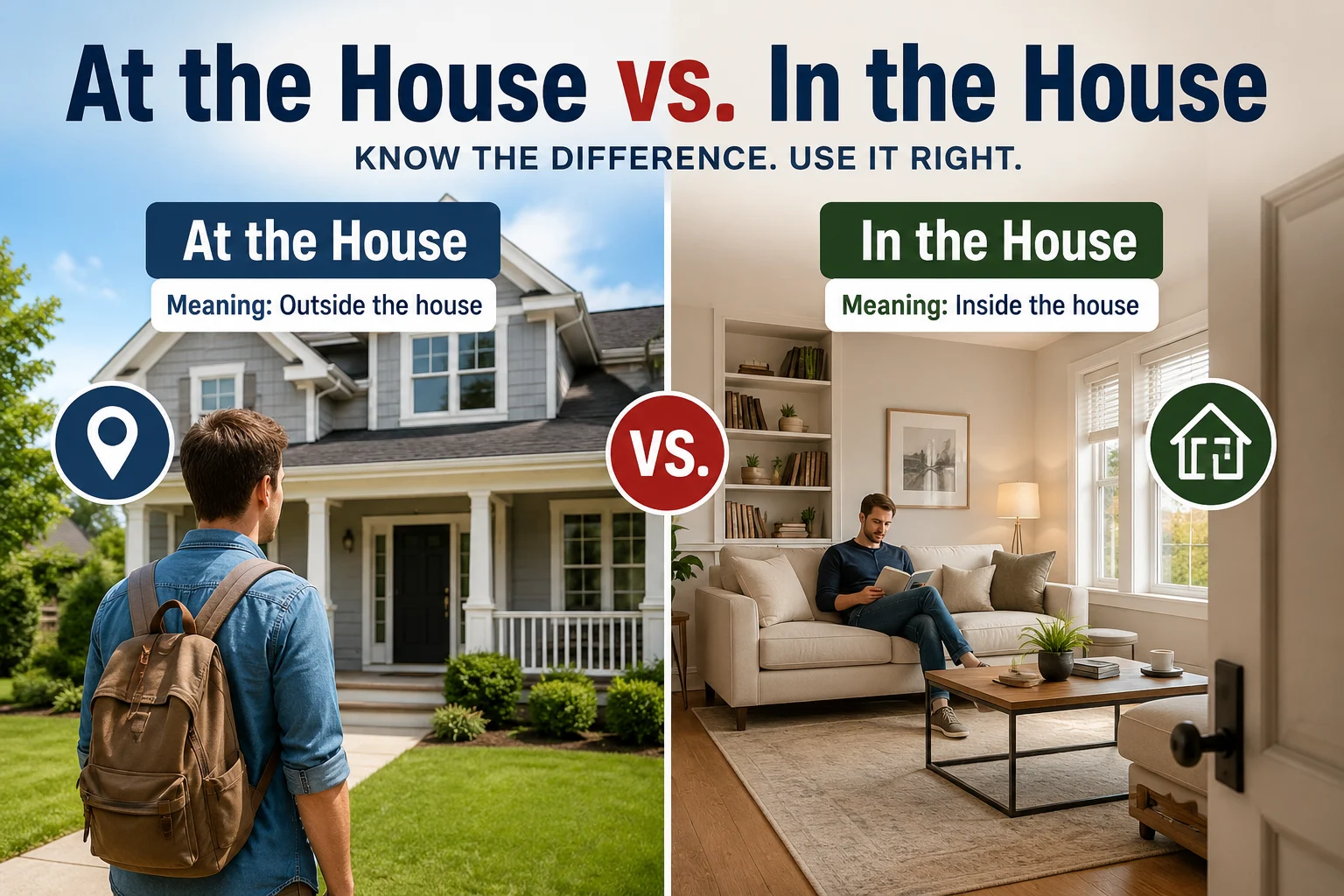
When should you say “at the house” and when is “in the house” the better choice? These two phrases are closely related, so it is easy to use one when you really mean the other. The difference, however, is simple once you focus on whether you mean the location generally or the inside of the building.
“At the house” usually refers to being at a house or its general location. “In the house” specifically means being inside the house. Native English speakers use both expressions naturally, but the context determines which preposition sounds right. This distinction is useful in everyday conversations, texts, emails, and writing because a small change in preposition can slightly change the meaning. In this guide, we’ll explain at the house vs. in the house, provide clear examples, compare their uses, and show you an easy memory trick.
Quick Answer
“At the house” means being at the house or its location, without emphasizing being inside. “In the house” means physically inside the building. For example, “I’m at the house” gives a general location, while “I’m in the house” clearly says you are indoors.
Why People Confuse It
The confusion comes from the fact that both phrases can describe someone’s location.
For example:
- I’m at the house.
- I’m in the house.
Both can be correct, but they do not emphasize exactly the same thing.
The preposition at often identifies a general point or location. Meanwhile, in indicates that someone or something is contained within an enclosed space.
Think of it this way:
At = location
In = inside
This simple distinction will help you choose the right phrase in most situations.
First Word: “At the House”
“At the house” means someone is located at a particular house or property.
The phrase does not necessarily tell us that the person is inside the house. They could be in the yard, driveway, garage, porch, or somewhere else on or around the property.
Examples
- I’m at the house right now.
- She’s waiting for you at the house.
- We’ll meet at the house at six.
- He left his phone at the house.
- There are several people at the house.
For example, if someone asks:
“Where is Sarah?”
You might answer:
“She’s at the house.”
This gives the general location without specifying whether Sarah is inside.
When “at the house” sounds natural
Use it when the house is being treated as a destination or location.
For example:
“I’ll see you at the house.”
The speaker is identifying the house as the meeting point. They are not necessarily saying everyone must be physically inside.
Second Word: “In the House”
“In the house” means physically inside the house.
It is more specific than “at the house.”
For example:
“John is in the house.”
This tells us that John is indoors rather than outside in the yard, driveway, or street.
Examples
- My keys are in the house.
- The children are playing in the house.
- Nobody is in the house.
- There’s someone in the house.
- She left her bag in the house.
Here, in creates the idea of being within the physical boundaries of the building.
At the House vs. In the House: Comparison Table
| Phrase | Basic Meaning | Focus | Example |
| At the house | At the house or property | General location | I’m at the house. |
| In the house | Inside the house | Interior location | I’m in the house. |
| At the house | A meeting point or destination | Location | Meet me at the house. |
| In the house | Within the building | Inside | The dog is in the house. |
| At the house | May include outside areas | General presence | They’re working at the house. |
| In the house | Clearly indoors | Physical position | They’re eating in the house. |
When to Use Each
Use “at the house” when:
- You mean the general location.
- The house is a meeting point.
- You are talking about being at a property.
- You do not need to specify whether someone is inside.
- The person could be outside, inside, or around the property.
Example:
“I’m at the house, but I’m working in the garden.”
This sentence demonstrates the difference perfectly. The person is at the house generally but is specifically outside in the garden.
Use “in the house” when:
- You specifically mean inside the building.
- You want to contrast indoors with outdoors.
- You are describing something physically located inside.
- The interior location matters.
Example:
“It’s cold outside, but it’s warm in the house.”
Here, in the house clearly refers to the interior.
Examples: At the House vs. In the House
Here are more than 10 examples to make the distinction clear:
- I’m at the house right now.
→ I’m at that location; my exact position is not specified. - I’m in the house right now.
→ I’m physically inside. - We’ll meet at the house.
→ The house is the meeting location. - We’re having dinner in the house.
→ Dinner is taking place indoors. - There are five workers at the house.
→ Five workers are present at the property. - There are five workers in the house.
→ The workers are specifically inside. - She’s waiting at the house.
→ She is at the house generally. - She’s waiting in the house.
→ She is waiting indoors. - I left my shoes at the house.
→ The house is the relevant location. - I left my shoes in the house.
→ The shoes are specifically inside the house. - The children are at the house.
→ They are at that property. - The children are in the house.
→ They are inside the building. - He’s working at the house today.
→ The house/property is his work location. - He’s working in the house today.
→ He is working inside the building. - I saw your car at the house.
→ The car was located at the property. - I saw your coat in the house.
→ The coat was inside.
Common Mistakes
Mistake 1: Assuming “at” always means outside
Not necessarily.
“I’m at the house” can mean you are inside the house. The phrase simply does not emphasize your exact indoor position.
Mistake 2: Using “in” when you mean a meeting location
If you’re arranging a meeting, at is often more natural:
“Meet me at the house.”
You could say “Meet me in the house,” but that specifically tells the person to come inside.
Mistake 3: Thinking the phrases are interchangeable
They can overlap in some contexts, but the emphasis differs.
Compare:
The police are at the house.
This tells us where they are.
The police are in the house.
This tells us they are inside.
The second sentence gives more specific information.
Mistake 4: Forgetting the context
Context determines which phrase is best. Always ask yourself whether you are talking about a general location or an interior space.
Memory Trick
Use this easy rule:
AT = a point on the map
IN = inside the walls
Imagine looking at a map. You can point to a house and say:
“They are at the house.”
Now imagine opening the front door and seeing them inside:
“They are in the house.”
So remember:
At the house = where?
In the house = inside where?
American vs. British English
The distinction between at and in works in both American and British English.
Both varieties commonly use:
- at the house
- in the house
There can be differences in how speakers describe homes, buildings, or locations in particular contexts, but the basic distinction remains the same.
For example, both American and British speakers can naturally say:
“I’m at the house.”
and:
“I’m in the house.”
The important factor is the intended meaning, not whether you are using American or British English.
Similar Words and Expressions
Understanding related expressions can make English prepositions much easier.
At home vs. in the house
At home describes someone’s general home location:
“I’m at home.”
In the house specifically means inside the house:
“I’m in the house.”
You can even combine the ideas:
“I’m at home, but I’m not in the house. I’m sitting in the backyard.”
At the house vs. inside the house
These are similar in meaning to the main distinction:
- At the house = general location
- Inside the house = clearly indoors
Outside the house
This specifically means outside the building:
“There is a car outside the house.”
Around the house
This usually refers to the area surrounding the house:
“We have several trees around the house.”
FAQs
Is “at the house” grammatically correct?
Yes. “At the house” is grammatically correct when you mean being at a particular house or property.
Is “in the house” grammatically correct?
Yes. “In the house” is correct when you mean physically inside the house.
What is the difference between “at the house” and “in the house”?
“At the house” gives a general location, while “in the house” specifically indicates that someone or something is inside the building.
Can “at the house” mean inside the house?
Yes. Someone who says “I’m at the house” could be inside. The phrase simply focuses on the general location rather than the interior.
Which is correct: “I am at the house” or “I am in the house”?
Both can be correct. Use “I am at the house” for a general location and “I am in the house” when you specifically mean indoors.
Should I say “meet me at the house” or “meet me in the house”?
Use “meet me at the house” when the house is the meeting location. Use “meet me in the house” when you specifically want the person to meet you inside.
Is “at the house” the same as “at home”?
Not always. “At home” means someone is at their home, while “at the house” generally identifies a particular house or property. The context determines the exact meaning.
Final Verdict
The difference between “at the house” and “in the house” is mainly about specificity.
- At the house → general location or property
- In the house → specifically inside the building
If you are simply saying where someone is, at often works well. If you need to make it clear that someone is indoors, choose in.
The best way to avoid confusion is to picture the situation. If you can imagine pointing to the house on a map, think at. If you can imagine someone standing behind the walls or inside the rooms, think in.
Remember This
At the house = at the location.
In the house = inside the building.
When in doubt, ask yourself: “Am I talking about the general location, or do I specifically mean inside?” That one question will help you choose the correct preposition.
Conclusion
“At the house” and “in the house” are both correct English expressions, but they communicate slightly different ideas. “At the house” is broader and focuses on the house as a location, destination, or property. “In the house” is narrower and tells the reader or listener that someone or something is inside the building.
Once you understand this difference, choosing between the two becomes much easier. Whether you’re writing a text message, speaking with a friend, or improving your English grammar, remember the simple rule: at describes the location; in emphasizes the inside.

I’m Elliot Pierce, Administrator at Grammetics, dedicated to improving word matching and grammar. I help maintain useful content, support readers, and make language learning simple, clear, accurate, and engaging.