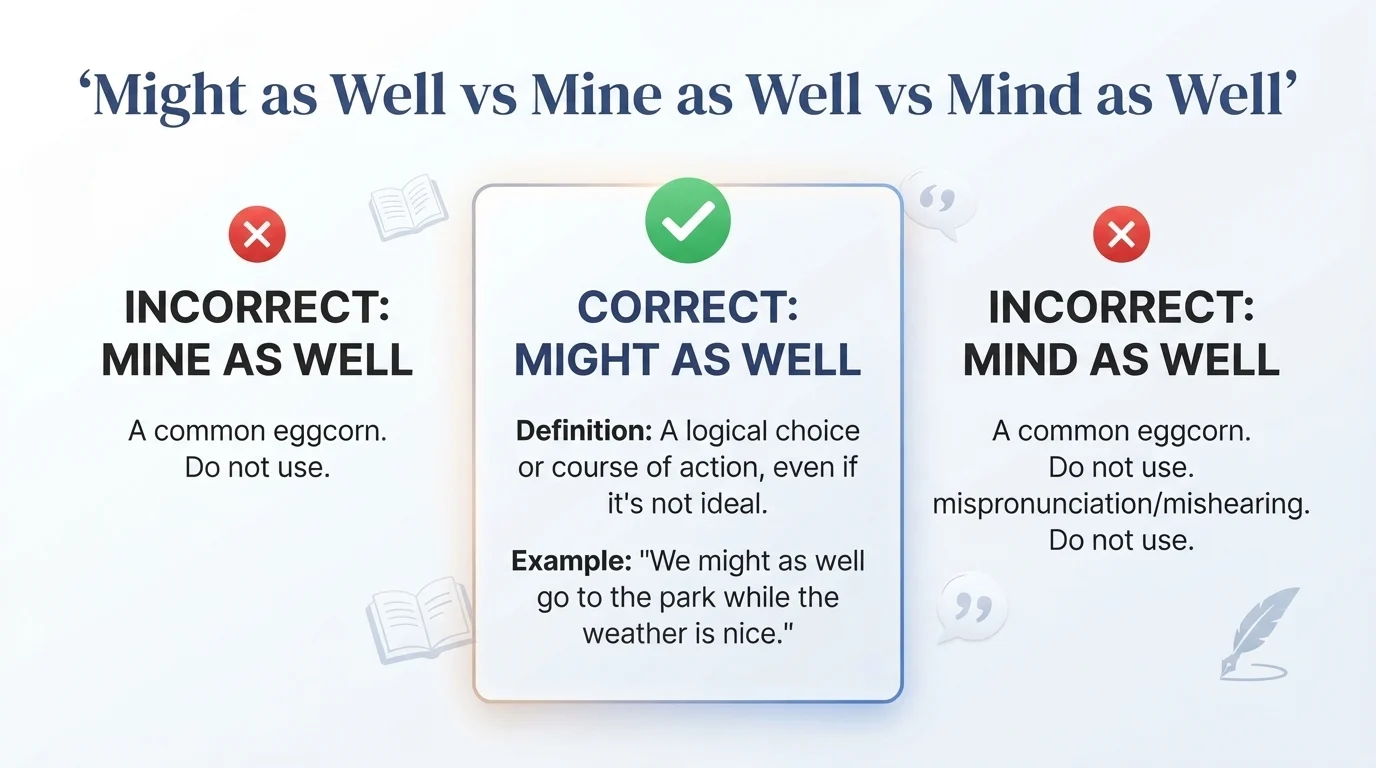
When writing or speaking English, you may come across phrases that sound almost identical but have completely different meanings. “Might as well,” “mine as well,” and “mind as well” are a good example. Because these expressions can sound similar in fast speech, learners sometimes confuse their spelling and usage.
The key point is simple: “might as well” is the standard English expression used to suggest doing something because there is no strong reason not to. For example, “We’re already here, so we might as well stay.” On the other hand, “mine as well” and “mind as well” are generally incorrect when someone intends to use this expression. Understanding the difference can help you avoid common spelling mistakes and make your English sound more natural.
Quick Answer
“Might as well” is the correct phrase. It means that doing something seems reasonable, especially when there is little reason to choose another option. “Mine as well” and “mind as well” are incorrect spellings when used with this meaning.
Why People Confuse It
The confusion mainly comes from pronunciation.
In natural conversation, “might as well” can sound like a single, flowing phrase. When people hear it rather than see it written, they may mistakenly write:
- ❌ mine as well
- ❌ mind as well
- ✅ might as well
The words might, mine, and mind have similar sounds, particularly for English learners.
Another reason is that mine and mind are both real English words. This can make the incorrect versions look believable.
For example:
“We might as well go home.”
Here, might as well is an established English expression. You cannot replace might with mine or mind.
First Word: Might
Might is a modal verb. It commonly expresses possibility or uncertainty.
Examples:
- It might rain tonight.
- She might come later.
- They might be busy.
- We might need more time.
However, when might is followed by as well, the phrase has a special meaning.
What Does “Might as Well” Mean?
Might as well means that an action is reasonable because there is little reason not to do it.
It can suggest:
- accepting a situation
- making a practical choice
- doing something because another option is unavailable
- deciding that an action is worthwhile
- suggesting an action casually
For example:
“The movie has already started, so we might as well watch it.”
The speaker is saying that, given the situation, watching the movie seems reasonable.
Second Word: Mine and Mind
What Does “Mine” Mean?
Mine is usually a possessive pronoun.
Examples:
- This book is mine.
- That phone is mine.
- The blue car is mine.
It can also appear as a noun or verb:
- The workers entered the mine.
- They mine coal from the area.
But mine as well is not the standard expression meaning “we may as well.”
What Does “Mind” Mean?
Mind can be a noun or a verb.
As a noun:
She has a brilliant mind.
As a verb:
Would you mind opening the window?
It can also appear in expressions such as:
- mind your manners
- never mind
- keep in mind
- bear in mind
However, mind as well is not the correct replacement for might as well.
Comparison Table
| Phrase | Correct? | Meaning | Example |
| might as well | ✅ Yes | It is reasonable to do something | We might as well leave now. |
| mine as well | ❌ No | Not the standard expression | ❌ We mine as well leave. |
| mind as well | ❌ No | Not the standard expression | ❌ We mind as well leave. |
When to Use Each
Use “Might as Well”
Use might as well + base verb when you want to say that an action is reasonable under the circumstances.
Structure:
Subject + might as well + base verb
Examples:
- I might as well call him.
- We might as well wait here.
- You might as well ask.
- They might as well stay.
Use “Mine”
Use mine when talking about possession or the other meanings of the word.
Examples:
- That jacket is mine.
- This seat is mine.
- The company operates a gold mine.
Use “Mind”
Use mind when referring to thoughts, attention, memory, or the verb meaning “to care about” or “to object.”
Examples:
- Do you mind if I sit here?
- Keep it in mind.
- She changed her mind.
Examples: 12 Sentences With “Might as Well”
- We have already driven this far, so we might as well continue.
- It is getting late, so I might as well go home.
- If nobody else wants the ticket, I might as well take it.
- You are already at the store, so you might as well buy some milk.
- Since the meeting has been canceled, we might as well leave.
- There is no bus for another hour, so we might as well walk.
- We have nothing else to do, so we might as well watch a movie.
- If you are going to ask, you might as well be honest.
- The weather is already bad, so we might as well stay inside.
- I am already awake, so I might as well finish my work.
- Since you are here, you might as well join us.
- We have waited this long, so we might as well give it another few minutes.
Examples of “Mine”
- This laptop is mine.
- The decision is mine.
- That room is mine.
- The workers discovered gold in the mine.
Examples of “Mind”
- Do you mind helping me?
- I changed my mind.
- Please mind the step.
- Keep that information in mind.
Common Mistakes
1. Writing “Mine as Well”
❌ We mine as well go.
✅ We might as well go.
Mine does not work in this expression.
2. Writing “Mind as Well”
❌ You mind as well come with us.
✅ You might as well come with us.
The phrase requires might, not mind.
3. Adding “to” After “Might as Well”
A common grammar mistake is:
❌ We might as well to leave.
The correct construction is:
✅ We might as well leave.
After might as well, use the base form of the verb.
4. Confusing It With “May as Well”
You may also hear:
“We may as well leave.”
May as well can be used similarly to might as well. However, might as well is extremely common in everyday English.
Memory Trick
Use this simple trick:
MIGHT = MAYBE IT MAKES SENSE
When you are considering an action because there is little reason not to do it, think:
“We might as well do it.”
Remember:
MIGHT + AS WELL + BASE VERB
For example:
We might as well go.
Not:
❌ We mine as well go.
❌ We mind as well go.
American vs British English
The expression might as well is standard in both American English and British English.
You can use it naturally in everyday conversations, writing, and informal situations in both varieties.
For example:
“It’s already raining, so we might as well stay home.”
There is no major American-versus-British spelling difference here. The important point is to use might, not mine or mind.
Similar Words and Expressions
Several expressions can communicate a related idea.
May as Well
May as well can mean essentially the same thing in many contexts.
We may as well start now.
Could Just
Could just can sometimes express a practical alternative.
We could just take the train.
Why Not
Why not can introduce a suggestion.
Why not try again?
Might Be Better to
This expression can introduce a more cautious recommendation.
It might be better to wait.
Although these expressions can overlap in meaning, might as well has its own common grammatical pattern.
FAQs
Is “might as well” grammatically correct?
Yes. Might as well is a standard English expression used to suggest that an action is reasonable or worthwhile under the circumstances.
Is “mine as well” correct?
No, not when you mean “might as well.” The correct phrase is might as well.
Is “mind as well” correct?
No. Mind as well is not the standard expression. Use might as well instead.
What does “might as well” mean?
It generally means that there is little reason not to do something, so doing it seems reasonable.
What verb comes after “might as well”?
Use the base form of the verb.
Correct:
We might as well leave.
Incorrect:
We might as well to leave.
Can I say “may as well” instead?
Yes. May as well is also a standard expression and can have a similar meaning to might as well.
Is “might as well” formal or informal?
It is common in everyday English and is generally natural in conversational and informal writing.
Final Verdict
When you want to express the idea that doing something is reasonable because there is little reason not to, the correct expression is “might as well.”
“Mine” and “mind” are both legitimate English words, but they do not belong in this expression. Remember the standard pattern:
might as well + base verb
So write:
✅ We might as well go.
Not:
❌ We mine as well go.
❌ We mind as well go.
Conclusion
The difference between might as well, mine as well, and mind as well is straightforward once you focus on the meaning of each word. Might as well is the correct expression for suggesting that an action is reasonable under the circumstances. Mine relates mainly to possession, while mind can refer to thoughts, attention, or caring about something.
Because these phrases can sound similar in rapid speech, spelling mistakes are understandable, especially for English learners. The easiest way to avoid the mistake is to memorize the complete expression rather than trying to spell it from pronunciation. Whenever you mean “there is little reason not to do this,” choose might as well.
Remember This
Might as well = the correct phrase
Mine as well = incorrect for this meaning
Mind as well = incorrect for this meaning
Formula: might as well + base verb

I’m Micah Wheeler, a passionate author who enjoys exploring matching words, grammar, and language. I create clear, helpful content to make word choices and grammar easier for everyone.