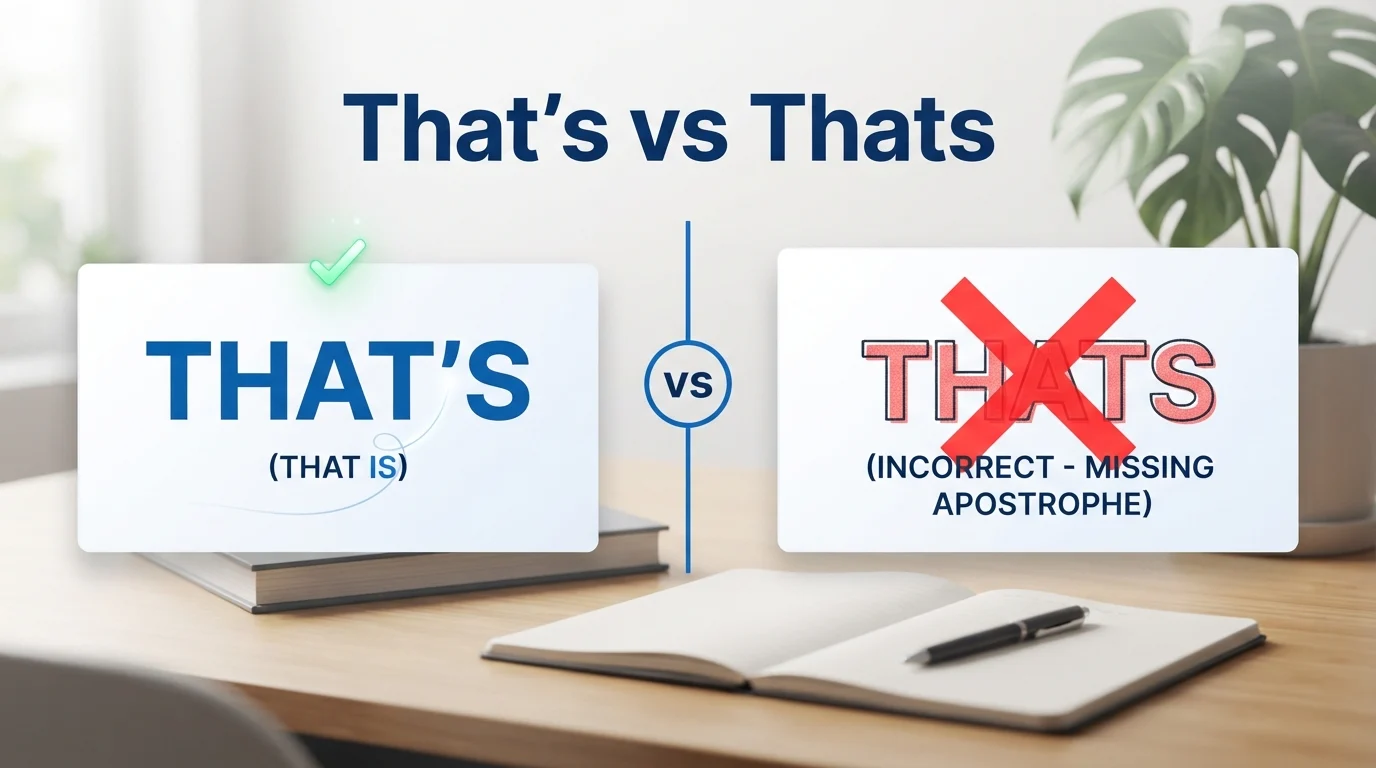
When writing quickly, it is easy to type “thats” instead of “that’s.” The two forms look almost identical, but they do not serve the same grammatical purpose. One is a standard English contraction, while the other is generally considered a spelling and punctuation error in modern standard English.
That’s is the correct form when you mean “that is” or “that has.” For example, “That’s my book” means “That is my book,” while “That’s been difficult” means “That has been difficult.” The apostrophe is important because it shows that letters have been omitted.
Understanding the difference between that’s and thats can help you write more accurately in emails, essays, social media posts, and professional communication. In this guide, we’ll explain the meaning, grammar, pronunciation, common mistakes, and practical examples so you can confidently choose the correct form every time.
Quick Answer
That’s is the correct standard spelling. It is a contraction of “that is” or “that has.” Thats without an apostrophe is generally incorrect in standard English. Use that’s in sentences such as “That’s beautiful” or “That’s happened before.”
Why People Confuse It
The confusion happens because that’s and thats sound exactly the same when spoken.
The apostrophe does not change the pronunciation. Instead, it tells the reader that that’s is a shortened form of another expression.
For example:
- That’s = that is
- That’s = that has
- Thats = generally an incorrect spelling in standard English
Because English speakers often type quickly, especially in text messages and social media, the apostrophe is frequently omitted.
However, in formal writing, academic work, business communication, and edited content, you should use that’s when a contraction is appropriate.
The First Word: That’s
That’s contains an apostrophe and is the standard contraction of either:
- That is
- That has
That’s = That Is
Examples:
- That’s a great idea.
→ That is a great idea. - That’s my favorite restaurant.
→ That is my favorite restaurant. - That’s exactly what I meant.
→ That is exactly what I meant.
That’s = That Has
Examples:
- That’s been a difficult experience.
→ That has been a difficult experience. - That’s happened to me before.
→ That has happened to me before. - That’s already changed.
→ That has already changed.
The meaning becomes clear from the context.
The Second Word: Thats
Thats without an apostrophe is generally not the correct spelling when you intend to write the contraction “that’s.”
For example:
❌ Thats a beautiful house.
✅ That’s a beautiful house.
The missing apostrophe is a punctuation error because that’s represents shortened words.
You may see thats in informal messages, comments, captions, or unedited online writing, but its frequent appearance does not make it standard English.
That’s vs Thats: Comparison Table
| Feature | That’s | Thats |
| Apostrophe | Yes | No |
| Standard English | Correct | Generally incorrect |
| Meaning | “That is” or “that has” | No standard contraction |
| Used in formal writing | Yes, when appropriate | No |
| Pronunciation | /ðæts/ | Usually pronounced the same |
| Example | That’s a good point. | ❌ Thats a good point. |
| Main issue | Correct punctuation | Missing apostrophe |
When to Use Each
Use “That’s” When You Mean “That Is”
This is the most common use.
That’s interesting.
Expand it:
That is interesting.
Another example:
That’s the answer.
→ That is the answer.
If replacing that’s with that is makes sense, you can normally use that’s.
Use “That’s” When You Mean “That Has”
You can also use that’s when it means that has.
For example:
That’s been a long day.
→ That has been a long day.
Here, “that’s” is followed by been, so it represents that has.
Don’t Use “Thats” as a Standard Contraction
If you mean “that is” or “that has,” write that’s, not thats.
Examples of That’s vs Thats
Here are practical examples to make the difference easy to remember:
- That’s my new laptop.
❌ Thats my new laptop. - That’s exactly what I needed.
❌ Thats exactly what I needed. - That’s a beautiful painting.
❌ Thats a beautiful painting. - That’s not what I expected.
❌ Thats not what I expected. - That’s the problem we discussed.
❌ Thats the problem we discussed. - That’s been a difficult question.
❌ Thats been a difficult question. - That’s already happened once.
❌ Thats already happened once. - That’s why I called you.
❌ Thats why I called you. - That’s an excellent example.
❌ Thats an excellent example. - That’s probably the easiest solution.
❌ Thats probably the easiest solution. - That’s what makes this interesting.
❌ Thats what makes this interesting. - That’s enough for today.
❌ Thats enough for today.
Common Mistakes
1. Leaving Out the Apostrophe
❌ Thats a good question.
✅ That’s a good question.
The apostrophe is required in standard English.
2. Assuming Apostrophes Are Optional
In casual texting, people sometimes omit apostrophes. That does not mean the punctuation is grammatically unnecessary.
Compare:
- thats → informal/incorrect spelling
- that’s → standard spelling
3. Confusing “That’s” With “That”
Sometimes writers use that’s when they actually need that.
❌ The book that’s I bought was expensive.
✅ The book that I bought was expensive.
Here, that introduces a relative clause. There is no need for is or has, so that’s is incorrect.
4. Using “That’s” When “Its” Is Needed
Another common confusion involves possessive forms.
- That’s = that is / that has
- Its = belonging to it
Example:
That’s a dog. Its tail is wagging.
The first word means “that is,” while its shows possession.
Memory Trick
Use this simple test:
Can you replace “that’s” with “that is” or “that has”?
If yes, that’s is correct.
For example:
That’s a great movie.
Replace it:
That is a great movie.
It works, so that’s is correct.
But:
Thats a great movie.
There is no grammatical reason to remove the apostrophe.
Easy memory trick:
Apostrophe = missing letters.
“That’s” contains an apostrophe because it shortens that is or that has.
American vs British English
There is essentially no difference between American and British English regarding the spelling of “that’s.”
Both varieties use:
- that’s = that is
- that’s = that has
And both generally consider thats without an apostrophe incorrect in standard edited writing.
Differences between American and British English can affect vocabulary, spelling, and certain grammatical preferences, but the apostrophe in that’s is not one of those differences.
Similar Words
Understanding related contractions can make apostrophe rules easier.
That’s vs Its
- That’s = that is / that has
- Its = belonging to it
That’s a cat. Its ears are small.
It’s vs Its
- It’s = it is / it has
- Its = possessive form of it
It’s raining.
The dog wagged its tail.
Who’s vs Whose
- Who’s = who is / who has
- Whose = belonging to whom
Who’s coming tonight?
Whose phone is this?
They’re vs Their vs There
- They’re = they are
- Their = belonging to them
- There = a place or existence
These examples show why apostrophes matter: they can distinguish different grammatical functions.
FAQs
Is “thats” a correct word?
In standard English, thats without an apostrophe is generally considered incorrect when you mean “that’s.” The standard contraction is that’s.
What does “that’s” mean?
That’s is a contraction of “that is” or “that has.” The intended meaning depends on the sentence.
Is “that’s” formal English?
Yes. That’s is grammatically correct in standard English. However, in particularly formal or academic writing, some writers may prefer the full form “that is” instead of the contraction.
Is “thats” acceptable in texting?
You may see thats in casual texting, social media, or informal online communication. However, if you want to follow standard English punctuation, use that’s.
Why does “that’s” have an apostrophe?
The apostrophe shows that letters have been omitted from “that is” or “that has.”
Can “that’s” mean “that has”?
Yes. For example, “That’s been difficult” means “That has been difficult.”
How do I remember “that’s” vs “thats”?
Remember the expansion test: if “that is” or “that has” works in the sentence, use that’s with an apostrophe.
Final Verdict
The correct standard form is “that’s.” It is a contraction meaning “that is” or “that has.” The form “thats” without an apostrophe is generally a punctuation or spelling error when used as a contraction.
The easiest way to check your writing is to expand that’s. If the sentence still works with “that is” or “that has,” the apostrophe belongs there. This quick test works in everyday writing as well as professional and academic contexts.
Remember This
That’s = That is / That has
Thats = Generally incorrect in standard English
Example:
✅ That’s a wonderful idea.
❌ Thats a wonderful idea.
When in doubt, look for the missing “is” or “has” and keep the apostrophe.
Conclusion
The difference between that’s and thats is small visually but important grammatically. That’s is the standard contraction for “that is” or “that has,” while thats without an apostrophe is not normally correct standard English. Because both forms are pronounced the same, the apostrophe is easy to overlook when writing quickly.
Once you remember the simple “that is/that has” test, choosing the correct form becomes almost automatic. Whether you are writing an email, school assignment, blog post, social media caption, or everyday message, use that’s whenever you mean “that is” or “that has.”

I’m Aria White, a passionate word enthusiast who enjoys exploring grammar, vocabulary, and meaningful word connections. I create simple, helpful content that makes matching words easier, clearer, and enjoyable.