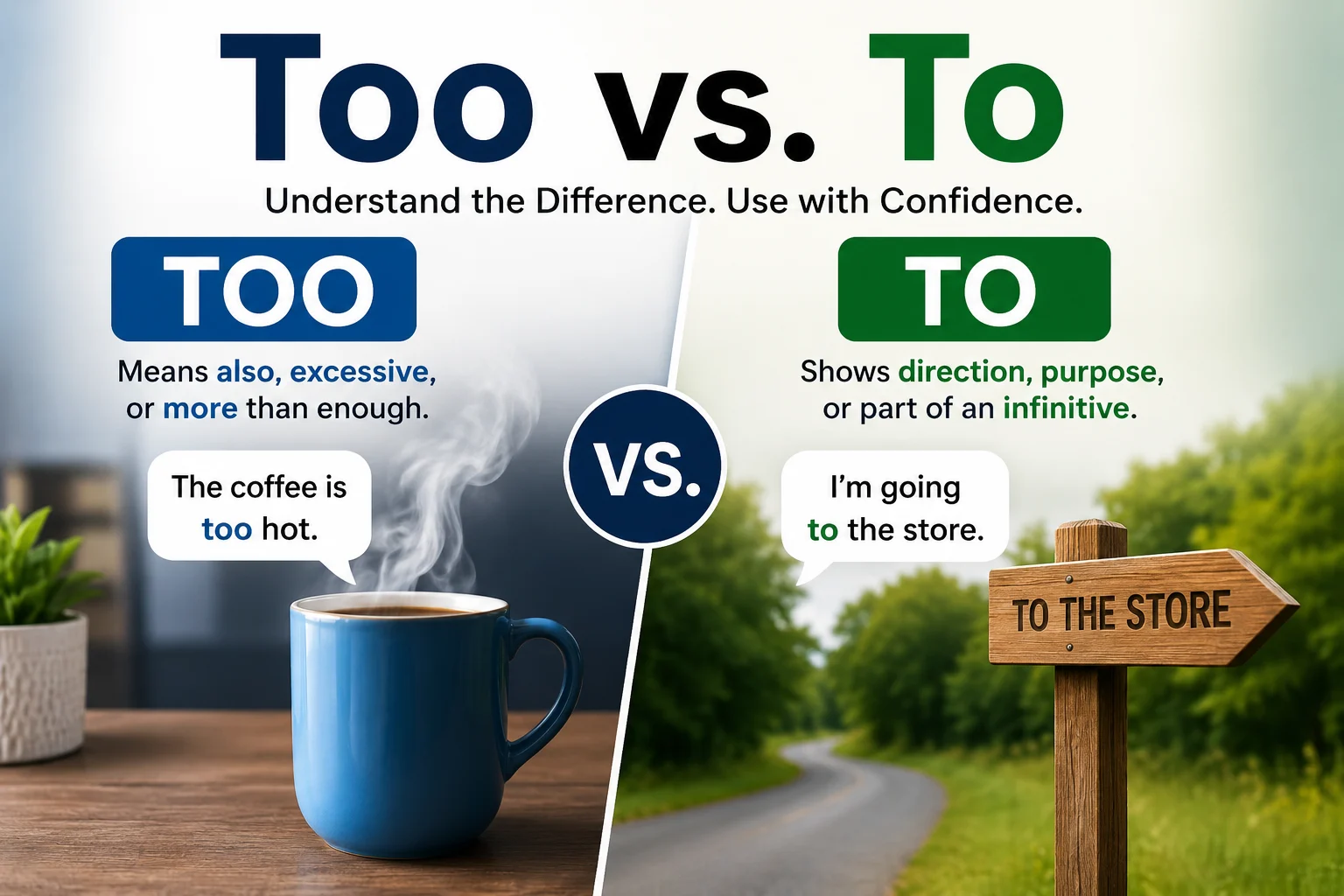
If you have ever paused while writing a sentence and wondered whether you need too or to, you are not alone. These two words sound exactly alike in most varieties of English, but they perform completely different jobs. One can mean “also” or “excessively,” while the other commonly introduces an infinitive or shows direction. Because they are homophones, even confident writers sometimes mix them up.
The good news is that learning the difference between too vs. to is much easier than memorizing complicated grammar rules. Once you recognize what each word is doing in a sentence, the correct choice becomes almost automatic. In this guide, you will learn simple definitions, clear examples, common mistakes, a comparison table, and an easy memory trick. Whether you are improving your everyday writing, studying English, or trying to avoid grammar errors, these rules will help you use too and to correctly.
Quick Answer
To is usually used for direction, relationships, or before a verb: “I want to go.” Too means “also” or “more than necessary”: “I want to go too” or “It is too hot.” If you can replace too with “also” or “excessively,” use too.
Why People Confuse It
The main reason people confuse too and to is pronunciation. In standard English, both words are generally pronounced /tuː/, so they sound identical when spoken.
Writing is different because their meanings and grammatical functions are not the same.
Consider these sentences:
- I want to learn English.
- I want to go home too.
- This coffee is too hot.
The first to connects with a verb. The second too means “also.” In the third sentence, too means “more than is desirable or necessary.”
A useful habit is to focus on meaning and function rather than sound.
First Word: To
To is one of the most common words in English. It has several important grammatical uses.
1. To show direction
Use to when someone or something moves toward a place or person.
- We walked to the park.
- She drove to work.
- Please send the package to my office.
Here, to indicates movement or destination.
2. To connect with a verb
To + base verb forms an infinitive.
Examples:
- I want to sleep.
- He needs to study.
- They decided to leave.
- She hopes to win.
This is one of the most important uses of to.
3. To show a relationship or connection
To can also describe a relationship between people or things.
- This gift belongs to Sarah.
- He is married to an engineer.
- The answer to the question is simple.
Quick test for “to”
If to is followed by a base verb, such as go, eat, learn, read, or write, it is almost certainly the correct word.
I want to learn English.
Second Word: Too
Too has two main meanings: also and excessively.
1. Too means “also”
Use too when you mean “as well” or “also.”
- I like pizza too.
- She wants to come too.
- He is a teacher too.
- We enjoyed the movie too.
In many sentences, you can replace too with also.
I like coffee too.
I also like coffee.
If the replacement works naturally, too is probably correct.
2. Too means “excessively”
Too can also mean more than necessary, desirable, or appropriate.
- The bag is too heavy.
- It is too cold outside.
- You are driving too fast.
- This shirt is too expensive.
Compare:
The soup is hot.
This simply describes the soup.
The soup is too hot.
This suggests that the soup is hotter than it should be or than you can comfortably handle.
Comparison Table
| Word | Main Meaning | Common Function | Example |
| to | Direction or connection | Preposition | We went to school. |
| to | Introduces an infinitive | Infinitive marker | I want to learn. |
| too | Also | Adverb | I want to come too. |
| too | Excessively | Adverb | It is too expensive. |
The easiest distinction
Think of it this way:
- to = direction, connection, or before a verb
- too = also or excessively
When to Use Each
Use “to” when:
- You are describing movement or direction.
- You are showing a relationship or connection.
- It comes before a base-form verb in an infinitive.
- You are expressing a destination or recipient.
Examples:
- We went to London.
- Give the book to John.
- I need to work.
- She wants to improve.
Use “too” when:
- You mean also.
- You mean as well.
- Something is excessive or beyond a desirable amount.
Examples:
- I want one too.
- She is coming too.
- This box is too large.
- The music is too loud.
Examples: Too vs. To in Sentences
Here are more examples to make the difference clear.
- I want to visit my grandmother.
- I want to visit my grandmother too.
- She went to the store.
- The store was too crowded.
- He needs to finish his homework.
- I need a notebook too.
- It is too late to call him.
- We are going to the beach.
- Are you coming too?
- This coffee is too sweet for me.
- I hope to see you tomorrow.
- My brother wants to come too.
- She gave the keys to her sister.
- The shoes are too expensive.
- They decided to stay home.
- He talks too loudly.
- I would like to order dinner.
- Can I have some dessert too?
Notice how the meaning changes depending on the word.
Common Mistakes
Mistake 1: Using “too” before a verb
Incorrect:
I want too go home.
Correct:
I want to go home.
Why? To comes before the base verb go.
Mistake 2: Using “to” when you mean “also”
Incorrect:
I want to come to.
Correct:
I want to come too.
Here, too means “also.”
Mistake 3: Confusing “too” with “to” in expressions
Incorrect:
It is to cold outside.
Correct:
It is too cold outside.
Here, too means “excessively.”
Mistake 4: Writing “too much” incorrectly
Correct:
There is too much sugar in this tea.
Too much means more than the appropriate amount.
Compare:
I have to drink some water.
The first sentence uses too for excess. The second uses to before a verb.
Mistake 5: Forgetting that “too” can mean “also”
Sarah is coming too.
This does not mean Sarah is coming excessively. It means Sarah is coming also.
Memory Trick
Here is a simple trick:
Too has two O’s because it can mean “two” things.
Remember the two major meanings of too:
- Also
- Excessively
For example:
- I want to go too = I want to go also.
- It is too hot = It is excessively hot.
Meanwhile, to has only one O.
Another quick trick:
Too = extra
If the sentence contains the idea of extra, also, or excessive, think of too.
I want extra cake too.
The cake is too sweet.
American vs. British English
The distinction between to and too is essentially the same in American and British English.
Both varieties use:
- to for direction and infinitives
- too for “also”
- too for “excessively”
For example:
I want to go too.
This sentence works naturally in both American and British English.
Pronunciation can vary slightly depending on accent and speech context, but the spelling and core grammatical rules remain the same.
Similar Words
Because to and too are homophones, they belong to a larger group of commonly confused English words.
To vs. Too vs. Two
There is actually a third word that sounds the same:
- to = direction, connection, or infinitive marker
- too = also or excessively
- two = the number 2
Examples:
I want to buy two books too.
Each word has a completely different meaning, even though they sound alike.
Other commonly confused homophones
English contains many similar examples:
- there / their / they’re
- your / you’re
- its / it’s
- than / then
- accept / except
Learning these word pairs can significantly improve spelling, grammar, and everyday English writing.
FAQs
1. What is the difference between “too” and “to”?
To commonly shows direction or comes before a verb, while too means “also” or “excessively.”
2. Is it “I want to” or “I want too”?
It is “I want to” when the sentence continues with an understood verb, such as “I want to go.” If you mean “I want also,” use too in a complete sentence such as “I want one too.”
3. Is “too” always used for something excessive?
No. Too has two major meanings. It can mean “also” or “excessively.”
4. How can I remember when to use “too”?
Remember that too has two O’s and two common meanings: also and excessively.
5. Can “to” be used before every verb?
Not always. To + base verb is common for infinitives, but some English structures use a verb without to, such as after modal verbs: “I can swim,” not “I can to swim.”
6. Are “to” and “too” pronounced the same?
In most standard varieties of English, they are pronounced the same or very similarly, which is why they are easy to confuse when writing.
7. What about “two”?
Two is the number 2. For example: “I have two brothers.”
Final Verdict
The difference between too vs. to becomes simple once you stop relying on pronunciation and look at the word’s role in the sentence. Use to for direction, relationships, and infinitives such as to eat, to read, and to learn. Use too when you mean also or excessively.
When you are unsure, try a quick substitution. If too can be replaced by also or excessively, choose too. If you are showing direction or placing a word before a base verb, to is usually the right choice. With a little practice, this common homophone confusion can disappear from your writing.
Remember This
To = direction, connection, or before a verb.
Too = also or excessively.
Two = the number 2.
One final example:
I want to buy two books too.
That single sentence contains all three words—and shows exactly why spelling matters even when pronunciation does not.
Conclusion
Understanding too vs. to is one of those small English grammar lessons that can make a noticeable difference in your writing. Although the words sound alike, their meanings are distinct. To usually connects ideas, indicates direction, or introduces an infinitive, while too adds the meaning of “also” or “more than necessary.”
The best way to remember the difference is to focus on what you mean. If you mean also or excessively, choose too. Otherwise, when you need direction, connection, or an infinitive marker, to is generally the correct choice. Keep these simple rules in mind, and you will be much less likely to confuse these common English words.

I’m Elliot Pierce, Administrator at Grammetics, dedicated to improving word matching and grammar. I help maintain useful content, support readers, and make language learning simple, clear, accurate, and engaging.