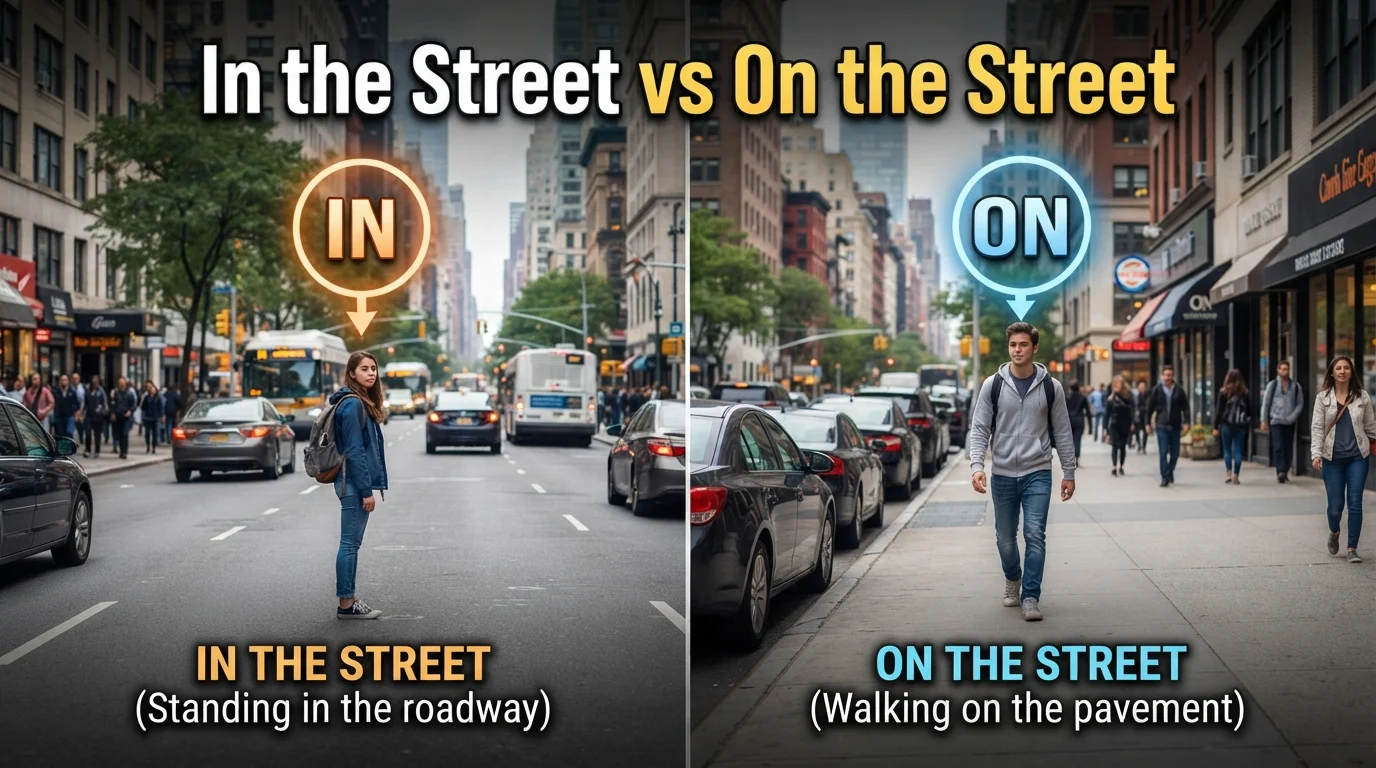
When should you say “in the street” and when is “on the street” the better choice? These two phrases look almost identical, so it is easy to use the wrong preposition. However, they can communicate slightly different ideas depending on whether you are talking about a location, activity, movement, or something physically happening within the roadway.
The phrase “on the street” is generally more common in everyday English, especially when referring to someone’s location or something situated along a particular street. “In the street” is also correct, but it often emphasizes being physically within the street or roadway, rather than simply being located there. Understanding this small distinction can make your English sound more natural and precise in conversations, writing, and everyday descriptions.
Quick Answer
“On the street” is usually used for someone or something located along or at a street. “In the street” often means physically within the roadway or street area. For general location, “on the street” is usually the safer and more natural choice.
Why People Confuse It
The confusion comes from the fact that in and on can both describe physical location.
For example:
- “There is a man on the street.”
- “There is a man in the street.”
Both sentences can be grammatically correct, but they create different mental pictures.
On the street normally presents the street as a location or route.
In the street often suggests that someone or something is actually occupying the street itself, particularly the roadway.
The difference becomes clearer when you think about what you want to emphasize: general location or physical position within the street.
First Word: “In the Street”
The preposition in often suggests being inside or within an area.
Therefore, “in the street” can mean physically located in the street, especially in the roadway.
Examples
- “The children were playing in the street.”
- “A car stopped in the street.”
- “There was a large hole in the street.”
- “Someone left a bicycle in the street.”
In these examples, the subject is understood to be physically occupying the street area.
“In the street” can also be used when describing activities traditionally associated with the street:
People were dancing in the street during the celebration.
Here, the emphasis is on the activity taking place within the street space.
Second Word: “On the Street”
“On the street” is extremely common when describing someone’s location, a particular street, or something situated along a street.
For example:
- “I saw Sarah on the street.”
- “The restaurant is on the street.”
- “He lives on Main Street.”
- “There is a bank on this street.”
It can also refer to being outdoors or away from home:
“I met him on the street.”
The phrase does not necessarily mean that the person was standing in the middle of the roadway. They could have been walking on a sidewalk, standing outside a shop, or simply somewhere along the street.
Comparison Table
| Phrase | Main Meaning | Typical Use | Example |
| In the street | Physically within the street/roadway | Activities or objects occupying the street | “The children are playing in the street.” |
| On the street | Located along or at a street | General location | “I saw him on the street.” |
| In a street | Within a particular street area | Describing physical position | “A truck was parked in a street nearby.” |
| On a street | Located along a particular street | Addresses and locations | “They opened a shop on a busy street.” |
The simplest distinction
In the street = inside the street space
On the street = along/at the street
This is a useful guideline, although real-world English can be flexible depending on context and regional usage.
When to Use Each
Use “in the street” when:
Use in the street when you want to emphasize that someone or something is physically within the street or roadway.
Common situations include:
- Children playing in the roadway
- Cars stopped in the road
- Objects blocking traffic
- People gathering in the street
- Events taking place in the street
Example:
“A group of people was standing in the street, blocking traffic.”
The phrase makes it clear that they were occupying the roadway.
Use “on the street” when:
Use on the street for a general location or when something is situated along a street.
Common situations include:
- Finding someone
- Describing a shop
- Giving a location
- Talking about a particular street
- Describing someone walking or spending time outdoors
Example:
“I ran into an old friend on the street.”
The sentence simply means you encountered the person while you were out in the street area. It does not suggest that either person was standing in traffic.
Examples: “In the Street” vs “On the Street”
Here are more examples to make the difference clear.
Examples with “in the street”
- “The children were playing in the street.”
- “A broken-down car was sitting in the street.”
- “People gathered in the street after the parade.”
- “There was water in the street after the storm.”
- “A dog suddenly ran into the street.”
- “The workers found a damaged pipe in the street.”
In each example, the street is treated as a physical space that someone or something is occupying.
Examples with “on the street”
- “I saw your brother on the street yesterday.”
- “There is a new café on the street.”
- “She lives on Oak Street.”
- “We met on the street after work.”
- “There are several stores on this street.”
- “He was walking on the street when I called him.”
Here, on the street generally identifies a person’s or thing’s location along the street rather than specifically placing it in the roadway.
Common Mistakes
Mistake 1: Thinking “in the street” is always wrong
It isn’t.
“The children are playing in the street.”
This is perfectly natural English when the children are actually in the roadway.
Mistake 2: Using “in” for every street location
If you are simply saying where a shop, person, or building is located, on is often more natural.
❌ “The pharmacy is in Green Street.”
✅ “The pharmacy is on Green Street.”
Mistake 3: Assuming “on the street” means standing on the road
Not necessarily.
Someone who is on the street might be on the sidewalk, near a storefront, crossing the road, or simply somewhere along the street.
Mistake 4: Confusing “in the street” with “on the street”
Compare:
“The children are playing in the street.”
This suggests they are actually occupying the roadway.
“I saw the children on the street.”
This is broader and simply tells you where you saw them.
Memory Trick
Here is an easy way to remember the difference:
IN = inside the street space
ON = along the street
Think about a street as an area:
- If someone is inside that area, use in.
- If you are identifying something along the street, use on.
Quick memory examples
In the street:
🚗 “A car is in the street.”
On the street:
🏪 “A shop is on the street.”
This isn’t an absolute rule for every possible context, but it is a highly useful starting point for everyday English.
American vs British English
Both American English and British English use “in the street” and “on the street.”
The basic distinction is broadly similar, but everyday preferences can vary depending on context and region.
In American English, “on the street” is particularly common for general location:
“I saw him on the street.”
British English also commonly uses “on the street” for general location and street names.
However, “in the street” is natural in both varieties when the meaning is that someone or something is physically within the roadway or street area:
“The children were playing in the street.”
So this is not primarily an American-versus-British grammar difference. Context is more important than nationality.
Similar Words and Phrases
Understanding related expressions can make the distinction even easier.
On the road
Usually refers to traveling or being on a road.
“We spent six hours on the road.”
In the road
Usually emphasizes something physically occupying the roadway.
“There is a large rock in the road.”
On Main Street
Used for locations or addresses.
“The bookstore is on Main Street.”
In the middle of the street
This strongly emphasizes a position inside the roadway.
“He was standing in the middle of the street.”
Across the street
Means on the opposite side of the street.
“The bank is across the street.”
Along the street
Means following or extending beside/along a street.
“There are trees along the street.”
FAQs
1. Is “in the street” grammatically correct?
Yes. “In the street” is grammatically correct when you mean that someone or something is physically within the street or roadway.
2. Is “on the street” correct?
Yes. “On the street” is very common and usually refers to a general location along or at a street.
3. Which is more common: “in the street” or “on the street”?
“On the street” is generally more common for talking about a person’s or thing’s general location. “In the street” is more specific when emphasizing physical presence within the street.
4. Do you live “in” or “on” a street?
In standard English, we normally say “live on a street.”
“I live on King Street.”
5. Do you say “on Main Street” or “in Main Street”?
Normally, “on Main Street” is the natural expression.
“The hotel is on Main Street.”
6. Is “walking in the street” correct?
Yes. It can mean that someone is literally walking within the roadway.
“He was walking in the street because the sidewalk was closed.”
7. Is “walking on the street” correct?
It can be understood, but depending on the intended meaning, “walking on the street” may sound less precise. If you mean walking along a street generally, English speakers often use “walking down the street” or “walking along the street.”
Final Verdict
The difference between “in the street” and “on the street” is mainly about how you view the location.
Use “in the street” when someone or something is physically within the street, especially the roadway. Use “on the street” when referring to a general location along a street, a street address, or something situated beside the street.
The easiest rule is: “in” emphasizes being within the street space, while “on” usually emphasizes location along the street. When talking about addresses or where a business is located, “on the street” is usually the natural choice.
Remember This
In the street = physically within the street/roadway.
On the street = located along or at the street.
- “The children are playing in the street.” → They are occupying the street.
- “I saw the children on the street.” → They were somewhere along the street.
- “The store is on the street.” → It is located along that street.
- “There is a car in the street.” → The car is physically in the roadway.
When you’re unsure, ask yourself: Am I emphasizing the street as a physical space, or simply giving a location? That question will usually point you toward the correct preposition.
Conclusion
Although “in the street” and “on the street” are both correct expressions, they are not always interchangeable. “In the street” usually gives a stronger sense of physical presence within the street, while “on the street” is broader and more commonly used for general location and street addresses.
Once you connect in with being within the street space and on with being along the street, the distinction becomes much easier to remember. With regular exposure to real English examples, choosing between these two phrases will quickly become natural.

I’m Micah Wheeler, a passionate author who enjoys exploring matching words, grammar, and language. I create clear, helpful content to make word choices and grammar easier for everyone.