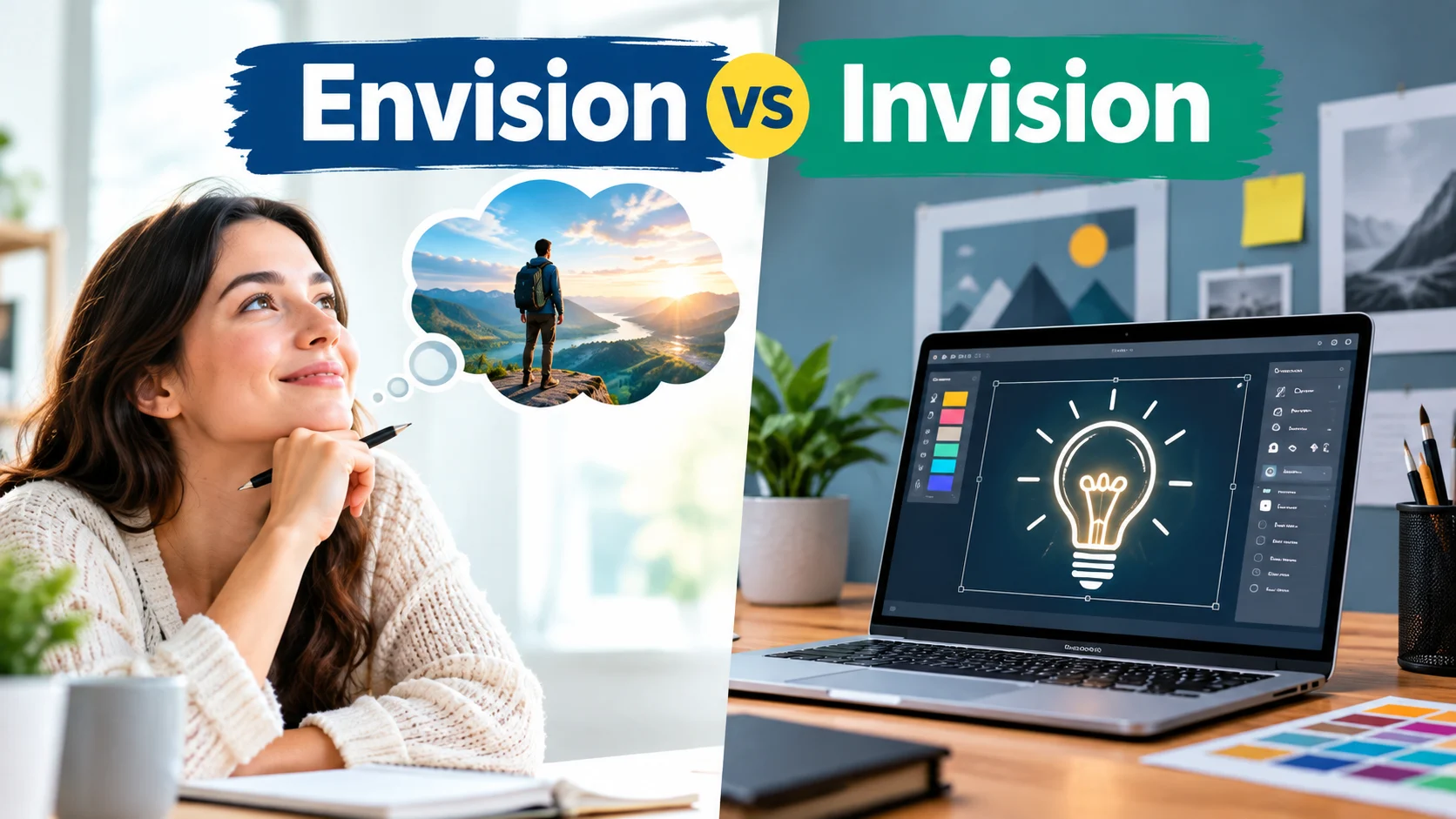
When you want to describe imagining something in your mind, should you write envision or invision? This is a common spelling confusion because both forms look and sound similar. However, in standard English, only one is generally accepted as the correct word for the meaning “to imagine” or “to picture something mentally.”
The correct spelling is envision. It is a verb commonly used when someone imagines a future situation, plans a goal, or forms a mental picture of something. Invision, on the other hand, is generally considered a misspelling when used with this meaning. Knowing the difference can help you avoid spelling errors in essays, emails, professional documents, websites, and everyday writing. In this guide, we will explain envision vs invision, their meanings, correct usage, examples, common mistakes, and an easy memory trick to remember the right spelling.
Quick Answer
Envision is the standard and correct spelling when you mean “to imagine,” “to picture,” or “to visualize.” Invision is generally a misspelling of envision. Use envision in formal, academic, professional, and everyday English.
Why People Confuse It
The confusion between envision and invision is understandable because they are pronounced similarly and both look like they could be English words.
The main problem is the prefix. English contains many words beginning with in-, while envision begins with en-.
For example:
- envision = imagine or picture something
- vision = the ability to see or a mental image
- envision combines the idea of forming a mental picture with the word vision
Because of this similarity, writers sometimes accidentally replace en- with in- and write invision.
For standard English writing, however, envision is the spelling you should use.
First Word: Envision
Envision is a verb meaning to imagine, picture, or visualize something, especially something that may happen in the future.
Envision meaning
To envision something means to create a mental picture of it or imagine it as a possibility.
Examples:
- I envision a successful future for our company.
- She envisioned herself living near the ocean.
- They envision a world with cleaner energy.
- He can easily envision how the finished house will look.
The word is especially common when talking about:
- Future plans
- Goals
- Dreams
- Business strategies
- Personal ambitions
- Possible outcomes
- New ideas
- Long-term plans
Envision as a verb
The main forms of the verb are:
| Form | Example |
| Base form | envision |
| Third-person singular | envisions |
| Present participle | envisioning |
| Past tense | envisioned |
| Past participle | envisioned |
For example:
We envision a better future.
She envisioned becoming a successful writer.
They are envisioning a new approach.
Second Word: Invision
Invision is generally not the standard spelling of the verb meaning “to imagine” or “to picture.”
If you write invision when you mean “imagine,” readers will usually understand what you mean, but the spelling is considered incorrect in standard English.
Incorrect:
I invision a better future.
Correct:
I envision a better future.
Another example:
Incorrect:
She invisioned herself becoming a doctor.
Correct:
She envisioned herself becoming a doctor.
Is “invision” ever a proper name?
You may encounter InVision as a brand or company name. A proper name can follow its own spelling conventions, so this should not be confused with the standard English verb envision.
When you simply mean “to imagine” or “to visualize,” use “envision.”
Comparison Table
| Feature | Envision | Invision |
| Standard English word? | Yes | Generally no |
| Meaning | To imagine or visualize | Usually a misspelling of envision |
| Part of speech | Verb | Not normally used as the standard verb |
| Correct in formal writing? | Yes | No, when intended to mean “imagine” |
| Example | I envision a better future. | I invision a better future. ❌ |
| Past tense | Envisioned | Invisioned ❌ |
| Common usage | Academic, professional, everyday English | Usually a spelling error |
When to Use Each
Use “envision” when you mean “imagine”
Choose envision whenever you are talking about forming a mental image or imagining a possible situation.
Example:
I can envision myself working abroad someday.
Use “envision” for future goals
The word is particularly natural when discussing ambitions and plans.
Example:
She envisions a successful career in medicine.
Use “envision” in professional writing
Business and professional writers often use envision to describe future plans.
Example:
The company envisions expanding into international markets.
Avoid “invision” as a spelling of “envision”
If you are writing an essay, report, email, application, article, or other formal text, use envision.
Examples of Envision vs Invision
Here are more examples to make the spelling difference easy to remember.
- Correct: I envision a peaceful future for my children.
Incorrect: I invision a peaceful future for my children. - Correct: She envisioned herself becoming a successful entrepreneur.
Incorrect: She invisioned herself becoming a successful entrepreneur. - Correct: We can envision several possible solutions.
Incorrect: We can invision several possible solutions. - Correct: He envisions a modern and efficient workplace.
Incorrect: He invisions a modern and efficient workplace. - Correct: They are envisioning a completely different approach.
Incorrect: They are invisioning a completely different approach. - Correct: Can you envision what the city will look like in twenty years?
- Correct: The architect envisioned a spacious, environmentally friendly building.
- Correct: I cannot envision living in such a busy city.
- Correct: The team envisions significant improvements next year.
- Correct: She envisioned a future where everyone had access to education.
- Correct: Before starting the project, we tried to envision the final result.
- Correct: He could easily envision himself running his own business.
These examples show that envision works naturally with dreams, plans, possibilities, and mental images.
Common Mistakes
1. Writing “invision” instead of “envision”
This is the most common mistake.
❌ I invision a bright future.
✅ I envision a bright future.
2. Writing “invisioned”
Because invision is often treated like a normal verb, people may also create the form invisioned.
❌ She invisioned a different outcome.
✅ She envisioned a different outcome.
3. Confusing envision with visualize
Envision and visualize can have similar meanings, but they are not necessarily interchangeable in every sentence.
I envision a successful career.
I visualize myself standing on the stage.
Both can describe mental imagery, but envision is especially useful for imagining a future possibility, plan, or outcome.
4. Assuming “in-” must be the correct prefix
English has many words beginning with in-, but that does not mean every similar-looking word uses that prefix.
Remember the spelling:
EN + VISION = ENVISION
Memory Trick
Here is a simple way to remember the correct spelling:
EN + VISION = ENVISION
Think of envision as putting something into your mental vision.
If you are imagining something in your mind, you are envisioning it.
You can also remember:
“I ENvision my future.”
The word EN comes before vision.
So:
✅ envision
❌ invision
American vs British English
There is no major American-versus-British spelling difference between envision and invision.
Envision is the standard spelling in both American English and British English when the word means “to imagine” or “to picture.”
For example:
American English:
She envisions a better future.
British English:
She envisions a better future.
The spelling remains envision.
You may encounter invision in informal writing, online content, or as a proper name, but that does not make it the standard spelling of the English verb.
Similar Words
Several words are related to envision and can sometimes be used in similar contexts.
Imagine
Imagine means to form an idea or picture in your mind.
Can you imagine living on another planet?
Visualize
Visualize means to create a mental picture of something.
Try to visualize your goal before starting.
Picture
Picture can mean to imagine something mentally.
I can picture myself living there.
Foresee
Foresee means to anticipate or recognize something that may happen in the future.
Nobody could foresee the changes that followed.
Anticipate
Anticipate means to expect or prepare for something that may happen.
We anticipate strong demand next year.
Conceive
Conceive can mean to form an idea or concept mentally.
She conceived a new approach to the problem.
Although these words overlap in meaning, envision is particularly useful for imagining a future situation, possibility, goal, or outcome.
Final Verdict
When comparing envision vs invision, the choice is straightforward: envision is the standard English spelling when you mean “to imagine,” “to picture,” or “to visualize.”
Invision is generally a spelling error in this context. If you are writing an essay, professional email, article, business document, or academic assignment, use envision.
The easiest way to remember it is to connect the word with vision:
EN + VISION = ENVISION.
Once you remember this pattern, you can avoid one of the most common spelling mistakes involving this word.
Frequently Asked Questions
Is “envision” or “invision” correct?
Envision is correct when you mean “to imagine,” “to picture,” or “to visualize.” Invision is generally an incorrect spelling of the word in standard English.
What does envision mean?
Envision means to imagine, picture, or visualize something, especially a future situation, goal, plan, or possibility.
Is “invision” a real English word?
As a standard English verb meaning “to imagine,” invision is generally not accepted. It is usually a misspelling of envision. You may encounter InVision as a proper name or brand.
What is the past tense of envision?
The past tense of envision is envisioned.
Example:
She envisioned a successful future.
Can I use “envision” in formal writing?
Yes. Envision is appropriate for formal, academic, business, professional, and everyday writing.
What is another word for envision?
Depending on the context, alternatives include imagine, visualize, picture, foresee, anticipate, and conceive.
Is “envision” American or British English?
Envision is used in both American and British English. It is the standard spelling in both varieties.
Conclusion
The difference between envision vs invision is mainly a matter of correct spelling. When you want to say that someone imagines, pictures, or mentally sees a possible future, the correct word is envision. The spelling invision is generally a mistake when used with this meaning.
Whether you are writing an academic assignment, business proposal, blog post, email, or everyday message, choosing envision will keep your English accurate and professional. Remember that the word contains vision, giving you a simple clue to its spelling.
Remember This
Envision = correct standard spelling
Invision = generally a misspelling when meaning “imagine”
👉 EN + VISION = ENVISION
If you mean “to imagine or picture something,” always choose “envision.”

I’m Aria White, a passionate word enthusiast who enjoys exploring grammar, vocabulary, and meaningful word connections. I create simple, helpful content that makes matching words easier, clearer, and enjoyable.