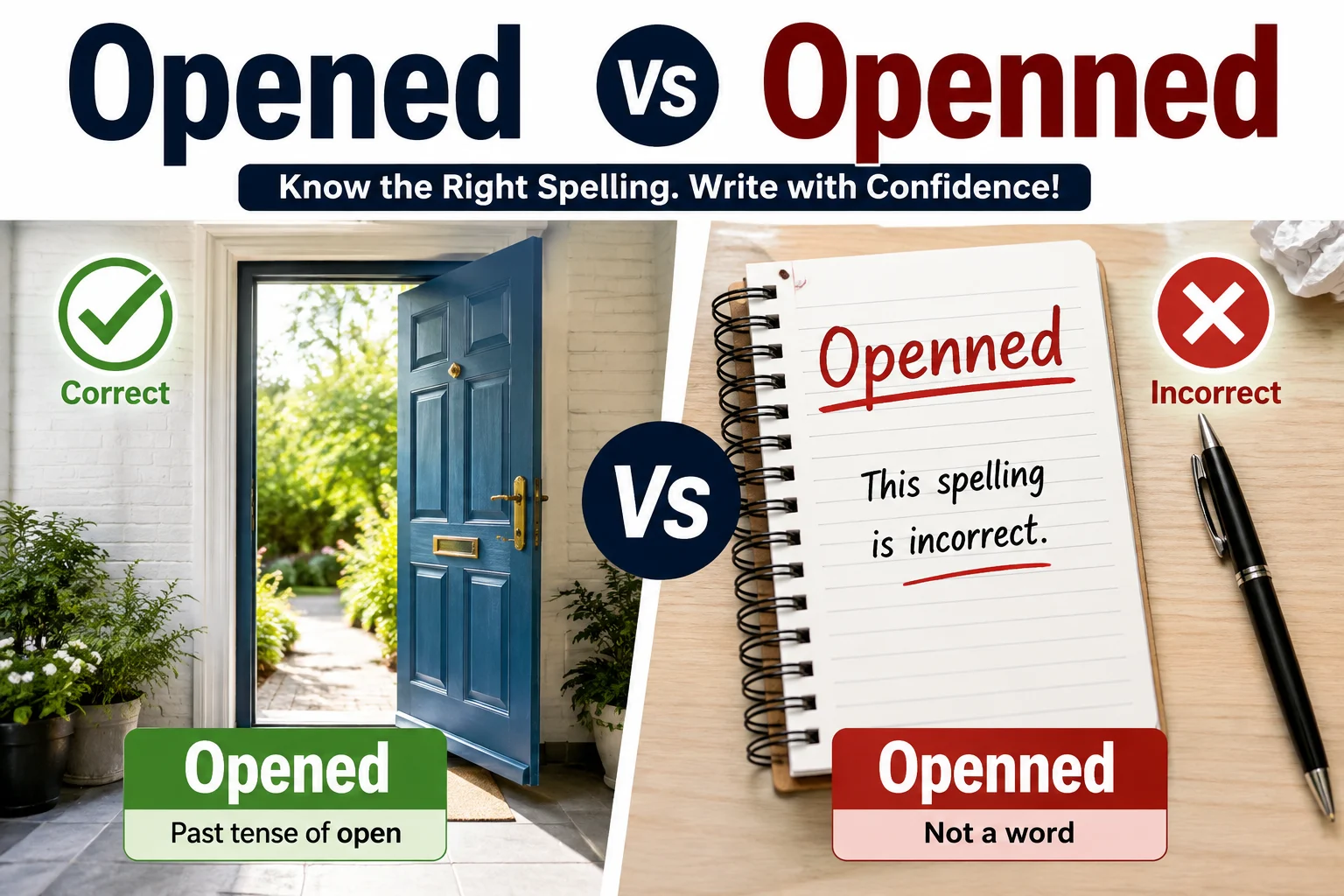
If you have ever typed “openned” and wondered whether it should have one n or two, you are not alone. English spelling can be surprisingly tricky, especially when forming the past tense of verbs. Words such as stopped, planned, and preferred double their final consonant before -ed, so it is easy to assume that open follows the same pattern. It does not. The correct past-tense spelling is opened, with only one n.
The difference between opened vs openned is therefore not a difference in meaning. One is the standard English spelling, while the other is simply a misspelling. Whether you are writing an email, school assignment, business report, blog post, or everyday message, choosing opened will keep your writing accurate and professional. In this guide, we will explain why the mistake happens, how to use opened correctly, and an easy memory trick to help you remember the spelling.
Quick Answer
Opened is the correct spelling. Openned is incorrect. The word opened is the past tense and past participle of open, formed by adding -ed without doubling the final n. Always write: “She opened the door.”
Why People Confuse It
The confusion usually comes from English verbs that double their final consonant before adding -ed.
For example:
- stop → stopped
- plan → planned
- drop → dropped
- prefer → preferred
Seeing these patterns can make open → openned look reasonable.
However, open does not follow that pattern. Its correct past form is opened, not openned. Major dictionaries list opened as the past form of open.
Another reason for the confusion is pronunciation. When people say opened quickly, the word may not sound as clearly divided into open + ed as it looks in writing. This can encourage an extra n when spelling it.
First Word: Opened
Opened is the correct word.
It is the past tense and past participle of the verb open. The verb can describe physically making something accessible, starting something, making something available, or revealing something.
Examples of “opened”
- She opened the door.
- He opened the window.
- I opened the package carefully.
- The store opened at nine o’clock.
- They opened a new office downtown.
- Maria opened the email immediately.
It can also be used in less literal situations:
- He opened the meeting with a short speech.
- She opened her heart to her friend.
- The discussion opened new possibilities.
So, opened is both grammatically correct and widely used in everyday and formal English.
Second Word: Openned
Openned is incorrect.
It is a common spelling mistake created by adding an unnecessary second n before -ed. It is not the standard past-tense form of open.
❌ She openned the door.
✅ She opened the door.
The easiest correction is simply to remove the extra n.
Think of it this way:
open + ed = opened
Not:
open + n + ed = openned
Comparison Table
| Feature | Opened | Openned |
| Correct spelling | ✅ Yes | ❌ No |
| Standard English word | ✅ Yes | ❌ No |
| Past tense of “open” | ✅ Yes | ❌ No |
| Past participle | ✅ Yes | ❌ No |
| Number of “n” letters | One | Two |
| Suitable for formal writing | ✅ Yes | ❌ No |
| Example | She opened the box. | She openned the box. ❌ |
Dictionary sources identify opened as the past form of open; openned is a misspelling.
When to Use Each
There is actually a very simple rule:
Use “opened” every time you need the past form of “open.”
For example:
Physical actions
He opened the door.
Starting something
She opened the meeting with a welcome.
Beginning business activity
The restaurant opened last year.
Accessing something
I opened the file on my computer.
Revealing something
He opened the letter and smiled.
What about “openned”?
Do not use openned in standard English writing.
If your spellchecker underlines it, the correction you need is almost certainly opened.
Examples: Opened in Real Sentences
Here are more examples to make the correct spelling natural:
- She opened the door for her guests.
- I opened the book to the first page.
- He opened the window because the room was hot.
- They opened a new restaurant in town.
- The teacher opened the lesson with a question.
- Sarah opened her email before breakfast.
- We opened the package carefully.
- The museum opened to visitors at ten.
- He opened the conversation by asking a simple question.
- The company opened its first international branch.
- She opened the gift immediately.
- The flowers opened in the morning sunlight.
- The manager opened the meeting on time.
- I opened the document and checked the details.
- The opportunity opened a new path for the team.
Notice that the spelling stays opened regardless of the context.
Common Mistakes
Mistake 1: Writing “openned”
❌ The shop openned early.
✅ The shop opened early.
Mistake 2: Thinking every verb doubles its final consonant
Not every verb follows the same spelling pattern.
Compare:
- stop → stopped
- plan → planned
- open → opened
The fact that stopped has two ps does not mean opened needs two ns.
Mistake 3: Using the wrong spelling in professional writing
A spelling error may seem minor, but repeated mistakes can make otherwise strong writing look less polished.
Use opened in:
- Emails
- Essays
- Reports
- Resumes
- Business documents
- Blog posts
- Academic writing
Memory Trick
Here is a simple way to remember it:
“Open has one N, so opened has one N.”
Think:
OPEN → OPENED
Not:
OPEN → OPENNED
You can also remember the phrase:
One open, one N, one opened.
The extra n is unnecessary.
American vs British English
There is no standard American vs. British spelling difference between opened and openned.
Both American and British English use:
✅ opened
Neither standard variety uses openned as the normal past tense of open.
So whether you are writing for an American audience, a British audience, or an international English audience, the correct spelling remains opened.
Similar Words
Understanding related forms can make the spelling easier to remember.
| Base Word | Present Form | Past Form | -ing Form |
| open | open | opened | opening |
| close | close | closed | closing |
| listen | listen | listened | listening |
| visit | visit | visited | visiting |
| happen | happen | happened | happening |
Notice that open becomes opened, not openned.
You should also distinguish opened from opening:
- The store opened yesterday.
- The store is opening tomorrow.
Opened describes a completed past action, while opening is the present participle/gerund form.
FAQs
1. Is “openned” a correct word?
No. Openned is a misspelling. The correct spelling is opened, the past tense and past participle of open.
2. Is it “opened” or “openned”?
It is opened.
Correct: She opened the door.
Incorrect: She openned the door.
3. Why doesn’t “open” become “openned”?
Because open does not require the final n to be doubled when forming its past tense. The standard form is simply open + ed = opened.
4. Is “opened” past tense?
Yes. Opened is the past tense of open.
Example:
He opened the window.
5. Is “opened” also a past participle?
Yes. Opened functions as both the simple past and past participle of the regular verb open.
For example:
- Simple past: She opened the door.
- Present perfect: She has opened the door.
6. Can I ever write “openned”?
In standard English, no. Use opened instead.
7. How do you spell the past tense of open?
The correct spelling is:
O-P-E-N-E-D — opened
There is only one n.
Final Verdict
When comparing opened vs openned, the answer is straightforward: opened is correct, and openned is incorrect.
Opened is the standard past-tense and past-participle form of open. It can describe opening a physical object, starting an event, making something available, accessing something, or beginning a new activity.
The easiest way to avoid the mistake is to remember that open keeps its single n when -ed is added. So whenever you hesitate, choose opened.
Remember This
Opened = correct ✅
Openned = incorrect ❌
The rule is simple:
OPEN + ED = OPENED
Never add another n.
Conclusion
The opened vs openned confusion is understandable because English has many verbs that double their final consonant before -ed. However, open does not belong to that group. Its correct past tense and past participle is opened, with only one n.
Once you memorize open → opened, this spelling problem becomes easy to avoid. Whether you are writing an academic essay, professional email, website content, or everyday message, use opened with confidence. When in doubt, remember the simplest rule: one N in open, one N in opened.

I am Chase Larson, an author at Grammetics, passionate about grammar and matching words. I create clear, useful content that helps readers improve vocabulary, writing, and communication.