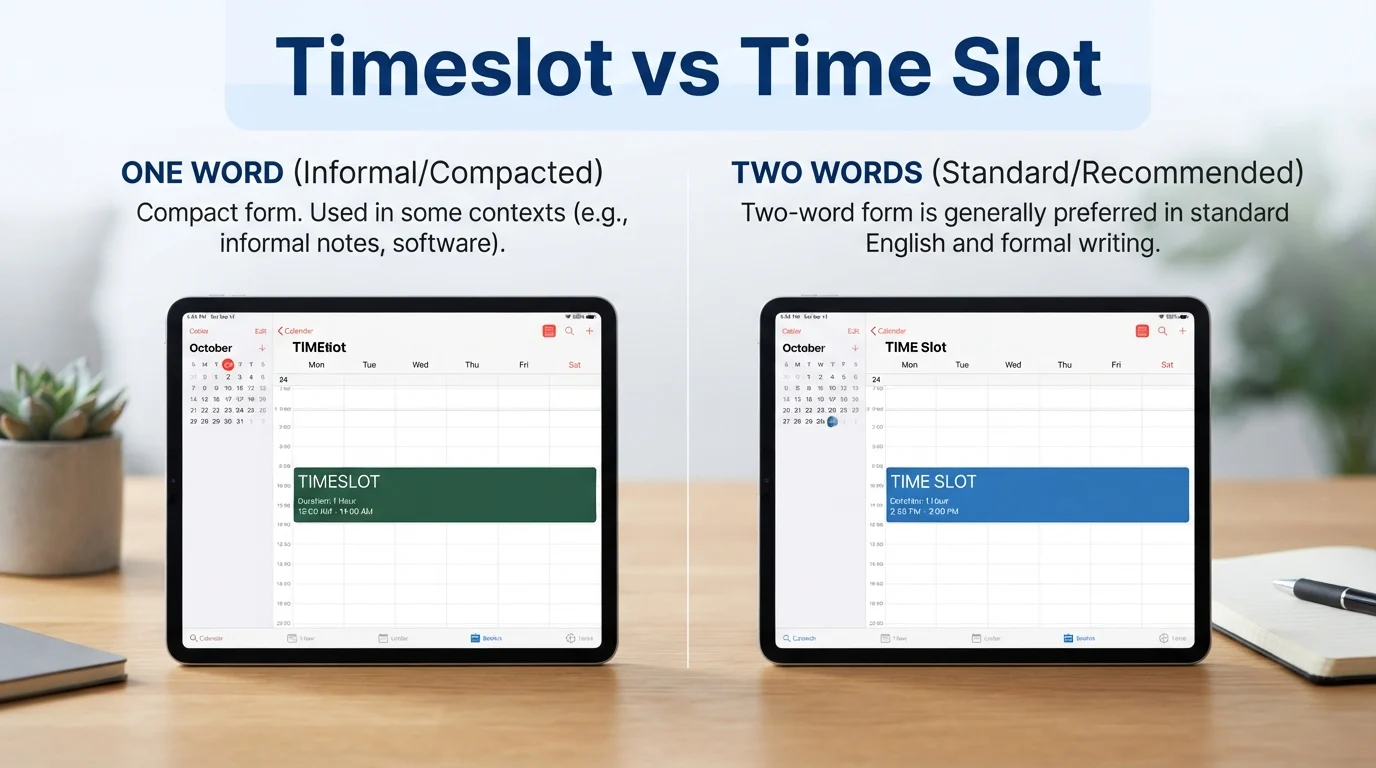
When writing about appointments, meetings, bookings, schedules, or available periods, you may come across both “timeslot” and “time slot.” They look almost identical, but which form is actually correct? This small spelling question can create uncertainty, especially in professional emails, workplace communication, calendars, and online scheduling systems.
The standard and safest form in modern English is “time slot”—two words. It refers to a specific period of time reserved or available for an activity, appointment, event, or task. “Timeslot” does appear in some dictionaries, websites, and specialized contexts, but it is much less common and is generally not the preferred choice in careful writing. Understanding the difference helps you choose wording that sounds natural and professional. In this guide, we’ll explain timeslot vs time slot, show real-world examples, discuss American and British usage, and give you a simple memory trick.
Quick Answer
“Time slot” is the standard and most widely accepted spelling. Use it for an available or reserved period of time, such as an appointment or meeting. “Timeslot” is sometimes used, particularly in technical or informal contexts, but “time slot” is the safer choice for professional and general English.
Why People Confuse It
The confusion happens because English often combines frequently used word pairs into single words over time.
For example:
- time + table → timetable
- time + line → timeline
- time + zone → timezone
- time + slot → time slot
Unlike timetable and timeline, time slot is conventionally written as two words in standard usage.
Another reason for the confusion is technology. Scheduling platforms, software interfaces, databases, and websites sometimes use “timeslot” as a single word. Seeing it repeatedly can make the spelling appear universally correct.
However, a word appearing in software or on a website does not necessarily mean it is the preferred form in standard English.
First Word: Timeslot
“Timeslot” is a closed compound spelling sometimes used to mean a period of time allocated to a particular activity.
For example:
The system automatically assigned a timeslot to each customer.
You may encounter this spelling in:
- Software and scheduling systems
- Technical documentation
- Online booking platforms
- Informal writing
- Specialized industries
That said, timeslot is less conventional than time slot in general English.
If you’re writing an article, business email, academic paper, formal document, or professional message, choosing time slot is usually the better option.
Is “timeslot” wrong?
Not necessarily. It is used and recognized in some contexts, but it is not the safest general-purpose spelling.
When in doubt, write time slot.
Second Word: Time Slot
“Time slot” is the standard two-word form used for a designated or available period of time.
It commonly refers to a period reserved for:
- An appointment
- A meeting
- A class
- A television program
- A delivery
- A consultation
- An interview
- A task
- A presentation
Examples
- I booked a time slot for Tuesday morning.
- Which time slot works best for you?
- The doctor has an available time slot at 3 p.m.
- Please select a time slot for your interview.
Because time slot is widely understood and natural, it is the recommended choice in most situations.
Timeslot vs Time Slot: Comparison Table
| Feature | Timeslot | Time slot |
| Spelling | One word | Two words |
| Meaning | A period of time | A period of time |
| General usage | Less common | Standard and common |
| Professional writing | Usually avoid | Recommended |
| Informal/technical usage | Sometimes used | Widely used |
| Appointment scheduling | Possible | Preferred |
| Safest choice | No | Yes |
When to Use Each
Use “time slot” when:
You are writing standard English for a general audience.
Examples:
- Please choose a time slot.
- I reserved a time slot for the meeting.
- We need a suitable time slot for the interview.
- The next available time slot is at 10:30.
Use “timeslot” when:
You are following an established technical convention or a platform’s terminology.
For example, a software system may have a database field named timeslot, or a scheduling application may consistently label its feature Timeslot.
In that case, keeping the platform’s terminology may be appropriate.
Best general rule
Use “time slot” in ordinary writing.
It is clear, natural, and unlikely to attract criticism.
Examples of “Time Slot” in Sentences
Here are more than 10 natural examples:
- Could you give me a time slot for the interview?
- I selected the earliest available time slot.
- What time slot would be convenient for you?
- The doctor has an open time slot at 2 p.m.
- Please choose a time slot before completing your booking.
- We need to find a suitable time slot for the meeting.
- Your delivery time slot is between 4 and 6 p.m.
- She reserved a time slot for her presentation.
- There are no available time slots this afternoon.
- I can offer you a time slot next Monday.
- The interview will take place during your selected time slot.
- Students must register for a time slot before attending the session.
- Can we move our time slot to the afternoon?
- Each speaker was given a 20-minute time slot.
- The website lets customers choose their preferred time slot.
Common Mistakes
1. Assuming “timeslot” is always the correct compound
Just because two words are frequently used together doesn’t mean they should automatically be combined.
Better:
Please select a time slot.
2. Changing the spelling randomly
Avoid switching between timeslot and time slot throughout the same document.
Choose one form based on your intended style. For general English, consistently use time slot.
3. Confusing “time slot” with “appointment”
A time slot is a period that can be allocated to an appointment.
For example:
I booked a time slot for my appointment.
The two expressions are related but not identical.
4. Writing “time-slot” unnecessarily
You may occasionally see time-slot with a hyphen. In ordinary modern usage, time slot is generally written as two separate words.
Memory Trick
Think of time slot as a slot in your schedule.
Your schedule contains a slot of time:
TIME + SLOT = TIME SLOT
Imagine your calendar divided into boxes:
9:00–10:00 → Time slot
10:00–11:00 → Time slot
11:00–12:00 → Time slot
Remember:
A slot belongs to your time, so write “time slot.”
American vs British English
Both American and British English commonly use “time slot” as two words.
There is no major American-versus-British difference that requires you to change the spelling.
For example, these are natural in both varieties:
- available time slot
- appointment time slot
- morning time slot
- booking time slot
- preferred time slot
You may encounter timeslot in digital products, technical writing, or specialized contexts in either variety, but time slot remains the safer general choice.
Similar Words
Several expressions are related to time slot but have slightly different meanings.
Time period
A general stretch of time.
The project lasted over a short time period.
Appointment
A scheduled arrangement to meet someone.
I have a doctor’s appointment tomorrow.
Schedule
A plan showing when activities will happen.
Check the meeting schedule.
Time frame
The period within which something is expected to happen.
We have a two-week time frame.
Window
A period during which something can happen.
The delivery window is from 2 to 5 p.m.
Session
A planned period devoted to a particular activity.
The training session begins at 9 a.m.
Frequently Asked Questions
Is “timeslot” one word or two?
Time slot is the standard two-word spelling in general English. “Timeslot” is also encountered, especially in technical or specialized contexts, but it is less common.
Is “time slot” grammatically correct?
Yes. Time slot is a standard noun phrase referring to a specific period allocated or available for an activity.
Should I write “timeslot” or “time slot” in an email?
Use time slot. It is the more conventional choice and works well in professional emails.
Is “timeslot” an English word?
Yes, timeslot is used in English, particularly in some technical, scheduling, and specialized contexts. However, time slot is generally the safer choice for standard writing.
What is the plural of time slot?
The plural is time slots.
Several time slots are available tomorrow.
Is “time-slot” correct?
The hyphenated form can occur in certain grammatical constructions or style systems, but time slot is normally written as two words.
What does “time slot” mean?
A time slot is a particular period of time reserved, assigned, or available for an activity such as an appointment, meeting, class, interview, or delivery.
Final Verdict
When choosing between timeslot vs time slot, go with time slot in most cases. It is the clearest, most familiar, and safest form for everyday, professional, academic, and general-purpose English.
Timeslot isn’t necessarily meaningless or incomprehensible, and you may see it in software, technical documentation, or specialized usage. However, unless you’re following a specific terminology guide or product interface, there is little reason to prefer the closed form.
Conclusion
The difference between timeslot and time slot is mainly a matter of conventional spelling rather than meaning. Both can refer to a designated period of time, but time slot is the form most readers will expect in standard English. Whether you’re discussing appointments, interviews, meetings, deliveries, classes, or schedules, the two-word version is a reliable choice.
If you’re writing for a professional audience or optimizing content for clarity, consistency matters. Use time slot throughout your writing unless a particular organization, software system, or style guide specifically uses timeslot. This simple choice will make your writing sound natural and polished.
Remember This
Time slot = the preferred standard form.
- ✅ time slot — recommended
- ⚠️ timeslot — used in some contexts
- ⚠️ time-slot — generally unnecessary
- Plural: time slots
Easy rule: When you mean “a period of time reserved for something,” write time slot.

I’m Elliot Pierce, Administrator at Grammetics, dedicated to improving word matching and grammar. I help maintain useful content, support readers, and make language learning simple, clear, accurate, and engaging.