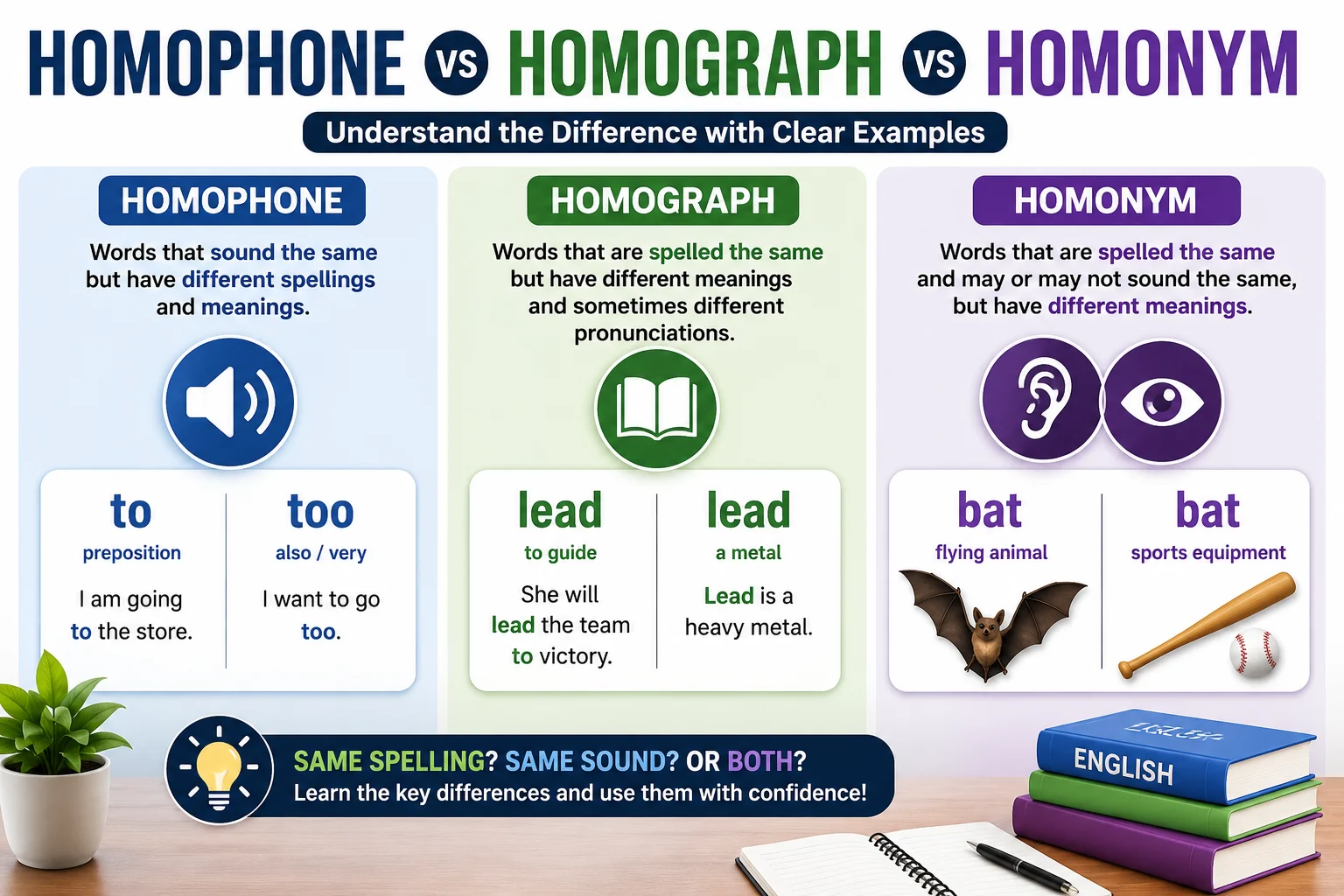
English has plenty of words that look or sound alike but mean completely different things. That is why terms such as homophone, homograph, and homonym can be confusing—even for people who have studied English for years. They describe different relationships between words based on their spelling, pronunciation, and meaning, but the boundaries between these terms are sometimes used differently in dictionaries and language textbooks.
The good news is that you do not need to memorize complicated linguistic definitions. Once you understand what happens with a word’s sound, spelling, and meaning, the differences become much easier to recognize. In this guide, we’ll compare homophones, homographs, and homonyms with clear definitions, practical examples, a simple comparison table, common mistakes, and an easy memory trick. Whether you are improving your vocabulary, studying English grammar, or preparing for an English test, this explanation will help you tell these commonly confused terms apart.
Quick Answer
A homophone is a word that sounds the same as another but usually has a different spelling and meaning, such as flour and flower. A homograph has the same spelling but a different meaning, sometimes with a different pronunciation, such as lead. Homonym is a broader or sometimes overlapping term for words that share spelling or pronunciation but have different meanings.
Why People Confuse It
The main reason these words are confusing is that all three involve words that have something in common.
The key difference is what they share:
- Homophone: shares the sound.
- Homograph: shares the spelling.
- Homonym: generally refers to words that have the same spelling and/or pronunciation but different meanings, depending on the linguistic definition being used.
For example:
- pair and pear sound alike → homophones
- bat (animal) and bat (sports equipment) are spelled and pronounced alike → homonyms
- lead (to guide) and lead (a metal) are spelled alike but pronounced differently → homographs
This overlap is important because some words can belong to more than one category.
Homophone: Words That Sound the Same
A homophone is a word that has the same pronunciation as another word but a different meaning. The spelling may be different.
The word homophone comes from Greek roots meaning roughly “same sound.”
Examples of Homophones
- to / two / too
- there / their / they’re
- right / write
- flower / flour
- sea / see
- night / knight
- hear / here
- brake / break
- peace / piece
- new / knew
For example:
I can hear the music from here.
The two words sound the same, but they have different spellings and meanings.
Another example:
She bought a beautiful flower and some flour for baking.
Important Point
Homophones do not have to be spelled differently in every definition of the term. The essential feature is that the words have the same pronunciation but different meanings.
Homograph: Words That Share Spelling
A homograph is a word that is spelled the same as another word but has a different meaning.
The name comes from roots meaning “same writing.”
Some homographs are pronounced differently, while others are pronounced the same.
Examples of Homographs
Lead
- Please lead the team. → /liːd/
- The pipe contains lead. → /led/
The spelling is identical, but the pronunciation and meaning change.
Tear
- A tear rolled down her cheek. → /tɪr/
- Be careful not to tear the paper. → /ter/
Again, the spelling is the same, but pronunciation and meaning differ.
Wind
- The wind is strong today. → /wɪnd/
- Wind the clock. → /waɪnd/
These are classic examples of heteronymic homographs because the spelling stays the same while pronunciation changes.
Homographs Can Also Sound the Same
Consider:
The bat flew out of the cave.
and:
He swung the bat at the ball.
Both meanings have the same spelling and pronunciation. This is where the categories begin to overlap with homonyms.
Homonym: Same Form, Different Meaning
Homonym is the broadest and most confusing term of the three.
In many English-language references, homonyms are words that have the same spelling and pronunciation but different meanings.
For example:
Bat
- bat = a flying mammal
- bat = equipment used in baseball or cricket
The words look and sound exactly the same, but their meanings are unrelated.
Bank
- bank = a financial institution
- bank = the land beside a river
Again, the spelling and pronunciation are the same.
However, linguistic terminology is not completely uniform. Some sources use homonym as an umbrella term that can include homophones and homographs, while others use it more narrowly for words that are both spelled and pronounced alike.
So, if you see slightly different definitions in dictionaries or textbooks, the difference may be terminological rather than a disagreement about the words themselves.
Comparison Table
| Feature | Homophone | Homograph | Homonym |
| Same sound? | Yes | Sometimes | Usually yes in the narrow definition |
| Same spelling? | Usually no | Yes | Yes in the narrow definition |
| Different meaning? | Yes | Yes | Yes |
| Example | flower / flour | lead / lead | bat / bat |
| Main clue | Same sound | Same spelling | Same form, different meaning |
| Pronunciation | Same | May differ | Usually the same |
The easiest way to remember:
Homophone = sound
Homograph = spelling
Homonym = same word form, different meaning
When to Use Each
You generally do not “use” a homophone or homograph in a sentence differently because of its category. Instead, you use these terms when describing relationships between words.
Use “Homophone” When Sound Matters
Use the term when two words sound alike but have different meanings.
Sea and see are homophones.
Use “Homograph” When Spelling Matters
Use the term when two words have identical spelling but different meanings.
Lead and lead are homographs.
Use “Homonym” When Referring to Same-Form Words
Use it when words share the same written and spoken form but have unrelated meanings, particularly under the narrower definition.
Bat is a homonym because it can refer to an animal or a piece of sports equipment.
Examples: 10+ Clear Comparisons
Here are practical examples that make the distinctions easier to see.
1. Right / Write — Homophones
- right = correct or opposite of left
- write = form words with letters
Please write the right answer.
2. Flower / Flour — Homophones
- flower = the blooming part of a plant
- flour = a baking ingredient
She put a flower on the table before making bread with flour.
3. Sea / See — Homophones
- sea = a large body of salt water
- see = perceive with the eyes
We went to the sea to see the sunset.
4. Lead / Lead — Homographs
- lead /liːd/ = guide
- lead /led/ = a metal
She will lead the group away from the old lead pipes.
5. Tear / Tear — Homographs
- tear /tɪr/ = a drop from the eye
- tear /ter/ = rip
A tear appeared in her eye when she accidentally tore the photograph.
6. Wind / Wind — Homographs
- wind /wɪnd/ = moving air
- wind /waɪnd/ = twist or turn
The wind made it difficult to wind the kite string.
7. Bat / Bat — Homonyms
- bat = flying mammal
- bat = sports equipment
A bat flew over the player holding a bat.
8. Bank / Bank — Homonyms
- bank = financial institution
- bank = edge of a river
The fisherman sat on the river bank after visiting the bank.
9. Bark / Bark — Homonyms
- bark = sound made by a dog
- bark = outer covering of a tree
The dog’s bark startled me as I touched the tree’s bark.
10. Match / Match — Homonyms
- match = a small stick used to make fire
- match = a contest or suitable pairing
He watched the football match after lighting a match.
11. Pair / Pear — Homophones
- pair = two things
- pear = a type of fruit
I bought a pair of shoes and a pear from the market.
12. Knight / Night — Homophones
- knight = a medieval warrior
- night = the period of darkness
The story was about a knight who traveled through the forest at night.
Common Mistakes
Mistake 1: Thinking All Three Mean the Same Thing
They are related, but they focus on different characteristics.
Homophone → sound
Homograph → spelling
Homonym → same form, different meaning
Mistake 2: Assuming Homographs Always Have Different Pronunciations
They do not.
Bat can have the same pronunciation for both meanings, while lead has different pronunciations.
Mistake 3: Treating Every Homophone as a Homonym
Different linguistic sources define homonym differently. Therefore, it is safer to say that flower and flour are definitely homophones rather than automatically labeling them homonyms.
Mistake 4: Ignoring Context
The sentence usually tells you which meaning is intended.
Compare:
The bank closed at five.
with:
We sat on the river bank.
The surrounding words make the meaning clear.
Memory Trick
Use the first parts of the words to remember what they describe:
- PHONE → think of sound → homophone
- GRAPH → think of writing → homograph
- NYM → think of name/word → homonym
A quick three-word formula:
Phone = Sound
Graph = Spelling
Nym = Word/Name
If you remember only one thing, remember sound vs. spelling vs. meaning/form.
American vs British English
The basic concepts of homophones, homographs, and homonyms are the same in American and British English.
However, pronunciation differences between the two varieties can affect whether two words are actually homophones in a particular accent.
For example, words that sound identical in one variety of English may have slightly different pronunciations in another. Regional accents can also change how certain word pairs are perceived.
This is why pronunciation dictionaries and recordings can be useful when studying homophones.
The terminology itself is not significantly different between American and British English, although individual dictionaries and linguists may use homonym with slightly different scopes.
Similar Words
Several related linguistic terms are worth knowing.
Heteronym
A heteronym is a type of homograph whose identical spelling has different pronunciations and meanings.
Examples:
- lead
- tear
- wind
Polysemy
Polysemy occurs when one word has several related meanings.
For example, head can refer to a body part, a leader, or the top/front part of something. These meanings are related, unlike many classic homonyms.
Synonym
A synonym has a similar meaning to another word.
Examples:
- big / large
- quick / fast
Antonym
An antonym has an opposite meaning.
Examples:
- hot / cold
- early / late
Understanding these related terms makes English vocabulary and word relationships much easier to study.
FAQs
1. What is the difference between a homophone and a homograph?
A homophone shares pronunciation with another word but has a different meaning. A homograph shares spelling with another word but has a different meaning.
2. Is “bat” a homonym or homograph?
Bat can be described as a homonym because the two meanings share spelling and pronunciation. It is also technically a homograph because the spellings are identical. Terminology can overlap.
3. Is “lead” a homophone?
The two meanings of lead are not homophones with each other because they are spelled the same and pronounced differently. They are homographs, specifically heteronyms.
4. Are homonyms and homophones the same?
No. A homophone specifically focuses on same pronunciation, while homonym has broader or narrower definitions depending on the linguistic source.
5. What is an easy example of a homophone?
Flower and flour are classic homophones because they sound alike but have different spellings and meanings.
6. What is an easy example of a homograph?
Wind is a useful example because wind meaning moving air and wind meaning to twist have the same spelling but different pronunciations and meanings.
7. Can one word be both a homograph and a homonym?
Yes. Bat can be considered both because the different meanings have identical spelling and pronunciation.
Final Verdict
The simplest way to separate these three terms is to ask what is the same?
When the sound is the same but the spelling or meaning differs, the term homophone applies. A homograph has the same spelling as another word but a different meaning or pronunciation. Meanwhile, homonym can describe words that share the same form while having different meanings, especially under the narrower definition of the term.
The important thing to remember is that linguistic terminology is not always perfectly standardized. Some dictionaries and language experts use homonym as a broad category that includes homophones and homographs, while others use it more narrowly. For everyday English learning, focusing on sound, spelling, and meaning is more useful than worrying about terminology alone.
Remember This
Homophone = same sound → flower / flour
Homograph = same spelling → lead / lead
Homonym = same spelling and sound, different meanings → bat / bat
When in doubt, ask yourself:
“Are the words sharing their sound, their spelling, or their whole form?”
That one question will help you identify the relationship quickly.
Conclusion
Homophones, homographs, and homonyms are different ways of describing relationships between English words. They can seem complicated because the categories sometimes overlap, but the basic ideas are straightforward. Homophones focus on pronunciation, homographs focus on spelling, and homonyms generally describe words that share the same form while carrying different meanings.
Learning these distinctions can also improve your spelling, vocabulary, reading comprehension, and writing accuracy. Instead of memorizing long linguistic definitions, pay attention to how a word sounds, how it is written, and what it means in context. Once you develop that habit, confusing word pairs such as right/write, lead/lead, and bat/bat become much easier to understand.

I’m Elliot Pierce, Administrator at Grammetics, dedicated to improving word matching and grammar. I help maintain useful content, support readers, and make language learning simple, clear, accurate, and engaging.