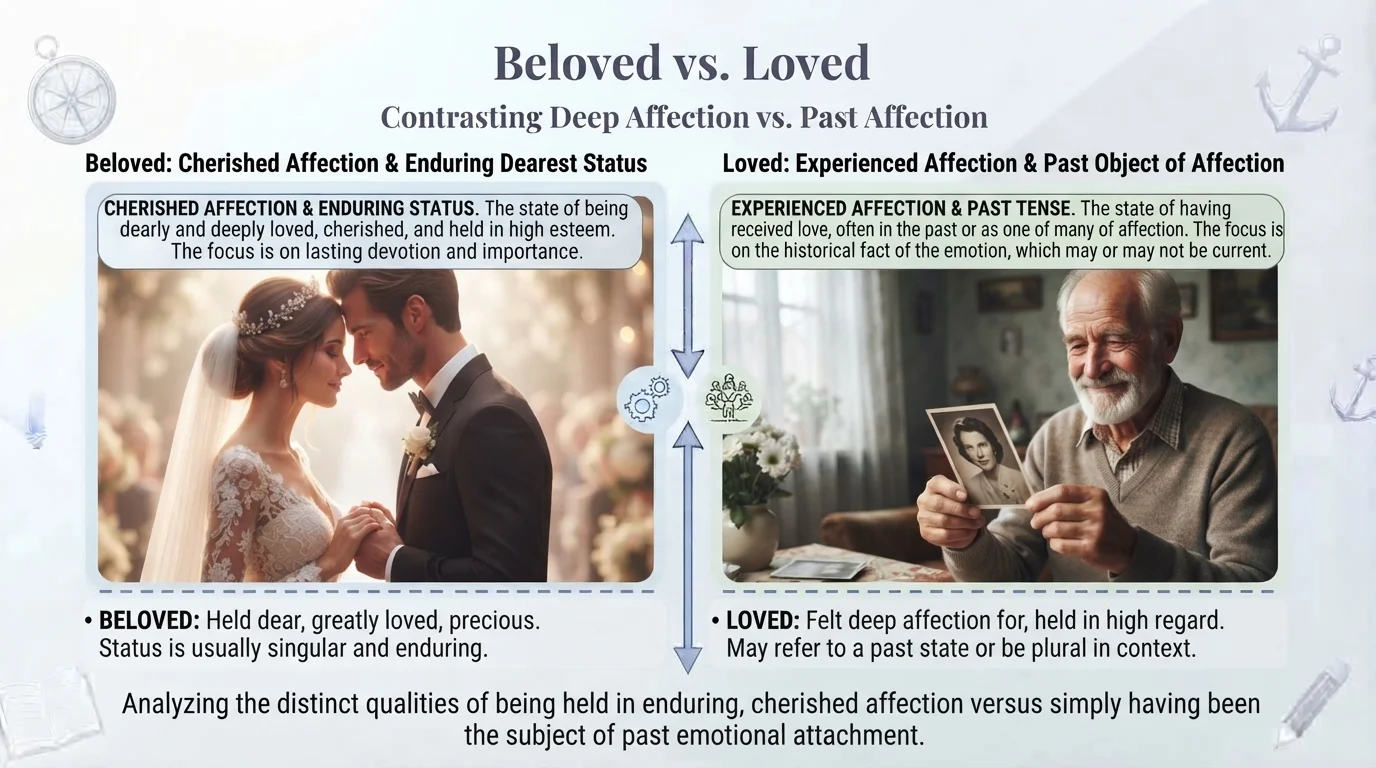
Beloved vs loved can be confusing because both words describe strong feelings of affection, care, and emotional attachment. In everyday English, they can sometimes appear interchangeable, but they do not always create the same tone. The main difference is often one of degree, emotional emphasis, and style. “Loved” is the common, flexible word used to describe someone or something that receives affection. “Beloved” usually expresses a deeper, more cherished, or especially valued relationship and can sound warmer, more formal, literary, or sentimental.
Understanding this distinction can help you choose the right word for personal messages, stories, formal writing, obituaries, speeches, and everyday conversations. Whether you are wondering about the meaning of beloved, the meaning of loved, or whether “beloved” is stronger than “loved,” this guide explains the difference with simple definitions, examples, common mistakes, and practical usage tips.
Quick Answer
Loved means cared for or held in affection. Beloved means deeply loved, cherished, or greatly valued. “Loved” is more common and general, while “beloved” carries stronger emotional warmth and often sounds more affectionate, respectful, formal, or literary.
Why People Confuse It
People confuse beloved and loved because both words communicate affection.
For example:
- “She is loved by her family.”
- “She is beloved by her family.”
Both sentences say that her family has strong affection for her. However, beloved adds a sense of being especially cherished or treasured.
The difference becomes clearer when you consider tone:
- Loved → common, direct, and versatile
- Beloved → deeply cherished, treasured, affectionate, and sometimes formal or poetic
“Loved” works in almost any ordinary situation. “Beloved” is more emotionally marked, so it is often chosen when the writer wants to emphasize someone’s special place in people’s hearts.
First Word: Beloved
Beloved is an adjective that means deeply loved, greatly cherished, or dearly loved.
It can describe a person, place, object, idea, or even a pet that is especially treasured.
Examples of “beloved”
- She was a beloved teacher.
- He returned to his beloved hometown.
- The author is remembered as a beloved figure.
- Their beloved dog passed away peacefully.
- This is my beloved grandmother.
The word can also be used as a noun, especially in romantic or literary contexts:
- “She waited patiently for her beloved.”
- “He wrote a letter to his beloved.”
Tone of “beloved”
“Beloved” often sounds:
- Deeply affectionate
- Warm
- Respectful
- Sentimental
- Literary
- Formal in certain contexts
You might see it in phrases such as beloved family member, beloved teacher, beloved child, or beloved leader.
Second Word: Loved
Loved is the past tense and past participle of love. It means that someone or something received love, affection, or strong positive feelings.
It is a much more general and frequently used word.
Examples of “loved”
- She was loved by her parents.
- He loved his childhood home.
- They loved the movie.
- I have always loved this song.
- The child felt loved and supported.
Unlike “beloved,” loved can describe both people and things in a very broad range of contexts.
For example:
“I loved the restaurant.”
Here, beloved would usually sound unnatural. You would not normally say, “I beloved the restaurant.”
This is because loved is also a verb form, while beloved is primarily used as an adjective or noun.
Comparison Table
| Feature | Beloved | Loved |
| Basic meaning | Deeply loved or cherished | Treated with affection or loved |
| Emotional strength | Often stronger or more intense | General |
| Commonness | Less common | Very common |
| Tone | Warm, sentimental, formal, or literary | Everyday and natural |
| Part of speech | Adjective; sometimes noun | Verb form; also adjective |
| Example | She was a beloved teacher. | She was loved by her students. |
| Suitable for everyday speech | Sometimes | Very often |
| Suitable for formal writing | Yes | Yes |
| Can describe an enjoyable thing | Less commonly | Very commonly |
When to Use Each
Use “beloved” when something is deeply cherished
Choose beloved when you want to emphasize that a person or thing has a special emotional place in someone’s heart.
Example:
“Our beloved grandfather taught us the value of kindness.”
The word “beloved” suggests more than simple affection. It emphasizes how deeply he was cherished.
Use “loved” for general affection
Use loved when you simply want to say that someone or something receives love.
Example:
“The child is loved by her parents.”
This is natural, straightforward, and appropriate in everyday English.
Use “loved” for past experiences
Because loved is a form of the verb “love,” it is extremely useful for talking about past feelings.
“I loved that book.”
You cannot replace “loved” with “beloved” here.
Use “beloved” for a stronger descriptive effect
In biographies, speeches, stories, memorials, and emotional writing, beloved can create a more meaningful tone.
“She was a beloved member of the community.”
This sounds more commemorative than:
“She was a loved member of the community.”
Examples of Beloved vs Loved
Here are practical examples showing how the two words differ.
- She is loved by her family.
Her family cares deeply about her. - She is beloved by her family.
Her family considers her especially cherished. - He loved his mother very much.
This describes his feelings toward his mother. - His beloved mother inspired him.
“Beloved” emphasizes how deeply cherished she was. - The teacher was loved by her students.
Her students had affection for her. - The teacher was beloved by her students.
Her students held her in especially high regard and affection. - I loved that movie.
This means I enjoyed the movie very much. - That movie became a beloved classic.
The movie became widely cherished and valued. - They loved their old house.
They had strong affection for their house. - They returned to their beloved old house.
“Beloved” gives the sentence a more nostalgic and emotional tone. - The puppy was loved by everyone.
Everyone cared about the puppy. - The puppy was beloved by everyone in the neighborhood.
The puppy was especially cherished by the community. - She loved her hometown.
She had strong affection for the place. - She returned to her beloved hometown.
The word suggests a particularly deep emotional attachment.
Common Mistakes
Mistake 1: Using “beloved” as a replacement for every form of “loved”
Not every sentence containing “loved” can use “beloved.”
Incorrect:
“I beloved this movie.”
Correct:
“I loved this movie.”
Mistake 2: Assuming “beloved” always means romantic love
Beloved can describe romantic relationships, but it is not limited to romance.
It can describe:
- Parents
- Children
- Teachers
- Friends
- Pets
- Places
- Books
- Cultural figures
- Traditions
Mistake 3: Thinking “beloved” is always more appropriate
“Beloved” can sound overly formal or sentimental in casual situations.
For example:
“I loved your new haircut.”
sounds natural.
“I beloved your new haircut.”
is grammatically wrong.
Mistake 4: Confusing “beloved” with “love”
Remember that beloved is not simply another form of the verb “love.”
- I love my family.
- I loved my family.
- My family is beloved.
These forms serve different grammatical functions.
Memory Trick
A simple way to remember the difference is:
Loved = received love.
Beloved = deeply cherished.
Think of beloved as “dearly loved.”
If you could naturally add “dearly” or “deeply cherished,” “beloved” may be a good choice.
For example:
“She was dearly loved by everyone.”
can become:
“She was beloved by everyone.”
But:
“I loved the movie.”
cannot become:
“I beloved the movie.”
American vs British English
The distinction between beloved and loved is generally the same in American and British English.
Both varieties use:
- loved for ordinary expressions of affection and enjoyment
- beloved for something or someone deeply cherished
However, beloved may appear particularly often in formal, literary, historical, religious, or commemorative writing in both varieties.
For everyday conversation, loved is usually the more natural choice.
Similar Words
Several words are related to beloved and loved, but each has its own shade of meaning.
Dear
Dear can mean loved, valued, or emotionally important.
“She is a dear friend.”
Cherished
Cherished emphasizes something being highly valued and protected emotionally.
“He treasured his cherished memories.”
Adored
Adored suggests very strong affection or admiration.
“The children adored their grandmother.”
Treasured
Treasured emphasizes great personal value.
“She kept the treasured photograph.”
Favorite
Favorite usually indicates preference rather than emotional love.
“This is my favorite book.”
Affectionate
Affectionate describes feelings or behavior showing affection.
“He gave his dog an affectionate pat.”
Final Verdict
Beloved and loved are closely related, but they are not completely interchangeable. Loved is the broader and more common term. It can describe ordinary affection, romantic feelings, family relationships, enjoyment, and past experiences.
Beloved is more specific in tone. It generally suggests that someone or something is deeply loved, cherished, or especially valued. It is particularly effective when you want a sentence to sound warm, emotional, respectful, nostalgic, or literary.
FAQs
Is “beloved” stronger than “loved”?
Usually, beloved carries a stronger sense of being deeply cherished or dearly loved. However, the exact emotional intensity depends on context.
Is beloved a synonym for loved?
Yes, beloved can be a synonym for “dearly loved” or “deeply cherished,” but it is not grammatically interchangeable with every use of “loved.”
Can beloved be used for a person?
Yes. You can say beloved mother, beloved teacher, beloved friend, or beloved child.
Can you say “I beloved you”?
No. The correct expression is “I love you” or “I loved you,” depending on the intended tense.
Is “beloved” formal?
It can be. “Beloved” is common in literary, sentimental, ceremonial, and commemorative language, although it can also appear in everyday descriptions.
Does beloved always mean romantic love?
No. Someone can be beloved by their family, friends, students, community, or followers without any romantic meaning.
What is the difference between beloved and dearly loved?
They are very close in meaning. Beloved is a concise adjective meaning deeply or dearly loved, while dearly loved is a descriptive phrase.
Conclusion
The easiest way to understand beloved vs loved is to remember that both express affection, but beloved adds the idea of being especially cherished. “Loved” is the everyday, flexible choice, while “beloved” often gives your writing a warmer, more emotional, or more respectful tone.
When talking about an action or past feeling, use loved: “I loved the book.” When describing someone or something that is deeply treasured, beloved may be more suitable: “It became a beloved book.” Choosing the right word ultimately depends on both grammar and the emotional tone you want to communicate.
Remember This
Loved = cared for or enjoyed.
Beloved = deeply loved or cherished.
Quick rule: If you mean “dearly loved,” think beloved. If you mean the ordinary verb “love” in the past tense, use loved.

I’m Micah Wheeler, a passionate author who enjoys exploring matching words, grammar, and language. I create clear, helpful content to make word choices and grammar easier for everyone.