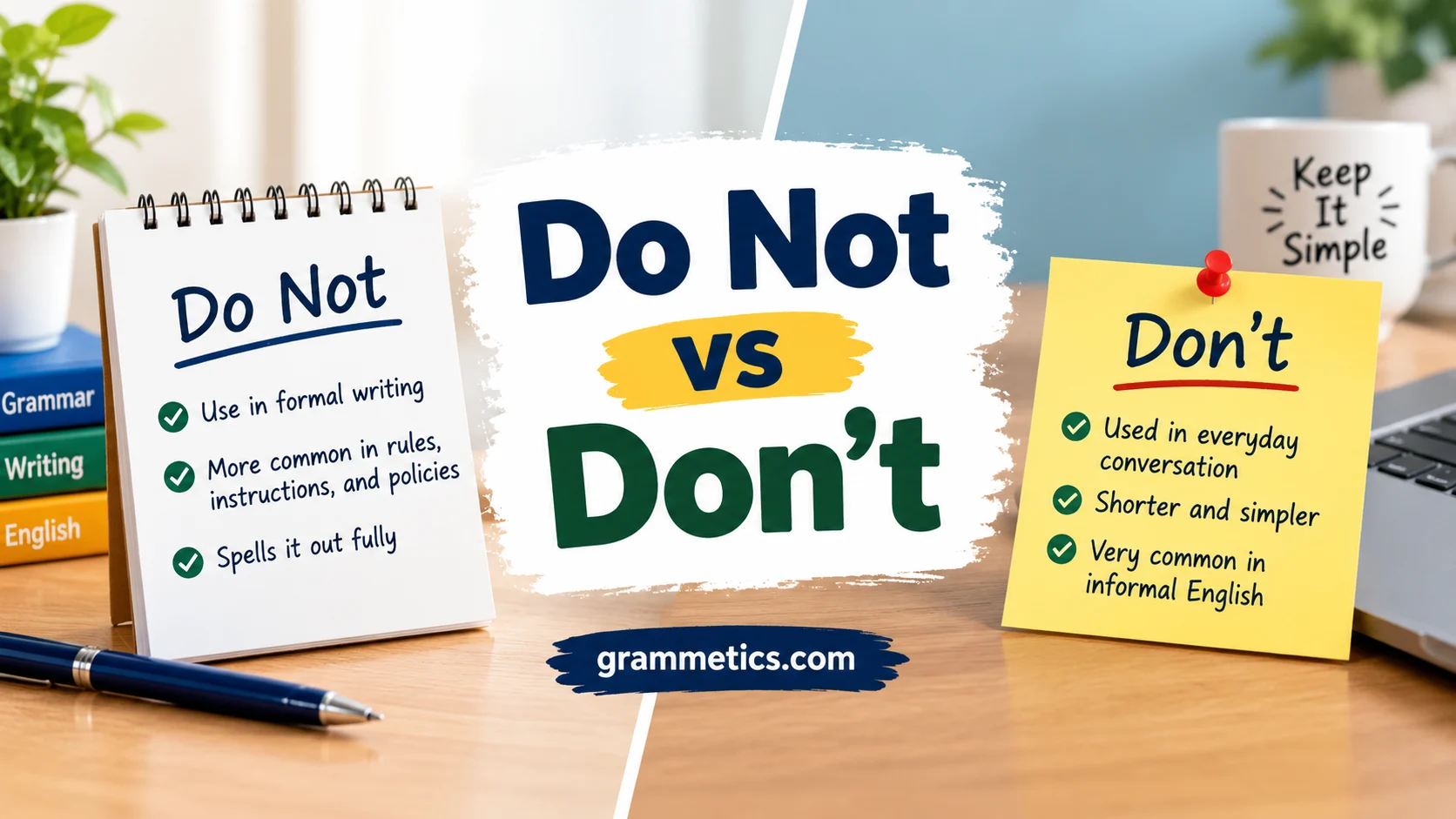
“Do not” and “don’t” have the same basic meaning, but they are not always used in exactly the same situations. Both forms express negation with the verb “do,” and both can be used to say that someone does not perform an action or should not perform one. The main difference is formality, emphasis, and tone. “Do not” is the full form, while “don’t” is its contraction.
Understanding when to use do not vs don’t can make your English sound more natural and appropriate for the situation. In everyday conversations, “don’t” is extremely common because it sounds relaxed and conversational. “Do not,” on the other hand, often appears in formal writing, instructions, warnings, and situations where the speaker wants to emphasize the negative. Learning this small distinction can help you improve your grammar, writing style, and overall English communication.
Quick Answer
“Do not” and “don’t” mean the same thing. “Do not” is the full and more formal form, while “don’t” is the contracted form commonly used in everyday speech and informal writing. Use “do not” for emphasis, formal contexts, or official instructions; use “don’t” for natural conversation.
Why People Confuse It
People often wonder whether do not vs don’t represents a difference in meaning. Usually, it does not.
The two forms are grammatically equivalent:
- I do not understand.
- I don’t understand.
Both mean that the speaker does not understand.
The confusion comes from the fact that their tone and usage can differ.
“Don’t” sounds shorter, more natural, and conversational. “Do not” can sound formal or more emphatic.
Compare:
Please don’t touch the display.
This sounds like an ordinary request.
Do not touch the display.
This sounds more like a firm instruction or warning.
First Word: Do Not
“Do not” is the full form of the negative auxiliary verb construction.
It is commonly used with the base form of a verb:
- I do not know.
- You do not need it.
- We do not agree.
- They do not understand.
- Do not open the door.
When “Do Not” Is Common
You will often see do not in:
- Formal writing
- Academic writing
- Official instructions
- Signs and notices
- Rules and regulations
- Strong commands
- Situations where the negative needs emphasis
For example:
Do not enter this area.
This sounds more authoritative than:
Don’t enter this area.
“Do Not” for Emphasis
Sometimes speakers deliberately use the full form to emphasize a negative statement.
For example:
I do not want to discuss this matter.
The full form can make the refusal sound stronger than:
I don’t want to discuss this matter.
The exact tone still depends on context and intonation.
Second Word: Don’t
“Don’t” is the contraction of “do not.”
It is extremely common in everyday English.
Examples include:
- I don’t know.
- You don’t need to worry.
- We don’t have enough time.
- They don’t like coffee.
- Don’t forget your keys.
“Don’t” is especially natural in:
- Casual conversations
- Text messages
- Emails between people who know each other
- Informal writing
- Everyday questions and answers
- Friendly instructions
For example:
Don’t worry about it.
This sounds natural and friendly.
Don’t = Do Not
In most grammatical situations, you can replace “don’t” with “do not” without changing the basic meaning.
I don’t understand.
= I do not understand.
They don’t agree.
= They do not agree.
The grammar remains correct; the style and emphasis change.
Comparison Table
| Feature | Do Not | Don’t |
| Form | Full form | Contraction |
| Meaning | Negative | Negative |
| Tone | Formal or emphatic | Casual and conversational |
| Common in speech | Less common | Very common |
| Formal writing | Often preferred | Sometimes avoided |
| Informal writing | Correct | Very common |
| Commands | Common for strong instructions | Common for everyday commands |
| Example | Do not touch this. | Don’t touch this. |
When to Use Each
Use “Do Not” When:
Use do not when you want your English to sound formal, official, or emphatic.
Examples:
- Do not remove the label.
- Please do not share this information.
- We do not accept returns without a receipt.
- I do not agree with that statement.
It is particularly useful when writing instructions, policies, academic material, or official notices.
Use “Don’t” When:
Use don’t when communicating naturally in everyday situations.
Examples:
- I don’t know the answer.
- Don’t be late.
- We don’t have much time.
- You don’t need to call me.
In ordinary conversation, “don’t” usually sounds more natural than “do not.”
A Simple Rule
Think of it this way:
Formal or emphatic → do not
Conversational or informal → don’t
This is a useful guideline, although context always matters.
Examples of Do Not vs Don’t
Here are some practical examples:
- I do not understand the question.
I don’t understand the question. - We do not have enough information.
We don’t have enough information. - Please do not touch the equipment.
Please don’t touch the equipment. - They do not live here anymore.
They don’t live here anymore. - I do not want to argue.
I don’t want to argue. - Do not forget your passport.
Don’t forget your passport. - You do not need to apologize.
You don’t need to apologize. - We do not sell this product.
We don’t sell this product. - I do not believe that is correct.
I don’t believe that is correct. - Do not enter without permission.
Don’t enter without permission. - They do not understand English well.
They don’t understand English well. - I do not remember his name.
I don’t remember his name.
Notice that the meaning stays essentially the same in each pair. What changes is mainly the level of formality and emphasis.
Common Mistakes
1. Writing “Dont”
The contraction requires an apostrophe.
❌ I dont know.
✅ I don’t know.
The apostrophe shows that letters have been omitted from do not.
2. Using “Do Not” as Two Separate Verbs
“Do not” works as a negative auxiliary construction.
Correct:
✅ I do not like coffee.
Incorrect:
❌ I do not liking coffee.
After “do not,” use the base form of the main verb.
3. Using “Don’t” With Third-Person Singular Subjects
For he, she, and it, use doesn’t, not “don’t,” in standard English.
❌ She don’t like tea.
✅ She doesn’t like tea.
However:
✅ I don’t like tea.
4. Thinking “Do Not” Is Always Better
“Do not” is not automatically more grammatically correct.
Both are correct:
- I do not know.
- I don’t know.
The best choice depends on the context and desired tone.
Memory Trick
Use this simple memory trick:
DON’T = DO NOT
The apostrophe in don’t replaces the missing letters from do not.
Think:
do not → don’t
If you are writing something formal or want extra emphasis, choose do not.
If you are having a normal conversation, don’t will usually sound more natural.
American vs British English
Both American English and British English commonly use “don’t” in everyday conversation.
For example:
- American: I don’t know.
- British: I don’t know.
There is no major difference between American and British English in the basic meaning of do not and don’t.
Both varieties also use do not for formal writing, strong emphasis, instructions, and official language.
The choice is therefore mainly about context and style, rather than a difference between American and British grammar.
Similar Words
Several related negative forms can cause confusion.
Do Not vs Does Not
Use do not with I, you, we, and they.
- I do not understand.
- They do not agree.
Use does not with he, she, and it.
- She does not understand.
- It does not work.
Don’t vs Doesn’t
Don’t = do not
Doesn’t = does not
Examples:
- I don’t like it.
- They don’t like it.
- She doesn’t like it.
- He doesn’t understand.
Do Not vs Never
These are not always interchangeable.
I do not smoke. means the person does not smoke.
I never smoke. emphasizes that smoking does not happen at any time.
The words have related negative meanings but different grammatical structures.
Final Verdict
Do not and don’t are both correct forms of standard English. The important difference is not basic meaning but style, formality, and emphasis.
Use don’t for natural everyday conversation and informal communication. Choose do not when writing formal material, giving official instructions, or deliberately emphasizing a negative statement.
FAQs
1. Is “do not” the same as “don’t”?
Yes. “Don’t” is the contraction of “do not,” and both generally have the same meaning.
2. Is “don’t” informal?
“Don’t” is less formal than “do not,” but it is completely standard English and is extremely common in everyday speech and writing.
3. Should I use “do not” in formal writing?
Generally, do not is a good choice for formal writing when you want to avoid contractions or create a more formal tone.
4. Is “don’t” grammatically correct?
Yes. Don’t is a standard contraction of “do not.”
5. Which is stronger: “do not” or “don’t”?
“Do not” can sound stronger or more emphatic, especially in commands or formal instructions, although tone and context determine the actual effect.
6. Can I use “don’t” in an essay?
You can, depending on the style guide and type of essay. However, academic or highly formal writing often avoids contractions and uses do not instead.
7. What is the difference between “don’t” and “doesn’t”?
Don’t means do not and is used with I, you, we, and they. Doesn’t means does not and is used with he, she, and it.
Conclusion
The difference between do not vs don’t is easy to remember once you focus on context. “Don’t” is simply the contracted form of “do not,” so the two expressions normally communicate the same basic negative meaning. The main distinction is the level of formality and emphasis.
In everyday English, don’t is usually the more natural choice. In formal writing, official instructions, rules, notices, or situations where you want to emphasize a negative statement, do not can be more appropriate. Learning this distinction will help you choose words that fit both the grammar and the situation.
Remember This
Do not = full form
Don’t = contraction
Formal/emphatic → Do not
Conversational/informal → Don’t
Both are correct. Choose the form that matches your context, audience, and tone.

I’m Elliot Pierce, Administrator at Grammetics, dedicated to improving word matching and grammar. I help maintain useful content, support readers, and make language learning simple, clear, accurate, and engaging.