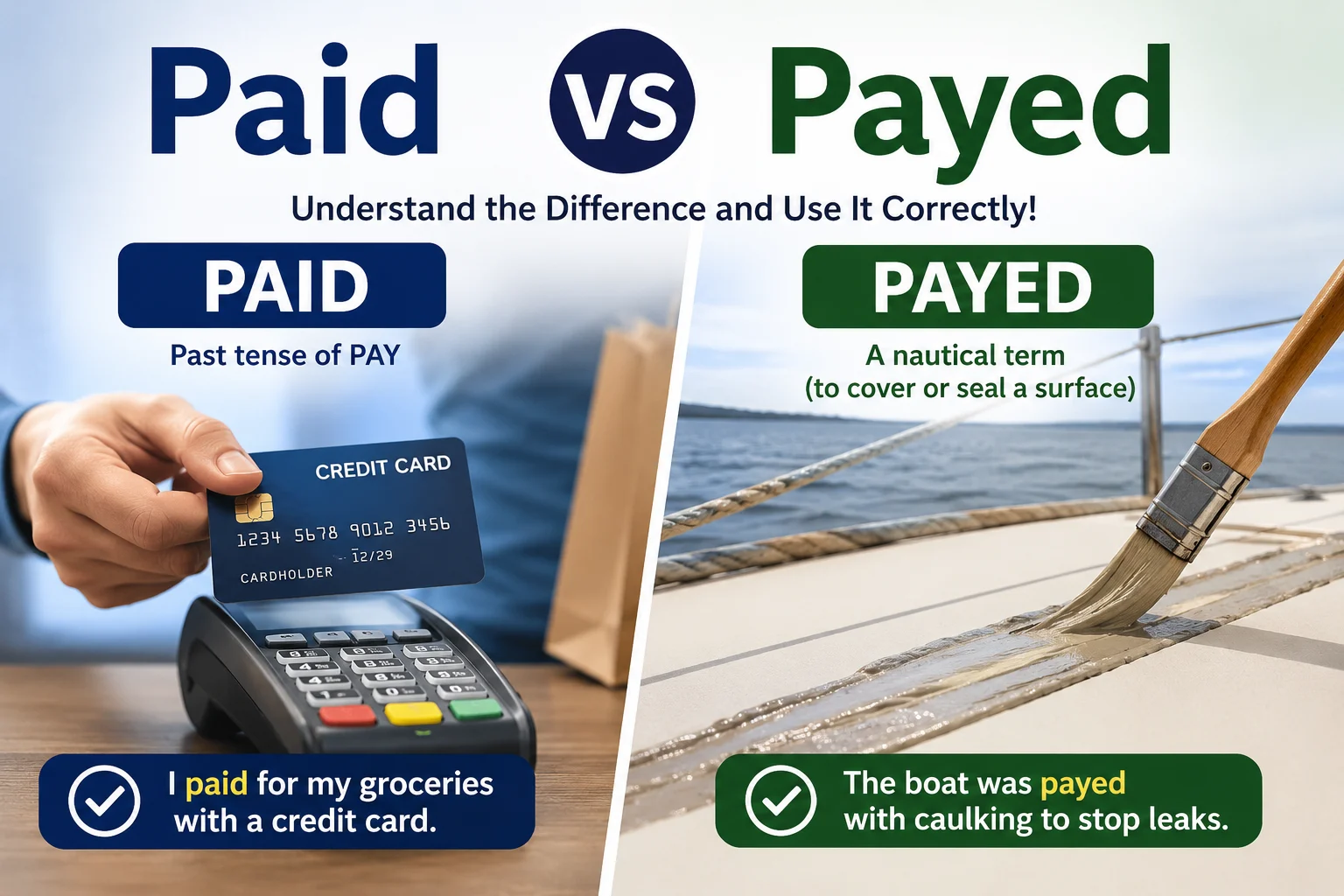
English learners often hesitate between paid vs payed because both words are associated with the verb pay. At first glance, the difference seems simple, but “payed” has a legitimate use that makes the choice more confusing. In everyday English, however, one form is overwhelmingly more common.
The key is understanding that paid is the standard past tense and past participle of pay when you mean giving money, settling a bill, or compensating someone. Payed is a specialized word mainly used in nautical contexts, particularly when referring to letting out or sealing something such as rope, cable, or a ship’s deck. Once you understand this distinction, choosing the correct spelling becomes much easier. In this guide, you’ll learn the meanings, grammar rules, examples, common mistakes, and a simple memory trick to remember paid vs payed permanently.
Quick Answer
Paid is the correct past tense of pay when talking about money, bills, wages, or debts: “I paid the bill.” Payed is a rare nautical term used for actions involving rope, cable, or ship-related materials. For ordinary English, use paid.
Why People Confuse It
The confusion comes from the fact that pay is an irregular verb.
Many English verbs form their past tense by adding -ed:
- play → played
- work → worked
- call → called
- clean → cleaned
So it is natural to assume:
pay → payed
But English does not always follow this pattern. The ordinary past tense of pay is paid.
- Present: pay
- Past: paid
- Past participle: paid
The word payed does exist, but its meaning is much narrower.
First Word: Paid
Paid is the past tense and past participle of pay when referring to money or other ordinary meanings of payment.
Meaning of Paid
Paid means that money was given or that an obligation was settled.
It can refer to:
- Paying a bill
- Paying a debt
- Paying for something
- Paying an employee
- Paying taxes
- Paying a fee
- Paying a fine
- Paying someone for a service
Examples
- I paid the electricity bill yesterday.
- She paid for her new laptop.
- We have already paid the rent.
- He paid me $50 for the repair.
- They paid their taxes on time.
Paid as a Past Participle
Paid can also be used with helping verbs such as have, has, and had.
- I have paid the bill.
- She has paid for the tickets.
- They had already paid the fee.
It can also function as an adjective:
- The invoice is paid.
- We need a paid employee for this position.
- The subscription is already paid.
Second Word: Payed
Payed is a real English word, but it is rare and specialized.
It is primarily used in nautical language. In this context, payed can describe letting out, loosening, or handling rope, cable, or related ship equipment.
For example:
The sailors payed out the rope.
Here, payed out has a specialized nautical meaning. It does not mean that the sailors gave someone money.
In ordinary conversations about money, payed is incorrect.
Simple Rule
If you’re talking about money, choose paid.
If you’re discussing a specialized nautical action involving rope or cable, payed may be correct.
Comparison Table
| Word | Meaning | Common Usage | Example |
| Paid | Gave money or settled an obligation | Very common | I paid the bill. |
| Paid | Past tense of pay | Everyday English | She paid for dinner. |
| Paid | Past participle of pay | Everyday English | He has paid already. |
| Payed | Nautical term involving rope/cable | Very rare | They payed out the rope. |
When to Use Each
Use “Paid” When Talking About Money
Use paid for almost every normal situation involving payment.
- I paid the rent.
- She paid the cashier.
- We paid the school fee.
- He paid his debt.
- They paid for the meal.
Use “Payed” Only in Specialized Nautical Contexts
Payed can appear in technical or maritime writing.
For example:
- The crew payed out the cable.
- The sailors payed out additional rope.
For general writing, business communication, emails, school assignments, and everyday conversation, paid is almost certainly the word you need.
Examples of Paid vs Payed
Here are more examples to make the distinction clear.
- I paid the restaurant bill.
Correct because this involves money. - She paid for the new shoes.
Correct. - Have you paid your electricity bill?
Correct. - He paid me for the work.
Correct. - We paid the registration fee yesterday.
Correct. - The company paid its employees on Friday.
Correct. - I have already paid for the tickets.
Correct. - They paid their outstanding debt.
Correct. - The sailors payed out the rope.
Correct in the specialized nautical sense. - The crew payed out more cable.
Correct in nautical/technical usage. - I payed my credit card bill yesterday.
Incorrect. Use paid. - She payed for the groceries.
Incorrect. Use paid. - He payed his employees last week.
Incorrect. Use paid. - We payed the invoice this morning.
Incorrect. Use paid. - Have you payed the school fee?
Incorrect. Use paid.
Common Mistakes
Mistake 1: Adding “-ed” to Pay
Because many regular verbs take -ed, learners sometimes write:
❌ I payed the bill.
✅ I paid the bill.
Mistake 2: Thinking “Payed” Is Always Wrong
This is also an oversimplification.
Payed can be a legitimate word in specialized nautical English.
So this statement is too broad:
“Payed is never a word.”
A better rule is:
Paid is used for ordinary payment; payed has specialized nautical uses.
Mistake 3: Using “Payed” in Business Writing
You may see payed occasionally online, but that doesn’t make it standard for financial contexts.
Use:
- paid invoice
- paid bill
- paid fee
- paid employee
- paid subscription
Not:
- ❌ payed invoice
- ❌ payed bill
- ❌ payed fee
Memory Trick
Here’s an easy way to remember paid vs payed:
Money = Paid
Think:
Money gets PAID.
If money changes hands, use paid.
Paid the bill.
Paid the rent.
Paid the fee.
Paid the debt.
Rope = Payed
Think:
Rope can be PAYED out.
If you’re reading specialized nautical language about releasing or handling rope or cable, payed may be the appropriate form.
Money → PAID
Nautical rope/cable → PAYED
American vs British English
There is essentially no major American-versus-British difference in the ordinary use of these words.
Both American and British English use:
pay → paid → paid
For example:
- American English: I paid the bill.
- British English: I paid the bill.
The specialized nautical use of payed is also not simply an American or British spelling difference. It is a matter of meaning and technical usage.
Similar Words
If you’re learning the different forms of pay, these related words are useful:
Pay
The present-tense form.
I pay my bills every month.
Paid
The standard past tense and past participle.
I paid my bill yesterday.
Paying
The present participle or gerund.
She is paying for dinner.
Payment
The noun referring to money given to settle an obligation.
Your payment is due Friday.
Payer
A person or organization that makes a payment.
The payer must provide the required information.
Payable
Something that must or can be paid.
The invoice is payable within 30 days.
FAQs
Is “payed” a correct word?
Yes, payed is a real word, but it is uncommon. It is mainly used in specialized nautical contexts involving actions such as letting out rope or cable.
Is it “paid” or “payed” a bill?
The correct form is paid.
I paid the bill.
Is “I payed for it” correct?
No. In standard everyday English, write:
I paid for it.
What is the past tense of pay?
The past tense of pay is paid.
Present: I pay.
Past: I paid.
What is the past participle of pay?
The past participle is also paid.
I have paid the invoice.
When can I use “payed”?
Use payed mainly in specialized nautical terminology, particularly when referring to paying out rope, cable, or similar material.
Why isn’t “payed” the normal past tense?
Pay is an irregular verb in its ordinary financial sense. Its standard past form developed as paid, rather than the regular payed.
Final Verdict
For almost every everyday situation, paid is the correct choice. If you’re talking about a bill, salary, debt, fee, purchase, tax, service, or any other ordinary financial transaction, use paid.
Payed isn’t simply a spelling mistake, though. It has a legitimate but highly specialized nautical use. Unless you’re writing about maritime terminology involving rope, cable, or similar technical actions, paid is the word you want.
Conclusion
The difference between paid vs payed becomes easy once you focus on meaning rather than spelling. Paid is the standard past tense and past participle of pay when money is involved: “I paid the bill,” “She has paid the fee,” and “They paid their employees.” It is the form you will use in normal English.
Payed survives mainly as a specialized nautical term, so encountering it in technical writing does not automatically mean it is a spelling error. For everyday English, however, there is a simple rule: when you’re talking about money, use paid.
Remember This
💰 Money = PAID
⚓ Nautical rope/cable = PAYED

I’m Elliot Pierce, Administrator at Grammetics, dedicated to improving word matching and grammar. I help maintain useful content, support readers, and make language learning simple, clear, accurate, and engaging.