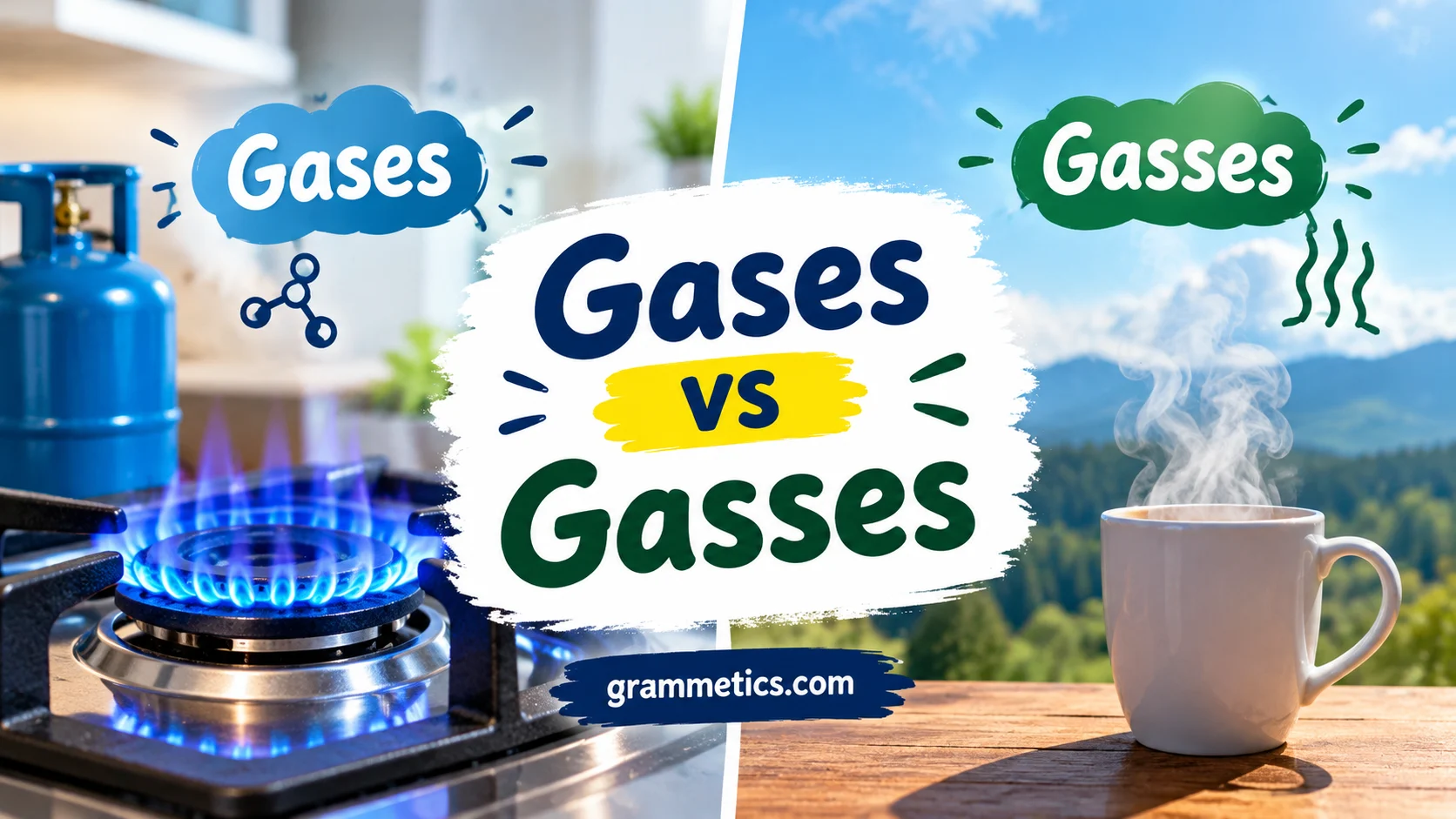
When you come across gases vs gasses, it is easy to wonder whether one spelling is wrong. Both forms are real English words, but they have different meanings and grammatical uses. The confusion mainly comes from the fact that gases and gasses are pronounced similarly in many contexts, while their spelling changes depending on the word they come from.
Gases is the plural of gas, referring to substances such as oxygen, hydrogen, carbon dioxide, or water vapor. Gasses, on the other hand, is a form of the verb gass, which means to talk excessively or, in informal usage, to flatter or excite someone. In some contexts, gasses can also be used as the third-person singular form of gass. Understanding this small spelling difference can help you avoid errors in writing, especially in science, education, and everyday communication.
Quick Answer
Gases is the standard plural of gas and refers to more than one gas. Gasses is a verb form of the less common verb gass, meaning to talk excessively or flatter. For scientific substances, always use gases: Oxygen and nitrogen are gases.
Why People Confuse It
The confusion between gases and gasses comes mainly from pronunciation and spelling patterns.
Normally, the plural of a noun ending in a single s does not simply become a double-s spelling. For example:
- gas → gases
- bus → buses
- class → classes
However, English has another word, gass, which is a verb. Its third-person singular form is gasses.
Because gas and gass look and sound similar, writers sometimes add an extra s when they mean the plural noun.
A simple way to remember the difference is:
Gas → gases when you mean substances.
Gass → gasses when you are using the verb.
Gases
Gases is the plural form of the noun gas.
A gas is a state of matter that has no fixed shape or volume and expands to fill its container. Common examples include oxygen, nitrogen, helium, hydrogen, and carbon dioxide.
Examples of gases
- Oxygen and nitrogen are gases.
- Some gases are invisible.
- Greenhouse gases can affect Earth’s climate.
- Scientists study different gases in laboratories.
- The reaction released several gases.
In most everyday and scientific writing, gases is the word you are looking for when referring to more than one gas.
Singular and plural
- Singular: gas
- Plural: gases
For example:
Carbon dioxide is a gas.
Carbon dioxide and oxygen are gases.
Gasses
Gasses is a verb form associated with gass, an informal or relatively uncommon verb.
Depending on the dictionary and context, gass can mean to talk excessively, chat, or flatter/excite someone.
For example:
He gasses about his new car all day.
Here, gasses is not the plural of gas. It is a verb.
The form can be broken down as:
- gass = base verb
- gasses = third-person singular present form
- gassing = present participle
- gassed = past tense/past participle
Because gass is uncommon, you are much more likely to encounter gases in standard writing.
Comparison Table
| Word | Word Type | Meaning | Example |
| gas | Noun | A substance in a gaseous state | Oxygen is a gas. |
| gases | Plural noun | More than one gas | Oxygen and hydrogen are gases. |
| gass | Verb | To talk excessively or flatter/excite, depending on context | He likes to gass about his achievements. |
| gasses | Verb | Third-person singular form of gass | He gasses about his success. |
When to Use Each
Use “gases” when talking about substances
Choose gases when you mean two or more types or quantities of gas.
Examples:
- toxic gases
- natural gases
- greenhouse gases
- noble gases
- industrial gases
- exhaust gases
Example:
The factory released several harmful gases.
Use “gasses” when using the verb “gass”
Use gasses when the sentence requires the third-person singular form of gass.
Example:
He gasses about his achievements whenever we meet.
Because gass is uncommon, check the intended meaning and context carefully before using gasses.
Examples of Gases vs Gasses
Here are clear examples showing the difference:
- Oxygen and hydrogen are gases.
- Several gases were detected in the laboratory.
- Carbon dioxide is one of the gases found in Earth’s atmosphere.
- Some gases have no color or smell.
- Scientists can separate certain gases using specialized equipment.
- The experiment produced two different gases.
- Greenhouse gases include carbon dioxide and methane.
- The container was filled with different gases.
- He gasses about his accomplishments whenever he gets the opportunity.
- She said he gasses too much about his expensive belongings.
- The scientist measured the gases produced during the reaction.
- Different gases behave differently under changing conditions.
Notice that examples 1–8 and 11–12 refer to substances, so gases is correct. Examples involving the uncommon verb gass use gasses.
Common Mistakes
Mistake 1: Writing “gasses” for the plural of gas
❌ Oxygen and nitrogen are gasses.
✅ Oxygen and nitrogen are gases.
The noun gas becomes gases in the plural.
Mistake 2: Assuming “gases” is always a verb
❌ He gases about his achievements.
This may be incorrect if you intend the uncommon verb gass. The correct form for that verb is gasses.
Mistake 3: Adding an unnecessary extra “s”
A common spelling error is treating gas as though its plural were formed by simply adding -s:
gas + s = gass
English instead uses:
gas → gases
The spelling changes to accommodate the plural ending.
Mistake 4: Confusing spelling with pronunciation
The pronunciation can make these words difficult to distinguish in conversation. When writing, focus on the meaning and grammatical role rather than sound alone.
Memory Trick
Use this simple trick:
Gas + ES = Gases
Think:
One gas → many gases
If you are talking about oxygen, helium, methane, nitrogen, or other substances, choose gases.
For the uncommon verb:
Gass → gasses
So remember:
Substances = GASES
Verb = GASSES
American vs British English
The spelling gases is standard in both American English and British English when gas is used as a plural noun.
For example:
- American English: Greenhouse gases
- British English: Greenhouse gases
There is no major American-versus-British spelling difference here.
The important distinction is between the noun gas and the less common verb gass. Therefore, regional English generally does not change the basic rule:
gas → gases
Similar Words
Understanding related words can make this spelling rule easier.
Gas vs gases
- gas = singular noun
- gases = plural noun
Example:
Methane is a gas.
Methane and oxygen are gases.
Gas vs gass
- gas = common noun referring to a gaseous substance
- gass = uncommon verb
These are separate words with different grammatical functions.
Gases vs gasses
- gases = plural of gas
- gasses = verb form of gass
This distinction is the key to understanding the entire gases vs gasses question.
Final Verdict
If you are asking for the plural of gas, the correct spelling is gases.
Use gasses only when you specifically mean the third-person singular form of the uncommon verb gass. In scientific, academic, educational, and most everyday contexts involving substances, gases is overwhelmingly the form you need.
FAQs
Is “gases” the plural of gas?
Yes. Gases is the standard plural form of gas.
Is “gasses” a correct word?
Yes, but it has a different grammatical function. Gasses is a form of the uncommon verb gass, rather than the normal plural of gas.
Which is correct: gases or gasses?
Both can be correct depending on meaning. Use gases for the plural noun and gasses for the verb form of gass.
What is the plural of gas?
The plural of gas is gases.
Why isn’t the plural of gas “gasses”?
English forms the plural of gas as gases, with -es. The spelling gasses belongs to the separate verb gass.
Are gases and gasses pronounced the same?
They can sound very similar, which is one reason they are frequently confused. Their grammatical roles and meanings distinguish them in writing.
Should I use “gases” in scientific writing?
Yes. When referring to multiple gaseous substances, gases is the standard spelling used in scientific and academic writing.
Conclusion
The difference between gases and gasses becomes straightforward once you identify the word’s grammatical role. Gases is the plural noun you use for multiple gaseous substances, such as oxygen, nitrogen, methane, or carbon dioxide. It is the spelling you will encounter most often in science, education, news, and everyday writing.
Gasses has a separate role as a form of the uncommon verb gass. So, if you’re writing about physical substances, don’t add an extra s: write gases. Remembering “gas → gases” will help you avoid one of the most common spelling mistakes involving this word.
Remember This
Gas → Gases = more than one gaseous substance.
Gass → Gasses = a verb form of the uncommon word gass.

I’m Aria White, a passionate word enthusiast who enjoys exploring grammar, vocabulary, and meaningful word connections. I create simple, helpful content that makes matching words easier, clearer, and enjoyable.