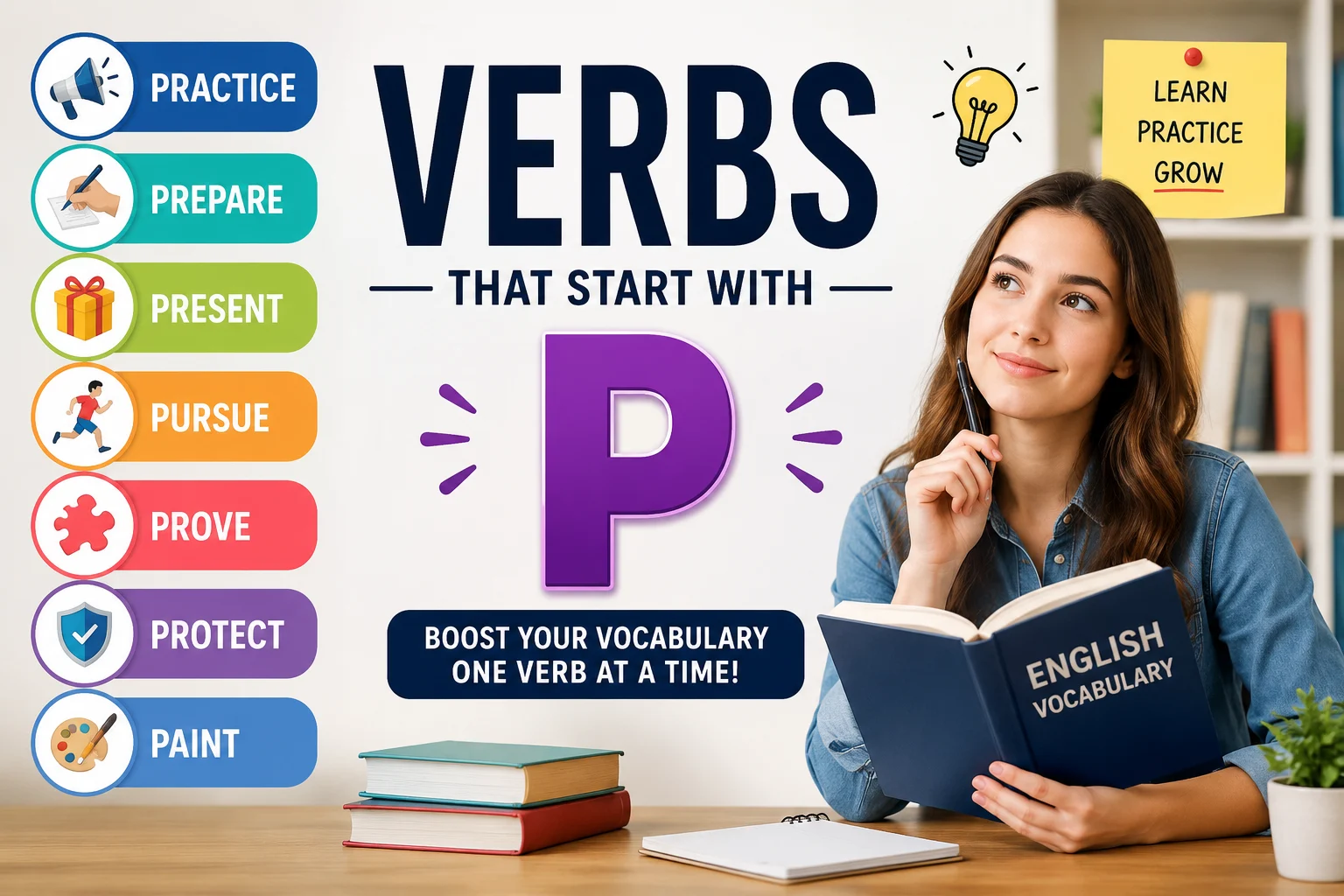
Looking for verbs that start with P? Whether you are improving your English vocabulary, writing an essay, preparing for an exam, or simply searching for stronger action words, P offers an impressive range of verbs. Words such as play, plan, prepare, protect, and persuade are common in everyday English, while verbs like perceive, prioritize, preserve, and proclaim can make your writing more precise and expressive.
Learning verbs by their first letter is also a practical way to expand your vocabulary without memorizing random word lists. In this guide, you will find common and useful P verbs, their meanings, example sentences, related words, and tips for using them correctly. From simple action verbs to more advanced vocabulary, this list is designed to help students, writers, teachers, and English learners use P verbs naturally and confidently.
Quick Answer
Verbs that start with P include paint, park, pass, pay, perform, persuade, plan, play, point, prepare, present, prevent, protect, prove, and provide. They describe actions, thoughts, communication, movement, decisions, and many everyday activities.
Why People Confuse It
People do not usually confuse one particular P verb with another. The bigger challenge is choosing the right verb for the intended meaning.
Many P verbs look or sound similar but have different uses:
- Prescribe means to officially recommend, especially medicine.
- Proscribe means to officially forbid.
- Persuade means to convince someone.
- Prevent means to stop something from happening.
- Proceed means to continue or move forward.
- Process means to deal with or handle something systematically.
Another common difficulty is distinguishing between everyday verbs and more advanced alternatives. For example, help is perfectly natural, but provide assistance may be more appropriate in formal writing.
First Word
Since this topic covers many words rather than one word pair, let’s start with some of the most common P verbs you will encounter in everyday English.
Common verbs that start with P
- Paint — to apply color to a surface.
- Park — to leave a vehicle in a particular place.
- Pass — to move beyond something or succeed in a test.
- Pay — to give money for something.
- Perform — to carry out an action or entertain an audience.
- Permit — to allow something.
- Persuade — to convince someone to do or believe something.
- Plan — to decide what you intend to do.
- Play — to participate in a game or activity.
- Point — to direct attention toward something.
- Practice — to do something repeatedly to improve.
- Praise — to express approval or admiration.
- Prefer — to like one thing more than another.
- Prepare — to make something or someone ready.
- Present — to show, introduce, or give something.
- Prevent — to stop something from happening.
- Produce — to make or create something.
- Promise — to say that you will definitely do something.
- Protect — to keep someone or something safe.
- Provide — to give or supply something.
Second Word
Beyond common vocabulary, English has many advanced verbs beginning with P. These can be particularly useful in academic, professional, and formal writing.
Some examples include:
- Perceive — to become aware of or understand something.
- Prioritize — to decide what is most important.
- Proclaim — to announce something publicly.
- Prohibit — to officially prevent something.
- Promote — to support, encourage, or advance something.
- Preserve — to protect something from damage or change.
- Proceed — to continue or move forward.
- Propose — to formally suggest an idea or plan.
- Prosecute — to conduct legal proceedings against someone.
- Participate — to take part in an activity.
- Predict — to say what you think will happen.
- Prove — to demonstrate that something is true.
- Publish — to make written or other material available publicly.
- Pursue — to continue trying to achieve something.
- Ponder — to think about something carefully.
These verbs can help you move beyond basic vocabulary and communicate ideas with greater accuracy.
Comparison Table
| P Verb | Meaning | Example |
| Paint | Apply color | She painted the wall blue. |
| Participate | Take part | Everyone participated in the activity. |
| Perceive | Become aware of | I perceived a change in his attitude. |
| Perform | Carry out or entertain | The team performed well. |
| Permit | Allow | The teacher permitted us to leave early. |
| Persuade | Convince | She persuaded him to apply. |
| Plan | Decide in advance | We planned the trip carefully. |
| Praise | Express approval | The manager praised her work. |
| Prefer | Like better | I prefer tea to coffee. |
| Prepare | Make ready | They prepared for the examination. |
| Prevent | Stop from happening | Exercise can prevent some health problems. |
| Produce | Make or create | The factory produces furniture. |
| Propose | Suggest formally | He proposed a new solution. |
| Protect | Keep safe | Helmets protect cyclists. |
| Provide | Give or supply | The school provides free books. |
| Prove | Show something is true | The evidence proved his claim. |
| Publish | Make public | The author published a new book. |
| Pursue | Continue seeking | She pursued her career goals. |
When to Use Each
Choosing the right P verb depends on the situation.
For everyday conversation
Use simple verbs such as:
- play
- pass
- pay
- park
- plan
- point
- practice
- prefer
- prepare
- protect
Example:
“I need to prepare for tomorrow’s meeting.”
For academic writing
More precise verbs can strengthen your writing:
- analyze
- perceive
- predict
- propose
- demonstrate
- prove
- prioritize
- investigate
Example:
“The researchers proposed a new explanation for the results.”
For professional communication
Useful business and workplace verbs include:
- plan
- present
- promote
- prioritize
- process
- produce
- provide
- propose
- perform
Example:
“Our team will present the findings next Monday.”
For creative writing
Verbs such as paint, portray, pursue, ponder, and proclaim can add variety and detail.
Example:
“She pondered the mysterious message before opening the door.”
Examples (10+)
Here are 20 examples of verbs that start with P used naturally in sentences:
- Please close the door quietly.
- Sarah painted a beautiful landscape.
- We parked the car near the entrance.
- He passed the final examination.
- I need to pay the electricity bill.
- The students performed a short play.
- You must permit the system to update.
- The lawyer persuaded the jury with strong evidence.
- We planned everything before the journey.
- The children played in the garden.
- She pointed toward the mountain.
- You should practice speaking English every day.
- The teacher praised the student for her effort.
- I prefer reading books to watching television.
- They prepared dinner for the guests.
- Wearing protective equipment can prevent injuries.
- The company produces high-quality products.
- He promised to call me later.
- The organization works to protect endangered animals.
- The website provides useful information for learners.
Common Mistakes
1. Confusing persuade and convince
Persuade is commonly followed by a person plus an action:
She persuaded me to apply.
Convince is often followed by a person plus a belief or idea:
She convinced me that it was safe.
2. Using prefer incorrectly
Avoid:
I prefer coffee than tea.
Use:
I prefer coffee to tea.
3. Confusing practice and practise
In American English, practice is used as both noun and verb.
In British English, practice is generally the noun, while practise is the verb.
4. Confusing permit and prohibit
These have almost opposite meanings:
- Permit = allow
- Prohibit = officially forbid
5. Using provide without the correct structure
Both of these patterns are common:
The school provided students with books.
The school provided books to students.
Memory Trick
A simple way to remember P verbs is to group them by purpose:
P = People, Plans, Progress, Protection, and Production
- People: persuade, praise, please, punish
- Plans: plan, prepare, propose
- Progress: proceed, pursue, progress
- Protection: prevent, protect, preserve
- Production: produce, publish, provide
Grouping vocabulary by meaning makes it easier to remember than memorizing an alphabetical list alone.
American vs British English
Most verbs beginning with P are used similarly in American and British English. However, a few spelling differences are worth knowing.
The best-known example is:
- American English: practice — noun and verb
- British English: practice — noun
- British English: practise — verb
For example:
American English:
“I practice English every day.”
British English:
“I practise English every day.”
Other P verbs, such as plan, prepare, protect, provide, and prefer, generally maintain the same spelling and meaning in both varieties.
Similar Words
Some P verbs are closely related in meaning but are not interchangeable.
| Verb | Meaning | Key Difference |
| Persuade | Convince someone | Focuses on influencing a person |
| Prevent | Stop something | Stops an event from occurring |
| Permit | Allow | Gives permission |
| Prohibit | Forbid | Officially stops or bans |
| Preserve | Keep safe or unchanged | Protects something from deterioration |
| Protect | Keep safe from harm | Focuses on safety |
| Proceed | Continue | Indicates movement or continuation |
| Pursue | Continue seeking | Focuses on achieving or following something |
| Propose | Suggest | Offers an idea or plan |
| Promote | Encourage or advance | Helps something develop or gain attention |
FAQs
What are some common verbs that start with P?
Common P verbs include play, plan, pay, pass, park, paint, practice, praise, prefer, prepare, protect, provide, produce, and perform.
What is a strong verb that starts with P?
Persuade, prioritize, pursue, preserve, promote, and proclaim are strong choices when you want more precise or advanced vocabulary.
What are positive verbs that start with P?
Positive P verbs include praise, promote, protect, provide, please, prepare, progress, and participate.
What are action verbs beginning with P?
Examples include paint, play, push, pull, perform, protect, prepare, pursue, and produce.
What are five verbs starting with P?
Five simple examples are play, plan, pay, prepare, and protect.
Is “practice” a verb?
Yes. Practice is a verb in American English. In British English, practise is normally used as the verb, while practice is the noun.
What is the difference between permit and prohibit?
Permit means to allow something, while prohibit means to officially prevent or forbid something.
Final Verdict
English has a rich collection of verbs that start with P, ranging from simple everyday words such as play and pay to advanced vocabulary such as perceive, prioritize, preserve, and proclaim. Learning these verbs can make your speaking and writing more varied and precise.
The most effective approach is not simply to memorize a long list. Instead, learn each verb with its meaning, grammatical pattern, and a natural example sentence. Pay particular attention to easily confused words such as permit/prohibit and persuade/prevent. With regular practice, these P verbs can become a useful part of your active English vocabulary.
Remember This
P is for powerful action: plan, prepare, perform, persuade, protect, prevent, provide, produce, promote, and pursue.
When learning a new P verb, remember three things: meaning + grammar + example. Knowing all three will help you use the word naturally rather than simply recognizing it.

I’m Aria White, a passionate word enthusiast who enjoys exploring grammar, vocabulary, and meaningful word connections. I create simple, helpful content that makes matching words easier, clearer, and enjoyable.