Have you ever paused while writing the word gluing and wondered whether it should be spelled glueing instead? You are not alone. Many English learners and native speakers find this spelling confusing because the word glue ends with a silent e, and English spelling rules can change when a verb takes an ending such as -ing. Both spellings appear in written English, but one is much more common and widely preferred in modern usage.
Understanding the difference between gluing vs glueing can help you write more confidently in school assignments, professional documents, DIY instructions, and everyday conversations. Although both forms communicate the same basic action, their frequency and acceptance are not identical. Learning the standard spelling rule will make it easier to avoid mistakes and recognize the correct form when reading English texts.
Quick Answer: Gluing vs Glueing
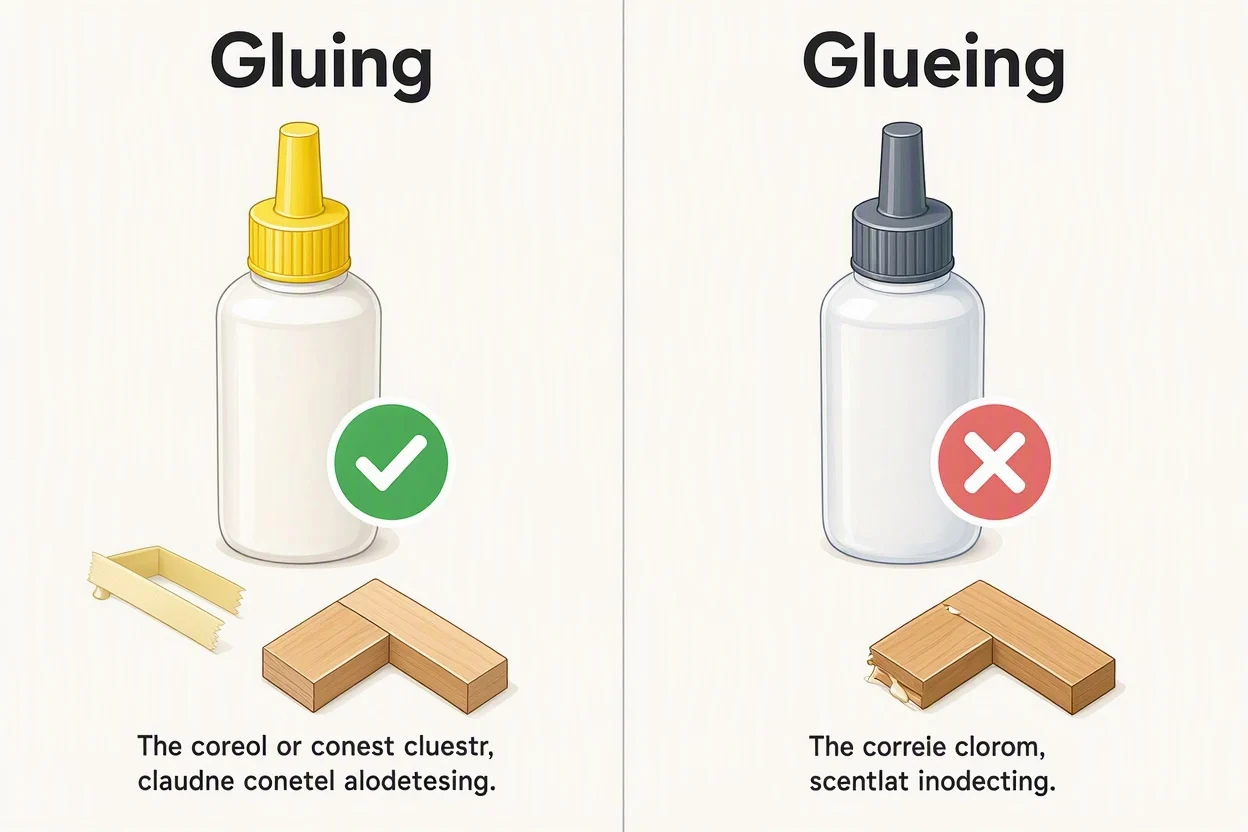
Gluing is the standard and most widely accepted spelling of the present participle of glue. It follows the usual English spelling rule of dropping the final silent e before adding -ing. Glueing is also recorded as a variant, but it is much less common. For most writing, choose gluing.
Why People Confuse It
The confusion between gluing and glueing comes from the way English verbs change when endings are added. Many verbs that end in a silent e drop that letter before taking -ing.
For example:
- Make → making
- Write → writing
- Bake → baking
- Glue → gluing
However, English spelling has exceptions and variations, so writers sometimes assume that keeping the original e is acceptable in every case.
Because glue contains the vowel combination ue, some people prefer glueing to preserve the original appearance of the word. While that spelling is recognized as a variant, gluing is the more conventional choice.
Gluing: Meaning, Definition, and Usage
Gluing is the standard spelling of the verb glue with the -ing ending. It means attaching two or more objects using glue or another adhesive substance.
The word can describe a physical activity, such as repairing a broken cup, assembling a craft project, or fixing a loose piece of furniture.
Examples of Gluing
- I am gluing the broken pieces of the vase together.
- She spent the afternoon gluing photographs into her scrapbook.
- The children are gluing colored paper onto their art projects.
- He is gluing the wooden pieces to build a small model.
- We were gluing the labels onto the jars before the event.
- The carpenter is gluing the loose wooden panel back into place.
- I enjoy gluing paper shapes to create handmade cards.
- They are gluing the cardboard pieces together for the school project.
- My brother is gluing the sole back onto his shoe.
- The students practiced cutting, folding, and gluing paper.
- She kept gluing the edges until the craft looked neat.
- He is gluing the two surfaces together with a strong adhesive.
In each example, gluing describes an action that is happening, continuing, or being discussed as an activity.
Why Is Gluing the Preferred Spelling?
The usual spelling rule for verbs ending in a silent e is to remove the final e before adding -ing. Since glue ends in a silent e, the standard form is gluing.
This spelling is widely used in dictionaries, educational materials, and general writing. It is the safest option when you want to follow conventional modern English spelling.
Glueing: Meaning, Definition, and Usage
Glueing is a less common variant spelling of the present participle of glue. It carries the same meaning as gluing: attaching objects with glue or an adhesive.
Although it may look logical to retain the final e, most writers do not need this extra letter. The spelling glueing is recognized in some dictionaries and references, but it is considerably less common.
Examples of Glueing
The following sentences illustrate how the less common spelling may appear:
- She was glueing the paper decorations onto the poster.
- He spent an hour glueing the pieces of the model together.
- They were glueing the photographs into an album.
- I am glueing the broken ornament back together.
- The children enjoyed glueing shapes onto their drawings.
- We finished glueing the cardboard before painting it.
- The student was glueing the edges of the paper carefully.
- She continued glueing the wooden pieces until the structure was stable.
- He practiced glueing small parts together for his craft project.
- They were glueing the fabric to the backing material.
These sentences are grammatically understandable, but gluing would generally be the better choice in standard contemporary writing.
Gluing vs Glueing: Comparison Table
| Feature | Gluing | Glueing |
| Meaning | Attaching with glue | Attaching with glue |
| Spelling status | Standard, preferred form | Recognized variant |
| Frequency | Much more common | Much less common |
| Spelling rule | Drops the final e | Retains the final e |
| General writing | Recommended | Usually avoid |
| Academic writing | Preferred | Use only if a specific style requires it |
| Example | She is gluing the pieces. | She is glueing the pieces. |
The key difference is spelling preference, not meaning. Both forms refer to the same action, but gluing is the more widely accepted choice for everyday and professional writing.
When to Use Each
Choosing between gluing and glueing is straightforward once you know which spelling is conventional.
When to Use Gluing
Use gluing in almost all ordinary writing situations, including:
- School assignments: “I am gluing the pictures into my notebook.”
- DIY instructions: “Start by gluing the two pieces together.”
- Professional documents: “The technician is gluing the damaged component.”
- Craft tutorials: “Finish the project by gluing the decorative pieces in place.”
- Online content: Use gluing in blog posts, articles, and instructional guides.
This spelling is familiar to most readers and follows the usual rule for adding -ing to verbs ending in a silent e.
When to Use Glueing
Use glueing only when there is a specific reason to retain that variant, such as reproducing a source exactly or following an established house style that explicitly requires it.
Otherwise, there is little practical benefit to choosing the less common spelling. If you are unsure, gluing is the reliable option.
Examples of Gluing vs Glueing in Sentences
Here are additional examples showing how the two spellings compare in context.
| Preferred spelling | Less common variant |
| She is gluing the envelope shut. | She is glueing the envelope shut. |
| I am gluing the broken handle back on. | I am glueing the broken handle back on. |
| They are gluing paper flowers onto the wall. | They are glueing paper flowers onto the wall. |
| He finished gluing the model together. | He finished glueing the model together. |
| We were gluing the pieces during the workshop. | We were glueing the pieces during the workshop. |
| The children are gluing stars onto their posters. | The children are glueing stars onto their posters. |
| She enjoys gluing decorations onto gift boxes. | She enjoys glueing decorations onto gift boxes. |
| I spent the morning gluing the torn pages. | I spent the morning glueing the torn pages. |
| The worker is gluing the rubber strip in place. | The worker is glueing the rubber strip in place. |
| He practiced gluing small wooden blocks together. | He practiced glueing small wooden blocks together. |
Notice that the meaning and grammar remain the same in every pair. The difference is simply which spelling convention the writer follows.
Common Mistakes
Writers sometimes make avoidable errors when using gluing and glueing. Keep these points in mind.
1. Assuming Glueing Is the Only Correct Form
The presence of the final e in glue does not mean it must remain before -ing. The standard form is gluing.
2. Thinking the Two Spellings Have Different Meanings
They do not normally express different actions. Both forms refer to attaching something with glue.
3. Applying the Silent-E Rule Incorrectly
Many verbs ending in a silent e drop it before -ing:
- Glue → gluing
- Use → using
- Hope → hoping
- Move → moving
There are exceptions to English spelling patterns, but gluing is the conventional form for this verb.
4. Mixing Spellings in the Same Article
Using gluing in one paragraph and glueing in another can make your writing look inconsistent. Choose the standard form and use it throughout your document.
5. Treating the Less Common Variant as a Typographical Error Every Time
Although glueing is unusual, it is a recognized variant. It is more accurate to call it less common than to claim that it is never acceptable.
Memory Trick: How to Remember Gluing
Here is a simple way to remember the correct spelling:
Glue + ing = gluing. Drop the final e.
Think of other familiar verbs that follow the same pattern:
- Bake → baking
- Dance → dancing
- Ride → riding
- Glue → gluing
You can also remember this short sentence:
“I am gluing the pieces together.”
The more often you see and use the standard form, the easier it becomes to spell it correctly without stopping to think.
American vs British English
The spelling difference between gluing and glueing is not primarily an American-versus-British English distinction.
Both American and British writers commonly use gluing. The less common spelling glueing may appear in either variety, but it is not the usual standard spelling in either one.
Some English words genuinely differ between American and British usage, such as color and colour or organize and organise. The choice between gluing and glueing does not follow that same national pattern.
For readers in the United States, the United Kingdom, Canada, Australia, or other English-speaking regions, gluing is generally the safest choice.
Similar Words and Spelling Patterns
Understanding related words can help you recognize the spelling rule more easily.
| Base verb | Standard -ing form |
| Glue | Gluing |
| Argue | Arguing |
| Continue | Continuing |
| Value | Valuing |
| Rescue | Rescuing |
| Queue | Queuing |
These examples generally drop the final e before adding -ing. English spelling does contain exceptions and special patterns, so it is always sensible to check a dictionary when a word looks unusual.
Related Words About Adhesives
You may also encounter these words when reading about gluing:
- Glue: A substance used to join materials.
- Glued: Attached with glue, or fixed firmly in place.
- Glues: The third-person singular form of the verb, or the plural noun.
- Glueing: A less common variant of gluing.
- Adhesive: A substance that makes surfaces stick together.
- Gluestick: A solid adhesive in a stick form.
Learning these related words can improve your vocabulary and make craft instructions, product descriptions, and everyday writing easier to understand.
Frequently Asked Questions
1. Is gluing or glueing correct?
Both spellings are recognized, but gluing is the standard and much more common form. It is the recommended spelling for everyday, academic, and professional writing.
2. Why is gluing spelled without an e?
The word glue ends in a silent e. Under the usual English spelling rule, this final letter is dropped before adding -ing, producing gluing.
3. Is glueing a misspelling?
Not necessarily. Glueing is recorded as a less common variant. However, because gluing is the conventional spelling, it is generally better to use that form.
4. Do gluing and glueing mean the same thing?
Yes. Both spellings describe the action of attaching objects with glue or an adhesive. There is no standard difference in meaning between them.
5. Is gluing correct in American English?
Yes. Gluing is the usual spelling in American English and is the preferred choice in most American publications and educational materials.
6. Is gluing correct in British English?
Yes. British English also commonly uses gluing. The spelling glueing is not an exclusive British variant.
7. What is the past tense of glue?
The simple past tense is glued. For example, “She glued the broken pieces together.” The past participle is also glued, as in “The pieces have been glued together.”
8. What is the easiest way to remember the spelling?
Remember the pattern: glue becomes gluing when you add -ing. Drop the final silent e, just as you do in bake → baking and write → writing.
Final Verdict: Gluing vs Glueing
When comparing gluing vs glueing, the main thing to remember is that gluing is the preferred spelling. It follows the common rule of dropping a verb’s final silent e before adding -ing. The spelling glueing is also recognized, but it appears much less frequently in modern English.
Whether you are writing an academic assignment, preparing a craft tutorial, creating website content, or sending a quick message, choosing gluing will help you maintain clear and consistent spelling. There is no need to overcomplicate the choice: use the standard form unless you have a specific reason to reproduce the alternative.
Conclusion
English spelling can sometimes seem unpredictable, especially when a word ends with a silent letter. The comparison between gluing and glueing is a good example of how a small spelling change can create uncertainty even when the meaning remains exactly the same. Fortunately, the conventional spelling is easy to learn and apply.
For confident English writing, choose gluing in most situations. Remember the simple rule, practice it in your own sentences, and apply the same approach to other verbs that lose their final silent e before taking -ing. A little attention to these patterns can make your writing more accurate, polished, and professional.
Remember This
- Preferred spelling: Gluing
- Less common variant: Glueing
- Meaning: Attaching objects with glue
- Spelling rule: Drop the final silent e before adding -ing.
- Best choice: Use gluing in everyday, academic, and professional writing.

I’m Elliot Pierce, Administrator at Grammetics, dedicated to improving word matching and grammar. I help maintain useful content, support readers, and make language learning simple, clear, accurate, and engaging.