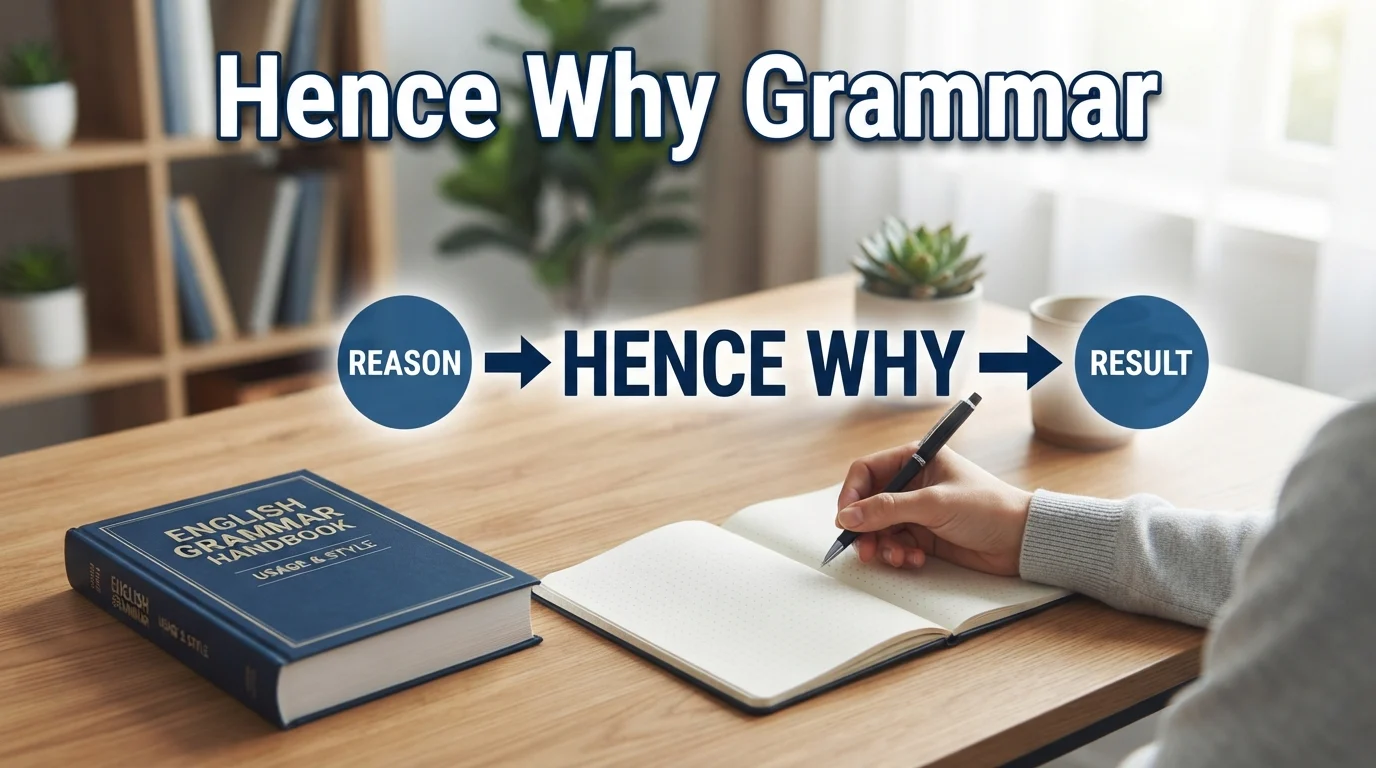
If you have ever wondered whether “hence why” is grammatically correct, you are not alone. The phrase appears frequently in everyday English, online writing, conversations, and even professional communication. However, its grammar can be confusing because hence already carries the meaning “for this reason” or “as a result,” while why introduces a reason or explanation.
The good news is that “hence why” is widely used and can be understood naturally in modern English. However, its acceptability depends on the sentence and the level of formality. In casual speech, phrases such as “That’s hence why I left” may be considered awkward, while “That’s why I left” is much more natural. On the other hand, constructions such as “Hence why I decided to leave” are common, especially in informal or conversational writing. Understanding the difference can help you choose wording that sounds clear, natural, and grammatically polished.
Quick Answer
“Hence why” is used in modern English, especially in informal speech, but it can sound redundant or awkward in formal writing. Since hence already means “for this reason” or “as a result,” alternatives such as “that’s why,” “hence,” or “which is why” are often clearer.
Why People Confuse It
The confusion comes from the meanings of the two words.
Hence is an adverb meaning:
- for this reason
- as a result
- therefore
- from this fact
Why is normally used to ask about or explain a reason.
For example:
She was tired; hence, she went home.
Here, hence already connects the situation with its result.
Compare that with:
She was tired, which is why she went home.
Here, which is why explicitly introduces the reason for the result.
The phrase “hence why” combines two elements that can perform overlapping functions. That’s why some speakers consider it redundant, particularly in formal or carefully edited prose.
However, language changes through usage. “Hence why” is common enough in contemporary English that it cannot simply be dismissed as meaningless or incomprehensible.
First Word: Hence
Hence is a relatively formal adverb used to show a consequence, conclusion, or reason.
It can mean “therefore,” “as a result,” or “for this reason.”
Examples of “hence”
- The roads were flooded; hence, the delay.
- He failed to submit the form; hence, his application was rejected.
- The store was closed; hence, we went somewhere else.
- She had little experience; hence, the need for additional training.
“Hence” is especially common in formal, academic, technical, and literary English.
A useful pattern is:
Cause → hence → result
For example:
The weather was terrible; hence, the cancellation.
This means:
The weather was terrible; therefore, the event was canceled.
“Hence” can also refer to time
“Hence” has another meaning in expressions such as:
The meeting will begin two weeks hence.
Here, hence means “from now.”
This use is more formal and less common in everyday conversation.
Second Word: Why
Why is primarily used to ask about a reason.
For example:
Why did you leave early?
It can also introduce an explanation:
I know why she left.
And it appears in structures such as:
That is why I called you.
This is why the system failed.
That’s why we changed the plan.
The word why is therefore strongly connected with explanations and reasons.
Why in “which is why”
One particularly useful structure is:
The store was closed, which is why we went home.
Here, which is why means:
That is the reason why…
This structure is completely natural and is often preferable to “hence why” in polished writing.
Comparison Table
| Expression | Meaning | Formality | Naturalness | Best Use |
| hence | therefore/as a result | Formal | Very natural | Academic/formal writing |
| that’s why | that is the reason | Neutral | Very natural | Everyday English |
| which is why | this is the reason | Neutral | Very natural | Speaking and writing |
| therefore | for that reason | Formal | Very natural | Formal writing |
| hence why | for this reason/that is why | Informal to neutral | Common but debated | Conversational contexts |
| that is why | that is the reason | Neutral | Very natural | General English |
When to Use Each
Choosing between hence, why, and hence why depends largely on context.
Use “hence” when you want a formal result
Use hence when you want to express “therefore” or “as a result.”
The evidence was incomplete; hence, the investigation continued.
This sounds appropriate in formal writing.
Use “that’s why” in everyday English
That’s why is one of the most natural ways to explain a reason.
I was tired. That’s why I went home.
It works extremely well in conversations, emails, messages, and general writing.
Use “which is why” to connect cause and result
Which is why is especially useful when the first clause provides the reason for the second.
The train was delayed, which is why I arrived late.
This construction is clear and natural.
Use “hence why” carefully
“Hence why” is most likely to sound natural in conversational English:
I didn’t know about the meeting, hence why I wasn’t there.
Many speakers use this construction without hesitation.
However, in formal writing, you may want to replace it with:
I didn’t know about the meeting, which is why I wasn’t there.
or:
I didn’t know about the meeting; hence, I wasn’t there.
These versions avoid the debate surrounding “hence why.”
Examples of “Hence Why” in Sentences
Here are practical examples showing how the phrase is commonly used and how you can make each sentence more polished.
1. Casual explanation
I was feeling sick, hence why I stayed home.
Meaning: I stayed home because I was feeling sick.
2. Explaining a decision
The project was too expensive, hence why we canceled it.
A more formal alternative:
The project was too expensive, which is why we canceled it.
3. Explaining an absence
She wasn’t feeling well, hence why she missed the class.
More formal:
She wasn’t feeling well, which is why she missed the class.
4. Explaining a result
The roads were icy, hence why the school closed.
More polished:
The roads were icy; hence, the school closed.
5. Explaining a change
Sales had declined, hence why the company changed its strategy.
Natural alternative:
Sales had declined, which is why the company changed its strategy.
6. Explaining someone’s behavior
He had been working all night, hence why he looked exhausted.
This is common in informal English.
7. Explaining a choice
I didn’t trust the website, hence why I didn’t order anything.
Better for formal writing:
I didn’t trust the website, which is why I didn’t order anything.
8. Explaining a delay
There was heavy traffic, hence why we arrived late.
Neutral alternative:
There was heavy traffic, which is why we arrived late.
9. Explaining a mistake
I misunderstood the instructions, hence why I made that mistake.
More formal:
I misunderstood the instructions; hence, I made that mistake.
10. Explaining a problem
The machine wasn’t maintained properly, hence why it stopped working.
Formal alternative:
The machine wasn’t maintained properly, which is why it stopped working.
11. Explaining a reaction
She was under a lot of pressure, hence why she reacted strongly.
This sounds conversational and understandable.
12. Explaining a decision
We didn’t have enough information, hence why we postponed the decision.
For formal writing:
We didn’t have enough information; therefore, we postponed the decision.
Common Mistakes
Mistake 1: Treating “hence” as exactly the same as “why”
Although the words can be related to reasons and results, they are not interchangeable in every sentence.
Incorrect or awkward:
Why hence did you leave?
Natural:
Why did you leave?
Or:
Hence, I decided to leave.
Mistake 2: Using “hence why” in every formal sentence
Because the expression is common in conversation, some writers assume it is automatically the best choice in formal English.
For example:
The data was unreliable, hence why the researchers repeated the experiment.
A more polished version is:
The data was unreliable, which is why the researchers repeated the experiment.
Mistake 3: Forgetting punctuation with “hence”
When hence connects independent clauses, punctuation matters.
For example:
The weather was poor; hence, the flight was delayed.
The semicolon and comma make the relationship between the clauses clear.
Mistake 4: Overusing “why”
English already has several natural ways to express cause and effect.
Instead of repeatedly writing:
That is why…
you can sometimes use:
- therefore
- hence
- as a result
- consequently
- for this reason
- which is why
Variety can make your writing smoother.
Memory Trick
Remember this simple rule:
Hence = therefore
Why = reason
Which is why = that is the reason
So:
It rained heavily; hence, the match was canceled.
means:
It rained heavily; therefore, the match was canceled.
And:
It rained heavily, which is why the match was canceled.
means:
The heavy rain is the reason the match was canceled.
When you see “hence why,” ask yourself:
“Do I really need both words?”
If the answer is no, choose hence, therefore, or which is why, depending on the sentence.
American vs British English
The basic meanings of hence, why, therefore, and which is why are the same in American and British English.
However, there can be differences in how frequently certain expressions are used.
“Hence” tends to sound formal in both varieties of English. It is common in academic, technical, legal, and formal contexts.
“That’s why” is extremely natural in both American and British everyday English.
“Which is why” is also widely used in both varieties.
The phrase “hence why” occurs in contemporary English, particularly in informal or conversational contexts. However, because some editors regard it as redundant or less polished, writers should generally prefer clearer alternatives in formal documents.
For academic essays, business reports, applications, and professional writing, “which is why,” “therefore,” “thus,” or “hence” may be safer choices.
Similar Words
Several words and expressions can replace “hence why,” depending on what you want to communicate.
Therefore
Therefore means “for that reason” or “as a result.”
The evidence was insufficient; therefore, the case was reopened.
It is particularly useful in formal writing.
Thus
Thus means “in this way” or “as a result.”
The company reduced costs and thus improved its profits.
It is common in academic and professional writing.
Consequently
Consequently means “as a result.”
The team missed several deadlines; consequently, the project was delayed.
It has a formal tone.
As a result
This is a clear and versatile alternative.
The road was closed. As a result, we took another route.
For this reason
This phrase directly highlights the reason.
He had no previous experience. For this reason, he received additional training.
That’s why
This is one of the best choices for everyday English.
I was busy. That’s why I didn’t answer.
Which is why
This is an excellent alternative when connecting two related clauses.
She was exhausted, which is why she went to bed early.
Final Verdict
So, is “hence why” grammatically correct?
The answer is more nuanced than simply yes or no.
“Hence why” is a real and commonly used construction in contemporary English, especially in informal speech and conversational writing. It is generally understandable and can sound perfectly natural to many speakers.
However, hence already expresses a consequence or reason, so combining it with “why” can create a sense of redundancy. Because of this, “hence why” is often avoided by careful writers in formal or academic contexts.
If you want the safest choice, use “which is why” or “that’s why” for everyday English, and “hence,” “therefore,” “thus,” or “consequently” for formal writing.
FAQs About “Hence Why” Grammar
Is “hence why” grammatically correct?
“Hence why” is widely used in modern English, particularly in informal contexts. However, some speakers and editors consider it redundant because “hence” already expresses a consequence or reason. Formal writing often benefits from alternatives such as “which is why” or “therefore.”
Is “hence why” formal English?
Not usually. Although “hence” itself is formal, the combination “hence why” tends to sound more conversational. In formal or academic writing, “hence,” “therefore,” “thus,” or “which is why” is often preferable.
Is “hence why” redundant?
It can be considered redundant because hence can mean “for this reason,” while why introduces a reason. Nevertheless, the phrase is established in contemporary usage, so calling it simply “wrong” does not accurately describe how English is used today.
What is a better alternative to “hence why”?
Good alternatives include:
- that’s why
- that is why
- which is why
- therefore
- hence
- thus
- as a result
- consequently
The best choice depends on the sentence and its level of formality.
Can I use “hence why” in an essay?
You can encounter it in modern English, but it is generally better to avoid it in a formal academic essay. Choose “which is why,” “therefore,” “hence,” or another precise cause-and-effect expression instead.
What is the difference between “hence” and “why”?
Hence usually expresses a consequence or conclusion, meaning “therefore” or “for this reason.” Why asks about or identifies a reason. They can overlap conceptually, but they perform different grammatical roles.
Is “hence why” common in British English?
Yes, the construction can be found in British English, especially in informal usage. However, it is not restricted to British English, and speakers of American English also use it. Formal writers in either variety may prefer clearer alternatives.
Conclusion
Understanding “hence why” grammar becomes much easier when you separate the meanings of its two parts. Hence generally means “therefore,” “as a result,” or “for this reason,” while why is used to ask about or explain a reason. Because their functions can overlap, “hence why” may sound redundant to some readers even though it is widely used in contemporary English.
For everyday conversation, “hence why” may be perfectly understandable and natural depending on the sentence. For polished professional or academic writing, however, you can usually improve clarity by choosing “which is why,” “that’s why,” “therefore,” or simply “hence.” The goal is not merely to follow a rigid grammar rule, but to choose the expression that communicates your meaning naturally and suits your audience.
Remember This
Hence = therefore / as a result
Why = asks or explains a reason
Which is why = that is the reason
“Hence why” = common in modern informal English, but often avoidable in formal writing.
When in doubt, use “which is why” for natural everyday writing and “therefore” or “hence” for formal writing.

I’m Elliot Pierce, Administrator at Grammetics, dedicated to improving word matching and grammar. I help maintain useful content, support readers, and make language learning simple, clear, accurate, and engaging.