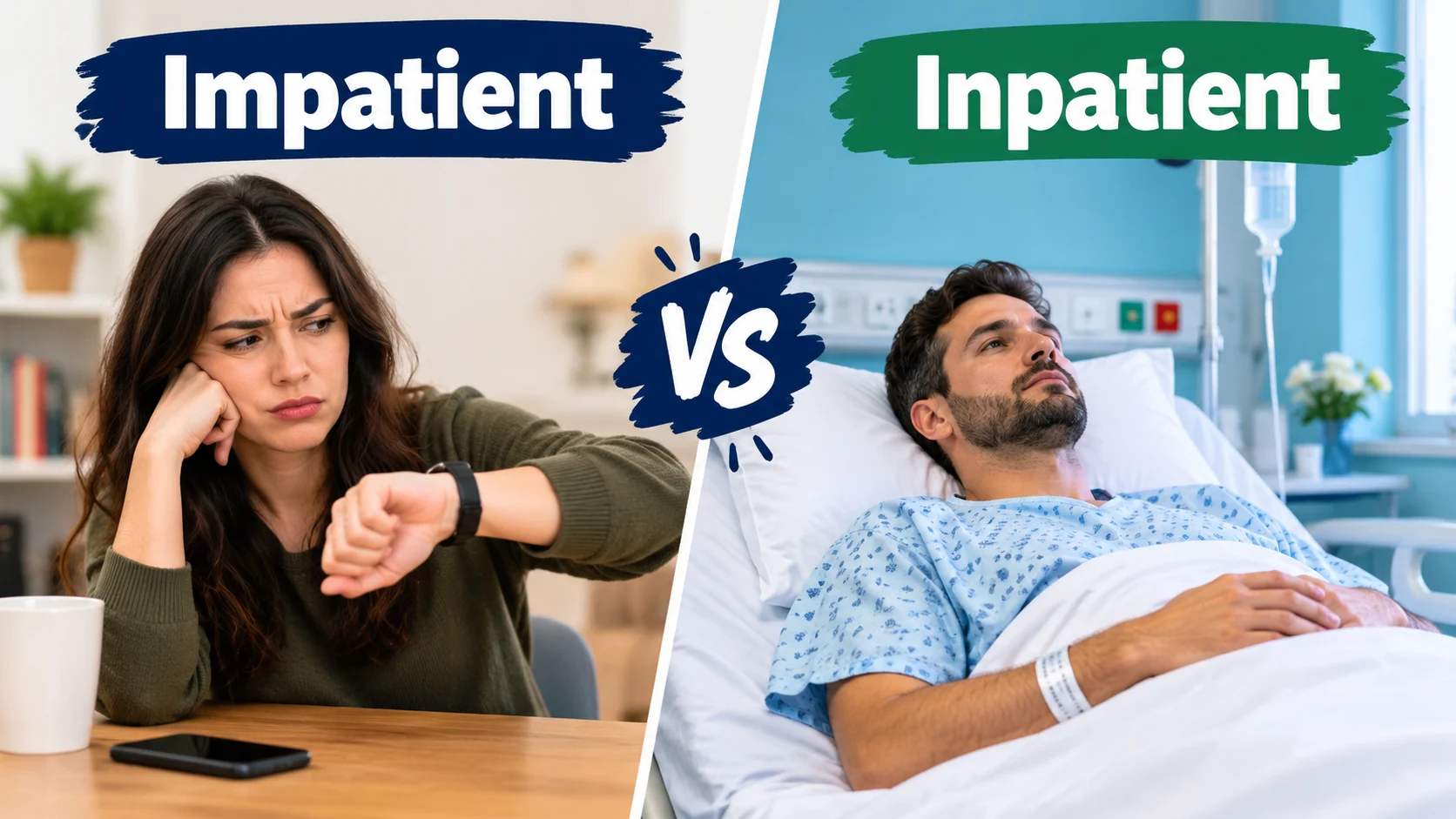
English has many word pairs that look and sound almost identical but have completely different meanings. Impatient vs inpatient is a perfect example. The difference is only one letter, yet using the wrong word can change your sentence entirely. One describes how someone feels when they cannot wait, while the other refers to a person receiving medical care in a hospital or healthcare facility.
This confusion is especially common in writing because “impatient” and “inpatient” are pronounced very similarly. However, their meanings, grammatical uses, and contexts are easy to separate once you know what to look for. In this guide, we’ll explain the difference between impatient and inpatient, show clear examples, compare their meanings in a simple table, and give you a memory trick that makes the distinction easy to remember.
Quick Answer
Impatient means unable or unwilling to wait calmly, while inpatient refers to a person who stays in a hospital or healthcare facility for treatment. For example, “She is impatient with delays” describes behavior, while “The patient became an inpatient” describes medical status.
Why People Confuse It
The words impatient and inpatient are easy to mix up because they differ by only one letter.
- Impatient → related to patience or waiting.
- Inpatient → related to medical treatment inside a facility.
- Both can describe a person.
- Their pronunciation can sound very similar in everyday speech.
The key is to focus on the meaning rather than just the spelling.
If the sentence is about waiting, frustration, or lack of patience, you probably need impatient.
If it is about hospital treatment or staying in a healthcare facility, you probably need inpatient.
First Word: Impatient
Impatient is an adjective meaning not willing to wait calmly or easily annoyed by delays.
Someone who is impatient may become frustrated when something takes too long.
Examples of “Impatient”
- The children became impatient while waiting for dinner.
- He was impatient to hear the results.
- She gets impatient when traffic moves slowly.
- Don’t be impatient; we’ll be there soon.
Impatient can also mean eager to do something immediately.
For example:
“The students were impatient to begin the experiment.”
Here, the students are eager to start.
Common meanings of impatient
Impatient can describe:
- A person who dislikes waiting.
- Someone who becomes irritated by delays.
- Someone who is eager for something to happen.
Second Word: Inpatient
Inpatient is a noun or adjective used mainly in healthcare.
An inpatient is a person who is admitted to a hospital or healthcare facility and stays there while receiving treatment.
For example:
“The hospital admitted the patient as an inpatient.”
Inpatient can also function as an adjective:
“She received inpatient treatment for several days.”
Examples of “Inpatient”
- The hospital has a new inpatient unit.
- He was admitted as an inpatient yesterday.
- The doctor recommended inpatient care.
- The facility provides both inpatient and outpatient services.
The opposite of inpatient is generally outpatient.
An outpatient receives medical care but does not stay overnight or remain admitted as a hospital patient.
Comparison Table
| Word | Part of Speech | Meaning | Typical Context | Example |
| Impatient | Adjective | Unable or unwilling to wait calmly | Emotions, behavior, delays | She became impatient in the long line. |
| Inpatient | Noun/Adjective | A person receiving care while admitted to a facility | Hospitals, healthcare | The inpatient received treatment overnight. |
| Outpatient | Noun/Adjective | A patient receiving care without being admitted | Healthcare | The clinic treats many outpatients. |
The simplest distinction
Impatient = can’t wait.
Inpatient = stays in for medical care.
When to Use Each
Use “impatient” when talking about behavior or waiting
Choose impatient when someone:
- dislikes waiting
- becomes frustrated by delays
- wants something to happen quickly
- has little patience
Example:
“I became impatient after waiting for an hour.”
Use “inpatient” when talking about healthcare
Choose inpatient when discussing:
- hospital admission
- overnight medical care
- hospital stays
- inpatient treatment
- inpatient facilities
- healthcare services
Example:
“The hospital provides inpatient and outpatient services.”
A useful question to ask
Before choosing the word, ask:
“Am I talking about patience or medical treatment?”
- Patience → impatient
- Medical admission → inpatient
Examples: Impatient vs Inpatient
Here are more examples to make the difference crystal clear:
- The customer became impatient after waiting for thirty minutes.
- The hospital admitted him as an inpatient.
- She was impatient to see the final results.
- The doctor recommended inpatient care.
- The children grew impatient during the long journey.
- The inpatient ward was full.
- He becomes impatient whenever meetings run late.
- The patient required inpatient treatment.
- Don’t be impatient; your order will arrive soon.
- The hospital has separate facilities for inpatient and outpatient care.
- Maria was impatient with the slow internet connection.
- The patient remained an inpatient for five days.
Notice how the surrounding words make the correct choice obvious.
Words such as waiting, delay, eager, frustrated, and patience usually point toward impatient.
Words such as hospital, admitted, treatment, ward, care, and facility point toward inpatient.
Common Mistakes
1. Using “inpatient” when you mean frustrated
Incorrect:
“I am inpatient because the bus is late.”
Correct:
“I am impatient because the bus is late.”
The sentence is about waiting, not healthcare.
2. Using “impatient” for hospital admission
Incorrect:
“The doctor transferred him to the impatient unit.”
Correct:
“The doctor transferred him to the inpatient unit.”
The unit is a medical facility, so inpatient is correct.
3. Confusing “inpatient” with “patient”
Patient has two important meanings:
- a person receiving medical treatment
- someone who can wait calmly
Impatient means lacking patience.
Inpatient relates specifically to being admitted for medical care.
4. Assuming the “im-” and “in-” prefixes mean the same thing
They don’t function the same way here.
In impatient, the word is connected to patient/patience and means lacking patience.
In inpatient, in- helps indicate someone who is receiving care inside a healthcare facility.
Memory Trick
Use this simple trick:
Impatient = “I’m waiting!”
If someone is frustrated because they have to wait, they are impatient.
Think:
Impatient → patience → waiting
Inpatient = “IN the hospital”
If someone is admitted and staying in a healthcare facility, they are an inpatient.
Think:
Inpatient → IN → inside for medical care
So remember:
Can’t wait? → Impatient.
Staying in for treatment? → Inpatient.
American vs British English
The distinction between impatient and inpatient is essentially the same in American and British English.
Both varieties use:
- impatient for someone who lacks patience or dislikes waiting
- inpatient for someone receiving medical care while admitted to a healthcare facility
Healthcare terminology can vary slightly between countries, but the basic meaning of inpatient remains consistent.
For example:
American English:
“He was admitted as an inpatient.”
British English:
“He was admitted as an inpatient.”
The spelling and core distinction remain unchanged.
Similar Words
Understanding related words can make this vocabulary easier.
Patient
Patient can mean someone receiving medical treatment or someone who waits calmly.
“The patient is waiting for the doctor.”
Impatient
Impatient means lacking patience or unwilling to wait.
“The patient became impatient.”
Inpatient
Inpatient refers to someone admitted to a healthcare facility.
“The patient was admitted as an inpatient.”
Outpatient
Outpatient refers to someone who receives medical treatment without being admitted as an inpatient.
“The clinic treats hundreds of outpatients each week.”
Patience
Patience is the ability to wait calmly without becoming annoyed.
“Good teachers need patience.”
Impatience
Impatience is the feeling or behavior of being unable to wait calmly.
“His impatience was obvious.”
Final Verdict
The difference between impatient and inpatient is straightforward once you connect each word with its context.
Impatient describes a person’s attitude toward waiting. If someone is frustrated, restless, or eager for something to happen, use impatient.
Inpatient belongs mainly to the healthcare world. It describes someone who is admitted to a hospital or healthcare facility for treatment, or something related to that type of care.
FAQs
1. What is the difference between impatient and inpatient?
Impatient means unable or unwilling to wait calmly. Inpatient refers to someone who is admitted to a hospital or healthcare facility for treatment.
2. Is “impatient” related to patience?
Yes. Impatient is directly related to patience and describes someone who lacks patience or dislikes waiting.
3. What does inpatient mean in a hospital?
An inpatient is a person who has been admitted to a healthcare facility and remains there while receiving medical care.
4. Is inpatient the opposite of outpatient?
In many healthcare contexts, yes. An inpatient is admitted for care, while an outpatient receives care without being admitted.
5. How do you remember impatient vs inpatient?
Think “impatient = can’t wait” and “inpatient = in for medical care.”
6. Can inpatient be an adjective?
Yes. For example: “The hospital has an inpatient department.”
7. Can impatient describe someone who is eager?
Yes. Impatient can also mean very eager for something to happen.
“She was impatient to start her new job.”
Conclusion
Although impatient and inpatient look almost identical, they belong to very different contexts. Impatient describes a person’s lack of patience, frustration with waiting, or eagerness for something to happen. Inpatient, on the other hand, is a healthcare term for someone admitted to a hospital or facility for treatment.
The easiest way to avoid the mistake is to connect each word with a simple idea: impatient means “can’t wait,” while inpatient means “in for medical care.” Once you recognize whether your sentence is about waiting or healthcare, choosing the correct word becomes much easier.
Remember This
Impatient = can’t wait.
Inpatient = admitted for medical care.

I’m Elliot Pierce, Administrator at Grammetics, dedicated to improving word matching and grammar. I help maintain useful content, support readers, and make language learning simple, clear, accurate, and engaging.