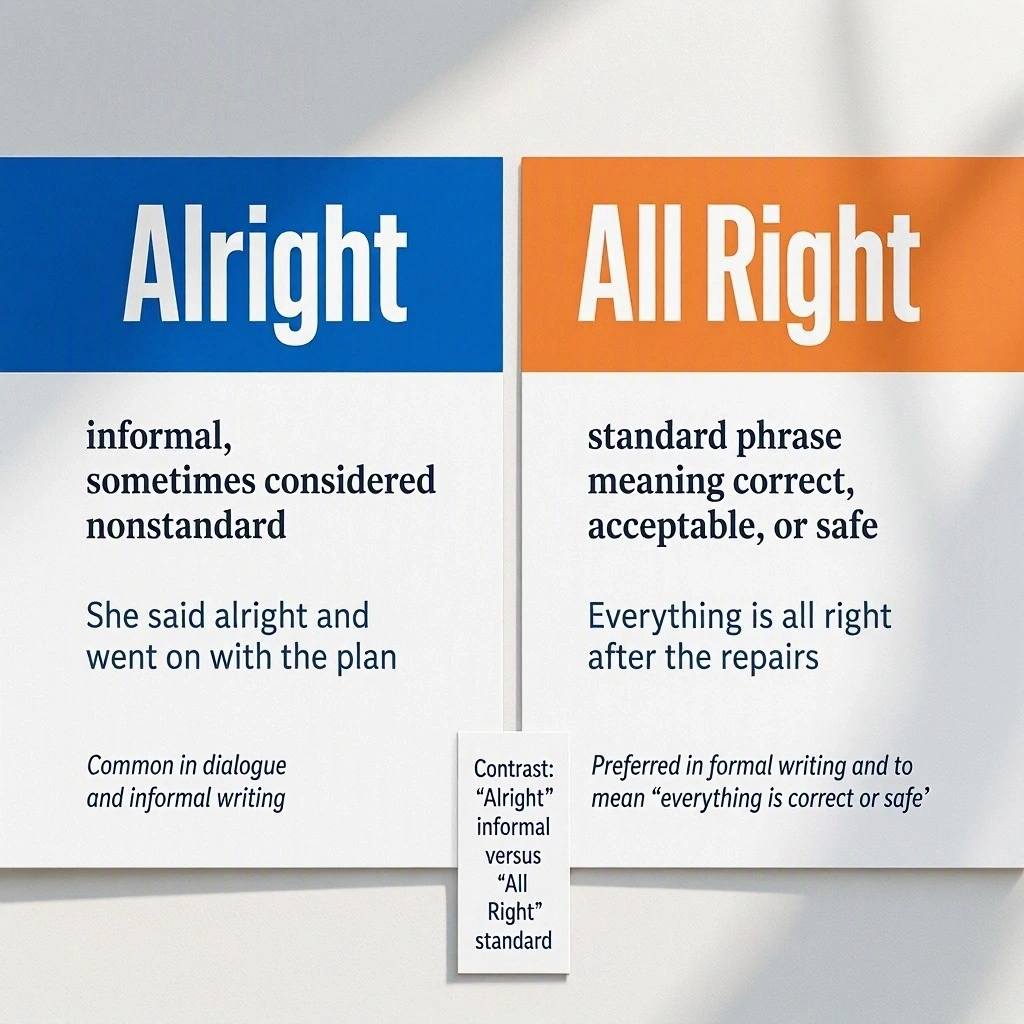
Have you ever wondered whether to write alright or all right? Both forms appear in everyday English, text messages, books, and online articles, so choosing the correct spelling can feel confusing. Although the two expressions often communicate the same idea, they differ in formality, acceptance, and traditional usage. Understanding these differences can help you write more confidently, whether you are sending a casual message or preparing a professional document.
The expression all right is the traditional and widely accepted form in formal English. Alright is a popular alternative, especially in informal writing, where it often means satisfactory, acceptable, or safe. However, some editors, teachers, and style guides still prefer all right and may consider alright unsuitable for formal contexts. In this guide, you will learn the meaning of each spelling, discover when to use them, and explore practical examples that make the distinction easy to remember.
Quick Answer: Alright vs All Right
All right is the traditional spelling and the safest choice for formal, academic, and professional writing. Alright is a widely used informal variant that generally means the same thing: satisfactory, acceptable, or safe. Although alright is common in modern English, all right remains the more universally accepted option.
Why People Confuse Alright and All Right
People confuse alright and all right because both forms are pronounced identically and frequently express the same meaning. In everyday conversations, there is usually no noticeable difference between them.
The confusion becomes more apparent in writing. Some dictionaries recognize alright as an established variant, while certain style guides and editors recommend using only all right, especially in formal documents.
Here are the main reasons for the confusion:
- Identical pronunciation: Both forms sound the same when spoken.
- Similar meanings: Both can mean acceptable, satisfactory, or safe.
- Different writing conventions: All right is traditionally preferred, while alright is more common in informal contexts.
- Changing language habits: Online communication has helped make the single-word spelling more familiar.
The easiest way to avoid mistakes is to understand the accepted spelling in your writing context.
1. All Right: Meaning, Definition, and Examples
All right is a two-word expression meaning satisfactory, acceptable, correct, safe, or in good health. It can also be used to agree to a suggestion or indicate that something is proceeding as expected.
It is the traditional spelling and is generally preferred in formal English.
Common Meanings of All Right
1. Satisfactory or acceptable
Use all right when something is good enough or meets expectations.
Example: The presentation was all right, but it could have been more engaging.
2. Safe or unharmed
Use it to ask whether someone is safe or to explain that someone is not injured.
Example: After the accident, everyone was all right.
3. In good health or feeling okay
Use it to describe someone’s physical or emotional condition.
Example: Are you feeling all right today?
4. Agreement or permission
Use all right to accept a suggestion or give permission.
Example: All right, we can meet at six o’clock.
5. Confirmation
Use it to indicate that a situation is acceptable or that everything is proceeding properly.
Example: Everything is all right with the new arrangement.
Example Sentences Using All Right
- Are you all right after your long journey?
- The food was all right, although I expected something better.
- All right, I will finish the assignment tonight.
- The doctor confirmed that the patient was all right.
- Is it all right if I open the window?
- Everything will be all right once we solve the problem.
- Your answer is all right, but it needs more explanation.
- The children were all right after the storm.
- It is all right to ask questions during the lesson.
- All right, let’s begin the meeting.
When Should You Use All Right?
Choose all right in these situations:
- Academic essays and research papers
- Professional emails and business reports
- Formal letters and official documents
- Educational articles and website content
- Writing that follows a strict editorial style guide
Example: “The proposed changes are all right, but the committee should review the budget first.”
Because all right is widely accepted across different writing styles, it is the safest choice whenever you are unsure.
2. Alright: Meaning, Definition, and Examples
Alright is a one-word variant of all right. It is commonly used in informal English and generally carries the same meanings, including satisfactory, acceptable, safe, or okay.
Although many readers and dictionaries recognize alright, some traditional editors and style guides discourage it in formal writing.
Common Meanings of Alright
1. Acceptable or satisfactory
Example: The movie was alright, but the ending was disappointing.
2. Safe or unharmed
Example: Don’t worry; the children are alright.
3. Feeling okay
Example: I’m feeling alright now, thanks for asking.
4. Agreement
Example: Alright, let’s meet outside the library.
5. Reassurance
Example: Everything will be alright if we stay calm.
Example Sentences Using Alright
- The concert was alright, but the sound quality was poor.
- I’m alright now, so you don’t need to worry.
- Alright, I’ll send you the details tomorrow.
- The team performed alright despite the difficult conditions.
- Are you alright with the proposed schedule?
- Don’t panic; everything is going to be alright.
- The new restaurant is alright, but it isn’t my favorite.
- Alright, let’s move on to the next question.
- She said she was alright after the examination.
- The plan sounds alright to me.
These sentences demonstrate how alright is used in everyday conversation and casual writing. In formal work, however, consider replacing it with all right or a more precise word such as acceptable, satisfactory, or fine.
When Should You Use Alright?
Alright is commonly used in:
- Text messages and online chats
- Informal emails
- Personal blogs and social media posts
- Dialogue in fiction
- Casual conversations and notes
Example: “Alright, I’ll call you when I get home.”
If you are writing for a publication, school, or workplace, check the relevant style guide before choosing the single-word form.
Alright vs All Right: Comparison Table
| Feature | All Right | Alright |
| Spelling | Two words | One word |
| Meaning | Acceptable, satisfactory, safe, or okay | Generally the same meanings |
| Traditional acceptance | Widely accepted | Less universally accepted |
| Formal writing | Preferred | May be discouraged |
| Informal writing | Appropriate | Very common |
| Pronunciation | /ɔːl raɪt/ or regional equivalent | Same pronunciation |
| Example | Everything is all right. | Everything is alright. |
| Best use | Formal and general writing | Casual writing, where appropriate |
When to Use Each
Knowing the meaning is helpful, but understanding the writing context is equally important.
Use All Right for Formal and Professional Writing
Choose all right when you need a spelling that is widely accepted by teachers, editors, employers, and readers.
Examples:
- The revised report is all right for submission.
- Is it all right to reschedule the appointment?
- The passengers were all right after the emergency landing.
This spelling is especially useful when you want to avoid editorial corrections.
Use Alright for Informal Communication
Choose alright when writing casually and when your audience or preferred style guide accepts it.
Examples:
- Alright, see you tomorrow!
- I’m alright, thanks for checking.
- The restaurant was alright, but I wouldn’t visit again.
This spelling often feels natural in conversational writing, text messages, and informal dialogue.
Can You Use Both in the Same Article?
You can, but consistency is usually better. If you choose all right as your standard spelling, use it throughout the article unless you are quoting a source or reproducing a character’s exact words.
For SEO articles, educational websites, and professional blog posts, all right is generally the safest editorial choice.
Examples: Alright vs All Right in Everyday English
The following examples show how both spellings may express the same idea.
- All right: Are you all right after the fall?
Alright: Are you alright after the fall?
Both ask whether someone is safe or unharmed. - All right: Everything will be all right.
Alright: Everything will be alright.
Both offer reassurance. - All right: The meal was all right.
Alright: The meal was alright.
Both describe a meal as acceptable, but not necessarily excellent. - All right: All right, I’ll help you with your homework.
Alright: Alright, I’ll help you with your homework.
Both express agreement. - All right: Is it all right to leave early?
Alright: Is it alright to leave early?
Both ask for permission or approval. - All right: She said she was all right.
Alright: She said she was alright.
Both indicate that she said she was okay. - All right: The project is all right so far.
Alright: The project is alright so far.
Both suggest that the project is progressing acceptably. - All right: The students were all right after the drill.
Alright: The students were alright after the drill.
Both communicate that the students were safe. - All right: All right, let’s start the lesson.
Alright: Alright, let’s start the lesson.
Both introduce an action or transition. - All right: Your explanation is all right, but it needs more detail.
Alright: Your explanation is alright, but it needs more detail.
Both indicate that the explanation is acceptable. - All right: Is everything all right at home?
Alright: Is everything alright at home?
Both ask whether things are okay. - All right: The new schedule looks all right to me.
Alright: The new schedule looks alright to me.
Both express approval.
Writing tip: Although these pairs are commonly understood in the same way, all right is the more dependable spelling for formal and edited writing.
Common Mistakes
Even fluent English speakers sometimes make mistakes when choosing between alright and all right. Here are the most common ones to avoid.
1. Assuming Alright Is Always Incorrect
It is too absolute to say that alright is never a real word. It is widely used and recognized by many dictionaries as a variant of all right.
Better approach: Recognize that alright is common, but follow the preferred spelling of your style guide.
2. Using Alright in Every Formal Document
Some academic institutions, employers, and publications prefer the traditional two-word form.
Less preferred in formal writing: The results are alright.
Preferred: The results are all right.
For a more precise and professional tone, you might write, “The results are satisfactory.”
3. Thinking All Right Always Means Excellent
Neither spelling necessarily means something is outstanding. Both can describe something that is merely acceptable or satisfactory.
Example: “The film was all right” usually suggests that it was okay, not exceptional.
4. Confusing All Right with Alrighty
Alrighty is a separate, informal expression often used to acknowledge something or signal that it is time to proceed.
Example: “Alrighty, let’s get started!”
It is generally unsuitable for formal academic or business writing.
5. Switching Between the Two Spellings Without a Reason
Using alright in one paragraph and all right in the next can make an article look inconsistent.
Better approach: Select one spelling based on your audience and use it consistently.
Memory Trick: How to Remember Alright vs All Right
Use this simple memory trick to remember which spelling to choose.
- All right = Always a safe choice. The two-word form works in formal and informal writing.
- Alright = Alternative for casual writing. The one-word form is common in relaxed, conversational contexts.
Think of it this way: when you want to be certain your writing follows traditional editorial standards, keep the two words separate.
Examples:
- Formal email: “Is it all right to schedule the meeting for Friday?”
- Casual text: “Alright, see you Friday!”
One important detail: all right does not mean that alright is automatically wrong. The memory trick simply helps you choose the more widely accepted form.
American vs British English
The difference between alright and all right is not primarily an American-versus-British spelling difference. Both forms appear in American and British English, although their acceptance can vary by publication and editorial style.
American English
In American English, all right remains the safer choice in formal writing. Alright is common in informal communication and appears in published material, but some American style guides continue to prefer the two-word spelling.
Examples:
- Formal: The documents are all right.
- Informal: Alright, I’ll be there soon.
British English
British English also uses all right as the traditional spelling. Alright appears in everyday writing and dialogue, but its suitability in formal prose depends on the publication’s conventions.
Examples:
- Formal: Is it all right if we leave early?
- Informal: Alright, let’s go.
Which Spelling Should English Learners Use?
For learners, international communication, academic writing, and professional website content, all right is the recommended default.
If a publisher, teacher, or employer specifically permits alright, you can use it according to those instructions.
Similar Words and Expressions
Understanding similar words helps you choose more precise language instead of repeatedly using alright or all right.
1. Okay vs All Right
Okay and all right often have similar meanings. Both can express agreement, approval, or an acceptable condition.
- Is it okay to call you later?
- Is it all right to call you later?
Both are natural in everyday English.
2. Fine vs Alright
Fine can mean satisfactory, healthy, or acceptable. Depending on the speaker’s tone, it may also communicate reluctance or annoyance.
- I’m fine, thank you.
- I’m alright, thank you.
Both can describe how someone feels, although their emotional implications depend on context.
3. Acceptable vs All Right
Acceptable is more precise and formal than all right when evaluating quality, behavior, or a proposal.
- The proposal is acceptable.
- The proposal is all right.
The first sentence is often more appropriate in professional reports.
4. Everything Is All Right vs Everything Is Okay
Both expressions reassure someone that there is no problem.
- Everything is all right.
- Everything is okay.
They are both natural and widely understood.
5. Alright vs All Right vs Allright
Alright is a recognized variant of all right, although it may be discouraged by some style guides. Allright, written as one word with two consecutive l letters, is generally considered a misspelling in standard English.
Correct:
- Everything is all right.
- Everything is alright in informal writing.
Incorrect in standard usage:
- Everything is allright.
Frequently Asked Questions
1. Is alright one word or two?
Alright is one word, while all right is written as two words. Both forms are used in modern English, but all right is the traditional spelling and is preferred in formal writing.
2. Which is correct: alright or all right?
Both forms are used, but all right is the safer choice in academic, professional, and formal writing. Alright is common in informal English and is accepted by many dictionaries as a variant.
3. Is alright grammatically incorrect?
Not necessarily. Many dictionaries recognize alright as a variant of all right. However, certain editors and style guides prefer the two-word form, particularly in formal writing.
4. Can I use alright in an email?
Yes, especially in a casual email to a friend or colleague. For formal business emails, professional correspondence, or communication with an unfamiliar recipient, all right is generally the better choice.
5. Is all right more formal than alright?
Generally, yes. All right is the traditional form and is more widely accepted in formal and edited writing. Alright tends to feel more conversational, although it also appears in published texts.
6. Do alright and all right mean the same thing?
In most everyday contexts, yes. Both can mean acceptable, satisfactory, safe, or okay. The main distinction is their spelling and how different writing conventions treat them.
7. Is alright accepted in British English?
Yes, alright appears in British English, especially in informal writing and dialogue. However, all right remains the safer choice for formal writing and publications that follow traditional style conventions.
8. What is the difference between all right and allright?
All right is the traditional two-word expression, while alright is a recognized one-word variant. Allright is generally considered a misspelling in standard English.
Final Verdict: Alright vs All Right
The difference between alright and all right is mainly a matter of spelling conventions and formality. Both expressions can communicate that something is satisfactory, acceptable, safe, or okay. However, all right is the traditional form and remains the most widely accepted choice in formal, academic, and professional writing.
Alright is common in everyday conversations, text messages, informal emails, and online content. Many dictionaries recognize it as a variant, so calling it universally incorrect would be misleading. Nevertheless, if you want to avoid spelling disputes or editorial corrections, use all right. It is a reliable choice for almost any audience.
Conclusion
Learning the difference between alright vs all right is simple once you understand that both expressions are generally used in the same way but are treated differently by some editors and style guides. The two-word form is the traditional spelling, while the one-word form is common in informal English. Your choice should depend on the audience, purpose, and writing conventions you follow.
For school assignments, professional communication, formal articles, and SEO-focused educational content, choose all right as your default. In casual messages or conversational dialogue, alright can sound perfectly natural when the style allows it. By applying this simple rule consistently, you can improve your English spelling, write with greater confidence, and avoid unnecessary corrections.
Remember This
- All right: Traditional spelling; safest for formal and professional writing.
- Alright: Common informal variant; accepted by many dictionaries.
- Meaning: Both generally mean okay, acceptable, satisfactory, or safe.
- Avoid: Allright, which is generally considered incorrect.
- Best tip: When in doubt, write all right.

I’m Micah Wheeler, a passionate author who enjoys exploring matching words, grammar, and language. I create clear, helpful content to make word choices and grammar easier for everyone.