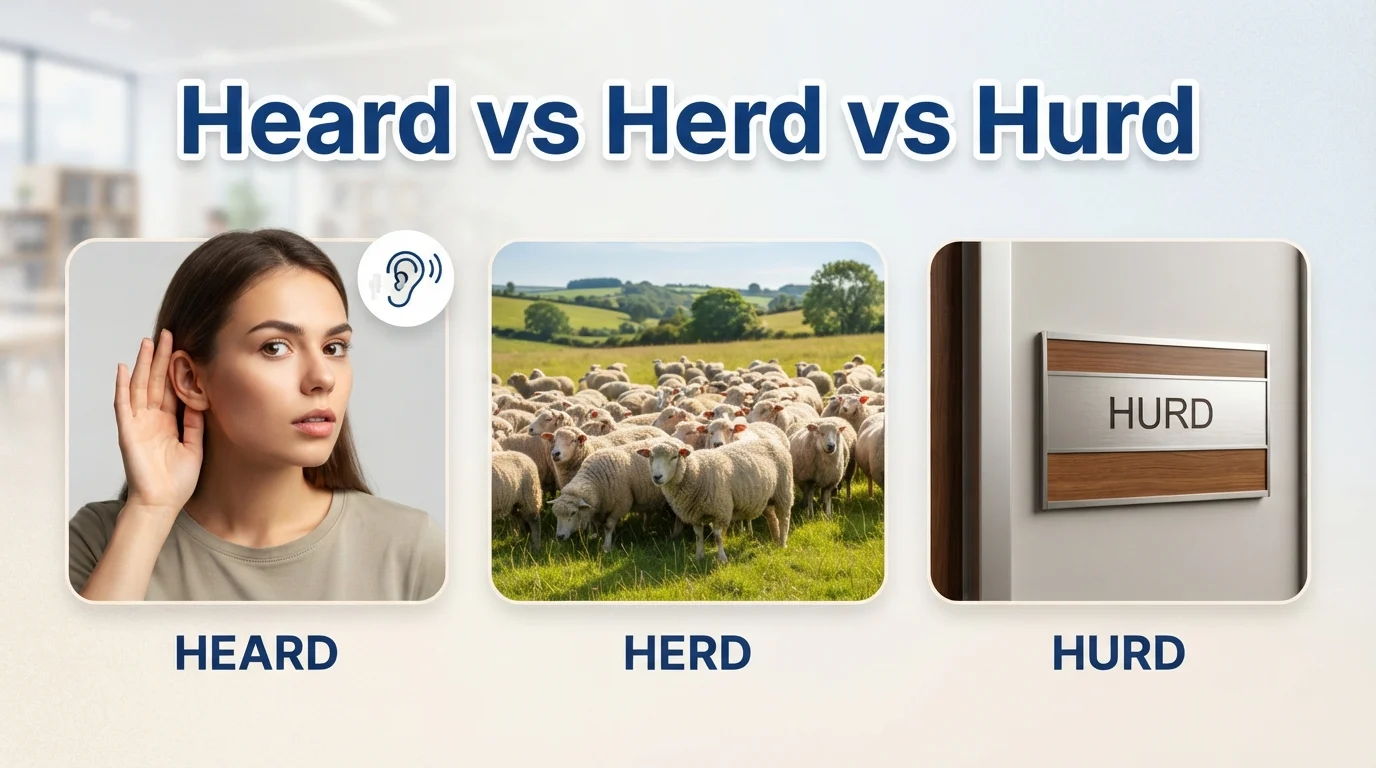
The words heard, herd, and hurd can be confusing because they sound very similar when spoken aloud. In fact, heard and herd are true homophones: they have different spellings and meanings but are pronounced the same. Hurd is much less common and is generally not the standard English word people mean when they use either of the other two. These similarities can easily lead to spelling mistakes, especially when writing quickly or relying on pronunciation.
Understanding the difference between heard vs herd vs hurd is useful for students, writers, English learners, and anyone who wants to improve their spelling and grammar. Heard is the past tense of hear, while herd refers to a group of animals or means to gather or guide animals together. Hurd is usually a proper name or appears in specialized contexts rather than normal everyday English. Once you connect each spelling with its meaning, the distinction becomes easy to remember.
Quick Answer
Heard is the past tense of hear: “I heard a noise.” Herd means a group of animals or the act of gathering animals: “A herd of cattle crossed the road.” Hurd is not normally used as a standard English word and is often a surname or proper name.
Why People Confuse It
The main reason people confuse heard, herd, and hurd is pronunciation.
Heard and herd are pronounced the same in standard English, usually like /hɜːrd/ in American English. Because there is no pronunciation difference to help you, you must use the meaning and context to choose the correct spelling.
For example:
- “I heard the announcement.” → You listened to or perceived a sound.
- “The herd moved across the field.” → A group of animals moved.
- “Hurd” → Usually not the word you want in ordinary English.
This is a classic example of a homophone problem. English contains many words that sound alike but have different spellings and meanings.
First Word: Heard
Heard is the past tense and past participle of the verb hear.
Meaning of Heard
It means that someone perceived a sound, listened to something, or received information through hearing.
Examples:
- I heard a strange noise outside.
- She heard the news yesterday.
- We heard someone knocking.
- Have you heard this song before?
The word can also be used when something becomes known or receives attention.
For example:
“Her complaint was heard by the manager.”
Here, heard means that the manager listened to and considered the complaint.
Heard as a Verb
The basic forms of the verb are:
- Hear — present
- Heard — past
- Heard — past participle
Examples:
- I hear music.
- I heard music yesterday.
- I have heard that song before.
A useful point to remember is that heard is always connected to hear.
Second Word: Herd
Herd is a noun and a verb.
Herd as a Noun
As a noun, herd means a group of animals, especially animals such as cattle, elephants, deer, or sheep.
Examples:
- A herd of cattle was grazing.
- We saw a herd of elephants.
- The farmer owns a large herd of goats.
- A herd of deer crossed the road.
Herd as a Verb
As a verb, herd means to gather, move, or guide animals as a group.
Examples:
- The farmer herded the goats into the pen.
- The shepherd herded the sheep toward the barn.
- The ranchers herded the cattle across the field.
So, when the meaning involves animals moving or being gathered together, herd is usually the correct choice.
Comparison Table
| Word | Part of Speech | Meaning | Example |
| Heard | Verb | Past tense of hear | I heard a loud noise. |
| Herd | Noun | A group of animals | A herd of cattle was nearby. |
| Herd | Verb | To gather or guide animals | They herded the sheep home. |
| Hurd | Usually a proper name | Not normally a standard everyday English word | Hurd may appear as a surname. |
When to Use Each
Use “Heard” When Talking About Hearing
Choose heard when someone perceived a sound or received information by hearing.
- I heard your voice.
- We heard the announcement.
- She heard a strange sound.
- Have you heard about the new project?
Use “Herd” for Animals
Use herd when referring to a group of animals.
- A herd of cows.
- A herd of elephants.
- A herd of deer.
- A herd of buffalo.
You can also use herd as a verb:
- They herded the cattle into the field.
What About “Hurd”?
In ordinary English writing, hurd is generally not the spelling you need for either heard or herd. It may occur as a surname or proper name, but it is not the normal spelling of the common words discussed here.
If you are writing a sentence such as “I ___ a noise,” the answer is heard.
If you are writing “a ___ of cattle,” the answer is herd.
Examples of Heard vs Herd vs Hurd
Here are practical examples showing the difference:
- I heard someone calling my name.
- A herd of cows was standing near the river.
- She heard the door close.
- The farmer has a large herd of goats.
- We heard an interesting story yesterday.
- A herd of elephants walked through the forest.
- Have you heard this news?
- The shepherd herded the sheep into the field.
- I heard a loud sound during the night.
- The herd moved slowly across the grassland.
- They heard the announcement at school.
- The rancher herded the cattle toward the barn.
- I have heard that restaurant is popular.
- A herd of deer appeared at dawn.
- She heard footsteps behind her.
A Simple Contrast
Compare these two sentences:
“I heard the cows.”
This means I perceived the sound of the cows.
“I saw a herd of cows.”
This means I saw a group of cows.
The pronunciation may sound similar in conversation, but the meanings are completely different.
Common Mistakes
Mistake 1: Using “Herd” for Hearing
Incorrect:
I herd a strange noise.
Correct:
I heard a strange noise.
The action is hearing, so use heard.
Mistake 2: Using “Heard” for a Group of Animals
Incorrect:
We saw a heard of sheep.
Correct:
We saw a herd of sheep.
The word refers to a group of animals, so herd is correct.
Mistake 3: Assuming “Hurd” Is Another Spelling
Some learners assume that hurd is simply another spelling of heard or herd. In standard everyday English, it is not.
Always check the meaning before choosing the spelling.
Mistake 4: Confusing Sound With Meaning
Because heard and herd sound alike, pronunciation alone cannot tell you which spelling is correct.
Look at the sentence and ask:
Is the sentence about hearing or animals?
That question will usually solve the problem immediately.
Memory Trick
Use this simple trick:
HEARD → EAR
The word heard contains the letters ear, which can remind you of hearing.
HEAR → HEARD
I heard it with my ears.
HERD → ANIMALS
Think of herd as a group of animals:
A herd of horses.
HURD → Usually Not the Everyday Word
If you are choosing between heard, herd, and hurd in a normal English sentence, hurd is usually not the answer.
A quick memory formula is:
HEARD = HEAR
HERD = ANIMALS
HURD = Usually a name, not the common word
American vs British English
There is essentially no spelling difference between American and British English for heard and herd.
Both varieties use:
- heard
- herd
The pronunciation can have small regional differences, but they remain homophones in standard varieties of both American and British English.
For example:
American English:
I heard a noise.
British English:
I heard a noise.
Likewise:
American English:
A herd of cattle crossed the road.
British English:
A herd of cattle crossed the road.
The distinction is therefore mainly about meaning and spelling, not regional usage.
Similar Words
Understanding related words can make the distinction even clearer.
Hear vs Here
- Hear = perceive sound
- Here = in this place
Example:
Can you hear me from here?
Heard vs Herd
- Heard = past tense of hear
- Herd = group of animals or gather animals
Example:
I heard a noise near the herd.
See vs Sea
These are another pair of homophones:
- See = perceive with your eyes
- Sea = a large body of salt water
Their vs There vs They’re
These words are also commonly confused:
- Their = belonging to them
- There = a place
- They’re = they are
Like heard and herd, context determines the correct spelling.
Final Verdict
The difference between heard vs herd vs hurd becomes simple once you focus on meaning.
Heard is the past tense of hear and relates to sounds, listening, or receiving information. Herd refers to a group of animals or the action of gathering and guiding animals. Hurd is not normally a standard everyday English word; you may encounter it primarily as a proper name.
When you are unsure, don’t rely on pronunciation because heard and herd sound alike. Instead, look at the context. If someone listened to or perceived something, use heard. If you are talking about a group of animals, use herd.
FAQs About Heard vs Herd vs Hurd
Is “heard” the past tense of “hear”?
Yes. Heard is both the past tense and past participle of hear.
I heard a noise yesterday.
What is the difference between heard and herd?
Heard relates to hearing, while herd refers to a group of animals or the act of gathering animals.
I heard a noise.
A herd of cattle passed by.
Is “heard” a homophone of “herd”?
Yes. Heard and herd are homophones because they have the same pronunciation but different spellings and meanings.
Is “hurd” a correct English word?
Hurd is not normally used as a common everyday English word. It can occur as a surname or proper name, but it is generally not the spelling you want for heard or herd.
Is it “a herd” or “a heard” of animals?
The correct phrase is a herd of animals.
We saw a herd of horses.
How can I remember the spelling of heard?
Connect heard with hear and ear:
You hear with your ear, and the past tense is heard.
How do you remember herd?
Think of herd = animals.
A herd of cows
A herd of elephants
A herd of deer
Conclusion
The words heard, herd, and hurd may look and sound confusing, but they have very different roles in English. Heard is the past tense of hear, so it belongs in sentences about sounds, listening, or information someone received. Herd is used for a group of animals and can also function as a verb meaning to gather or guide animals.
The easiest way to avoid mistakes is to ignore the sound and focus on the meaning. If the sentence involves your ears or something you listened to, choose heard. If it involves a group of animals, choose herd. In ordinary writing, hurd is generally not the word you need. Mastering this small distinction can make your English spelling more accurate and your writing much clearer.
Remember This
HEARD = past tense of HEAR → “I heard a sound.”
HERD = group of animals → “A herd of cows.”
HURD = usually a proper name, not a common English word.
Quick rule:
👂 HEARD = hearing
🐄 HERD = animals

I’m Elliot Pierce, Administrator at Grammetics, dedicated to improving word matching and grammar. I help maintain useful content, support readers, and make language learning simple, clear, accurate, and engaging.