When someone says “Have fun!” or “Enjoy yourself!”, the meaning seems almost identical: they are wishing someone a pleasant, enjoyable experience. However, these expressions are not always interchangeable. English learners often wonder whether “have fun” and “enjoy” mean exactly the same thing, and which one sounds more natural in a particular sentence.
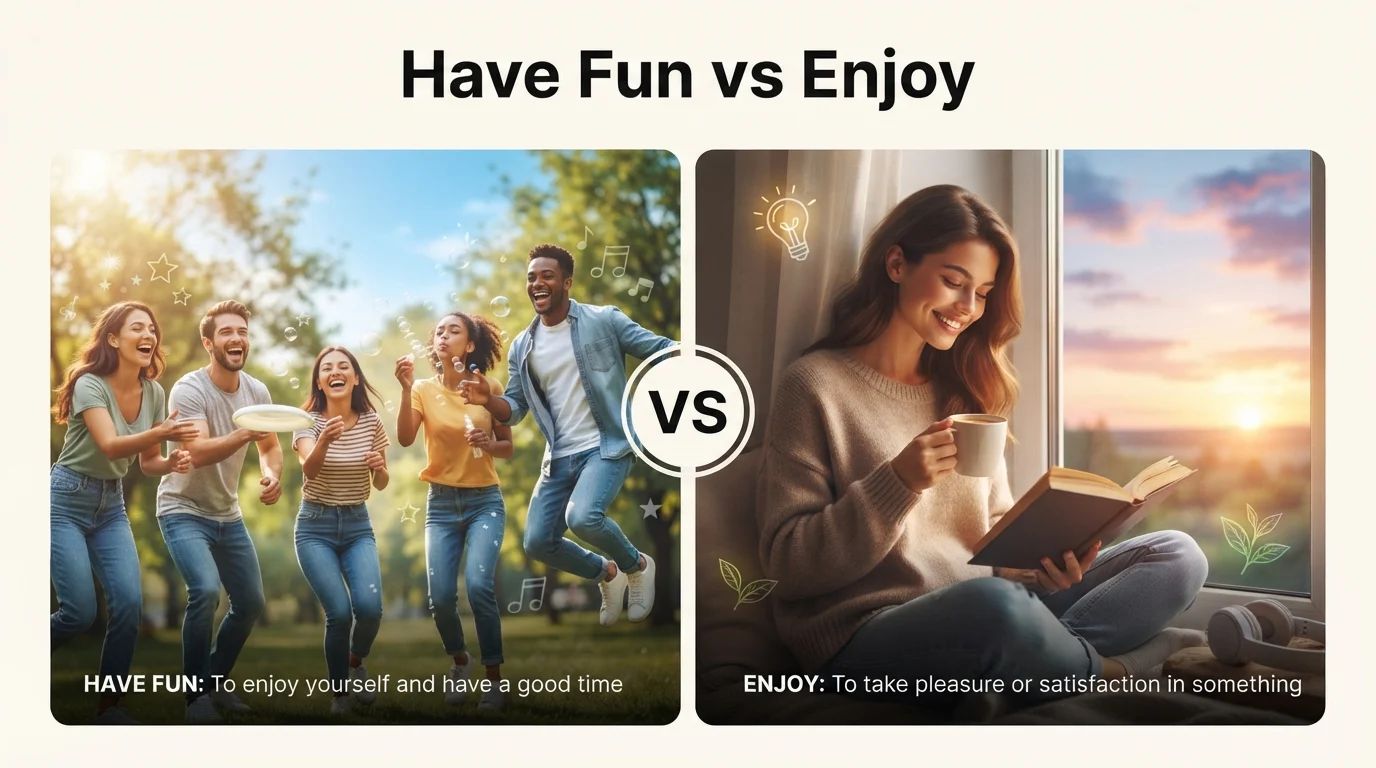
The main difference is grammatical as well as contextual. Have fun is a fixed expression used to talk about experiencing pleasure, especially during an activity or event. Enjoy, on the other hand, is a verb that normally takes an object, such as enjoy the movie, enjoy your meal, or enjoy the trip. Understanding this small distinction will help you sound more natural and avoid common mistakes in everyday English.
Quick Answer
“Have fun” means to enjoy yourself or experience pleasure, usually during an activity or event. “Enjoy” is a verb meaning to take pleasure in something. Say “Have fun!” when wishing someone a good time, but use “enjoy” when naming what someone should take pleasure in.
Why People Confuse It
The confusion happens because have fun and enjoy often communicate a very similar idea.
For example:
- Have fun at the party!
- Enjoy the party!
Both sentences are natural and mean that you hope the person has a good time.
However, their grammatical structures are different:
- Have fun → fixed expression
- Enjoy + noun/pronoun → verb + object
You can say:
Have fun at the concert!
But you would normally say:
Enjoy the concert!
Not:
Enjoy at the concert! ❌
This difference is particularly important for English learners because enjoy does not normally work with at in this construction.
First Word: Have Fun
Have fun is an idiomatic expression meaning to enjoy yourself, have a good time, or experience pleasure.
It is extremely common in casual English.
Examples
- Have fun at the beach!
- We had fun at the wedding.
- The children are having fun outside.
- Did you have fun on your vacation?
- Have fun tonight!
The expression can be used in different tenses:
| Tense | Example |
| Present | We have fun together. |
| Present continuous | We are having fun. |
| Past | We had fun yesterday. |
| Future | We will have fun tomorrow. |
| Imperative | Have fun! |
One important point: fun is generally treated as a noun in this expression.
So:
We had fun. ✅
is standard English.
Second Word: Enjoy
Enjoy is a verb meaning to take pleasure or satisfaction in something.
It is normally followed by a noun, pronoun, or gerund (-ing form).
Common patterns
- enjoy + noun
- enjoy + pronoun
- enjoy + -ing
Examples:
- I enjoyed the movie.
- She enjoys music.
- They enjoyed themselves.
- He enjoys swimming.
- We enjoyed our vacation.
Notice that enjoy can describe pleasure from a specific thing or activity.
I enjoyed the concert.
She enjoys reading.
They enjoyed themselves at the party.
A Common Grammar Rule
Don’t normally use an infinitive after enjoy.
❌ I enjoy to read.
✅ I enjoy reading.
This is one of the most common mistakes English learners make with enjoy.
Comparison Table
| Feature | Have Fun | Enjoy |
| Meaning | Have a good time | Take pleasure in something |
| Grammar | Fixed expression | Verb |
| Common structure | Have fun + place/activity | Enjoy + object |
| Example | Have fun at the party! | Enjoy the party! |
| Can be followed by -ing? | Not directly | Yes |
| Example with activity | We had fun swimming. | We enjoyed swimming. |
| Common as a farewell | Very common | Common with specific things |
| Tone | Friendly and casual | Neutral and versatile |
When to Use Each
Use “Have Fun” When Wishing Someone a Good Time
This is probably the most common situation.
I’m going to the concert tonight.
Have fun!
You don’t need to specify what the person will enjoy.
Use “Enjoy” With a Specific Thing
When you want to identify the experience, object, or activity, enjoy is often the better choice.
- Enjoy your meal.
- Enjoy the show.
- Enjoy your vacation.
- Enjoy the movie.
- Enjoy your weekend.
Use “Have Fun” for Activities and Social Events
Have fun at the party!
Have fun on your trip!
Have fun playing football!
Use “Enjoy” for Food and Experiences
Enjoy is especially natural with meals and specific experiences.
Enjoy your dinner!
Enjoy the view!
Enjoy your coffee!
You can technically use have fun for some activities, but it does not always carry the same meaning.
For example:
Have fun at dinner!
sounds like you’re wishing someone an enjoyable social experience.
Enjoy your dinner!
focuses more specifically on the meal.
Examples: Have Fun vs Enjoy
Here are more examples showing the difference in context.
- Have fun at the party!
A friendly way to wish someone a good time. - Enjoy the party!
Focuses specifically on the party. - We had fun at the beach.
We had an enjoyable time there. - We enjoyed the beach.
We found the beach itself pleasant or enjoyable. - Have fun on your vacation!
A natural holiday wish. - Enjoy your vacation!
Also natural and slightly more focused on the vacation experience. - Have fun playing tennis!
You’re wishing someone an enjoyable activity. - I enjoy playing tennis.
You are saying that playing tennis gives you pleasure. - Have fun at the concert tonight!
- Enjoy the concert tonight!
- The children had fun at the park.
- The children enjoyed playing at the park.
- Enjoy your meal!
A very common expression before someone eats. - We had a lot of fun together.
- She really enjoyed the trip.
Common Mistakes
1. “Enjoy to do”
❌ I enjoy to play football.
✅ I enjoy playing football.
After enjoy, use a noun, pronoun, or -ing form rather than a to + verb infinitive.
2. “Enjoy at the party”
❌ We enjoyed at the party.
✅ We had fun at the party.
Or:
✅ We enjoyed the party.
Enjoy normally needs an object in this meaning.
3. “Have enjoyable”
❌ Have enjoyable at the party.
✅ Have fun at the party.
Have fun is the natural fixed expression.
4. “Enjoy yourself” vs “Enjoy”
Both can be correct.
Enjoy yourself!
means have a good time.
Enjoy the movie!
means take pleasure in the movie.
5. Thinking They Are Always Interchangeable
Sometimes they can replace one another, but not without changing the sentence structure.
Have fun at the festival! ✅
Enjoy the festival! ✅
But:
Enjoy at the festival! ❌
Memory Trick
Use this simple rule:
Have fun = Have a good time.
Enjoy + something = Take pleasure in something.
Think of it this way:
Have fun → experience
Enjoy → object
So if someone is leaving for a party, say:
“Have fun!”
If someone is eating dinner, say:
“Enjoy your dinner!”
This quick distinction will help you choose the natural expression in most everyday situations.
American vs British English
There is no major difference between American and British English when it comes to have fun and enjoy.
Both expressions are standard and widely understood in both varieties of English.
You will commonly hear:
- Have fun!
- Enjoy yourself!
- Enjoy your meal!
- We had fun.
- We really enjoyed the show.
The choice depends more on context, grammar, and personal style than on whether the speaker is American or British.
Similar Words
Several expressions are related to have fun and enjoy:
Have a good time
This is very close to have fun.
Have a good time at the party!
Enjoy yourself
This means have fun or have a pleasant time.
Enjoy yourself at the wedding!
Have a blast
A very informal expression meaning have an extremely enjoyable time.
We had a blast at the concert.
Have a great time
A common and friendly alternative to have fun.
Have a great time on your trip!
Appreciate
Appreciate can sometimes overlap with enjoy, but its meaning is different. It often emphasizes recognizing the value or quality of something.
I appreciate good music.
Like
Like expresses preference or enjoyment.
I like this movie.
However, enjoy often sounds more directly connected to the experience of taking pleasure in something.
FAQs
Is “have fun” the same as “enjoy”?
They have similar meanings, but they are grammatically different. Have fun means to have a good time, while enjoy means to take pleasure in something.
Is it correct to say “enjoy the party”?
Yes. Enjoy the party! is completely natural English and means you hope the person has a good time at the party.
Is “have fun” grammatically correct?
Yes. Have fun is a standard and extremely common English expression.
Can I say “enjoy yourself”?
Yes. Enjoy yourself means have a good time. It is especially useful when you are not naming a specific thing the person should enjoy.
Which is correct: “enjoy to watch” or “enjoy watching”?
Enjoy watching is correct.
I enjoy watching movies. ✅
I enjoy to watch movies. ❌
Can I say “have fun” for a vacation?
Yes. Have fun on your vacation! is natural. You can also say Enjoy your vacation!
What is the difference between “enjoy yourself” and “have fun”?
They are very similar. Have fun is usually more casual and direct, while enjoy yourself emphasizes having a pleasant personal experience.
Final Verdict
Have fun and enjoy are closely related, but they are not grammatically identical.
Use have fun when you want to say “have a good time,” especially when wishing someone well before an activity, trip, party, or event.
Use enjoy when you want to say that someone takes pleasure in a specific thing, activity, or experience.
The easiest examples to remember are:
- Have fun at the party!
- Enjoy the party!
- Have fun on your trip!
- Enjoy your trip!
- I enjoy reading.
- We had fun reading together.
Remember This
Have fun = have a good time.
Enjoy + something = take pleasure in something.
If you’re sending someone off to an event, “Have fun!” is a natural choice. If you’re talking about a particular meal, movie, trip, activity, or experience, “Enjoy…” is usually the better structure.
Conclusion
Although have fun and enjoy often express the same general idea of pleasure, English uses them differently. Have fun works as a fixed expression and is especially common when wishing someone a good time. Enjoy functions as a verb and usually connects directly to the thing or activity being enjoyed.
Once you remember the basic pattern—“have fun” for having a good time and “enjoy + something” for taking pleasure in it—the distinction becomes much easier. Both are natural, useful expressions, and choosing between them correctly will make your everyday English sound smoother and more confident.

I am Chase Larson, an author at Grammetics, passionate about grammar and matching words. I create clear, useful content that helps readers improve vocabulary, writing, and communication.