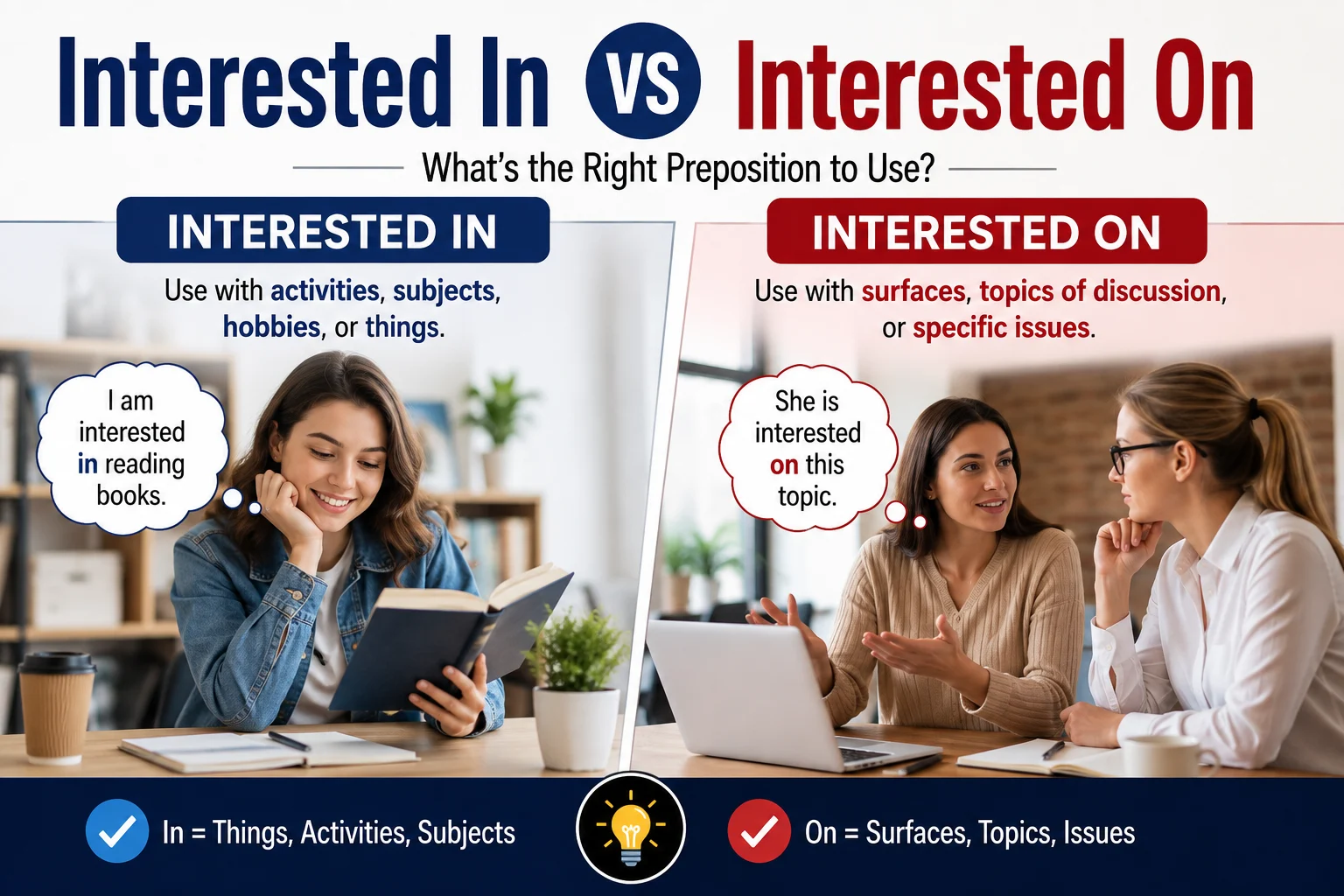
When you want to say that something catches your attention or matters to you, the natural English expression is “interested in.” For example, you might say, “I’m interested in photography,” “She’s interested in learning Spanish,” or “They’re interested in the new project.” The preposition in is an established part of this expression, so it sounds natural to native English speakers.
But what about “interested on”? This combination often appears because English learners may translate prepositions directly from their first language or choose on because it can mean “about” in other expressions, such as “a book on history.” However, interested on is generally incorrect in standard English. Understanding why in works—and when other prepositions might be appropriate—can help you avoid a common grammar mistake and make your writing and speech sound more natural.
Quick Answer
“Interested in” is the correct and standard expression. Use in when describing something that attracts your attention, curiosity, or enthusiasm: “I’m interested in science.” “Interested on” is not normally correct. Remember: you are interested in something, not interested on it.
Why People Confuse It
The confusion usually comes from the fact that English uses many different prepositions to express relationships between words.
For example:
- I’m interested in history.
- I’m working on a project.
- I read an article on climate change.
- We talked about the problem.
Because on can introduce a topic in phrases like “a lecture on biology,” learners sometimes incorrectly use it after interested.
The key point is that interested has a fixed and well-established preposition: in.
Think of interested in as one grammatical combination.
First Word: Interested In
Interested in is the correct expression when you want to say that someone has curiosity, attention, enthusiasm, or concern about something.
Examples
- I’m interested in photography.
- She’s interested in learning French.
- Are you interested in sports?
- He became interested in astronomy.
- We’re interested in your proposal.
The structure is:
Subject + be + interested in + noun/gerund
For example:
I am interested in music.
She is interested in starting a business.
They are interested in the position.
You can also use interested in with an activity expressed as an -ing form:
- interested in reading
- interested in traveling
- interested in cooking
- interested in studying
- interested in writing
What Does “Interested In” Mean?
It generally means that someone wants to know more about, learn about, participate in, or pay attention to something.
For example:
“Ali is interested in computers.”
This means Ali has an interest in computers and may enjoy learning about or using them.
Second Word: Interested On
“Interested on” is generally incorrect in standard English.
Native speakers normally do not say:
❌ I’m interested on photography.
Instead, say:
✅ I’m interested in photography.
Likewise:
❌ She is interested on history.
✅ She is interested in history.
The word on is not normally the preposition that follows interested when you are describing someone’s interest in a subject, activity, person, or idea.
Why “On” Sometimes Seems Possible
The confusion becomes understandable when you see expressions such as:
- a book on economics
- a lecture on biology
- an article on grammar
- a discussion on education
Here, on introduces the subject or topic of something.
But after interested, English uses in:
I’m interested in economics.
Not:
❌ I’m interested on economics.
Interested In vs Interested On: Comparison Table
| Expression | Correct? | Meaning | Example |
| Interested in | ✅ Yes | Having curiosity or enthusiasm about something | I’m interested in history. |
| Interested on | ❌ Usually no | Not the standard expression | ❌ I’m interested on history. |
| A book on | ✅ Yes | A book about a particular topic | I bought a book on history. |
| A lecture on | ✅ Yes | A lecture about a topic | She gave a lecture on biology. |
| Work on | ✅ Yes | Work related to a task/project | I’m working on a report. |
The important distinction is that interested in and work on follow different grammatical patterns.
When to Use Each
Use “Interested In” for Personal Interest
Use interested in when someone likes, wants to explore, or wants to learn about something.
Examples:
- I’m interested in psychology.
- She’s interested in art.
- He’s interested in your idea.
- They’re interested in buying a house.
Use “On” With Other Expressions
On is correct in many other combinations, but usually not after interested.
For example:
- I’m working on a new project.
- He wrote an essay on Shakespeare.
- She gave a presentation on marketing.
- We had a meeting on the new policy.
So don’t decide based only on the topic. Look at the word before the preposition.
Examples: Interested In vs Interested On
Here are more than ten examples to make the difference clear.
- I’m interested in learning Japanese.
Not: ❌ I’m interested on learning Japanese. - She’s interested in modern art.
Not: ❌ She’s interested on modern art. - Are you interested in this job?
Not: ❌ Are you interested on this job? - He became interested in photography.
- We’re interested in your proposal.
- My brother is interested in football.
- They’re interested in buying a new car.
- I’ve always been interested in history.
- The students are interested in science.
- She is interested in starting her own business.
- He isn’t interested in politics.
- Are they interested in joining the course?
- I’m particularly interested in environmental issues.
- She became interested in astronomy after watching a documentary.
- The company is interested in expanding internationally.
Notice that in remains the natural choice whether the object is a noun, activity, idea, subject, or opportunity.
Common Mistakes
1. Using “Interested On”
❌ I’m interested on photography.
✅ I’m interested in photography.
2. Using “Interested About”
Learners sometimes say:
❌ I’m interested about science.
The standard expression is:
✅ I’m interested in science.
However, interested in and concerned about are different expressions.
3. Forgetting “In” Before an -Ing Verb
After interested in, an activity can use the -ing form:
✅ She’s interested in learning Spanish.
Not:
❌ She’s interested in learn Spanish.
4. Confusing “Interested In” With “Interesting”
These words have different functions.
- I’m interested in the movie. → The movie attracts my attention.
- The movie is interesting. → The movie itself is engaging.
Don’t confuse the person who experiences interest with the thing that creates interest.
Memory Trick
Here’s an easy way to remember it:
You are INterested IN something.
The word IN appears twice:
INterested IN
For example:
I’m INterested IN music.
You can remember it as:
Interest goes IN.
If you’re talking about something that attracts your attention, put your interest in it—not on it.
American vs British English
There is no major American-versus-British difference here.
Both American and British English normally use:
interested in
For example:
- American English: “I’m interested in history.”
- British English: “I’m interested in history.”
The expression is standard in both varieties.
You may encounter different vocabulary or pronunciation between American and British English, but the preposition after interested remains in.
Similar Words
Several expressions are related to interested in, but their prepositions can differ.
Interested in
Used for curiosity, enthusiasm, or attention.
She’s interested in photography.
Curious about
Used when someone wants to know or discover something.
I’m curious about what happened.
Excited about
Used when someone feels enthusiasm or anticipation.
He’s excited about the trip.
Concerned about
Used when someone is worried about something.
They’re concerned about the cost.
Focused on
Used when attention is directed toward something.
She’s focused on her studies.
Working on
Used when someone is actively doing or developing something.
I’m working on a new project.
These expressions show why prepositions cannot always be translated or chosen logically. English word combinations often have conventional patterns that need to be learned.
FAQs
1. Is it interested in or interested on?
Interested in is the correct standard expression. For example: “I’m interested in music.” Interested on is generally incorrect in this meaning.
2. Can I say “I am interested on this topic”?
No. Say:
I am interested in this topic.
3. Is “interested in” followed by a noun?
Yes. For example:
She is interested in science.
It can also be followed by an -ing form:
She is interested in studying science.
4. Is “interested in learning” grammatically correct?
Yes. Interested in + -ing verb is a very common grammatical structure.
I’m interested in learning Spanish.
5. Why do we use “in” after interested?
Interested in is the conventional English collocation used to express curiosity, attention, enthusiasm, or involvement with something.
6. Can “on” ever be correct when talking about a topic?
Yes. For example, you can say:
a lecture on history
an article on grammar
a book on economics
But after interested, use in.
7. Is “interested in” the same in American and British English?
Yes. Both varieties of English normally use interested in.
Final Verdict
The correct choice is simple: use “interested in,” not “interested on,” when describing someone’s interest in a subject, person, activity, idea, or opportunity.
Interested in is a standard English collocation used in everyday conversation, academic writing, professional communication, and formal English. While on is perfectly correct after words such as book, lecture, article, and work, it does not normally belong after interested.
Remember This
Interested IN = correct.
✅ I’m interested in English.
✅ She’s interested in photography.
❌ I’m interested on English.
❌ She’s interested on photography.
Quick rule: If you mean “having an interest in something,” always choose interested in.
Conclusion
The difference between interested in and interested on is not really about choosing between two equally valid expressions. In standard English, interested in is the natural and correct construction. Whether you’re talking about a hobby, academic subject, career opportunity, person, idea, or activity, use in after interested.
Once you remember the simple pattern “interested in,” this common preposition mistake becomes easy to avoid. Just remember that English uses different prepositions with different words: you can be interested in a subject, focused on a task, curious about a question, and working on a project.

I’m Micah Wheeler, a passionate author who enjoys exploring matching words, grammar, and language. I create clear, helpful content to make word choices and grammar easier for everyone.