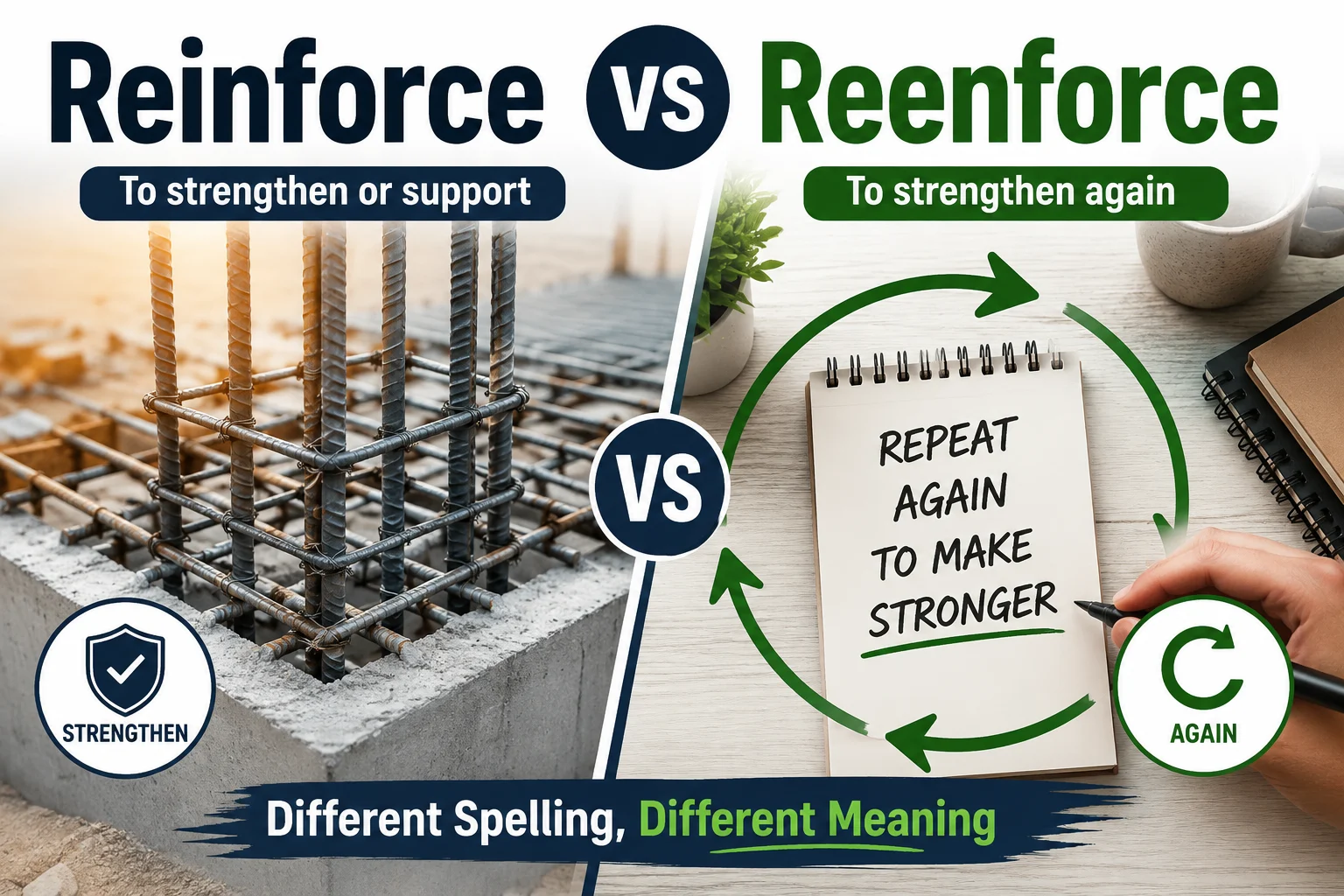
If you have ever paused over reinforce vs reenforce, you are not alone. The two spellings look almost identical, and the pronunciation can make the confusion even worse. However, there is an important difference: reinforce is the standard and widely accepted spelling, while reenforce is generally considered a misspelling or a nonstandard variant. If you are writing an essay, email, report, article, or professional document, reinforce is the spelling you should choose.
The word reinforce can mean to make something stronger, provide additional support, strengthen an idea, or encourage a behavior. It is commonly used in everyday English as well as academic, technical, business, and professional writing. In this guide, we will explain the difference between reinforce and reenforce, show you how to use the correct word in context, and give you simple examples and a memory trick so you will not have to second-guess the spelling again.
Quick Answer
Reinforce is the correct standard spelling. It means “to make stronger,” “to strengthen,” or “to support.” Reenforce is generally treated as a misspelling or nonstandard spelling. In formal, academic, business, and professional writing, always use reinforce.
Why People Confuse It
The confusion between reinforce and reenforce mainly comes from pronunciation and spelling patterns.
When people say reinforce aloud, the word can sound as though it begins with “ree-”. That makes reenforce seem logical, especially because English has many words beginning with re-.
There is also a spelling pattern that contributes to the mistake. English contains words such as:
- reenact
- reenter
- reelect
- reestablish
Because these words contain ree, writers may assume that reenforce follows the same pattern.
It does not.
The standard spelling is reinforce, with “in” after re-:
re + inforce → reinforce
The key point is simple: reenforce may look reasonable, but reinforce is the established standard spelling.
First Word: Reinforce
Reinforce is the standard English word.
It is a verb that generally means to make something stronger, provide additional support, or strengthen an idea, feeling, behavior, or effect.
Common meanings of reinforce
1. To make a physical structure stronger
Steel beams were added to reinforce the bridge.
2. To strengthen an idea or belief
The evidence reinforced her opinion.
3. To encourage a behavior
The teacher used praise to reinforce positive behavior.
4. To provide additional support
More workers were sent to reinforce the team.
Word forms
The word can appear in several forms:
- reinforce — base form
- reinforced — past tense
- reinforcing — present participle
- reinforcement — noun
Examples:
The wall needs to be reinforced.
Regular practice reinforces good habits.
Positive reinforcement can encourage learning.
Second Word: Reenforce
Reenforce is not the spelling you should normally use in modern standard English.
In most dictionaries and mainstream style contexts, reinforce is the preferred spelling. If you write reenforce in formal English, readers may interpret it as a spelling error.
For example:
❌ The training will reenforce the company’s safety procedures.
✅ The training will reinforce the company’s safety procedures.
The safest rule is straightforward:
Use reinforce, not reenforce.
If you encounter reenforce in older texts, specialized sources, or informal writing, that does not make it the preferred spelling for contemporary standard English.
Reinforce vs Reenforce: Comparison Table
| Feature | Reinforce | Reenforce |
| Standard spelling | ✅ Yes | ❌ Generally no |
| Common in modern English | ✅ Yes | ❌ Rare/nonstandard |
| Meaning | Make stronger or provide support | Intended to mean the same thing |
| Suitable for formal writing | ✅ Yes | ❌ Avoid |
| Suitable for academic writing | ✅ Yes | ❌ Avoid |
| Suitable for business writing | ✅ Yes | ❌ Avoid |
| Noun form | Reinforcement | — |
| Recommended choice | Use it | Avoid it |
When to Use Each
Use “reinforce” when you mean “make stronger”
This can refer to physical objects, arguments, beliefs, skills, habits, or relationships.
The company reinforced the building’s foundation.
Use “reinforce” when supporting an idea
You can reinforce an argument by providing evidence or additional information.
The latest research reinforces the importance of regular exercise.
Use “reinforce” for behavior
In education and psychology, reinforce is often used when something strengthens or encourages a particular behavior.
Rewards can reinforce desirable behavior.
What about “reenforce”?
In ordinary contemporary English, there is little reason to choose reenforce. If you mean “make stronger” or “support,” use reinforce.
Examples of Reinforce vs Reenforce
Here are more than 10 examples to make the difference clear.
1. Physical support
Workers installed additional beams to reinforce the roof.
Not:
Workers installed additional beams to reenforce the roof.
2. Strengthening an argument
The statistics reinforce the author’s main argument.
3. Supporting a belief
Her experience reinforced her belief that preparation matters.
4. Education
Teachers can use positive feedback to reinforce good study habits.
5. Training
The workshop was designed to reinforce the skills employees learned earlier.
6. Safety
The company added new procedures to reinforce workplace safety.
7. Team support
Additional players were brought in to reinforce the defense.
8. Memory
Reviewing vocabulary regularly helps reinforce new language skills.
9. Evidence
The new evidence reinforced the original conclusion.
10. Relationships
Honest communication can reinforce trust between colleagues.
11. Rules
The manager repeated the policy to reinforce its importance.
12. Learning
Practical exercises reinforce concepts introduced in the classroom.
13. Architecture
Engineers decided to reinforce the structure before construction continued.
14. Customer confidence
The positive reviews reinforced customers’ confidence in the product.
In every example, reinforce is the standard spelling.
Common Mistakes
Mistake 1: Writing “reenforce”
❌ The new policy will reenforce our commitment to quality.
✅ The new policy will reinforce our commitment to quality.
Mistake 2: Assuming pronunciation determines spelling
The beginning of reinforce can sound like “ree,” but English spelling does not always follow pronunciation exactly.
Mistake 3: Confusing “reinforce” with “reform”
These words have different meanings.
- reinforce = make stronger or support
- reform = improve or change something, usually to correct a problem
Mistake 4: Confusing “reinforce” with “reinforcement”
Reinforce is a verb:
We need to reinforce the wall.
Reinforcement is a noun:
The wall needs additional reinforcement.
Mistake 5: Treating “reenforce” as an equal alternative
Although you may occasionally encounter the spelling reenforce, it is not the standard choice for normal modern English writing.
Memory Trick
Here is an easy way to remember the correct spelling:
REINFORCE has “IN” inside it.
Think:
RE + IN + FORCE = REINFORCE
The word contains force, and the idea is to add strength or force to something.
You can also remember this sentence:
Reinforce it with “IN.”
If you are unsure whether to write reinforce or reenforce, look for the IN:
✅ REINFORCE
❌ REENFORCE
American vs British English
There is no major American-versus-British spelling difference here.
Both American English and British English use reinforce as the standard spelling.
For example:
American English:
The evidence reinforces the argument.
British English:
The evidence reinforces the argument.
The spelling remains the same.
This is different from words such as color/colour or organize/organise, where regional spelling conventions can differ.
So if you are writing for an American, British, Canadian, Australian, or international audience, reinforce is the safe standard form.
Similar Words
Understanding related words can make reinforce easier to remember.
Strengthen
Means to make something stronger.
Exercise can strengthen your muscles.
Support
Means to hold up, assist, or provide evidence for something.
The evidence supports the conclusion.
Fortify
Means to make something stronger, particularly against attack, damage, or weakness.
The walls were fortified to protect the city.
Bolster
Means to support or strengthen something.
The new evidence bolstered his argument.
Encourage
Means to give someone confidence or motivation.
Her teacher encouraged her to keep practicing.
Reinforcement
The noun form of reinforce, referring to additional support or the process of strengthening something.
The bridge requires structural reinforcement.
These words can overlap with reinforce, but they are not always interchangeable.
FAQs
Is “reenforce” a correct spelling?
Reenforce is generally considered a nonstandard or incorrect spelling in contemporary standard English. Reinforce is the recommended spelling.
Is reinforce one word?
Yes. Reinforce is written as one word.
The evidence will reinforce the argument.
What does reinforce mean?
Reinforce means to make something stronger, support it, strengthen an idea or belief, or encourage a particular behavior.
What is the noun form of reinforce?
The noun form is reinforcement.
The teacher used positive reinforcement.
Is “reinforce” used in American English?
Yes. Reinforce is the standard spelling in American English.
Is “reinforce” used in British English?
Yes. British English also uses reinforce.
Why does “reinforce” sound like “reenforce”?
English pronunciation does not always make spelling obvious. The first syllable of reinforce can sound like “ree,” which may lead writers to spell it reenforce. However, the standard spelling is reinforce.
What is the easiest way to remember reinforce?
Remember:
RE + IN + FORCE = REINFORCE
The letters IN are part of the standard spelling.
Final Verdict
When choosing between reinforce vs reenforce, there is a clear winner: reinforce.
Use reinforce when you mean to make something stronger, provide support, strengthen an argument, encourage behavior, or add additional support. It works naturally in everyday English, academic writing, business communication, technical writing, and professional documents.
Reenforce may occasionally appear in writing, but it is not the standard spelling you should rely on. When accuracy matters, remember the simple formula: RE + IN + FORCE = REINFORCE.
Remember This
Reinforce is the standard spelling. Reenforce is best avoided.
RE + IN + FORCE = REINFORCE
If you mean “make stronger,” “support,” or “strengthen,” choose reinforce.
Conclusion
The difference between reinforce and reenforce is primarily a matter of spelling rather than meaning. While reenforce may look natural because of the way reinforce is pronounced, reinforce is the standard form used in modern English. It is the spelling you should use in essays, websites, reports, emails, academic papers, and professional communication.
Once you remember that reinforce contains “IN” before “force,” the choice becomes much easier. Whether you are talking about reinforcing a building, reinforcing an argument, reinforcing a habit, or reinforcing someone’s confidence, the correct word is reinforce.

I’m Micah Wheeler, a passionate author who enjoys exploring matching words, grammar, and language. I create clear, helpful content to make word choices and grammar easier for everyone.