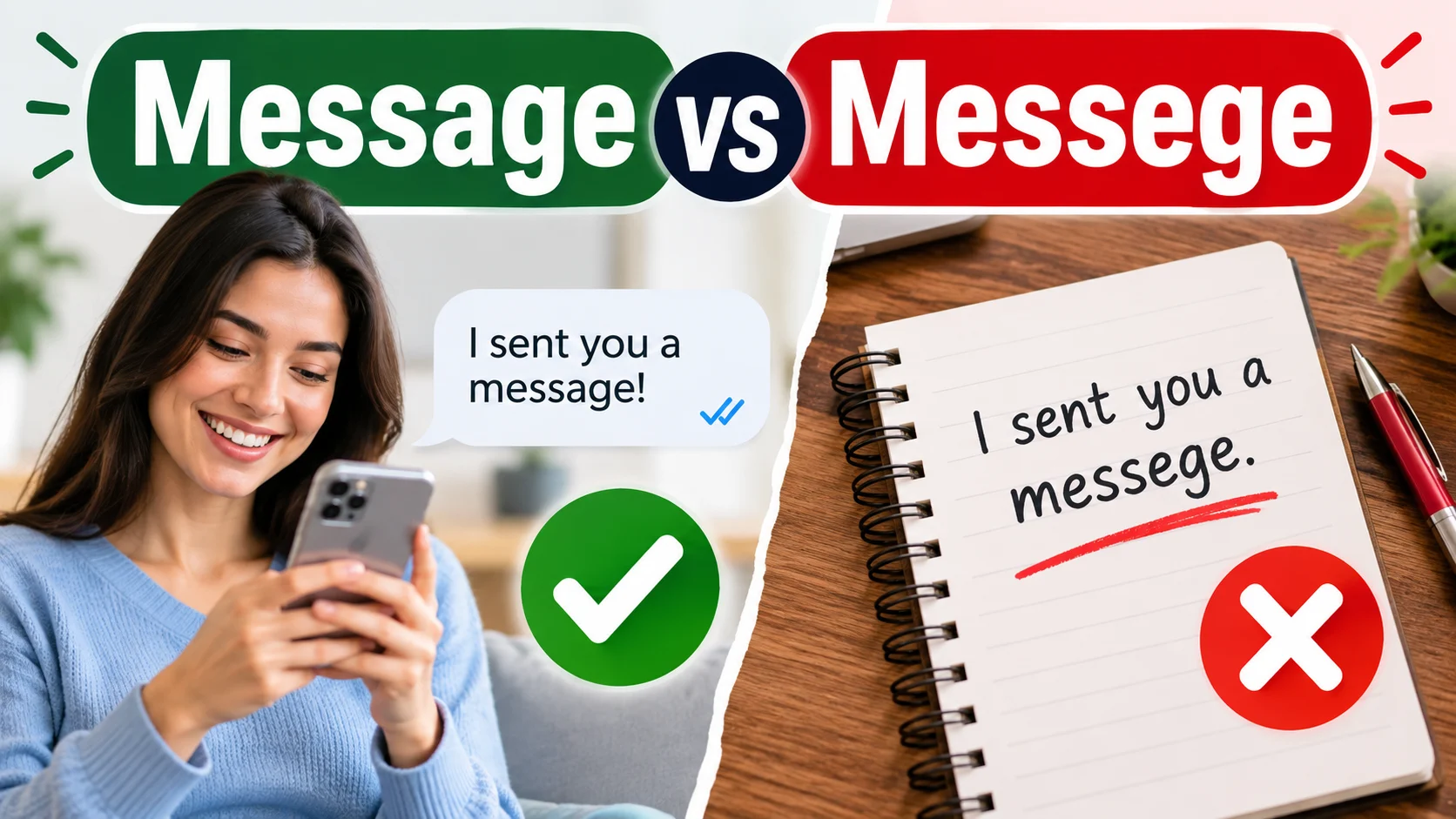
If you have ever hesitated between message vs messege, you are not alone. This is a common spelling mistake because both versions look and sound similar when spoken quickly. However, there is a clear answer: message is the correct English spelling, while messege is a misspelling. The word message is used for a piece of information sent from one person to another, whether it is delivered by text, email, letter, phone, or another communication method.
Knowing the difference matters because message is an extremely common word in everyday English. You may use it when talking about a text message, leaving a voicemail, sending a business message, or communicating an important idea. In this guide, we will explain message vs messege, show you when to use the correct spelling, provide practical examples, and share an easy memory trick so you do not make this mistake again.
Quick Answer
Message is the correct spelling. Messege is incorrect and should not be used in standard English. Use message when referring to information sent or communicated from one person, group, or organization to another.
Why People Confuse It
People often confuse message and messege because the pronunciation does not make the spelling completely obvious.
Several factors contribute to the mistake:
- The words look visually similar.
- The middle vowels can be confusing.
- English spelling does not always match pronunciation.
- People may write the word quickly in texts or online chats.
- Similar words such as passage and college can influence spelling patterns.
The key point is simple: messege is not an alternative spelling of message. It is simply a spelling error.
First Word: Message
Message is the correct word.
A message is information, communication, or an idea that is sent or expressed to someone.
As a noun
When used as a noun, message can refer to:
- A text sent to someone
- An email or written communication
- A spoken communication
- An important idea or meaning
- Information delivered from one person to another
Examples:
- I received a message from my brother.
- She left a message on my phone.
- The teacher sent a message to the parents.
- His speech had an important message about kindness.
As a verb
Message can also be used as a verb, particularly in modern informal and digital English.
- Message me when you arrive.
- I will message you later.
- She messaged her friend about the meeting.
Its past tense is messaged, and its present participle is messaging.
Second Word: Messege
Messege is incorrect.
It is a common misspelling of message and does not have a separate meaning in standard English.
❌ I sent you a messege.
✅ I sent you a message.
❌ Did you read my messege?
✅ Did you read my message?
If you are writing an email, school assignment, professional document, website content, or social media post, always use message.
Comparison Table
| Word | Correct? | Meaning | Example |
| message | ✅ Yes | Information or communication sent to someone | I sent her a message. |
| messege | ❌ No | Misspelling of message | I sent her a messege. |
The distinction is straightforward: message = correct; messege = incorrect.
When to Use Each
There is really only one standard spelling you should use.
Use “message” when:
- Sending a text
- Referring to an email
- Talking about a voicemail
- Describing written communication
- Discussing the main idea of a speech, book, movie, or advertisement
- Asking someone to contact you
Examples:
Please send me a message when you get home.
The movie has a powerful message about friendship.
Do not use “messege”
Messege should not be used in standard written English.
If you see it online, it is most likely a typo rather than a different English word.
Message vs Messege Examples
Here are more than ten examples to make the correct spelling easy to remember:
- I received a message from my manager.
- Please message me when you are free.
- She sent a message to her parents.
- Did you get my message?
- He left a message after the meeting.
- I will message you the details tonight.
- The teacher posted a message for the students.
- Your message was very clear.
- She messaged me yesterday.
- The campaign has a strong environmental message.
- I forgot to reply to his message.
- Please check your phone for my message.
- The speaker’s main message was about teamwork.
- You can message us through the website.
Notice that every example uses message, never messege.
Common Mistakes
1. Writing “messege”
This is the most common mistake.
❌ Please read my messege.
✅ Please read my message.
2. Adding an unnecessary vowel
Some writers remember the pronunciation but guess the spelling.
❌ messege
✅ message
3. Confusing spelling with pronunciation
English pronunciation can sometimes make spelling difficult. Instead of relying only on how the word sounds, remember its written form: m-e-s-s-a-g-e.
4. Using “messege” in professional writing
A spelling error in a business email, application, report, or formal document can make your writing appear less polished.
Memory Trick
Here is a simple way to remember the correct spelling:
MESSAGE has “SAGE” at the end.
Think:
mes + sage = message
You can also remember the spelling as:
M E S S A G E
The word contains “sage” at the end:
mes + sage = message
Whenever you are unsure, think of sage. This can help you avoid writing messege.
American vs British English
There is no spelling difference between American and British English for this word.
Both varieties use:
message
American English:
I sent him a message.
British English:
I sent him a message.
So, unlike words such as color/colour or favorite/favourite, message has the same spelling in both American and British English.
Similar Words
Understanding related words can make vocabulary and spelling easier.
Message
Information communicated to someone.
I received your message.
Messenger
A person, service, or application that delivers messages.
We use a messaging app to communicate.
Messaging
The act of sending messages.
Messaging has become an important part of online communication.
Messaged
The past tense of message when used as a verb.
She messaged me this morning.
Passage
A section of writing or a way through something.
Read the following passage carefully.
Although message, messenger, and messaging are related, their meanings and grammatical uses are different.
Frequently Asked Questions
1. Is “message” or “messege” correct?
Message is correct. Messege is a misspelling and should not be used in standard English.
2. Why do people spell message as messege?
The mistake usually happens because the pronunciation does not clearly reveal the spelling. People may also confuse the vowels in the middle of the word.
3. How do you spell message?
The correct spelling is M-E-S-S-A-G-E: message.
4. Is “messege” a real English word?
No. In standard English, messege is not the correct spelling of a standard English word. It is generally a misspelling of message.
5. Can “message” be a verb?
Yes. In modern English, message can be used as a verb, especially for digital communication.
I will message you later.
6. Is the spelling different in British English?
No. Both American and British English spell the word message.
7. What is the plural of message?
The plural is messages.
I have three messages on my phone.
8. What is the easiest way to remember the spelling?
Remember mes + sage = message. The ending “sage” can help you remember that the correct spelling contains a, not e, after the double s.
Final Verdict
When choosing between message vs messege, the answer is simple: message is always the correct spelling in standard English. It can function as a noun meaning communication or information, and it can also be used as a verb meaning to send someone a message.
Messege is not a second spelling or a British/American variation. It is simply a common spelling mistake. If you remember M-E-S-S-A-G-E or use the “mes + sage” memory trick, you can avoid this error in everyday, academic, and professional writing.
Remember This
Message ✅ = correct spelling
Messege ❌ = incorrect spelling
Think: mes + sage = message.
If you are writing about a text, email, voicemail, communication, or an important idea, use message.

I’m Elliot Pierce, Administrator at Grammetics, dedicated to improving word matching and grammar. I help maintain useful content, support readers, and make language learning simple, clear, accurate, and engaging.