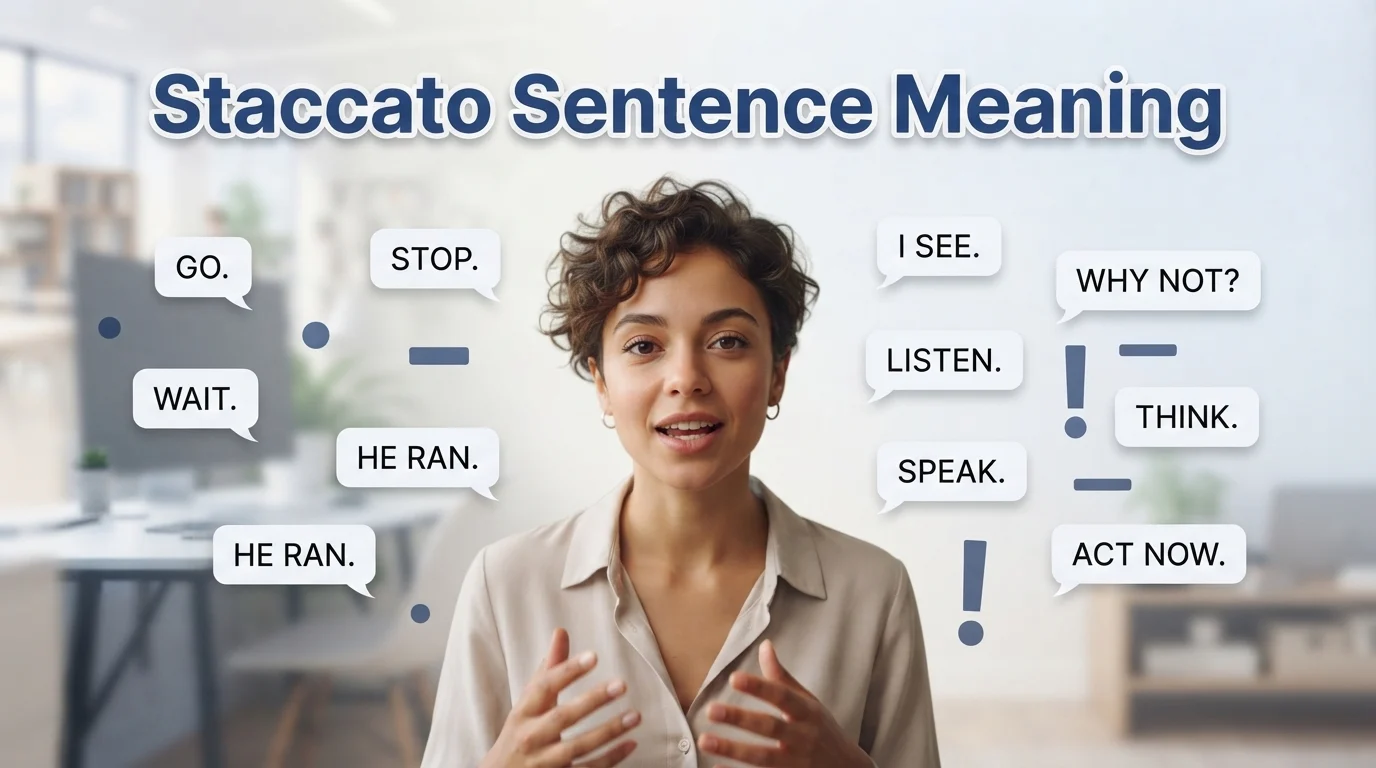
If you have come across the phrase “staccato sentence” and wondered what it means, you are not alone. The word staccato originally comes from music, where it describes notes played in a short, detached, and sharply separated way. In writing, a staccato sentence creates a similar effect. Instead of flowing smoothly from one idea to another, it uses short, clipped sentences or phrases to make each point feel separate and noticeable. Writers often use this technique to create tension, urgency, excitement, drama, or emphasis.
Understanding the staccato sentence meaning can help you recognize an important writing style used in novels, journalism, advertising, speeches, and online content. A staccato writing style can make a passage feel fast and energetic. It can also show a character’s nervous thoughts or a sudden sequence of events. However, using too many short sentences can make writing feel choppy. Learning when and why to use staccato sentences is therefore essential for effective communication.
Quick Answer
A staccato sentence is a sentence or sequence of short, sharply separated phrases or sentences that creates a clipped, rhythmic effect. Writers use staccato sentences to emphasize ideas, increase tension, show urgency, or make prose feel fast-paced and dramatic.
Why People Confuse It
People sometimes confuse staccato sentences with simply writing short sentences. Although they are closely related, they are not always exactly the same.
A short sentence can be completely normal:
She opened the door.
A staccato style usually involves several short, separated thoughts that produce a deliberate rhythm:
She opened the door. Silence. Darkness. Nothing moved.
The second example feels more abrupt and dramatic. The writer intentionally breaks the ideas into separate units.
The confusion also comes from the word staccato. Many people know it as a musical term but do not realize that it can describe a writing style as well.
First Word: Staccato
Staccato means short, detached, and sharply separated.
In music, staccato notes are played separately rather than smoothly connected.
In writing, staccato describes language that has a similarly short, abrupt, or disconnected rhythm.
Examples of “staccato”
- His breathing was staccato.
- The writer uses a staccato style.
- The dialogue has a staccato rhythm.
- Her thoughts came in staccato bursts.
The word can function as an adjective and, in some contexts, as a noun or adverb.
Second Word: Sentence
A sentence is a group of words that expresses a complete thought or idea.
When we combine staccato and sentence, we get a useful description of writing that sounds brief, clipped, abrupt, or strongly separated.
For example:
He ran. He fell. He got up. He kept going.
Each sentence is short, but together they create a strong staccato rhythm.
Comparison Table
| Feature | Staccato Sentence | Regular Short Sentence |
| Length | Usually short | Can be short |
| Rhythm | Abrupt and separated | Usually natural |
| Purpose | Often creates emphasis or tension | Simply communicates an idea |
| Effect | Fast, dramatic, urgent, or intense | Clear and direct |
| Common in | Fiction, journalism, speeches, advertising | Almost all types of writing |
| Example | “Stop. Wait. Listen.” | “Please wait here.” |
When to Use Each
Use Staccato Sentences When You Want:
- Tension: “The door opened. Slowly. Very slowly.”
- Urgency: “Run. Now.”
- Excitement: “The crowd erupted. Everyone screamed.”
- Emphasis: “One mistake. One moment. Everything changed.”
- A dramatic effect: “The lights went out. Total darkness.”
- A fast pace: “He grabbed his coat. Ran outside. Jumped into the car.”
Use Regular Sentences When You Want:
- Smooth explanation
- Detailed descriptions
- Formal academic writing
- Natural conversational flow
- Complex relationships between ideas
The key is balance. Strong writing often combines different sentence lengths instead of using one pattern throughout.
Examples of Staccato Sentences
Here are more examples showing how this writing technique works.
1. Creating suspense
The hallway was empty. Quiet. Too quiet.
The fragments make the scene feel unsettling.
2. Showing urgency
Get up. Move. Now!
The short units make the action feel immediate.
3. Showing shock
The phone rang. She answered. Silence.
The abrupt rhythm mirrors the character’s uncertainty.
4. Showing excitement
The doors opened. The crowd cheered. Music exploded.
The short sentences create energy.
5. Creating emphasis
One decision. One chance. No turning back.
Each phrase receives individual attention.
6. Describing rapid action
He jumped. Turned. Ran.
The clipped structure makes the action seem fast.
7. Showing fear
Footsteps. Behind her. Getting closer.
The broken rhythm reflects anxiety.
8. Creating a dramatic ending
He looked at me. Smiled. Walked away.
The separation gives each action weight.
9. Advertising
Fast. Simple. Powerful.
Short phrases are memorable and easy to process.
10. Dialogue
“Stop. Think. Then decide.”
The speaker sounds firm and deliberate.
11. Describing a battle
Smoke everywhere. Gunfire. Screams. Chaos.
The short expressions create an intense atmosphere.
12. Showing determination
No excuses. No fear. Just work.
The repeated structure strengthens the message.
Common Mistakes
1. Thinking every short sentence is staccato
Not every short sentence creates a staccato effect.
The baby slept.
This is simply a short sentence. Context and surrounding sentence structure determine whether the overall rhythm is staccato.
2. Using too many short sentences
Too many can make your writing sound mechanical.
Instead of:
He woke up. He dressed. He ate. He left. He drove. He arrived.
You could write:
He woke up, got dressed, ate quickly, and left for work.
3. Confusing staccato with poor writing
A clipped style is not automatically bad grammar. It can be a deliberate literary technique.
However, writers should make sure the fragments and short sentences serve a purpose.
4. Using staccato style in every paragraph
A constant staccato rhythm can become tiring.
Mix short sentences with medium and long sentences to create natural variation.
5. Forgetting the intended effect
Before using staccato sentences, ask yourself what effect you want.
Do you want:
- suspense?
- urgency?
- emphasis?
- excitement?
- fear?
- dramatic pacing?
If there is no clear purpose, a smoother sentence may work better.
Memory Trick
Think of staccato = stop, stop, stop.
The word comes from music, where staccato notes are separated rather than smoothly connected.
So when you see staccato sentence, imagine a writer putting little spaces between ideas:
Stop. Think. Listen.
That quick mental association makes the meaning easy to remember.
American vs British English
The term staccato is understood in both American and British English.
There is no major difference in the meaning of staccato sentence between the two varieties of English.
Both American and British writers can use the term to describe prose or speech that has a short, clipped, sharply separated rhythm.
The difference is more likely to come from writing style and context than from regional grammar.
For example:
“He stopped. Looked around. Waited.”
An American or British writer could use this structure for dramatic effect.
Similar Words
Several terms are related to staccato writing, although they are not always exact synonyms.
Choppy
Writing with many short or poorly connected sentences.
Example:
I went home. I ate. I watched TV. I slept.
“Choppy” can be a criticism, while “staccato” can describe an intentional technique.
Clipped
Language that is brief and direct.
Example:
“No. Not today.”
Fragmented
Writing that appears broken into separate pieces or fragments.
Abrupt
Something that happens suddenly or without a smooth transition.
Terse
Using very few words.
Punchy
Writing that is concise, energetic, and impactful.
Jerky
Movement or rhythm that lacks smoothness.
These words overlap, but staccato specifically emphasizes the short, detached rhythm.
Final Verdict
The staccato sentence meaning is essentially a short, clipped, sharply separated style of expression that creates a distinctive rhythm. It is closely connected to the musical meaning of staccato, where notes are played separately rather than smoothly connected.
Writers use this technique for a reason. It can increase tension, speed up a scene, emphasize important information, or communicate strong emotion. The most effective use usually comes from contrast: place short, staccato sentences next to longer sentences so the rhythm changes naturally.
FAQs About Staccato Sentence Meaning
What does “staccato sentence” mean?
A staccato sentence or staccato sentence style uses short, clipped, separated sentences or phrases to create an abrupt or strongly rhythmic effect.
Is a staccato sentence always grammatically short?
Usually, staccato writing relies on short sentences or fragments, but the important feature is the detached rhythm, not simply the number of words.
Why do writers use staccato sentences?
Writers use them to create tension, urgency, excitement, emphasis, suspense, or a faster pace.
Is staccato writing good or bad?
It depends on the purpose. Intentional staccato writing can be highly effective, but excessive use can make prose feel repetitive or choppy.
What is an example of staccato writing?
“He stopped. Turned. Listened.”
The three short units create a clipped and dramatic rhythm.
Is “staccato” originally a musical term?
Yes. Staccato is traditionally a musical term for notes performed in a short and detached manner. The term is also used metaphorically to describe speech and writing.
Is staccato sentence a formal grammar term?
It is better understood as a writing-style or rhetorical description rather than a standard grammatical sentence category.
Conclusion
A staccato sentence uses short, separated language to control the rhythm and emotional impact of writing. Instead of allowing every idea to flow smoothly into the next, the writer gives individual words, phrases, or sentences more space and emphasis. This makes the reader pause and process each point.
The technique is especially useful in fiction, journalism, speeches, advertising, and dramatic writing. Used carefully, it can make prose more energetic and memorable. The goal is not simply to make every sentence shorter, but to use sentence structure deliberately to create the desired effect.
Remember This
Staccato sentence = short + separated + punchy rhythm.
Think: “Stop. Pause. Continue.”
That is the easiest way to remember what staccato writing sounds and feels like.

I’m Aria White, a passionate word enthusiast who enjoys exploring grammar, vocabulary, and meaningful word connections. I create simple, helpful content that makes matching words easier, clearer, and enjoyable.