English learners often wonder whether to say “she has” or “she have.” The confusion usually comes from the fact that both has and have are forms of the same verb, but they are not interchangeable. Choosing the correct form depends mainly on the subject and the grammatical structure of the sentence.
The good news is that the rule is simple once you understand subject-verb agreement. With she, a third-person singular subject, the correct form is generally “she has.” For example, “She has a new job” and “She has finished her homework” are grammatically correct. “She have” is normally incorrect when she is the subject of a standard English sentence. In this guide, we’ll explain she has vs she have, show when to use each form, provide practical examples, discuss common mistakes, and give you an easy memory trick.
Quick Answer
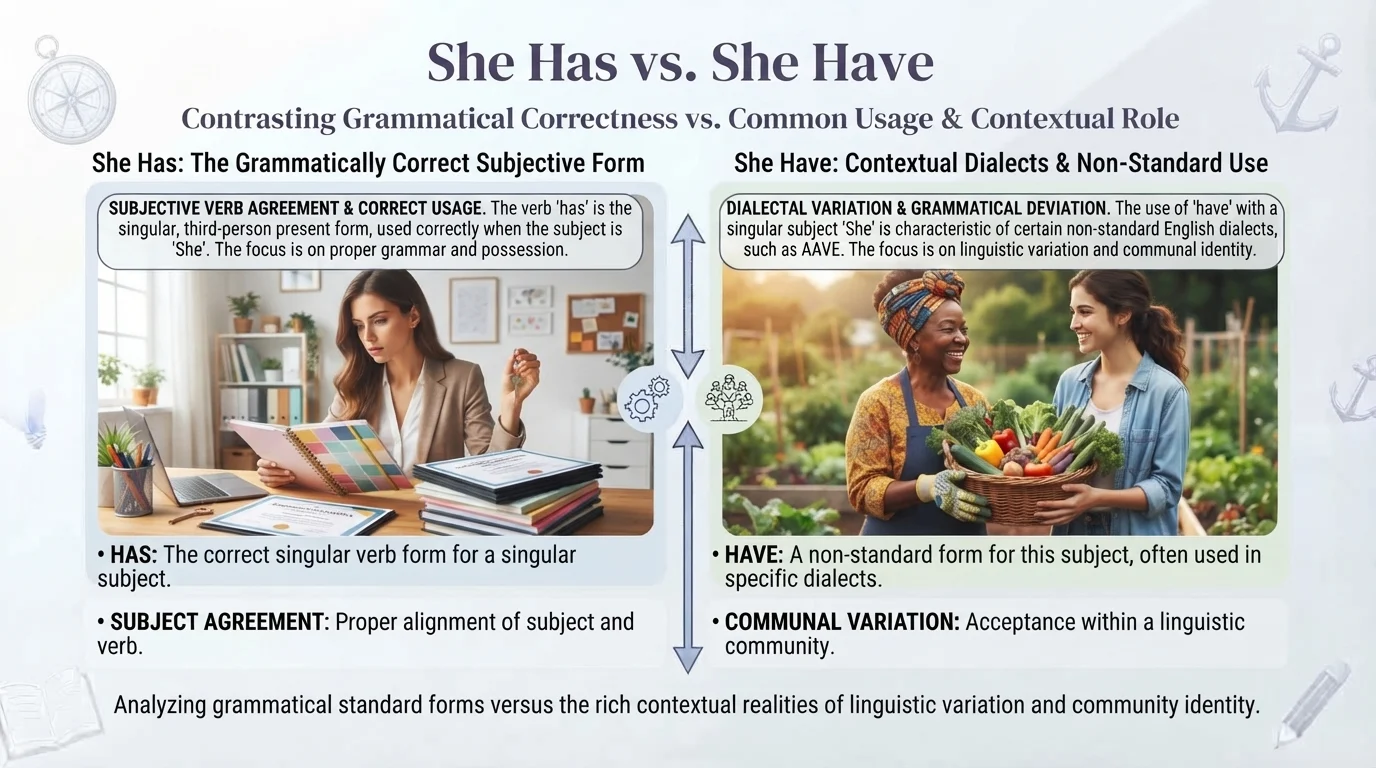
“She has” is correct in standard English. We use has with third-person singular subjects such as she, he, and it. “She have” is generally incorrect when she is the subject. However, have can appear after she in certain structures, such as “Does she have a car?”
Why People Confuse It
The confusion happens because has and have are both forms of the verb to have.
The basic pattern is:
- I have
- You have
- We have
- They have
- He has
- She has
- It has
Because she refers to one person, it takes the third-person singular form has in the present simple.
For example:
- She has a dog.
- She has two brothers.
- She has enough time.
However, have can still appear in a sentence involving she when another word or auxiliary verb controls the verb form:
- Does she have a car?
- She might have a problem.
- She will have more time tomorrow.
This is why simply looking for the word she is not always enough. You also need to examine the sentence structure.
First Word: “She Has”
“She has” is the standard and grammatically correct combination when she is the subject and has is the main verb in the present tense.
Examples:
- She has a beautiful house.
- She has three children.
- She has enough money.
- She has a meeting today.
- She has an interesting idea.
Has can also function as an auxiliary verb in the present perfect:
- She has finished her work.
- She has already eaten.
- She has gone home.
- She has seen that movie.
In these examples, has works with a past participle such as finished, eaten, gone, or seen.
Second Word: “She Have”
By itself, “she have” is generally incorrect in standard English when have is the main present-tense verb.
❌ She have a car.
✅ She has a car.
❌ She have two sisters.
✅ She has two sisters.
However, have can correctly occur after she when an auxiliary or modal verb comes before it.
For example:
- Does she have a car?
- Did she have breakfast?
- Will she have enough time?
- Can she have another piece?
- Should she have a doctor check it?
So, the important point is not that have can never follow she. Rather, she have is incorrect when have is being used as the ordinary present-tense main verb without a supporting auxiliary or modal.
Comparison Table
| Expression | Correct? | Example | Explanation |
| She has | ✅ Yes | She has a car. | Correct present-tense form |
| She have | ❌ Usually no | She have a car. | Incorrect standard English |
| Does she have | ✅ Yes | Does she have a car? | Does takes the base form have |
| She will have | ✅ Yes | She will have time. | Modal/future structure uses have |
| She can have | ✅ Yes | She can have it. | Modal can uses the base form |
| She has had | ✅ Yes | She has had lunch. | Present perfect |
| She had | ✅ Yes | She had a car. | Past tense |
When to Use Each
Use “She Has” When:
Use she has when she is the third-person singular subject and have is functioning as the present-tense main verb.
Examples:
- She has a new phone.
- She has a lot of work.
- She has two cats.
- She has a cold.
- She has an appointment.
You also use has in the present perfect:
- She has finished the project.
- She has arrived.
- She has written the email.
Use “Have” After “She” in Special Structures
Use have after she when an auxiliary verb or modal requires the base form.
Examples:
- Does she have a passport?
- Did she have lunch?
- Will she have enough money?
- Can she have some water?
- Should she have more time?
This distinction is essential for understanding English grammar and subject-verb agreement.
Examples of “She Has” vs “She Have”
Here are more than 10 practical examples:
- ✅ She has a new laptop.
- ❌ She have a new laptop.
- ✅ She has two sisters.
- ❌ She have two sisters.
- ✅ She has enough experience.
- ❌ She have enough experience.
- ✅ She has finished her homework.
- ❌ She have finished her homework.
- ✅ Does she have a car?
- ❌ Does she has a car?
- ✅ She will have more opportunities.
- ❌ She will has more opportunities.
- ✅ Can she have another cup of tea?
- ❌ Can she has another cup of tea?
- ✅ She has had enough time.
- ❌ She have had enough time.
- ✅ Did she have breakfast?
- ❌ Did she has breakfast?
Notice the pattern: when does, did, will, can, or another auxiliary/modal comes before the subject and verb, the main verb generally returns to its base form: have.
Common Mistakes
1. Using “She Have” as a Simple Present Verb
❌ She have a beautiful voice.
✅ She has a beautiful voice.
2. Using “Has” After “Does”
❌ Does she has a car?
✅ Does she have a car?
After does, use the base form have.
3. Using “Has” After “Will”
❌ She will has a meeting.
✅ She will have a meeting.
Modal and auxiliary structures generally require the base form.
4. Confusing “She Has” With “She Had”
Has refers to present situations or appears in present perfect constructions.
- She has a job.
- She has finished her work.
Had is the past form:
- She had a job last year.
5. Thinking “Have” Is Always Wrong After “She”
This is also a mistake.
Have is correct in sentences such as:
- Does she have a ticket?
- She might have a question.
- She will have dinner later.
The grammatical structure determines the correct form.
Memory Trick
Use this simple rule:
She → has
Think of he, she, it → has.
For example:
- He has
- She has
- It has
But after does, did, will, can, could, should, might, and similar words, use the base form:
- Does she have?
- Did she have?
- Will she have?
- Can she have?
A useful formula is:
She + has
but
Does/Did/Will/Can + she + have
American vs British English
There is essentially no difference between American and British English regarding the basic rule.
Both varieties normally use:
- She has a car.
- Does she have a car?
- She has finished her work.
- She will have more time.
Regional speech may sometimes contain nonstandard forms, dialect expressions, or informal usage, but standard American and British English follow the same subject-verb agreement pattern here.
Similar Words
Understanding has, have, and had together can make this grammar point easier.
Has
Used with third-person singular subjects in the present:
- She has
- He has
- It has
Have
Used with:
- I have
- You have
- We have
- They have
It is also the base form used after many auxiliary and modal verbs:
- Does she have?
- Will she have?
- Can she have?
Had
The past form of have:
- She had a car.
- They had a meeting.
- I had breakfast.
Having
The -ing form:
- She is having lunch.
- They are having fun.
Final Verdict
“She has” is the correct standard form when has is the present-tense main verb with the subject she.
“She have” is generally incorrect in that structure. However, have is correct after auxiliary or modal verbs, as in “Does she have a car?” or “She will have time.”
The key is to look at the complete verb structure rather than assuming that have can never appear after she.
FAQs
1. Is “she has” grammatically correct?
Yes. “She has” is grammatically correct and is the standard present-tense form of have with the third-person singular subject she.
2. Is “she have” correct?
Generally, no. “She have” is incorrect when have is being used as the ordinary present-tense main verb. The correct form is “she has.”
3. Should I say “Does she have” or “Does she has”?
The correct form is “Does she have?” After the auxiliary verb does, use the base form have, not has.
4. Is “she has had” correct?
Yes. “She has had” is correct. It is a present perfect construction using has plus the past participle had.
5. Why is “she have” sometimes heard in English?
It may occur in some dialects, informal speech, or nonstandard varieties of English. However, “she has” is the standard form for formal and general written English.
6. Is “she will have” correct?
Yes. “She will have” is completely correct because will is followed by the base form of the verb, have.
7. What is the easiest way to remember “she has vs she have”?
Remember “he, she, it → has.” But after words such as does, did, will, can, and should, use have.
Conclusion
The difference between she has vs she have becomes straightforward once you understand subject-verb agreement and auxiliary verbs. In a simple present-tense statement, she has is the correct form: “She has a new job.” The phrase she have is not standard in that structure.
At the same time, don’t assume that have can never follow she. Sentences such as “Does she have a car?” and “She will have enough time” are perfectly correct. Learning to recognize the entire verb phrase will help you avoid common English grammar mistakes and use has and have naturally in both speaking and writing.
Remember This
She → has
But:
Does/Did/Will/Can + she → have
- She has a car. ✅
- Does she have a car? ✅
- She will have a car. ✅
- She have a car. ❌

I’m Elliot Pierce, Administrator at Grammetics, dedicated to improving word matching and grammar. I help maintain useful content, support readers, and make language learning simple, clear, accurate, and engaging.