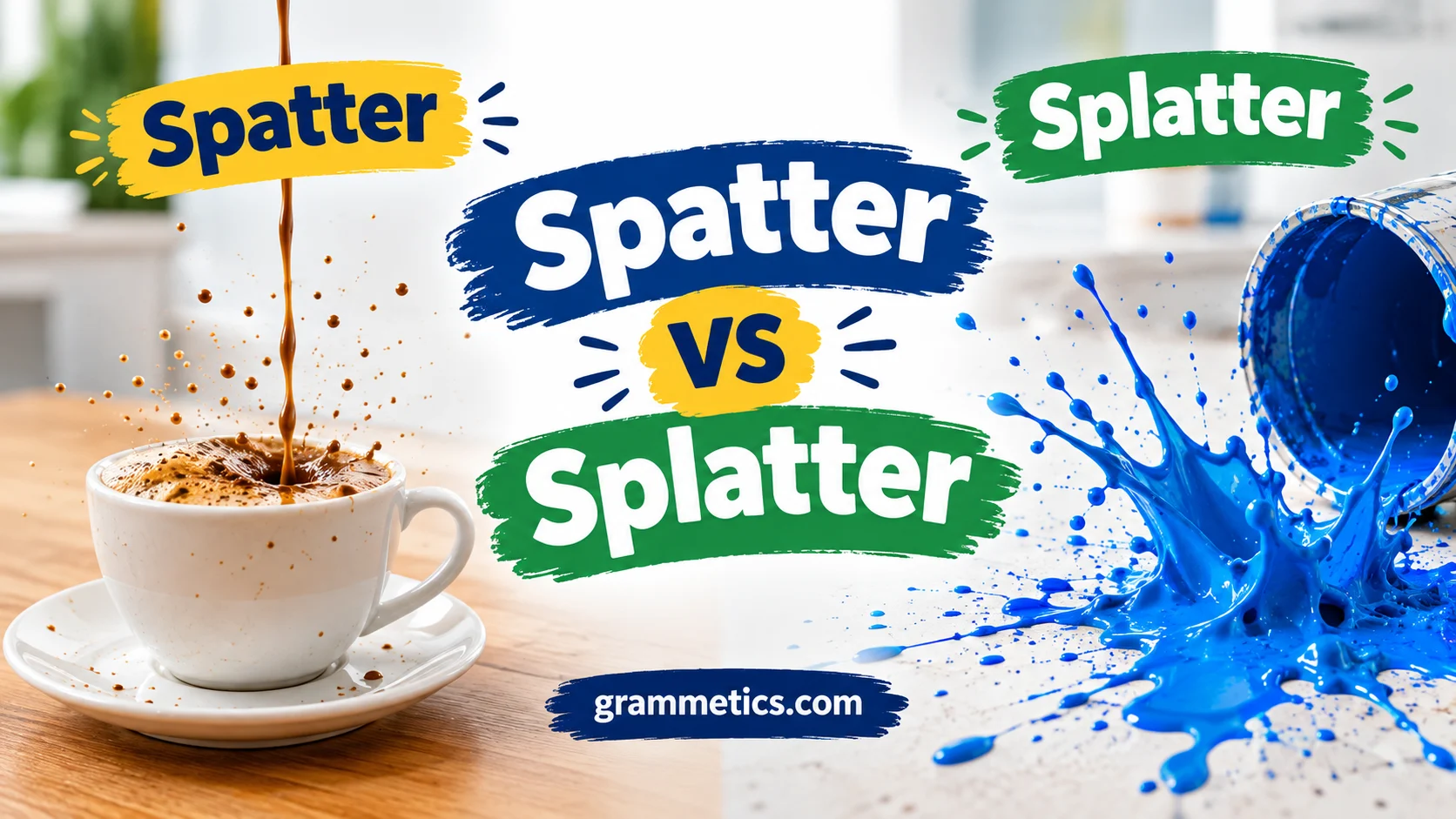
If you have ever described liquid hitting a surface, you may have wondered whether “spatter” or “splatter” is the correct word. The two terms are extremely similar, and in many everyday situations, native English speakers use them interchangeably. However, there are subtle differences in meaning, sound, and typical usage that can help you choose the more natural word.
Both spatter and splatter describe liquid or small particles being scattered onto or around something. The main distinction is often one of degree and impression. Spatter can suggest smaller, lighter, or more scattered droplets, while splatter often creates a stronger image of something being thrown or scattered messily, sometimes in larger amounts. Understanding this distinction is especially useful when writing about cooking, painting, rain, mud, accidents, or other messy situations.
Quick Answer
Spatter and splatter both mean to scatter small drops or particles over a surface. Spatter often suggests smaller or scattered droplets, while splatter can imply a larger, messier, or more noticeable splash. In everyday English, however, the two words frequently overlap.
Why People Confuse It
People confuse spatter vs splatter because the words have nearly identical meanings and differ by only one letter.
Both can function as verbs and nouns:
- Water can spatter the window.
- Water can splatter the window.
- There were spatters of paint on the wall.
- There were splatter marks on the wall.
The difference is usually about the nature or intensity of the scattering, rather than a completely different definition.
Another reason for the confusion is that both words are commonly used for:
- Water
- Paint
- Mud
- Blood
- Food
- Oil
- Rain
- Dirt
- Other liquids or small particles
Spatter
Spatter means to scatter small drops or particles onto something, usually in a scattered pattern.
It can describe something relatively light or consisting of many small droplets.
Spatter as a verb
Examples:
- The rain spattered against the window.
- Mud spattered the side of the car.
- Paint spattered across the floor.
- The pan spattered oil onto the stove.
Spatter as a noun
As a noun, spatter refers to the drops or marks produced by scattering.
- There was spatter on the wall.
- The artist used paint spatter to create texture.
- The windshield was covered with mud spatter.
Spatter is especially common when describing small droplets or scattered marks.
Splatter
Splatter also means to scatter liquid or small particles, but it often creates a stronger sense of messiness, force, or noticeable impact.
Splatter as a verb
Examples:
- The sauce splattered onto my shirt.
- Mud splattered across the windshield.
- The machine splattered oil everywhere.
- Paint splattered onto the canvas.
Splatter as a noun
As a noun, splatter refers to the scattered liquid, material, or resulting marks.
- There was tomato sauce splatter on the counter.
- The artist created a splatter effect.
- The floor was covered in paint splatter.
The word splatter can sound more dramatic or messy than spatter.
Comparison Table
| Feature | Spatter | Splatter |
| Basic meaning | Scatter small drops or particles | Scatter liquid or particles messily |
| Common impression | Small, scattered droplets | More forceful or messy scattering |
| Intensity | Often lighter | Often stronger |
| Can be a verb? | Yes | Yes |
| Can be a noun? | Yes | Yes |
| Common with paint | Yes | Yes |
| Common with water | Yes | Yes |
| Common with mud | Yes | Yes |
| Everyday usage | Very common | Very common |
| Can the words overlap? | Yes | Yes |
When to Use Each
Use “spatter” when:
Choose spatter when you want to emphasize small drops or a scattered pattern.
- Rain spattered the pavement.
- Paint spattered the artist’s clothes.
- There were tiny spatters of water on the mirror.
Use “splatter” when:
Choose splatter when the situation feels messier, more forceful, or visually dramatic.
- The sauce splattered all over the stove.
- Mud splattered across the car.
- Paint splattered onto the floor.
A useful rule
Think of the distinction this way:
Spatter = scattered small drops
Splatter = scattered drops with a messier or more forceful feel
This is a useful guideline rather than an absolute grammatical rule because the words frequently overlap.
Examples of Spatter vs Splatter
Here are examples that show how the two words are commonly used.
- Rain spattered against the glass.
- Mud spattered the tires.
- Paint spattered onto the wall.
- The windshield was covered with water spatter.
- Oil spattered from the hot pan.
- The soup splattered when I stirred it too quickly.
- Tomato sauce splattered across the kitchen counter.
- Mud splattered all over his shoes.
- The artist splattered paint onto the canvas.
- Grease splattered onto the stovetop.
- There were tiny spatters of paint on the floor.
- The children made splatter marks with the paint.
Notice that several examples could naturally use either word depending on the writer’s intended emphasis.
Common Mistakes
1. Assuming one word is always correct
It is incorrect to think that spatter is always right or splatter is always right.
Their meanings overlap considerably.
2. Thinking “splatter” is grammatically different
Both words can work as nouns and verbs.
- Paint spattered the wall.
- Paint splattered the wall.
Both constructions are grammatical.
3. Treating the difference as absolute
The distinction between the two words is often based on degree, force, pattern, and context, not a strict grammatical rule.
4. Using “splatter” when you mean a single splash
A splash usually emphasizes liquid hitting or moving through a surface in a larger, more unified movement.
A spatter or splatter emphasizes multiple scattered drops or particles.
Memory Trick
Here’s an easy way to remember spatter vs splatter:
SPATTER = Small scattered drops
SPLATTER = Stronger, messier scattering
The extra L in splatter can remind you of a larger-looking mess.
It is only a memory aid, not a formal dictionary rule, but it can help you remember the usual distinction.
American vs British English
Both spatter and splatter are used in American and British English.
There is no major American-versus-British spelling difference here.
The distinction is more about context and style than regional grammar. A British speaker can use splatter, and an American speaker can use spatter.
In both varieties of English, the words can describe:
- Paint
- Rain
- Mud
- Oil
- Food
- Water
- Small drops or particles
So you generally do not need to choose one based on whether you are writing for an American or British audience.
Similar Words
Several English words are related to spatter and splatter, but they are not always interchangeable.
Splash
A splash usually refers to a larger movement of liquid.
The child jumped into the puddle and made a splash.
Spray
Spray usually describes liquid released in many fine droplets.
The bottle sprayed water onto the plants.
Sprinkle
Sprinkle means to scatter small amounts of something over a surface, often deliberately.
She sprinkled sugar over the cake.
Scatter
Scatter is a much broader word meaning to distribute things over an area.
The wind scattered leaves across the yard.
Drip
Drip describes liquid falling in individual drops.
Water began to drip from the faucet.
Final Verdict
Spatter and splatter are both correct English words for scattering drops or small particles. The main difference is one of nuance rather than strict grammar.
Use spatter when you want to emphasize small, scattered droplets or marks. Use splatter when you want to emphasize a messier, more forceful, or visually dramatic scattering. In many everyday sentences, however, either word can work naturally.
Frequently Asked Questions
Is spatter and splatter the same thing?
They have very similar meanings. Both can describe liquid or small particles being scattered over an area, although splatter often suggests a messier or more forceful action.
Is it paint spatter or paint splatter?
Both paint spatter and paint splatter are correct. Paint splatter often sounds more dramatic or messy, while paint spatter can emphasize scattered droplets or marks.
What is the difference between spatter and splash?
A splash usually describes a larger movement or impact of liquid, while spatter refers more specifically to small drops scattered over an area.
Is “splatter” a real word?
Yes. Splatter is a standard English word that can function as both a verb and a noun.
Is “spatter” a verb or a noun?
Spatter can be both a verb and a noun. For example, “Rain spattered the window” uses it as a verb, while “There was water spatter on the glass” uses it as a noun.
Which is more messy: spatter or splatter?
Splatter often conveys a stronger sense of messiness or force, but the distinction is not absolute. Context determines which word sounds more appropriate.
Can I use spatter and splatter interchangeably?
Often, yes. In many everyday contexts, either word can describe scattered liquid or particles. The choice depends on the degree of force, messiness, and emphasis you want to convey.
Conclusion
The difference between spatter vs splatter is subtle but useful. Both words describe drops or particles being scattered, and both can be used as nouns and verbs. Spatter commonly suggests small or scattered droplets, while splatter often gives a stronger impression of force, mess, or a noticeable spread.
When you’re unsure, consider the image you want your sentence to create. For a light pattern of small droplets, spatter may sound natural. For a messy burst of sauce, mud, paint, or another liquid, splatter may be more expressive. Remember that English usage allows considerable overlap between these words.
Remember This
Spatter = small, scattered drops.
Splatter = scattered drops with a messier or more forceful feel.
Both are correct—the context determines which sounds more natural.

I’m Aria White, a passionate word enthusiast who enjoys exploring grammar, vocabulary, and meaningful word connections. I create simple, helpful content that makes matching words easier, clearer, and enjoyable.