The words prescribe and proscribe look and sound remarkably similar, but they have almost opposite meanings. This makes them a common source of confusion in English, especially when discussing medicine, rules, laws, or official recommendations. Knowing the difference can help you avoid a serious change in meaning.
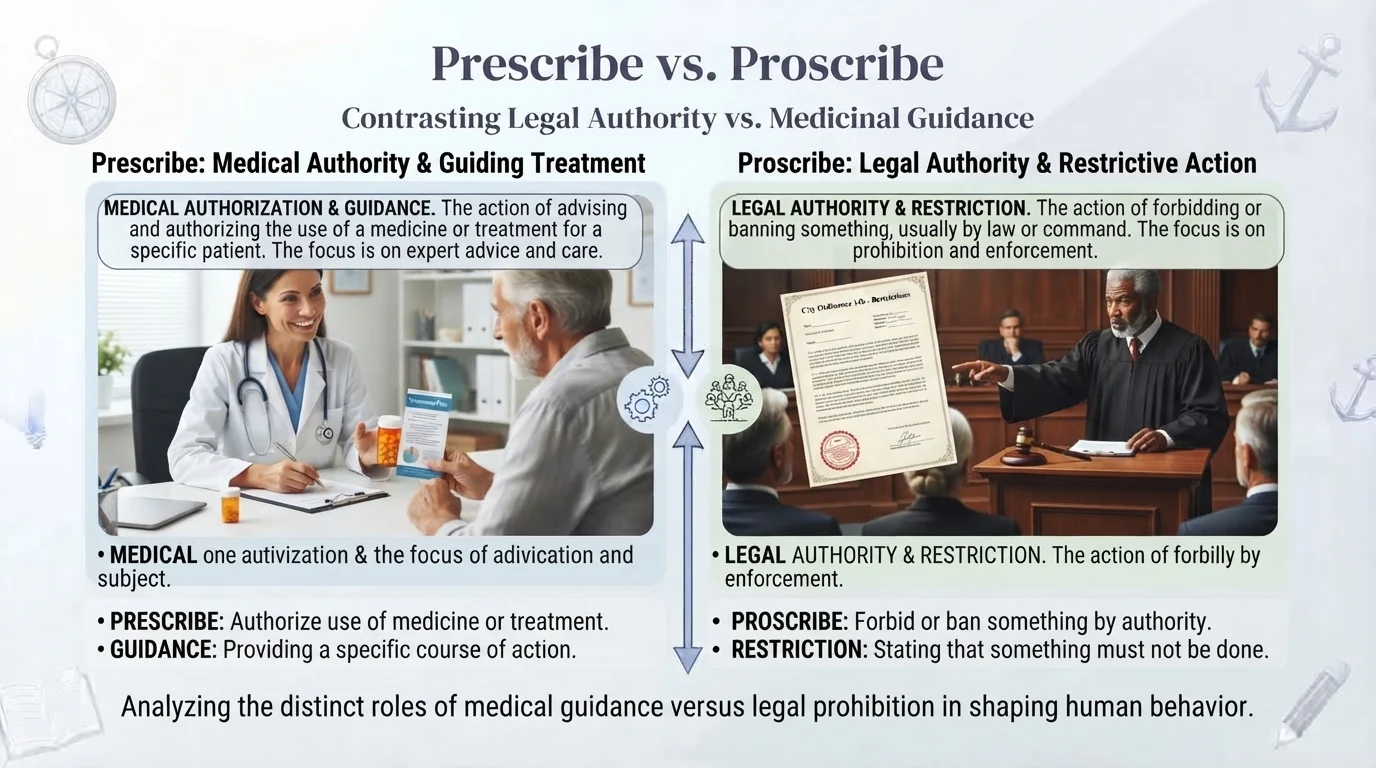
Prescribe generally means to officially recommend, authorize, or order something. Doctors prescribe medicines, while authorities can prescribe certain procedures or requirements. Proscribe, on the other hand, means to officially forbid, ban, or prohibit something. The distinction is small in spelling but significant in meaning. In this guide, you’ll learn the definitions of prescribe vs proscribe, see clear examples, compare their usage, and discover a simple memory trick that makes these words easier to remember.
Quick Answer
Prescribe means to recommend, order, or authorize something, especially a treatment or medicine. Proscribe means to officially forbid or ban something. Think of prescribe = tell someone what to do or use, while proscribe = officially say what is not allowed.
Why People Confuse It
People often confuse prescribe and proscribe because they:
- Begin with similar sounds.
- Have nearly identical spellings.
- Both are commonly used in formal English.
- Can appear in discussions about rules, laws, medicine, and official decisions.
- Come from Latin roots associated with writing or declaring something officially.
The easiest way to separate them is to focus on their meanings:
Prescribe = recommend or order.
Proscribe = prohibit or ban.
For example:
- The doctor prescribed antibiotics.
- The government proscribed the organization.
The first sentence tells us something was officially recommended or ordered. The second tells us something was officially forbidden.
Prescribe: Meaning and Usage
Prescribe is a verb meaning to recommend, order, or officially specify something.
The word is especially common in healthcare. A doctor may prescribe medicine, a treatment, or a specific course of action.
Common meanings of prescribe
- To order medicine for a patient.
- To recommend a particular treatment.
- To officially specify what should be done.
- To establish a rule or requirement.
Examples
- The doctor prescribed medication for the infection.
- She was prescribed a short course of antibiotics.
- The therapist prescribed daily exercises.
- The regulations prescribe certain safety procedures.
- The law prescribes a specific procedure for handling complaints.
Common expressions with prescribe
- prescribe medication
- prescribe medicine
- prescribe treatment
- prescribe antibiotics
- prescribe a course of action
- prescribe rules
- prescribe requirements
In everyday English, prescribe is most strongly associated with doctors and medical treatment.
Proscribe: Meaning and Usage
Proscribe is a verb meaning to officially forbid, prohibit, or ban something.
It is considerably less common than prescribe and tends to appear in formal, legal, political, academic, or institutional writing.
Common meanings of proscribe
- To officially prohibit something
- To ban an activity
- To forbid a practice
- To declare something unacceptable or illegal
Examples
- The law proscribes discrimination.
- The organization proscribed the use of certain materials.
- The government proscribed the group under national law.
- The rules proscribe unauthorized access.
- Certain forms of conduct are proscribed by the regulations.
The key idea is prohibition.
If something is proscribed, it is not merely discouraged. It is formally forbidden or prohibited.
Prescribe vs Proscribe: Comparison Table
| Feature | Prescribe | Proscribe |
| Part of speech | Verb | Verb |
| Basic meaning | Recommend, order, or specify | Forbid, ban, or prohibit |
| Common context | Medicine, rules, procedures | Laws, regulations, official bans |
| Example | The doctor prescribed medicine. | The law proscribes the practice. |
| Related noun | Prescription | Proscription |
| Memory idea | Prescribe = provide | Proscribe = prohibit |
| Opposite idea | Tell what should be done | Tell what must not be done |
When to Use Each
Use “prescribe” when something is recommended or ordered
Use prescribe when a doctor orders medication or treatment.
The doctor prescribed pain medication.
You can also use it more broadly when an authority officially specifies what should happen.
The policy prescribes a three-step process.
Use “proscribe” when something is prohibited
Use proscribe when an authority formally bans or forbids something.
The regulations proscribe unauthorized disclosure of confidential information.
A useful question is:
Is someone being told what to do, or what not to do?
- What to do → prescribe
- What not to do → proscribe
Examples of Prescribe vs Proscribe
Here are practical examples to make the difference clearer:
- The doctor prescribed a new medication.
- The hospital prescribed a strict treatment schedule.
- The regulations prescribe minimum safety standards.
- The physician prescribed physical therapy.
- The law prescribes how applications must be submitted.
- The regulations proscribe the use of unauthorized equipment.
- The law proscribes certain forms of discrimination.
- The organization proscribed the practice.
- The rules proscribe employees from sharing confidential information.
- The government proscribed the activity under the new law.
- The doctor prescribed rest and medication.
- The policy proscribes conduct that violates workplace standards.
Notice the difference: prescribe establishes or recommends something to be followed, while proscribe establishes something that must not be followed or done.
Common Mistakes
Mistake 1: Using “proscribe” when you mean “prescribe”
Incorrect:
The doctor proscribed antibiotics.
This means the doctor forbade antibiotics.
Correct:
The doctor prescribed antibiotics.
Mistake 2: Assuming “proscribe” means “recommend”
Because the two words look similar, writers sometimes treat them as synonyms.
They are not synonyms.
Prescribe involves recommending, ordering, or specifying.
Proscribe involves prohibiting.
Mistake 3: Confusing “proscribe” with “prescription”
A prescription is an instruction or authorization, usually from a medical professional, for medicine or treatment.
Proscription means an official prohibition or ban.
Mistake 4: Using “prescribe” for every type of rule
Although prescribe can mean “specify,” it often sounds formal when used for general rules. Depending on the context, require, specify, or mandate may sound more natural.
Memory Trick: Prescribe vs Proscribe
Try this simple trick:
PRESCRIBE = PROVIDE
Both begin with P and can be connected with the idea of providing instructions or treatment.
Prescribe = provide what should be used or done.
PROSCRIBE = PROHIBIT
Both proscribe and prohibit begin with PRO.
Proscribe = prohibit something.
So remember:
Prescribe = do/use this.
Proscribe = don’t do/use this.
This simple contrast is usually enough to keep the two words apart.
American vs British English
The distinction between prescribe and proscribe is essentially the same in American and British English.
In both varieties:
- Prescribe means to recommend, order, or specify.
- Proscribe means to prohibit or ban.
The main difference is frequency and context rather than meaning. Prescribe is very common in both American and British English because of its frequent use in healthcare.
Proscribe is less common in everyday conversation in both varieties and is more likely to appear in formal writing, legal documents, academic texts, government language, or discussions of regulations.
Similar Words
Several words are closely related to prescribe and proscribe, but their meanings are not identical.
Words similar to “prescribe”
- Recommend — suggest something as a good choice
- Order — officially instruct someone to do something
- Specify — state something precisely
- Mandate — officially require something
- Advise — suggest a course of action
Words similar to “proscribe”
- Prohibit — officially prevent something
- Ban — officially forbid something
- Forbid — tell someone that something is not allowed
- Outlaw — make something illegal
- Disallow — refuse to permit something
A useful distinction is that recommend can be less forceful than prescribe, while proscribe generally conveys formal prohibition.
Final Verdict
The difference between prescribe and proscribe comes down to one central idea: prescribe tells what should be done, while proscribe tells what must not be done.
When you’re talking about medicine, treatments, instructions, or officially specified procedures, prescribe is usually the correct word. When you’re talking about formal bans, prohibited activities, or forbidden conduct, choose proscribe.
FAQs
1. What is the difference between prescribe and proscribe?
Prescribe means to recommend, order, or specify something. Proscribe means to officially prohibit or ban something.
2. Does prescribe mean recommend?
Yes. Prescribe can mean to recommend or order something, especially medical treatment. It can also mean to officially specify a requirement or procedure.
3. Does proscribe mean prohibit?
Yes. Proscribe means to officially forbid, prohibit, or ban something.
4. Is proscribe the opposite of prescribe?
In many contexts, the meanings can be viewed as contrasting: prescribe says what should be done, while proscribe says what should not be done. However, they are not exact opposites in every possible use.
5. Is prescribe only used for medicine?
No. Although medical usage is extremely common, prescribe can also mean to specify or establish a rule, procedure, or requirement.
6. Is proscribe a common English word?
Proscribe is a legitimate English word, but it is less common in everyday conversation than prescribe. It frequently appears in formal, legal, academic, and institutional contexts.
7. What is an easy way to remember prescribe and proscribe?
Remember: prescribe = provide or recommend, while proscribe = prohibit.
Conclusion
Although prescribe and proscribe differ by only a few letters, their meanings are significantly different. Prescribe is about recommending, ordering, or specifying something, especially medicine or treatment. Proscribe is about formally prohibiting or banning something. Understanding this distinction can make your writing more precise and prevent potentially confusing statements.
Whenever you are unsure, ask yourself whether the sentence is saying “this should be done” or “this should not be done.” If it is the first, prescribe is likely the word you need. If it is the second, proscribe may be appropriate.
Remember This
Prescribe = recommend, order, or specify.
Proscribe = prohibit, forbid, or ban.
Easy memory trick: Prescribe = provide; Proscribe = prohibit.

I’m Elliot Pierce, Administrator at Grammetics, dedicated to improving word matching and grammar. I help maintain useful content, support readers, and make language learning simple, clear, accurate, and engaging.