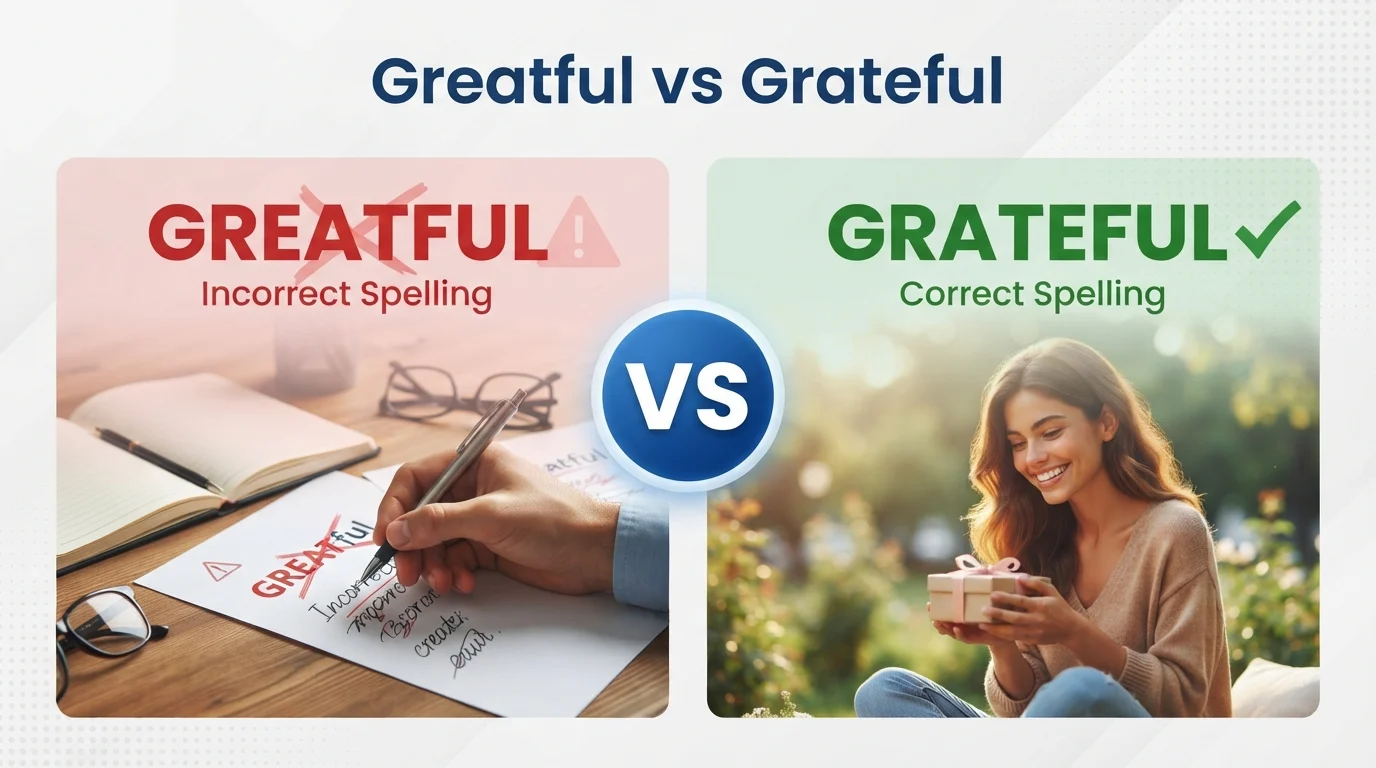
If you have ever paused while writing “greatful” or “grateful,” you are definitely not alone. The two spellings look almost identical, and it is easy to assume that greatful comes from the word great. After all, something wonderful can make you feel great, so the spelling seems logical. However, English spelling does not always follow that kind of simple pattern.
The correct spelling is grateful. It means feeling or expressing appreciation, thankfulness, or gratitude. Greatful is a common spelling mistake and is not considered standard English. Once you understand where grateful comes from and connect it with the related word gratitude, the correct spelling becomes much easier to remember. In this guide, we will compare greatful vs grateful, explain their meanings, look at real-world examples, cover common mistakes, and give you a simple memory trick so you can spell the word correctly every time.
Quick Answer
Grateful is the correct spelling. It means feeling or showing appreciation or thankfulness. Greatful is a misspelling and should not be used in standard English. Remember: grateful contains “grat,” just like gratitude. For example: I’m grateful for your help.
Why People Confuse It
The confusion between greatful and grateful mainly comes from pronunciation and the familiar word great.
When people hear grateful, they may naturally connect it with great and spell it as greatful. The pronunciation can also make the “a” in grat- easy to overlook.
There is another reason for the mistake: the suffix -ful is familiar in words such as:
- helpful
- thankful
- beautiful
- careful
- useful
So someone may think that great + ful = greatful.
However, grateful is not formed from great. It is related to gratitude, which refers to thankfulness or appreciation.
That distinction is the key to getting the spelling right.
First Word: Greatful
Greatful is incorrect in standard English.
It is a common misspelling of grateful, usually caused by associating the word with great. You may occasionally see greatful in informal online writing, social media posts, comments, or messages, but its appearance does not make it a correct spelling.
Incorrect:
I am greatful for everything you have done.
Correct:
I am grateful for everything you have done.
If you are writing an email, essay, article, professional message, application, or academic assignment, always use grateful.
Second Word: Grateful
Grateful is the correct word.
It is an adjective meaning thankful, appreciative, or pleased because of something someone has done or something you have received.
Examples:
- I am grateful for your support.
- She was grateful for the opportunity.
- We are grateful to everyone who helped us.
- He felt grateful for his family.
- They were grateful to receive assistance.
The noun related to grateful is gratitude.
grateful → gratitude
This connection provides one of the easiest ways to remember the correct spelling.
Grateful in common phrases
You will often see grateful in expressions such as:
- grateful for your help
- grateful for the opportunity
- grateful to you
- grateful to everyone
- deeply grateful
- truly grateful
- forever grateful
- extremely grateful
Comparison Table
| Feature | Greatful | Grateful |
| Correct spelling? | ❌ No | ✅ Yes |
| Meaning | No standard meaning | Thankful or appreciative |
| Standard English | ❌ Incorrect | ✅ Correct |
| Related noun | — | Gratitude |
| Example | I am greatful. ❌ | I am grateful. ✅ |
| Common mistake? | Yes | No |
When to Use Each
There is an important difference here: you should use “grateful” in standard English, while “greatful” should generally not be used at all.
Use “grateful” when you mean thankful
Use grateful when someone helps you, gives you something, supports you, or provides an opportunity.
I’m grateful for your advice.
Use “grateful” when expressing appreciation
We are grateful to our teachers for their guidance.
Use “grateful” in professional communication
It is especially useful when expressing polite appreciation:
I’m grateful for your time and consideration.
Don’t use “greatful”
If you mean thankful, don’t write:
I am greatful for your kindness. ❌
Write:
I am grateful for your kindness. ✅
Examples of Grateful in Sentences
Here are several natural examples showing how grateful works in everyday English.
- I’m grateful for your help.
- She is grateful to her parents for their support.
- We are grateful for this wonderful opportunity.
- He felt grateful when his friend came to help.
- I’m deeply grateful for everything you have done.
- They were grateful to everyone who supported them.
- She was grateful for the chance to learn something new.
- I will always be grateful for your kindness.
- He is truly grateful to his team.
- We are extremely grateful for your generosity.
- The students were grateful for their teacher’s guidance.
- I’m grateful that you took the time to explain it.
Notice that grateful for and grateful to are both common, but they are used slightly differently.
Grateful for
Use grateful for before the thing or situation you appreciate.
I’m grateful for your support.
Grateful to
Use grateful to before the person you appreciate.
I’m grateful to you for your support.
You can combine both:
I’m grateful to you for your help.
Common Mistakes
1. Writing “greatful”
This is the most common error.
❌ I’m greatful for your support.
✅ I’m grateful for your support.
2. Connecting it with “great”
Although great and grateful look similar, grateful is associated with gratitude, not great.
3. Forgetting the “a”
Some people write:
❌ gretful
❌ greateful
❌ greatfull
The correct spelling is:
✅ grateful
4. Adding an extra “l”
Because grateful ends with -ful, some writers mistakenly write greatfull or gratefull.
The correct spelling has one l:
grateful
5. Confusing grateful with gratitude
These words are related but have different grammatical roles.
- grateful = adjective
- gratitude = noun
Example:
I am grateful for your kindness.
I expressed my gratitude for your kindness.
Memory Trick
Here is the easiest way to remember grateful:
Think: GRATITUDE → GRATEFUL
Both words begin with GRAT.
GRAT + EFUL = GRATEFUL
So when you’re unsure whether to write greatful or grateful, think:
“I feel grateful because I have gratitude.”
This prevents your brain from connecting the word with great.
Another quick trick:
Grateful = Gratitude + -ful
Not:
Great + -ful
American vs British English
There is no spelling difference between American and British English for this word.
Both varieties use:
grateful
American English:
I’m grateful for your help.
British English:
I’m grateful for your help.
So this is not a case like color/colour or favorite/favourite. Greatful is not an alternative British spelling of grateful.
It is simply a misspelling in both varieties of standard English.
Similar Words
If you’re learning vocabulary related to grateful, these words are useful:
- Thankful — feeling pleased or appreciative about something.
- Appreciative — recognizing the value or benefit of something.
- Gratitude — the feeling or expression of thankfulness.
- Indebted — feeling that you owe someone because they helped you.
- Obliged — grateful or appreciative, especially in formal usage.
- Thanks — an expression of appreciation.
- Appreciation — recognition and enjoyment of someone’s value, effort, or benefit.
Grateful vs Thankful
These words are very close in meaning.
I’m grateful for your support.
I’m thankful for your support.
Both are correct. However, grateful can sound especially appropriate when emphasizing sincere appreciation.
FAQs
Is “greatful” a correct word?
No. Greatful is a common misspelling of grateful. In standard English, use grateful when you mean thankful or appreciative.
Is it “grateful” or “greatful”?
The correct spelling is grateful, with “grat” at the beginning.
Why is grateful spelled with “a”?
Because grateful is connected to gratitude and historically comes from the same word family. It is not formed from the adjective great.
How do you spell grateful correctly?
The spelling is:
G-R-A-T-E-F-U-L
A useful reminder is gratitude → grateful.
What does grateful mean?
Grateful means feeling or expressing sincere appreciation or thankfulness for something or someone.
Is “greatful” acceptable in informal writing?
It may appear in casual online writing, but it is still considered a misspelling. For correct standard English, use grateful.
What is the difference between grateful and thankful?
Both mean appreciative or thankful. Grateful often emphasizes sincere appreciation, while thankful can also describe relief or appreciation for a positive situation.
Final Verdict
When choosing between greatful vs grateful, there is really only one correct choice in standard English: grateful.
Greatful is a spelling mistake caused mainly by the word’s pronunciation and its visual similarity to great. If you remember the related noun gratitude, the correct spelling becomes much easier to recognize.
Remember This
✅ GRATEFUL = Correct
❌ GREATFUL = Incorrect
Memory trick: Grateful comes with gratitude, so remember GRAT, not GREAT.
Conclusion
The greatful vs grateful confusion is understandable, but the solution is simple: always choose grateful when you want to express appreciation or thankfulness. Whether you’re writing a personal message, professional email, school assignment, or social media post, grateful is the standard spelling.
The next time you hesitate, connect grateful with gratitude. That small association can stop the common greatful spelling mistake before it happens. Once you remember that connection, grateful becomes one of those words you can spell confidently without having to think twice.

I’m Aria White, a passionate word enthusiast who enjoys exploring grammar, vocabulary, and meaningful word connections. I create simple, helpful content that makes matching words easier, clearer, and enjoyable.