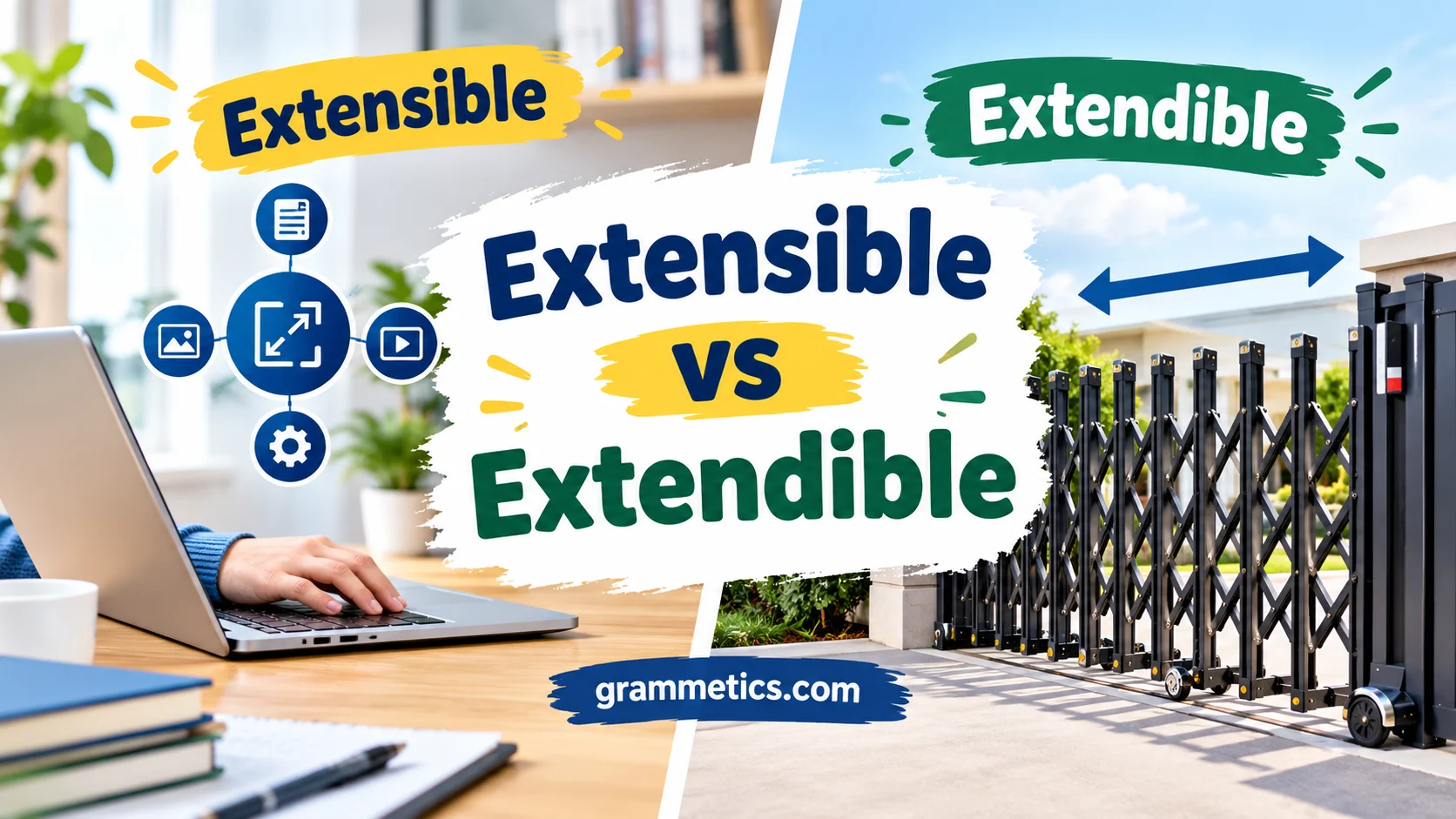
When two words look almost identical, it is easy to assume they have exactly the same meaning. Extensible and extendible are a good example. Both words are related to the verb extend, and both can describe something that can be made longer, larger, or more extensive. However, they are not equally common in modern English, and their typical usage can differ depending on the context.
The word extensible is especially common in technology, software, systems, and design. It often describes something that can be expanded or modified by adding new features or components. Extendible, meanwhile, is a valid word that generally means capable of being extended, but it is less common in many contexts. Understanding this distinction can help you choose the more natural word in professional, technical, and everyday writing.
Quick Answer
Extensible and extendible both mean “capable of being extended.” However, extensible is much more common, especially in technology and software. Use extensible when discussing systems, programs, frameworks, or designs that can be expanded with additional features or functionality.
Why People Confuse It
People often confuse extensible and extendible because both are formed from the verb extend.
They also have essentially the same basic idea:
- Extensible = capable of being extended
- Extendible = capable of being extended
The main difference is usage and frequency, rather than a completely different definition.
This becomes particularly important in technical English. For example, developers commonly describe software as an extensible system, meaning it has been designed so that additional functionality can be added without completely redesigning it.
Because extensible is much more established in technical terminology, it is usually the better choice in software documentation and professional writing.
Extensible
Extensible is an adjective meaning capable of being extended, expanded, or developed further.
It is particularly common when talking about:
- Software
- Programming languages
- APIs
- Frameworks
- Systems
- Platforms
- Architectures
- Designs
- Features
For example:
The platform has an extensible architecture.
This means the architecture can accommodate additional components or functionality.
Another example:
The software is highly extensible through plugins.
Here, extensible means users or developers can add new functionality without replacing the entire system.
Extensible in Technology
In computing, extensible often carries a more specific idea than simply “able to become longer.”
An extensible system is generally designed so that it can grow or adapt by adding new functionality.
For example:
WordPress has an extensible plugin system.
The important idea is not physical length. Instead, the system can be expanded with additional capabilities.
Extendible
Extendible is also an adjective meaning capable of being extended.
For example:
The contract is extendible for another six months.
This means the contract can be extended.
You might also encounter:
The table has an extendible design.
This indicates that the table can be made longer or expanded.
However, extendible is less common than extensible, especially in modern technical and professional writing.
In many situations where both words are grammatically possible, extensible sounds more natural to contemporary English speakers.
Extensible vs Extendible: Comparison Table
| Feature | Extensible | Extendible |
| Basic meaning | Capable of being extended | Capable of being extended |
| Part of speech | Adjective | Adjective |
| Commonness | More common | Less common |
| Technology | Very common | Uncommon |
| Software | Preferred | Less natural |
| Physical objects | Possible | Possible |
| Contracts/plans | Possible | Possible |
| Means “expandable” | Yes | Yes |
| Professional technical writing | Common choice | Less common choice |
When to Use Each
Use “Extensible” When:
Choose extensible when describing something designed to accommodate additional features, components, or functionality.
Common examples include:
- Extensible software
- Extensible architecture
- Extensible framework
- Extensible platform
- Extensible API
- Extensible system
- Extensible design
For example:
The framework provides an extensible architecture for developers.
Use “Extendible” When:
Extendible can be used when you simply mean that something can be extended.
For example:
The deadline is extendible under certain circumstances.
Or:
The warranty is extendible for an additional year.
However, because extensible is generally more common, you should consider the context carefully before choosing extendible.
Extensible vs Extendible Examples
Here are examples showing how the two words can be used naturally.
- The software has an extensible architecture.
- The platform was designed to be extensible.
- Developers can create extensible plugins for the application.
- The API provides an extensible structure for future features.
- We need an extensible system that can support future requirements.
- The contract is extendible for another three months.
- The warranty is extendible after the initial period.
- The table has an extendible section for larger gatherings.
- The framework is highly extensible and supports custom modules.
- The deadline may be extendible if both parties agree.
- The application uses an extensible plugin architecture.
- The design is extensible enough to accommodate new components.
Notice that extensible appears particularly naturally in technology-related examples, while extendible can be used for things such as contracts, deadlines, warranties, and physical objects.
Common Mistakes
1. Assuming They Have Completely Different Meanings
They do not. Both words can mean capable of being extended.
The difference is primarily related to usage, frequency, and context.
2. Using “Extendible” in Technical Writing
While extendible is understandable, extensible is usually the more established choice in software and computing.
For example:
The application has an extensible architecture.
This is more natural than:
The application has an extendible architecture.
3. Thinking “Extensible” Only Means Physically Longer
In modern technical English, extensible often refers to adding functionality, not increasing physical size.
An extensible application can gain new capabilities without necessarily becoming physically larger.
4. Confusing “Extensible” With “Extendable”
Extendable is another related word.
Depending on the context, you may see:
- Extensible
- Extendible
- Extendable
They overlap in meaning, but their preferred contexts can differ.
Memory Trick
A simple way to remember the difference is:
Extensible = expandable with new possibilities.
Think:
Extensible software → extra features
If you’re talking about software, systems, platforms, or frameworks, extensible is usually the word to reach for.
For a simple situation where something can literally or administratively be extended, extendible may work.
American vs British English
There is no major American-versus-British distinction that makes extensible correct in one variety and extendible correct in the other.
Both forms can be found in English usage.
However, extensible is widely established in modern technical English, including American and British professional writing.
So, if you’re writing software documentation, an academic paper about computing, or technical content for an international audience, extensible is generally the safer and more familiar choice.
Similar Words
Several words are closely related to extensible and extendible.
Extendable
Extendable means capable of being extended.
The table is extendable to accommodate more guests.
Expandable
Expandable means capable of being expanded or made larger.
The storage system is expandable.
Scalable
Scalable usually means capable of increasing in size or capacity while continuing to function effectively.
The company needs a scalable infrastructure.
Modular
Modular describes something made from separate components or modules that can be combined or replaced.
The software uses a modular architecture.
Adaptable
Adaptable means capable of being modified to suit new conditions or requirements.
The system is adaptable to different environments.
These words overlap, but they should not automatically be treated as interchangeable.
Final Verdict
Extensible and extendible are both legitimate adjectives that describe something capable of being extended.
The key difference is usage preference. Extensible is substantially more common in modern technical English and is especially well established in software, programming, APIs, frameworks, systems, and architecture.
Extendible is also valid, but it is less common. It may appear naturally when discussing things such as contracts, deadlines, warranties, or physical objects that can be extended.
FAQs
Is “extensible” a correct word?
Yes. Extensible is a standard English adjective meaning capable of being extended or expanded. It is particularly common in technical and computing contexts.
Is “extendible” a correct word?
Yes. Extendible is also a valid adjective meaning capable of being extended. However, it is less common than extensible in many modern contexts.
Is extensible or extendible more common?
Extensible is generally more common, particularly in technology, software development, and professional technical writing.
Is extensible the same as expandable?
They can overlap, but they are not always identical. Expandable usually emphasizes becoming larger, while extensible can emphasize adding new capabilities or functionality.
Should I use “extensible architecture” or “extendible architecture”?
Extensible architecture is the more natural and established phrase, particularly in software and computing.
Can I use “extendible” for a contract?
Yes. For example:
The contract is extendible for another six months.
However, extendable or simply can be extended may also be used depending on the intended style.
What is the opposite of extensible?
There is no single universal opposite. Depending on the context, words such as fixed, non-expandable, or inflexible may express the opposite idea.
Conclusion
Although extensible and extendible both mean “capable of being extended,” they are not equally common. Extensible is the more familiar and widely used form, especially when discussing software, systems, frameworks, platforms, APIs, and technical architecture.
Extendible remains a legitimate word and can be appropriate when something can be extended, such as a contract, warranty, deadline, or physical object. When you’re unsure, particularly in technical writing, extensible will usually be the more natural choice.
Remember This
Extensible = capable of being expanded or enhanced, especially in technical contexts.
Extendible = capable of being extended, but less commonly used.
For most modern technical writing, remember: extensible is usually the preferred choice.

I’m Elliot Pierce, Administrator at Grammetics, dedicated to improving word matching and grammar. I help maintain useful content, support readers, and make language learning simple, clear, accurate, and engaging.