When you want to remove your name, account, device, subscription, or registration from something, you may come across the words unregister and deregister. Because both can describe the act of ending a registration, they are easy to confuse. However, their usage and context are not always identical. Choosing the right word depends largely on what is being removed from a register and the style of English being used.
Both unregister and deregister are legitimate English verbs. Unregister is generally straightforward and commonly used for removing something from a registration, list, service, or system. Deregister often sounds more formal or administrative and is frequently used when an official registration, authorization, or status is being cancelled. Understanding this distinction can make your writing clearer, especially in business, education, technology, government, and professional contexts.
Quick Answer
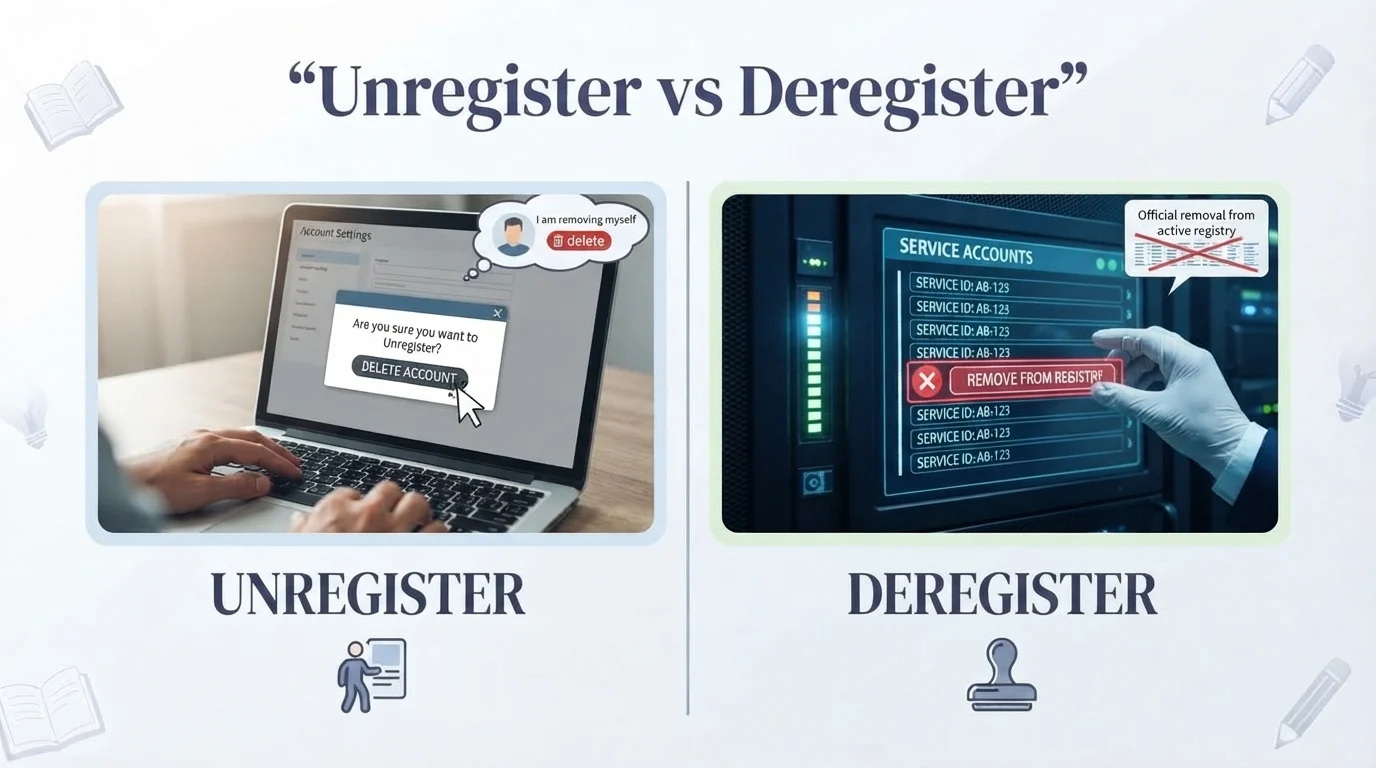
Unregister means to remove yourself or something from a registration, list, service, or system. Deregister also means to remove or cancel a registration but often sounds more formal or administrative. In everyday technology and service contexts, unregister is common; for official registration or status, deregister may be preferred.
Why People Confuse It
People confuse unregister and deregister because both describe reversing the action of registering.
For example:
- Register a device → unregister a device
- Register for a course → deregister from a course
- Register a vehicle → deregister a vehicle
The difficulty is that English does not always use one fixed opposite of register.
The choice can depend on:
- The type of registration
- Whether the context is formal or informal
- Regional English preferences
- The organization or software system using the term
In many cases, either word can communicate the basic idea of removing a registration.
Unregister: Meaning and Usage
Unregister means to remove someone or something from a registration, list, service, database, or system.
It is especially common in technology and everyday contexts.
Examples
- Please unregister my email address from the mailing list.
- You can unregister the device from your account.
- I want to unregister from this service.
- The software allows users to unregister a computer remotely.
- Please unregister the old phone before adding the new one.
The word is formed by adding un- to register, giving it the sense of reversing the registration.
Unregister in Technology
In computing, unregister is particularly common.
For example:
You need to unregister the old device before registering a new one.
Software documentation may also use expressions such as:
- unregister a user
- unregister a device
- unregister a callback
- unregister an event listener
- unregister a service
- unregister an application
So, when discussing software, accounts, devices, or digital services, unregister is often a natural choice.
Deregister: Meaning and Usage
Deregister also means to remove something from an official register or cancel an existing registration.
It tends to have a more formal, administrative, institutional, or regulatory feel.
Examples
- The company was deregistered from the official register.
- Students may deregister from a course before the deadline.
- The organization decided to deregister the vehicle.
- The authority can deregister a business that no longer meets the requirements.
- You must formally deregister if you leave the program.
The noun deregistration is also commonly used in formal contexts.
For example:
Deregistration from the program must be completed before the withdrawal deadline.
Comparison Table
| Feature | Unregister | Deregister |
| Basic meaning | Remove from registration | Remove from an official registration |
| Tone | Neutral, often informal | More formal or administrative |
| Technology | Very common | Less common |
| Official records | Possible | Very common |
| Business contexts | Common | Common |
| Education | Used in some systems | Common in formal contexts |
| Government/regulatory contexts | Possible | Often preferred |
| Noun form | Unregistration | Deregistration |
| Opposite | Register | Register |
| Example | Unregister the device | Deregister the company |
When to Use Each
Use “Unregister” When:
Choose unregister when you are talking about removing something from a service, system, list, or digital platform.
Common examples include:
- unregister a device
- unregister an account
- unregister from a mailing list
- unregister a software component
- unregister an application
- unregister an event listener
Example:
I need to unregister my old laptop from the account.
Use “Deregister” When:
Use deregister when the context involves an official, institutional, legal, academic, or administrative registration.
Common examples include:
- deregister a company
- deregister a vehicle
- deregister from a university
- deregister from a course
- deregister a business
- deregister from an official program
Example:
Students who want to leave the program must deregister before Friday.
Important Note
The distinction is not absolute. Some organizations use unregister where others use deregister. Always consider the terminology used by the specific institution, website, software, or authority.
Unregister vs Deregister: 15 Examples
- Please unregister the old device from my account.
- The company decided to deregister its business.
- You can unregister from the mailing list at any time.
- Students must deregister from the course before the deadline.
- The application lets users unregister a device remotely.
- The organization was deregistered from the official database.
- I accidentally registered the wrong phone, so I need to unregister it.
- The university allows students to deregister from selected courses.
- Please unregister my email address from the service.
- The owner decided to deregister the vehicle.
- You should unregister the old software component before installing the replacement.
- The business was deregistered after failing to meet the requirements.
- I want to unregister from this online service.
- Applicants may deregister from the program before the stated deadline.
- The developer forgot to unregister the event listener.
Notice the pattern: unregister frequently appears in technology and service-related situations, while deregister often appears in official or administrative contexts.
Common Mistakes
1. Assuming “Deregister” Is Incorrect
Some learners assume that deregister is not standard English because they are more familiar with unregister.
That is incorrect. Deregister is a legitimate English word.
2. Using “Unregister” in Every Situation
Although unregister is broad and useful, it may sound less appropriate in highly formal administrative writing.
For example:
The company was deregistered from the official register.
This sounds more natural in a formal regulatory context than:
The company was unregistered from the official register.
3. Assuming They Are Always Interchangeable
The two words overlap, but actual usage varies by context and institution.
A software developer may naturally say unregister a callback, while an academic institution may say deregister from a course.
4. Confusing “Deregister” With “Unsubscribe”
These words are related but not always interchangeable.
You normally unsubscribe from an email list, while you might unregister a device from an account.
Memory Trick
A simple way to remember the difference is:
UNREGISTER = undo a registration
Think about everyday systems:
Register a device → Unregister a device.
For formal or official situations, remember:
DEREGISTER = formally remove from a register
For example:
Register a company → Deregister a company.
This is not an absolute grammar rule, but it is a useful vocabulary guide.
American vs British English
Both unregister and deregister are used in English varieties around the world, including American and British English.
However, individual organizations may have different preferences.
Unregister is particularly familiar in technology, software, online services, and digital systems.
Deregister is often encountered in formal, academic, business, legal, and administrative contexts, particularly where an official registration or status is involved.
Regional usage can also vary. Therefore, if you are writing for a particular institution or audience, following that organization’s terminology is usually the safest approach.
Similar Words
Several words are related to unregister and deregister, but they are not exact synonyms in every situation.
Unsubscribe
Means to stop receiving a service, publication, newsletter, or communication.
I unsubscribed from the newsletter.
Withdraw
Means to formally remove yourself from something, especially a course, application, competition, or program.
She withdrew from the course.
Cancel
Means to stop or terminate an arrangement, reservation, subscription, or service.
I canceled my subscription.
Remove
A broad word meaning to take something away from a place, list, or system.
Please remove my name from the list.
Deactivate
Means to make an account, device, service, or feature inactive.
I deactivated my account.
Delete
Usually means to erase data, records, files, or information.
Please delete my old account.
These words overlap with unregister and deregister, but the exact meaning depends on the situation.
FAQs
Is “unregister” a correct word?
Yes. Unregister is a standard English verb meaning to remove someone or something from a registration, list, service, or system.
Is “deregister” a correct word?
Yes. Deregister is also a standard English verb. It commonly refers to formally removing something or someone from an official register or registration.
What is the difference between unregister and deregister?
Both can mean to reverse or cancel a registration. Unregister is especially common in technology and everyday service contexts, while deregister often has a more formal or administrative tone.
Should I say “unregister from a course” or “deregister from a course”?
Both may be understood, but deregister from a course is common in formal educational contexts. The institution’s own terminology should take priority.
Is “deregister” more formal than “unregister”?
Generally, yes. Deregister often sounds more formal or administrative, although the distinction is not an absolute grammar rule.
Is “unregister” the opposite of “register”?
Yes, unregister can function as the opposite or reversal of register. Deregister can also describe reversing or cancelling a registration.
Which is better: unregister or deregister?
Neither is universally “better.” Choose according to context. Unregister is often natural for software, devices, and online systems, while deregister is frequently used for official, academic, business, or regulatory registrations.
Final Verdict
Unregister and deregister both describe removing or cancelling a registration, but their typical contexts differ. Unregister is particularly natural for technology, devices, accounts, lists, and online services. Deregister tends to fit formal, official, academic, business, and administrative situations.
The distinction is mainly about usage and context rather than completely different meanings. When a specific organization, university, government agency, or software platform has its own terminology, follow that wording.
Conclusion
Choosing between unregister and deregister becomes easier when you focus on the context. If you’re talking about removing a device, software component, account, or online service registration, unregister is usually a natural choice. If you’re discussing an official record, business, course, program, or administrative registration, deregister often fits better.
Neither word is inherently wrong. Both are useful English verbs, and their meanings overlap considerably. Understanding their common patterns will help you write more naturally and avoid treating one as a universal replacement for the other.
Remember This
Unregister = remove from a registration, system, service, or list.
Deregister = formally remove from an official registration or register.
Register → Unregister / Deregister

I’m Elliot Pierce, Administrator at Grammetics, dedicated to improving word matching and grammar. I help maintain useful content, support readers, and make language learning simple, clear, accurate, and engaging.