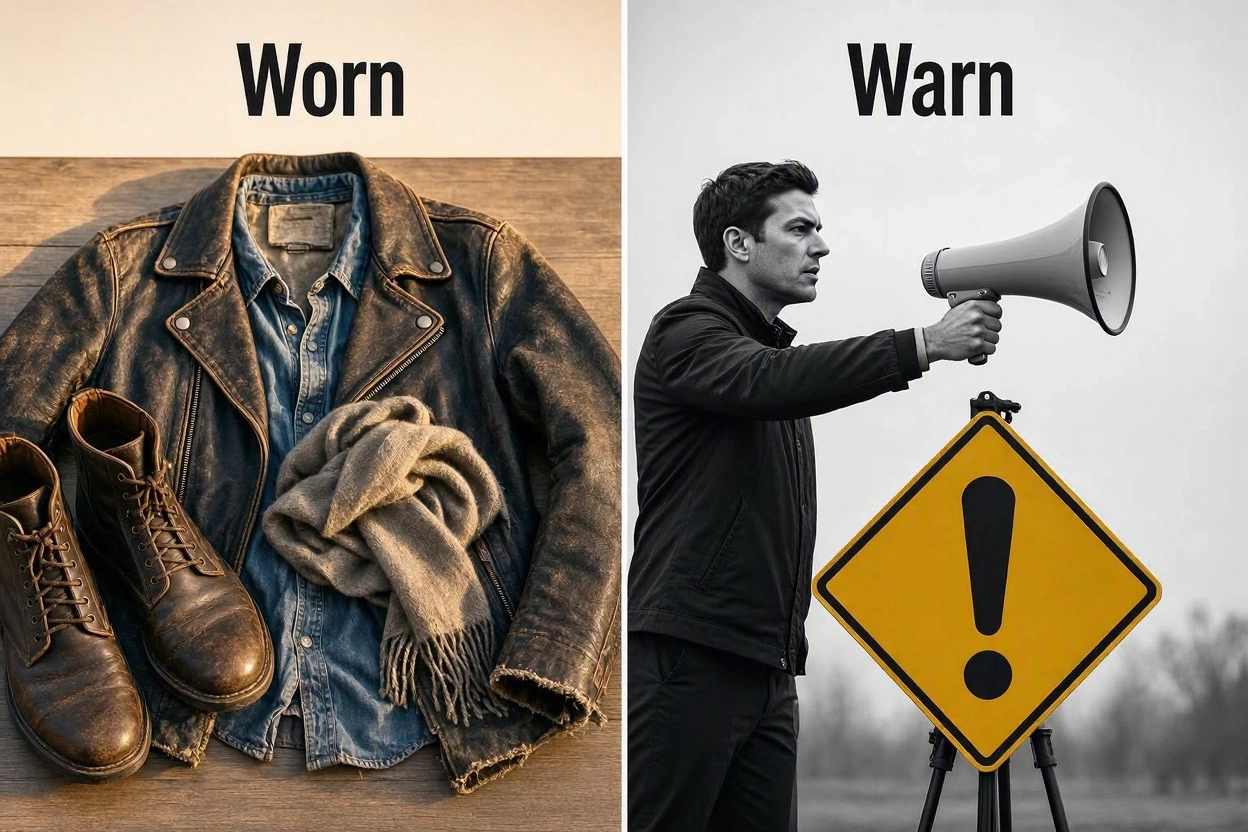
Have you ever confused worn vs. warn while writing a message, reading a sentence, or learning English grammar? These two words look similar and sound alike in some accents, but they have completely different meanings. One describes something that has been used or something a person has on their body, while the other means telling someone about a possible danger or problem. Using the wrong word can change the meaning of your sentence entirely.
Understanding the difference between worn and warn is important for students, writers, and anyone who wants to improve their English vocabulary. Both words appear frequently in everyday conversations, online articles, and professional communication. Fortunately, learning their definitions, grammatical roles, and common examples makes the distinction easy to remember. In this guide, you will discover when to use each word, explore practical sentence examples, identify common spelling mistakes, and learn a simple memory trick to choose the correct word confidently.
Quick Answer: Worn vs. Warn
Worn is the past participle of wear and describes clothing or objects that have been used, damaged, or carried on the body. Warn is a verb meaning to alert someone about danger, a risk, or a possible problem. Remember: you wear clothes, but you warn people.
Why People Confuse Worn and Warn
The words worn and warn are easy to mix up because they contain the same letters except for the vowels’ positions. Their pronunciation can also sound similar, depending on a speaker’s accent.
However, their meanings and grammatical functions are different.
- Worn: Related to wearing clothes or the effects of use over time.
- Warn: Related to giving someone a warning or alerting them to a risk.
For example:
- The shoes are worn. (The shoes have been used and may be damaged.)
- I will warn you about the danger. (I will tell you about a possible risk.)
The easiest way to avoid confusion is to examine the meaning of the sentence rather than relying on spelling alone.
Worn: Meaning, Definition, and Examples
Worn is the past participle of the verb wear. It can describe clothing that someone has put on, as well as objects that have become damaged, faded, or deteriorated through regular use.
Definition of Worn
According to standard English usage, worn has two common meanings:
- Wearing something: Having clothing, jewelry, or another item on your body.
- Damaged through use: Showing signs of age, friction, or repeated use.
Examples:
- She has worn that dress several times.
- His shoes look worn after years of walking.
- The old carpet is badly worn near the doorway.
- He has worn glasses since childhood.
- The book has a worn cover.
In the first and fourth examples, worn describes something a person has worn on their body. In the other examples, it describes the condition of an object.
Synonyms for Worn
Depending on the context, similar words include:
- Used
- Weathered
- Faded
- Threadbare
- Damaged
- Deteriorated
These words are not always interchangeable. For example, threadbare usually describes fabric that has become thin through use, while worn has a broader range of meanings.
When Should You Use Worn?
Use worn when talking about clothing, accessories, or objects that have experienced use.
Common expressions include:
- Worn clothes
- Worn shoes
- Worn-out furniture
- Worn tires
- Worn appearance
- Frequently worn jewelry
Example: “The mechanic replaced the worn tires before the long journey.”
Grammar tip: Worn is often used with has, have, or had when forming perfect tenses.
- I have worn this jacket before.
- She had worn the uniform for several years.
It can also function as an adjective: “He bought a worn leather jacket.”
Warn: Meaning, Definition, and Examples
Warn is a verb that means to tell someone about a possible danger, risk, mistake, or unpleasant situation so they can prepare or avoid harm.
A warning can be given through spoken words, written messages, signs, or other signals.
Definition of Warn
To warn someone means to alert them to something that could cause trouble, injury, loss, or another undesirable result.
Examples:
- The teacher will warn the students about the upcoming test.
- I tried to warn him about the slippery road.
- The weather service may warn residents about a storm.
- Please warn me if the situation changes.
- The sign is there to warn drivers about the sharp turn.
In each example, warn describes the act of informing someone about a possible problem or danger.
Synonyms for Warn
Common synonyms include:
- Alert
- Caution
- Advise
- Notify
- Forewarn
- Inform
The best synonym depends on the context. Alert often emphasizes bringing something to someone’s attention, while caution emphasizes advising someone to be careful.
When Should You Use Warn?
Use warn when someone gives information about a potential risk or advises another person to be careful.
Common expressions include:
- Warn someone about danger
- Warn against a mistake
- Warn of possible consequences
- Warn someone in advance
- Warn the public
- Warning sign
Examples:
- The doctor warned him about the risks of smoking.
- The manager warned employees against sharing confidential information.
- Police warned residents of possible flooding.
Grammar tip: Warn is a regular verb, so its forms are warn, warns, warned, and warning.
Examples:
- I warn my friends about online scams.
- She warns everyone before the road closes.
- They warned us about the delay.
- The officer is warning drivers to slow down.
Worn vs. Warn: Comparison Table
| Feature | Worn | Warn |
| Part of speech | Past participle; can also be an adjective | Verb |
| Main meaning | Used, damaged, or put on the body | Alert someone to danger or a problem |
| Base verb | Wear | Warn |
| Past tense | Wore (the simple past of wear) | Warned |
| Past participle | Worn | Warned |
| Common context | Clothing, shoes, objects, appearance | Safety, risks, advice, consequences |
| Example | These shoes are worn. | I will warn you. |
| Related expression | Worn out | Warning sign |
When to Use Worn vs. Warn
Choosing the correct word becomes easier when you identify the action or description in your sentence.
Use Worn When Describing Clothing or Damage
Choose worn when discussing what someone has worn or an object that has deteriorated through use.
Examples:
- The jacket looks worn after years of use.
- She has worn the same necklace since her wedding.
- The steps are worn from thousands of footsteps.
Ask yourself: Does the sentence involve wearing something or describing signs of use? If so, worn may be the right choice.
Use Warn When Giving Advice or Alerting Someone
Choose warn when someone is communicating a possible danger or problem.
Examples:
- I need to warn my brother about the scam.
- The guide will warn visitors about dangerous wildlife.
- Please warn me before you make any changes.
Ask yourself: Is someone alerting another person to a possible problem? If so, use warn.
A Simple Sentence Test
Compare these sentences:
- The worker’s gloves are worn. (The gloves show signs of use.)
- The worker will warn us about the unsafe equipment. (The worker will alert us to danger.)
The context determines the correct spelling and meaning.
Examples of Worn vs. Warn in Sentences
Here are 15 examples showing how to use worn and warn correctly.
- Worn: My favorite shoes are too worn to wear comfortably.
- Warn: The guide will warn hikers about the steep trail.
- Worn: She has worn her school uniform for three years.
- Warn: Please warn me if you notice any unusual activity.
- Worn: The old sofa has a worn patch on one arm.
- Warn: The lifeguard tried to warn swimmers about the strong current.
- Worn: His jacket looked worn after years of travel.
- Warn: The company will warn customers about the product recall.
- Worn: The carpet is badly worn near the entrance.
- Warn: Parents should warn children about talking to strangers online.
- Worn: I have worn these boots on many hiking trips.
- Warn: The sign will warn drivers of road construction ahead.
- Worn: The book’s pages were worn and yellow.
- Warn: She warned her friend not to share personal information with strangers.
- Worn: The athlete’s running shoes were completely worn out after the marathon.
These examples show that worn describes the result of wearing or using something, while warn expresses the action of alerting someone.
Common Mistakes When Using Worn and Warn
Even though these words have different meanings, their similar spelling can lead to mistakes. Here are some common errors to avoid.
1. Using Warn When You Mean Worn
Incorrect: My shoes are warn from daily use.
Correct: My shoes are worn from daily use.
The sentence describes the condition of the shoes, so worn is correct.
2. Using Worn When You Mean Warn
Incorrect: I want to worn you about the danger.
Correct: I want to warn you about the danger.
The speaker intends to alert someone, so the correct verb is warn.
3. Confusing Worn With Wore
Both words come from wear, but they serve different grammatical purposes.
- Wore: Simple past tense. “She wore a red dress yesterday.”
- Worn: Past participle. “She has worn that dress before.”
Using the correct verb form helps make your sentence grammatically accurate.
4. Writing Warned When You Mean Worn
Incorrect: The tires are badly warned.
Correct: The tires are badly worn.
Warned is the past tense and past participle of warn. It does not describe physical deterioration.
5. Forgetting the Meaning of Worn Out
The expression worn out can describe something damaged through extensive use or someone who feels extremely tired.
Examples:
- These shoes are worn out.
- I feel worn out after working all day.
Do not confuse this expression with warn out, which is not the standard spelling for these meanings.
Memory Trick: How to Remember Worn vs. Warn
Use this simple memory trick to remember the difference.
- Worn = Wear. Both contain the letter combination wor. Think of clothes, shoes, and objects that have been used.
- Warn = Warning. Both contain warn. Think of a warning sign or someone alerting you to danger.
Remember these examples:
- I have worn my boots many times.
- I will warn you about the icy road.
You can also use a quick question:
Are you describing something used, or alerting someone to a risk?
- Something used or put on the body → Worn
- Alerting someone to danger → Warn
This simple association can help you select the right word when writing quickly.
American vs. British English
The difference between worn and warn is not a matter of American versus British spelling. Both words have the same standard meanings in American and British English.
| Usage | American English | British English |
| Past participle of wear | Worn | Worn |
| Verb meaning to alert someone | Warn | Warn |
| Past tense of warn | Warned | Warned |
| Describing damaged clothing | Worn | Worn |
| Warning someone about danger | Warn someone | Warn someone |
Pronunciation can vary by accent. Some speakers pronounce the vowel sounds in worn and warn differently, while others pronounce them very similarly. This can make the words difficult to distinguish in conversation.
Regardless of accent, their spelling and meaning remain distinct. Use worn for wearing or deterioration and warn for alerting someone to a risk.
Similar Words: Worn vs. Warn and Related Terms
Learning related words can strengthen your understanding of these terms and help you avoid similar spelling mistakes.
1. Worn vs. Wore
Both words come from the verb wear.
- Wore: The simple past tense of wear.
- Worn: The past participle of wear.
Examples:
- I wore a blue shirt yesterday.
- I have worn that shirt before.
2. Warn vs. Warning
Warn is the base verb, while warning can function as a noun or the -ing form of the verb.
Examples:
- I will warn the team.
- The teacher gave us a warning.
- She is warning everyone about the danger.
3. Worn vs. Torn
Both words can describe the condition of clothing, but their meanings differ.
- Worn: Damaged or deteriorated through use.
- Torn: Split or ripped apart.
Examples:
- His jeans are worn at the knees.
- His jeans are torn at the knees.
4. Warn vs. Caution
Both words can relate to safety, but they are used somewhat differently.
- Warn: Inform someone about a possible danger or problem.
- Caution: Advise someone to act carefully or express a warning.
Examples:
- The guide will warn us about falling rocks.
- The guide will caution us to stay on the marked path.
5. Worn Out vs. Warned
These expressions are particularly easy to confuse in writing.
- Worn out: Exhausted or damaged through use.
- Warned: Told about a possible danger or problem.
Examples:
- I am worn out after the long journey.
- I was warned about the difficult journey.
Frequently Asked Questions
1. What is the difference between worn and warn?
Worn is the past participle of wear and can describe clothing or objects that have been used. Warn is a verb meaning to alert someone to danger, risk, or a problem.
2. Is worn the past tense of wear?
No. Wore is the simple past tense of wear, while worn is its past participle.
Examples: “I wore a coat yesterday” and “I have worn this coat before.”
3. How do you use warn in a sentence?
Use warn when telling someone about a possible danger or problem. For example: “The police warned residents about the approaching storm.”
4. Is it worn out or warn out?
Worn out is correct when describing something damaged through use or a person who is extremely tired.
Example: “I am worn out after working all day.”
5. Are worn and warn pronounced the same?
Their pronunciation depends on the speaker’s accent. Some speakers pronounce them differently, while others pronounce them similarly. Their meanings and spellings remain different.
6. What is the past tense of warn?
The past tense of warn is warned.
Example: “The teacher warned the students about the upcoming deadline.”
7. Can worn describe a person?
Yes. Worn can describe someone who looks tired or shows the effects of stress, age, or hardship.
Example: “He had a worn expression after several sleepless nights.”
8. What are synonyms for worn and warn?
Synonyms for worn include used, weathered, and threadbare, depending on the context. Synonyms for warn include alert, caution, and forewarn.
Final Verdict: Worn vs. Warn
The difference between worn and warn is simple once you focus on their meanings. Worn comes from wear and describes clothing someone has put on or objects that show signs of use. Warn is a verb that means to alert someone about a possible danger, risk, or problem. Although the words look and sound similar, they cannot be used interchangeably.
When writing, check whether you are describing the condition of something or communicating a warning. If the sentence concerns old shoes, faded clothing, or something that has been worn many times, choose worn. If it involves telling someone to be careful or informing them of a potential problem, choose warn. Understanding this distinction will improve your spelling, grammar, and everyday English communication.
Remember This
- Worn = Wear: Clothing or objects that have been used, or something someone has worn.
- Warn = Warning: Telling someone about a possible danger or problem.
- Wore vs. worn: Wore is the simple past; worn is the past participle of wear.
- Warned: The past tense and past participle of warn.
- Best tip: If you mean “alert someone,” use warn. If you mean “used or put on,” use worn.

I’m Micah Wheeler, a passionate author who enjoys exploring matching words, grammar, and language. I create clear, helpful content to make word choices and grammar easier for everyone.