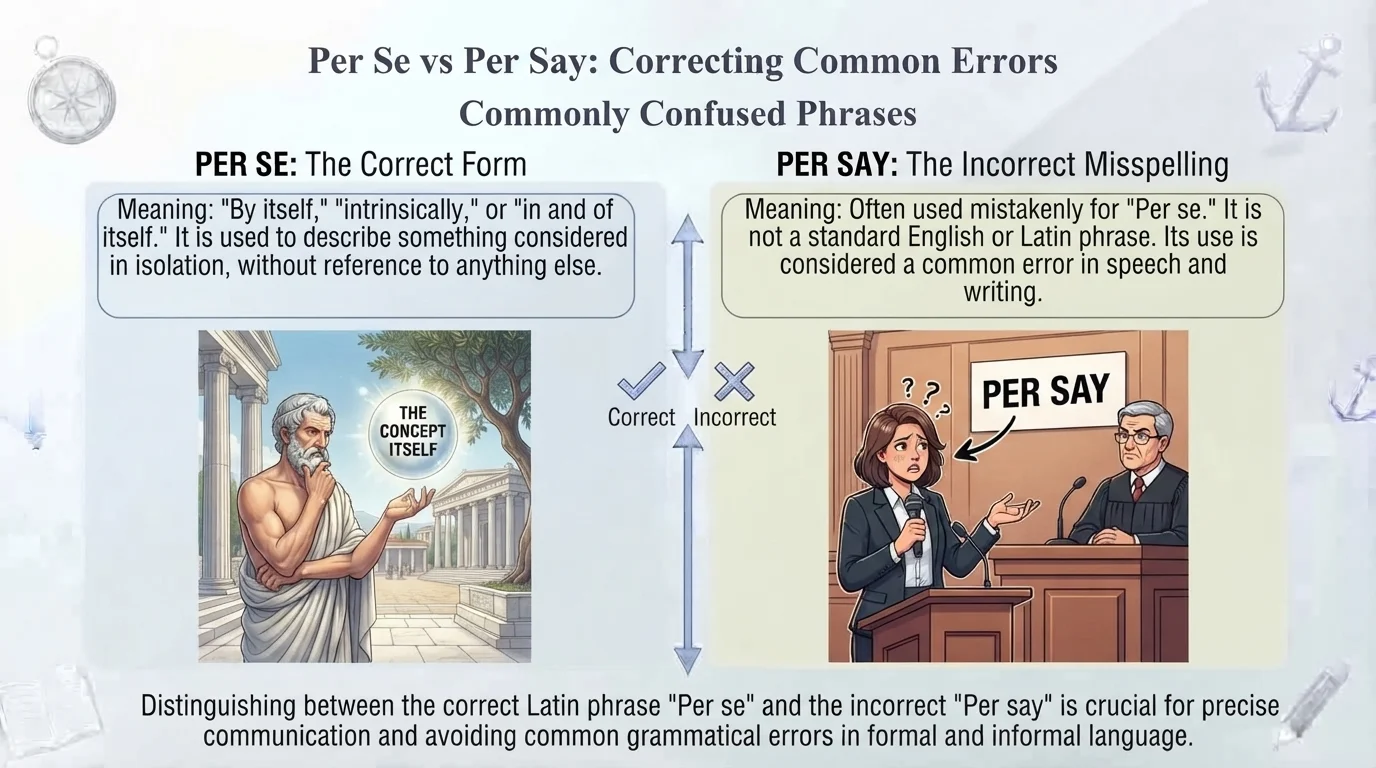
If you have ever written “per say” when you meant “per se,” you are not alone. These two expressions sound almost identical in everyday speech, which makes this a common spelling and usage mistake. However, only one of them is the standard expression in English: per se.
The phrase per se comes from Latin and means “by itself,” “in itself,” or “intrinsically.” It is commonly used when you want to discuss something on its own, rather than its connection to other factors. Per say, on the other hand, is generally considered a misspelling caused by hearing the phrase rather than seeing it written. Understanding the difference is useful for students, writers, professionals, and anyone who wants to improve their English grammar and vocabulary.
Quick Answer
Per se is the correct expression. It means “by itself,” “in itself,” or “intrinsically.” Per say is a common misspelling because both phrases sound similar. For example: “The job isn’t difficult per se, but it is time-consuming.”
Why People Confuse It
The main reason people confuse per se vs per say is pronunciation.
When spoken naturally, per se sounds like “per say.” Someone who has only heard the expression may reasonably assume that say is the correct spelling.
There is also a useful distinction in meaning:
- Per se → a Latin phrase meaning “by itself” or “in itself”
- Per say → not the standard spelling of this expression
So, if you are trying to express the idea of something considered independently, use per se.
Why “per se” appears in English
English has adopted many Latin expressions, particularly in academic, legal, professional, and formal writing. Per se is one of them.
For example:
“The plan is not bad per se, but it needs more preparation.”
Here, per se means the plan is not inherently bad.
First Word: Per Se
Per se is the correct expression.
It is derived from Latin and literally conveys the idea of “by itself” or “in itself.”
In modern English, it is usually used to clarify that something is not inherently a particular way.
Examples
- “The idea isn’t wrong per se.”
- “I don’t dislike the movie per se.”
- “Money isn’t the problem per se.”
- “The rule isn’t unfair per se.”
- “He isn’t lazy per se; he simply lacks motivation.”
In many sentences, per se can be replaced with phrases such as:
- in itself
- by itself
- inherently
- intrinsically
- strictly speaking
However, the best replacement depends on the sentence.
Pronunciation of “per se”
Per se is generally pronounced approximately:
/pər ˈseɪ/
It sounds very similar to “per say,” which explains the spelling confusion.
Second Word: Per Say
Per say is not the standard form of the expression.
It is usually a misspelling of “per se.”
Because per se is pronounced like “per say,” people sometimes write the words according to how they sound.
For example:
❌ “The idea isn’t bad per say.”
Correct:
✅ “The idea isn’t bad per se.”
The word say itself is, of course, a normal English verb:
“Please say your name.”
But per say does not normally function as the established expression meaning “in itself.”
Comparison Table
| Expression | Correct? | Meaning | Example |
| per se | ✅ Yes | In itself; by itself | “The plan isn’t bad per se.” |
| per say | ❌ No | Common misspelling of per se | “The plan isn’t bad per say.” |
| in itself | ✅ Yes | Considered independently | “The plan isn’t bad in itself.” |
| by itself | ✅ Yes | Alone or independently | “The machine works by itself.” |
When to Use Each
Use “per se” when you mean “in itself”
Use per se when you are separating something from its surrounding circumstances.
For example:
“Working from home isn’t difficult per se, but staying focused can be challenging.”
The speaker isn’t saying working from home is inherently difficult. The difficulty comes from another factor.
Use “per se” for qualification
It is especially useful when you want to make a nuanced statement.
For example:
“There isn’t a problem with the design per se; the issue is the cost.”
This means the design itself isn’t the problem.
Do not use “per say” for this meaning
If you are writing an essay, article, email, report, or professional document, avoid per say when you mean per se.
Use:
“The policy isn’t harmful per se.”
Not:
“The policy isn’t harmful per say.”
Examples of “Per Se” in Sentences
Here are more examples showing how per se works naturally in everyday and formal English.
- “The restaurant isn’t expensive per se, but the portions are small.”
- “There’s nothing wrong with the idea per se.”
- “I don’t dislike social media per se; I dislike how much time I spend on it.”
- “The task isn’t difficult per se, but it requires patience.”
- “He isn’t unfriendly per se; he’s simply quiet.”
- “The book isn’t boring per se, but the opening chapters are slow.”
- “The rule isn’t unreasonable per se.”
- “I’m not against the proposal per se.”
- “The technology isn’t dangerous per se; improper use can make it dangerous.”
- “The weather wasn’t bad per se, but it made traveling uncomfortable.”
- “There’s no problem with the design per se.”
- “Being competitive isn’t negative per se.”
- “The decision wasn’t wrong per se, but it was poorly timed.”
- “The product isn’t defective per se; it simply doesn’t meet our needs.”
- “The argument isn’t convincing per se, but it raises an interesting question.”
Notice the common pattern: per se often appears after an adjective or noun to emphasize that something is being considered independently.
Common Mistakes
1. Writing “per say”
This is the most common mistake.
❌ “The movie wasn’t bad per say.”
✅ “The movie wasn’t bad per se.”
2. Assuming “say” is part of the phrase
The pronunciation can be misleading. Remember that per se comes from Latin, not from the English verb say.
3. Using “per se” when you mean “by oneself”
Although per se can mean “by itself,” it does not always mean physically or literally alone.
For example:
“The machine operates by itself.”
This is different from:
“The machine isn’t dangerous per se.”
The second sentence means the machine is not inherently dangerous.
4. Overusing “per se”
Per se is useful, but it can sound unnecessarily formal if used repeatedly.
Instead of:
“I don’t like the color per se.”
You could simply say:
“I don’t particularly like the color.”
Choose the expression that best fits your tone.
Memory Trick
Here’s an easy way to remember the correct spelling:
Per SE = in itSELF
Both SE and SELF remind you that per se means something considered in itself.
Another simple trick:
Per se has an “e,” not “say.”
Whenever you hear “per say,” pause and ask:
“Do I mean ‘in itself’?”
If the answer is yes, write per se.
American vs British English
There is no meaningful American vs. British spelling difference here.
Both American English and British English use:
per se
The expression is standard in both varieties of English.
The pronunciation is also broadly similar, which means speakers in both American and British English may write per say incorrectly if they have learned the phrase primarily through listening.
So whether you are writing for an American or British audience, the correct form remains:
✅ per se
Similar Words and Expressions
Several expressions can communicate a similar idea to per se, although their exact meanings may differ slightly.
In itself
“The proposal isn’t bad in itself.”
This is probably the closest everyday alternative.
By itself
“The problem isn’t serious by itself.”
This can emphasize independence or separation.
Inherently
“The activity isn’t inherently dangerous.”
This emphasizes an essential or natural quality.
Intrinsically
“The work isn’t intrinsically difficult.”
This is more formal and often appears in academic or professional writing.
Essentially
“The issue isn’t essentially about money.”
This can work in some contexts, but it is not always interchangeable with per se.
Final Verdict
When choosing between per se vs per say, the answer is straightforward:
Per se is correct.
It means “in itself,” “by itself,” or “intrinsically.” It is commonly used to make a distinction between something itself and the circumstances surrounding it.
Per say is generally a spelling mistake caused by the pronunciation of per se.
Remember This
✅ Per se = correct
❌ Per say = common misspelling
If you mean “in itself”, always choose per se.
Frequently Asked Questions
Is “per say” correct?
No. Per say is generally a misspelling of per se. The standard expression is per se, meaning “in itself” or “by itself.”
What does “per se” mean?
Per se means “in itself,” “by itself,” or “intrinsically.” It is used when something is considered independently from other factors.
Is “per se” formal English?
Yes. Per se is somewhat formal and is common in academic, professional, legal, and analytical writing. However, it is also used in everyday conversation.
How do you pronounce “per se”?
Per se is commonly pronounced approximately “per SAY.” Its pronunciation is one reason people often mistakenly spell it per say.
Can I replace “per se” with “in itself”?
Often, yes. For example:
“The idea isn’t bad per se.”
can become:
“The idea isn’t bad in itself.”
Is “per se” used in American English?
Yes. Per se is standard in American English as well as British English.
Is “per se” Latin?
Yes. Per se is a Latin expression that has been adopted into English. It essentially means “by itself” or “in itself.”
Conclusion
The difference between per se and per say is mainly a matter of correct spelling. Per se is the established English expression, while per say is a common misspelling based on pronunciation. Once you remember that per se means “in itself,” the distinction becomes much easier.
Use per se when you want to describe something independently or emphasize that it is not inherently good, bad, difficult, harmful, or problematic. Whether you are writing an academic essay, professional email, blog post, or casual message, per se is the form you should choose.

I’m Micah Wheeler, a passionate author who enjoys exploring matching words, grammar, and language. I create clear, helpful content to make word choices and grammar easier for everyone.










1 thought on “Per Se vs Per Say: Which Is Correct? Meaning, Usage & Examples”