Do you often begin your emails, conversations, or presentations with the phrase “My question is”? Although this expression is grammatically correct, using it repeatedly can make your communication sound predictable. Fortunately, there are many alternatives to “my question is” that can help you sound more natural, professional, polite, or confident, depending on the situation.
Choosing the right phrase is not just about finding a synonym. It is about understanding your audience, the purpose of your question, and the tone you want to convey. For example, “I’d like to ask” works well in professional conversations, while “What I’m wondering is” sounds more relaxed and conversational. In this guide, you will discover useful alternatives to “my question is,” learn when to use each expression, and explore practical examples for emails, meetings, academic discussions, interviews, and everyday English conversations.
Quick Answer: What Are the Best Alternatives to “My Question Is”?
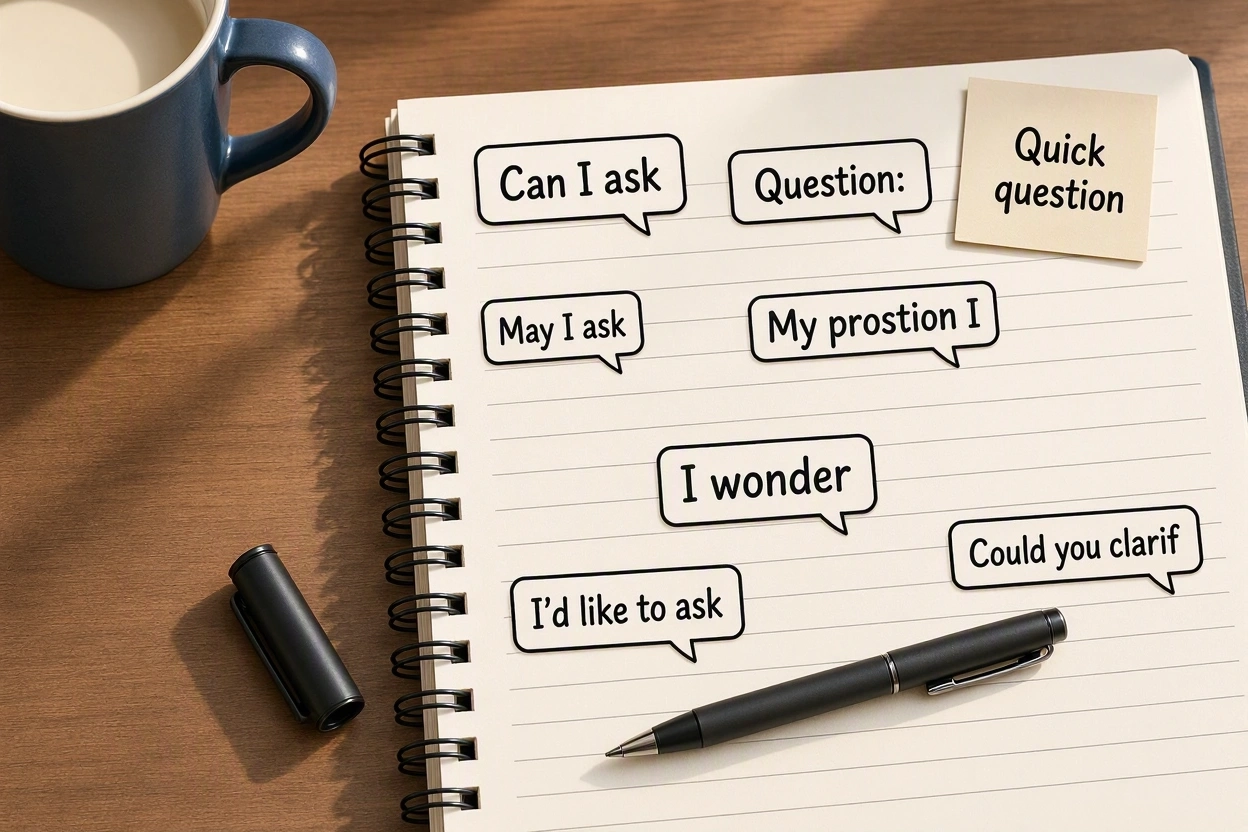
The best alternatives to “my question is” include “I’d like to ask,” “I’m wondering whether,” “Could you clarify,” “What I’d like to know is,” and “May I ask?” Use direct expressions for everyday conversations, polite phrases for professional communication, and formal wording for academic or official settings.
Why People Confuse It
People often search for alternatives to “my question is” because they want to communicate more effectively without repeating the same phrase. However, not every alternative has the same meaning or tone.
Some expressions introduce a direct question, while others request clarification, express curiosity, or politely ask for information.
For example:
- “My question is…” introduces the specific point you want answered.
- “I’m wondering whether…” expresses curiosity or uncertainty.
- “Could you clarify…?” asks someone to explain something more clearly.
- “May I ask…?” politely requests permission to ask a question.
- “What I’d like to know is…” emphasizes the information you want.
Understanding these differences helps you select a phrase that suits the situation instead of replacing one expression with another without considering its meaning.
1. My: Meaning and Usage
The word my is a possessive determiner. It indicates that something belongs to or is associated with the speaker.
In the phrase “my question is,” the word my identifies the question as the one the speaker wants to ask.
Although this wording is perfectly correct, you do not always need to emphasize ownership of the question. In many situations, you can introduce your point directly or use a more polite expression.
Examples
- My question is whether the deadline can be extended.
- My question is about the new company policy.
- My question is how we can improve the process.
- My question is related to your latest announcement.
These sentences are grammatically correct. However, depending on the context, you could make them sound more conversational by saying:
- Could the deadline be extended?
- I’d like to ask about the new company policy.
- How can we improve the process?
- Could you explain your latest announcement?
Writing tip: If the question itself is clear, you can often remove the introductory phrase altogether.
2. Question Is: Meaning and Usage
The phrase “question is” introduces the main point that someone wants answered or discussed.
It often appears in presentations, discussions, interviews, and written communication.
For example:
- The question is whether we have enough time.
- The main question is how to reduce costs.
- My question is why the results have changed.
Depending on the context, you can replace “question is” with expressions such as:
- The issue is…
- What I want to know is…
- The key point is…
- I’m trying to understand…
- Could you explain…?
These alternatives can make your message more precise. For instance, “The issue is whether we have enough time” emphasizes a problem, whereas “What I want to know is whether we have enough time” focuses on obtaining information.
Writing tip: Choose an alternative that reflects your actual intention, whether you are asking, clarifying, investigating, or identifying a problem.
Comparison Table: Alternatives to “My Question Is”
| Alternative phrase | Tone | Best situation |
| I’d like to ask | Polite and professional | Emails and meetings |
| May I ask? | Respectful | Formal conversations |
| I’m wondering whether | Thoughtful and conversational | Everyday discussions |
| What I’d like to know is | Clear and focused | Presentations and discussions |
| Could you clarify? | Professional | Requesting an explanation |
| Can you tell me? | Friendly and direct | Everyday conversations |
| I have a question about | Neutral | Emails and classroom discussions |
| Could I ask you something? | Polite and casual | Informal conversations |
| The main thing I’m wondering is | Conversational | Explaining curiosity |
| I’d appreciate your insight on | Professional | Seeking advice or expertise |
| I’m curious about | Friendly | Informal discussions |
| One thing I’d like to understand is | Thoughtful | Learning and problem-solving |
When to Use Each Alternative
The most effective alternative depends on your audience, setting, and communication goal.
1. For Professional Emails
When writing to a manager, client, colleague, or business partner, choose expressions that are clear and courteous.
Recommended phrases:
- I’d like to ask about…
- Could you clarify…?
- I would appreciate your guidance on…
- I have a question regarding…
- Could you please explain…?
Example:
Instead of:
“My question is, when will the report be ready?”
Write:
“I’d like to ask when the report is expected to be ready.”
The revised version sounds professional while keeping the request straightforward.
2. For Meetings and Presentations
In meetings, you generally want to introduce your question without making your point unnecessarily complicated.
Useful alternatives include:
- My main question is…
- What I’d like to understand is…
- Could you explain…?
- I’d like to know…
- One point I’d like to clarify is…
Example:
“My main question is how we will measure the project’s success.”
This wording works well because it identifies the central issue clearly.
3. For Casual Conversations
With friends, classmates, or familiar colleagues, a relaxed expression may sound more natural.
Try these alternatives:
- I’m wondering…
- Can I ask you something?
- I’m curious about…
- Do you happen to know…?
- Here’s what I’m wondering…
Example:
“I’m curious about how you learned to speak English so fluently.”
This feels conversational and encourages the other person to share information.
4. For Academic Writing and Research
Academic communication often requires precise wording and a clear distinction between asking a question and stating a research objective.
Useful phrases include:
- This raises the question of whether…
- The central question concerns…
- An important question is whether…
- This study investigates…
- The issue under consideration is…
Example:
“An important question is whether the results can be replicated in a larger sample.”
For formal research writing, “This study investigates whether…” may be even more appropriate when describing the purpose of a study.
5. For Interviews
When interviewing someone, your wording should be respectful, direct, and easy to understand.
Useful alternatives include:
- Could you tell me more about…?
- I’d like to hear your thoughts on…
- May I ask how…?
- What was your experience with…?
- Could you explain your approach to…?
Example:
“Could you tell me more about your experience managing a remote team?”
This phrasing invites a detailed response without sounding demanding.
Examples: 20 Alternatives to “My Question Is” in Sentences
Here are 20 practical examples you can use in professional writing, academic discussions, and everyday conversations.
- I’d like to ask: I’d like to ask whether the meeting can be moved to Friday.
- May I ask?: May I ask how you reached that conclusion?
- I’m wondering whether: I’m wondering whether we should revise the proposal.
- What I’d like to know is: What I’d like to know is how the new system works.
- Could you clarify?: Could you clarify what you mean by the final requirement?
- Can you tell me?: Can you tell me where I can find the application form?
- I have a question about: I have a question about the payment schedule.
- Could I ask you something?: Could I ask you something about your recent project?
- I’m curious about: I’m curious about why the results were different this time.
- I’d appreciate your insight on: I’d appreciate your insight on how to improve customer satisfaction.
- One thing I’d like to understand is: One thing I’d like to understand is how the decision was made.
- The main thing I’m wondering is: The main thing I’m wondering is whether the plan is affordable.
- Could you explain?: Could you explain how this formula works?
- I’d like some clarification on: I’d like some clarification on the new attendance policy.
- Do you happen to know?: Do you happen to know when the office will reopen?
- Here’s what I’m wondering: Here’s what I’m wondering: why did the team change its strategy?
- I’d like to understand: I’d like to understand what caused the delay.
- This raises the question of: This raises the question of whether the method is reliable.
- One point I’d like to clarify is: One point I’d like to clarify is who will approve the final draft.
- Could you shed some light on?: Could you shed some light on the reasons behind this change?
These phrases are not interchangeable in every situation. For example, “Could you clarify?” asks for a clearer explanation, while “I’m curious about” expresses interest. Choose the wording that matches your purpose.
Common Mistakes When Replacing “My Question Is”
Even useful alternatives can sound unnatural when used incorrectly. Avoid these common mistakes to improve your English communication.
1. Using an Overly Formal Phrase in a Casual Conversation
You probably would not say, “I would appreciate your clarification regarding your weekend plans” to a close friend.
A more natural option is:
“Can you tell me what you’re doing this weekend?”
Match your language to the relationship and situation.
2. Confusing a Question With a Statement
“My question is whether the project is complete” is an indirect question.
“Is the project complete?” is a direct question.
Both are correct, but they use different sentence structures. Avoid combining them incorrectly, such as:
Incorrect: “Could you tell me whether is the project complete?”
Correct: “Could you tell me whether the project is complete?”
Alternatively, ask directly: “Is the project complete?”
3. Using “May I Ask?” Without a Clear Question
“May I ask?” is often used to request permission to ask something. It can sound incomplete if the context does not make your intention clear.
Better: “May I ask when the results will be announced?”
4. Repeating the Same Introductory Phrase
Using “My question is” in every paragraph or email can make your writing repetitive.
Instead, vary your wording naturally:
- Could you explain…?
- I’d like to know…
- One point I’d like to clarify is…
- Do you happen to know…?
You can also omit the introductory phrase when a direct question would be clearer.
5. Using “Regarding” as a Complete Question
“Regarding the new policy” introduces a topic, but it does not form a complete question on its own.
Less complete: “Regarding the new policy?”
Clearer: “I have a question regarding the new policy. When will it take effect?”
Memory Trick: How to Choose the Right Alternative
Remember these three simple categories:
- Ask: Use “I’d like to ask” when introducing a question politely.
- Clarify: Use “Could you clarify?” when something is unclear.
- Wonder: Use “I’m wondering whether” when expressing curiosity or uncertainty.
You can remember the distinction as Ask, Clarify, Wonder.
For example:
- Ask: “I’d like to ask about the schedule.”
- Clarify: “Could you clarify the deadline?”
- Wonder: “I’m wondering whether the deadline can be extended.”
This quick method helps you choose a natural expression without overthinking your wording.
American vs. British English
Most alternatives to “my question is” are used in both American and British English. The main differences usually involve tone, conversational preferences, and levels of formality rather than grammar.
| Expression | American English | British English |
| I’d like to ask | Common and polite | Common and polite |
| May I ask? | Formal and respectful | Formal and respectful |
| Could you clarify? | Professional | Professional |
| I’m wondering whether | Natural and conversational | Natural and conversational |
| Do you happen to know? | Friendly and polite | Friendly and polite |
| I have a question about | Common in speech and writing | Common in speech and writing |
In both varieties, direct questions are often preferred when the situation is simple. For example, “When does the meeting start?” is perfectly natural in either variety.
In professional settings, expressions such as “I’d appreciate your guidance” and “Could you clarify?” can help maintain a courteous tone on both sides of the Atlantic.
Similar Words and Expressions
Several expressions are related to “my question is,” but each serves a slightly different purpose.
1. I’d Like to Know
Use this phrase when you want information.
Example: “I’d like to know when the application process begins.”
2. I’m Wondering
Use this expression to communicate curiosity or uncertainty.
Example: “I’m wondering whether the office is open today.”
3. Could You Clarify?
Use it when you need someone to explain a statement, instruction, or detail.
Example: “Could you clarify which documents we need to submit?”
4. May I Ask?
Use it to politely introduce a question, especially when you are speaking to someone you do not know well.
Example: “May I ask how long you have worked here?”
5. I’d Appreciate Your Input
Use it when you want another person’s opinion, advice, or suggestions.
Example: “I’d appreciate your input on the proposed marketing strategy.”
6. The Point I’m Trying to Understand Is
Use this phrase when explaining the specific issue that is confusing you.
Example: “The point I’m trying to understand is why the figures changed overnight.”
7. I Have a Quick Question
Use this expression when introducing a question that you expect to be brief.
Example: “I have a quick question about tomorrow’s schedule.”
8. Could You Shed Some Light On?
Use it when requesting an explanation or additional context, often in professional discussions.
Example: “Could you shed some light on the reasons for the recent policy change?”
Frequently Asked Questions
1. What is another way to say “my question is”?
Common alternatives include “I’d like to ask,” “What I’d like to know is,” “I’m wondering whether,” and “I have a question about.” The best choice depends on your audience and the tone you want.
2. What is a professional alternative to “my question is”?
“I’d like to ask,” “Could you clarify?” and “I would appreciate your guidance on” are useful professional alternatives. They sound courteous and work well in emails, meetings, and workplace discussions.
3. How can I ask a question politely?
You can use expressions such as “May I ask…?”, “Could you please explain…?” or “Would you mind clarifying…?” These phrases help you request information respectfully without sounding demanding.
4. Is “my question is” grammatically correct?
Yes. “My question is” is grammatically correct and widely used in spoken and written English. However, you can often make your communication more natural by using a suitable alternative or asking the question directly.
5. What can I say instead of “I have a question”?
You can say “I’d like to ask something,” “Could I ask you something?”, “I’m wondering about…” or “I’d like some clarification on…”. Choose a phrase that reflects whether you need information, clarification, or advice.
6. What is a casual alternative to “my question is”?
Casual alternatives include “I’m wondering…,” “I’m curious about…,” “Can I ask you something?” and “Do you happen to know…?” These expressions work well in everyday conversations.
7. How do I introduce a question in an academic discussion?
You can say “The central question is…,” “One point I’d like to clarify is…” or “This raises the question of whether…”. These expressions help present your question clearly and maintain an academic tone.
8. Should I always replace “my question is” with a synonym?
No. “My question is” is correct and sometimes the clearest option. Use alternatives when they improve the tone, reduce repetition, or communicate your intention more precisely.
Final Verdict:
The best alternative to “my question is” depends on what you want to communicate. If you need a polite introduction, choose “I’d like to ask.” If something is unclear, use “Could you clarify?” If you want to express curiosity, “I’m wondering whether” is a natural choice. For professional communication, expressions such as “I would appreciate your guidance on” can help you request advice respectfully.
Remember that good English is not about replacing every familiar phrase with a more complicated one. The goal is to communicate clearly, naturally, and appropriately. Sometimes a direct question is the strongest option, while in other situations, a thoughtful introductory phrase makes your message sound more considerate.
Conclusion
Learning alternatives to “my question is” can improve your emails, workplace conversations, academic writing, and everyday English. Expressions such as “I’d like to ask,” “I’m curious about,” “Could you clarify?” and “What I’d like to know is” give you more flexibility and help you avoid repetitive wording. Each phrase serves a slightly different purpose, so consider your audience and the information you need before choosing one.
The most important rule is to prioritize clarity over complexity. You do not need to sound overly formal to communicate professionally, and you do not need a long introduction when a simple question will do. By practicing these alternatives in real conversations and written messages, you can develop a more natural, confident, and effective communication style.
Remember This
- For polite questions: “I’d like to ask…”
- For clarification: “Could you clarify…?”
- For curiosity: “I’m wondering whether…”
- For professional advice: “I’d appreciate your insight on…”
- For simple questions: Ask directly when it is clearer.
Choose the phrase that matches your purpose, and your English will sound more natural and effective.

I’m Micah Wheeler, a passionate author who enjoys exploring matching words, grammar, and language. I create clear, helpful content to make word choices and grammar easier for everyone.