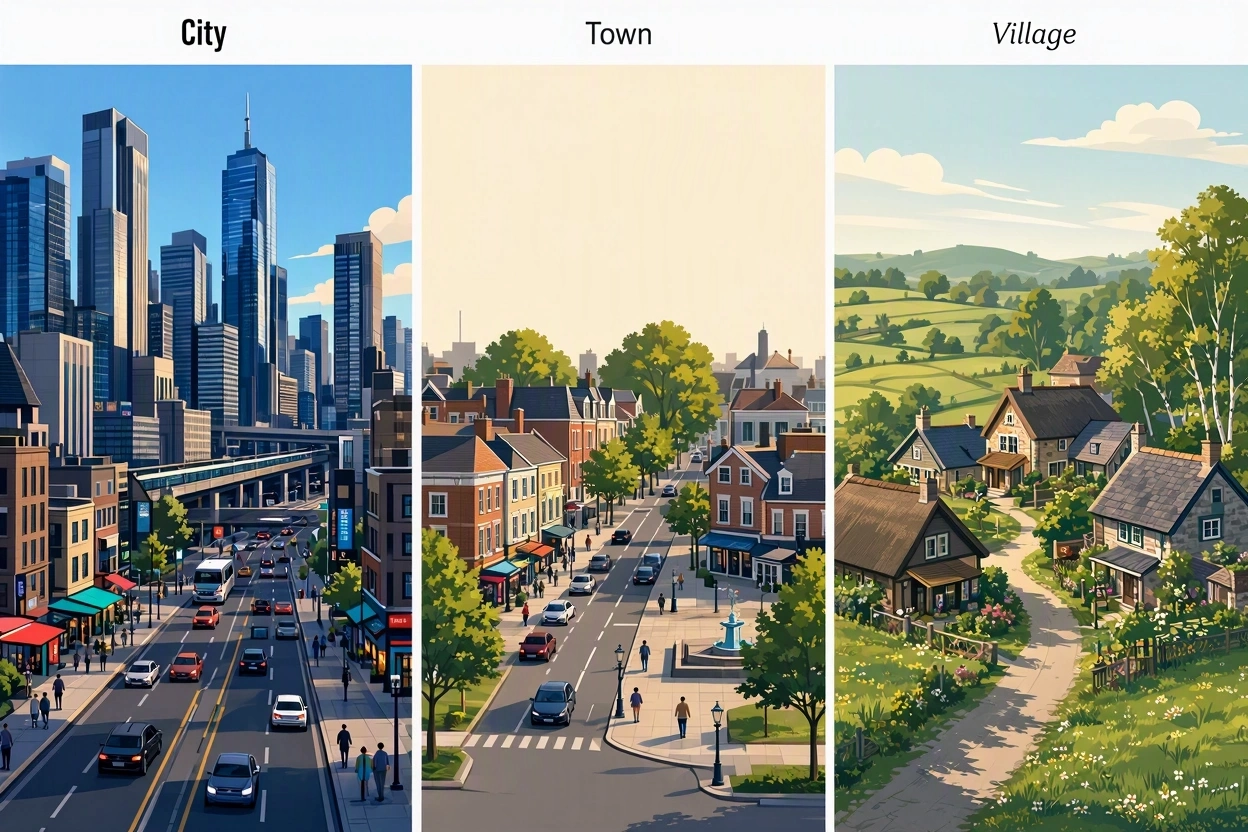
Have you ever wondered whether a place should be called a city, a town, or a village? These three words describe human settlements, but they do not always mean the same thing. A city is generally associated with a large population, extensive services, and busy commercial areas. A town is often smaller and less densely developed, while a village usually has a smaller population and a more rural character. However, the exact differences depend on the country and its official definitions.
Understanding city vs town vs village is useful when learning English, describing places, writing travel guides, or discussing where people live. Although population size is an important factor, it is not the only one. Local government rules, historical traditions, infrastructure, and economic activity can also determine how a settlement is classified. In this guide, you will learn the meanings of city, town, and village, explore their differences through examples, and discover how to use each word naturally in everyday English.
Quick Answer: City vs Town vs Village
A city is generally a large, developed settlement with extensive services and economic activity. A town is often smaller, with a local commercial center and community facilities. A village is usually a smaller settlement associated with rural life. However, population limits and official classifications vary by country.
Why People Confuse City, Town, and Village
People often confuse these terms because all three refer to places where people live, work, and interact. They can also share similar features, including homes, schools, shops, roads, and places of worship.
The main difference is the settlement’s size, character, services, and sometimes its legal status. Even these distinctions are not universal.
For example, a place called a town in one country might be officially classified as a city in another. Some small settlements have city status because of historical traditions, while some large communities may not have that designation.
Here are three useful points to remember:
- City: Usually larger and more developed, with a wider range of services.
- Town: Often a medium-sized settlement serving a local community.
- Village: Usually smaller and more rural, with a closer-knit community.
These are general descriptions rather than strict rules. Always consider the country and local context when deciding which term is appropriate.
1. City: Meaning, Definition, and Examples
A city is a settlement that generally has a substantial population, developed infrastructure, and a broad range of residential, commercial, educational, and public services.
Cities often contain business districts, hospitals, universities, shopping centers, transport networks, and government offices. They may also serve as important centers for industry, culture, tourism, and employment.
However, a city does not have to be enormous. In some countries, official city status depends on legal or historical factors rather than population alone.
Examples of a City
- Karachi is a major city in Pakistan.
- London is the capital city of the United Kingdom.
- Tokyo is a major city in Japan.
- New York City is a major urban center in the United States.
- Lahore is a historic city known for its culture, education, and architecture.
Example Sentences Using City
- My brother works in a large city.
- The city has several universities and modern hospitals.
- Traffic is often heavy in the city during rush hour.
- Many people move to the city to find better job opportunities.
- The city attracts tourists with its historic buildings and museums.
When Should You Use City?
Use city when referring to a settlement officially recognized as a city or when describing a large, developed urban area.
Common expressions include:
- City center
- City life
- City council
- City population
- City traffic
- City limits
- City government
Example: “She enjoys city life because restaurants, offices, and public transport are nearby.”
2. Town: Meaning, Definition, and Examples
A town is generally a settlement that is smaller than a major city but larger or more developed than a typical village. Towns commonly have shops, schools, healthcare facilities, residential neighborhoods, and a local commercial center.
Some towns support surrounding rural communities by providing essential services, markets, and employment. Others are busy urban settlements in their own right.
As with cities, the meaning of town depends on local conventions and laws. A town can be relatively large in one country and comparatively small in another.
Examples of a Town
- A market town serving nearby farms and villages.
- A coastal town known for its beaches and tourism.
- A historic town with traditional streets and local shops.
- A small industrial town with factories and residential neighborhoods.
- A university town where a university plays a major role in local life.
Example Sentences Using Town
- My grandparents live in a quiet town.
- The town has a busy market and several schools.
- We visited a seaside town during our holiday.
- The local town attracts visitors throughout the summer.
- Many residents travel from the town to a nearby city for work.
When Should You Use Town?
Use town when a place is commonly described or officially classified as a town, or when you want to distinguish it from a larger city or a smaller village.
Common expressions include:
- Town center
- Town hall
- Town square
- Town market
- Town life
- Small town
- University town
Example: “The town center becomes crowded on market days.”
Remember that a town can be highly developed. The word does not necessarily mean that the place is old-fashioned, quiet, or lacking modern facilities.
3. Village: Meaning, Definition, and Examples
A village is generally a small settlement, often located in a rural area. Villages may have houses grouped around a main road, a market, farmland, a school, or a community gathering place.
Village life is often associated with agriculture, open spaces, and close social relationships. Nevertheless, not every village is agricultural, and modern villages can have internet access, businesses, schools, and other contemporary facilities.
Some villages are tourist destinations, while others are residential communities near larger towns and cities.
Examples of a Village
- A farming settlement surrounded by fields.
- A mountain village with traditional houses.
- A fishing village located near the coast.
- A rural community with a small market and primary school.
- A village known for its traditional crafts and local culture.
Example Sentences Using Village
- My uncle lives in a peaceful village.
- The village is surrounded by green fields.
- Children walk to the local school in the village.
- The village holds a festival every year.
- Farmers from the village sell fresh vegetables at the market.
When Should You Use Village?
Use village when describing a small settlement, particularly one with a rural character, or when the place is officially or traditionally known as a village.
Common expressions include:
- Village life
- Village market
- Village school
- Village community
- Fishing village
- Mountain village
- Rural village
Example: “Village life can offer a quieter environment than life in a busy urban center.”
City vs Town vs Village: Comparison Table
| Feature | City | Town | Village |
| Typical size | Large | Small to medium-sized | Small |
| Population | Often relatively high | Often moderate | Often relatively low |
| Development | Extensive urban infrastructure | Local services and infrastructure | Usually fewer services locally |
| Employment | Diverse industries and businesses | Local businesses and regional employment | Often local businesses, agriculture, or nearby employment |
| Facilities | Hospitals, universities, transport networks, and shopping centers may be common | Schools, shops, clinics, and markets may be available | Basic services may be available locally |
| Environment | Often busy and densely developed | Can be urban, suburban, or relatively quiet | Often rural, with more open space |
| Community | Diverse and often large | Often locally connected | May have close-knit social relationships |
| Official status | May have a legal designation | May have a legal designation | May have a recognized local classification |
Important: These are general tendencies, not universal rules. A village may have modern facilities, a town may be very large, and a city may have quiet residential neighborhoods.
When to Use Each: City vs Town vs Village
Choosing the right word depends on what you know about the settlement and what you want to communicate.
Use City When
- The place is officially recognized as a city.
- You are describing a large urban area.
- You are discussing extensive infrastructure or diverse economic activity.
- The settlement is commonly known as a city.
Example: “Karachi is a major city with extensive commercial activity.”
Use Town When
- The settlement is known as a town.
- You are describing a local commercial or administrative center.
- The place has a mix of residential areas, shops, and community services.
- You want to distinguish it from a nearby major city or rural village.
Example: “We stopped in a small town to buy food before continuing our journey.”
Use Village When
- The settlement is traditionally or officially called a village.
- You are describing a small rural community.
- The place has a strong connection to surrounding countryside or agricultural land.
- You want to emphasize its small-settlement character.
Example: “The village is surrounded by farms and rolling hills.”
What If You Do Not Know the Official Classification?
Avoid guessing based only on population size. If the legal status is unknown, you can use broader terms such as settlement, community, or populated place.
For instance, “The settlement lies near a river” is a reasonable description when you do not know whether the place is officially a city, town, or village.
Examples: City vs Town vs Village in Sentences
Here are 15 examples to help you understand the differences in context.
- City: The city has an international airport and several universities.
- Town: We visited a historic town during our road trip.
- Village: The village is surrounded by farmland.
- City: She moved to the city to pursue a career in technology.
- Town: The town’s main street is lined with independent shops.
- Village: People gathered in the village square for the annual celebration.
- City: Public transportation makes it easier to travel across the city.
- Town: My cousin runs a bakery in a nearby town.
- Village: The village school serves children from surrounding areas.
- City: Many international companies have offices in the city.
- Town: The coastal town becomes busy during the summer holidays.
- Village: The fishing village is known for its fresh seafood.
- City: They spent the weekend exploring the city’s museums.
- Town: The town holds a weekly market where local farmers sell produce.
- Village: The family returned to their village to celebrate a traditional festival.
One Situation, Three Different Descriptions
Imagine a family is deciding where to live.
- City: They choose a large urban area with many employers, hospitals, universities, and transport options.
- Town: They choose a smaller community with local shops, schools, and access to nearby employment.
- Village: They choose a small rural settlement with open spaces and a quieter atmosphere.
These examples describe common patterns rather than rules. The best word still depends on the settlement’s actual identity and local classification.
Common Mistakes When Using City, Town, and Village
1. Assuming Population Is the Only Difference
A common mistake is believing that every city must be larger than every town and every town must be larger than every village.
In reality, legal status, historical tradition, and administrative rules can affect how a settlement is classified.
Better approach: Consider the place’s official designation and local usage alongside its population.
2. Assuming Every Village Is Poor or Underdeveloped
A village is not necessarily lacking in modern facilities. Some villages have good roads, reliable internet, schools, businesses, and access to healthcare.
Better approach: Use village to describe the type of settlement, not to make assumptions about its residents’ income or lifestyle.
3. Thinking Every Town Is Quiet
Some towns are busy commercial centers with significant traffic, industry, and tourism.
Better approach: Describe a place as quiet, busy, industrial, or tourist-oriented when those characteristics are relevant rather than assuming them from the word town.
4. Using City and Town Interchangeably Without Checking
In casual conversation, people may use these terms loosely. However, official documents, travel writing, and geographical descriptions may require the correct local designation.
Better approach: Check an authoritative local source when precision matters.
5. Confusing a Settlement With Its Administrative Area
A city may refer to a built-up urban area, a municipal jurisdiction, or a larger administrative unit. These boundaries do not always match.
Better approach: Clarify whether you mean the urban settlement itself or the government area associated with it.
Memory Trick: How to Remember City vs Town vs Village
Use this simple memory trick:
- City = Extensive urban life. Think of major roads, offices, hospitals, and a wide range of services.
- Town = Local center. Think of a main street, shops, schools, and services for nearby communities.
- Village = Small community. Think of a smaller settlement, often surrounded by countryside.
You can also remember the general pattern as:
City → Town → Village
This sequence represents a common pattern of decreasing settlement size, not an absolute legal ranking. Some places do not fit this pattern because their official status is based on different criteria.
American vs British English
The words city, town, and village are used in both American and British English. Their general meanings are similar, but official classifications and everyday conventions can differ.
American English
In the United States, city and town may have specific legal meanings determined by state law. The word town can describe a small community, but in some states, it also refers to a particular form of local government. The exact meaning varies by location.
For example:
- New York City is a major city.
- A small community may be called a town.
- A rural settlement may be described as a village, depending on its local designation.
British English
In the United Kingdom, city status is a formal designation granted to particular settlements. It is not determined simply by how large a place is. A town may have a substantial population without being officially designated a city.
The term village commonly describes a smaller settlement, often in a rural setting.
What About Other English-Speaking Countries?
In countries such as Australia, Canada, and Pakistan, the meanings and official classifications can also vary according to local administrative systems and historical practices.
For international English learners, the safest rule is to learn the general meanings while checking the local classification whenever accuracy is important.
Similar Words: Settlement, Hamlet, Suburb, and Metropolis
Several related words help describe places more precisely.
1. Settlement
A settlement is a general term for a place where people live. It can refer to a city, town, village, or another type of inhabited place.
Example: “The settlement developed near a major river.”
2. Hamlet
A hamlet is generally a very small settlement, often smaller than a village and sometimes without its own church, school, or local center.
Example: “A tiny hamlet lies at the foot of the mountain.”
The exact distinction between a hamlet and a village varies by country.
3. Suburb
A suburb is a residential or mixed-use area located within or around a larger urban area. Suburbs may have houses, apartments, schools, shops, and parks.
Example: “They bought a house in a suburb outside the city center.”
A suburb is not necessarily a separate town or village.
4. Metropolis
A metropolis is a very large, important city, often serving as a major center of commerce, culture, transport, or government.
Example: “The metropolis attracts workers and visitors from around the world.”
5. Urban Area
An urban area is a developed, built-up area characterized by relatively concentrated population and infrastructure. It may include a city, parts of neighboring towns, or a wider connected settlement.
Example: “The urban area has expanded as new housing developments have been built.”
6. Rural Area
A rural area is a region outside densely developed urban settlements, often associated with agriculture, open land, forests, or smaller communities.
Example: “The family moved to a rural area for more space and a quieter environment.”
Frequently Asked Questions
1. What is the main difference between a city, town, and village?
A city is generally a larger urban settlement with extensive services and infrastructure. A town is often smaller and serves a local community, while a village is usually a smaller settlement with a more rural character. Official definitions differ by country.
2. Is a town bigger than a village?
Generally, a town is larger than a village or has a broader range of services. However, population size alone does not determine the official classification in every country.
3. Is a city always bigger than a town?
No. Although cities are often larger, some places have city status because of historical or legal reasons. A town in another location may have a larger population than a city.
4. Can a village become a town or a city?
Yes, a settlement may grow and eventually receive a different official designation. However, population growth does not automatically change its status; the process depends on local laws and administrative rules.
5. What is smaller than a village?
A hamlet is often considered smaller than a village. However, this distinction varies by region, and some very small settlements do not have a universally accepted classification.
6. Is a suburb a town or a village?
A suburb is generally a residential or mixed-use area within or around a larger urban area. It may be part of a city or town, or it may have its own local identity. It is not simply another word for a village.
7. What is the difference between urban and rural areas?
Urban areas are generally more densely developed and have concentrated buildings, infrastructure, and services. Rural areas usually have more open land and lower-density settlements, including villages and some small towns.
8. Which word should I use when describing my hometown?
Use the term that matches your hometown’s common or official classification. If you are unsure, hometown, community, or settlement may work without making an inaccurate claim about its status.
Final Verdict: City vs Town vs Village
The difference between a city, town, and village is mainly related to settlement size, development, community structure, and local classification. A city generally offers extensive services and a broad range of economic opportunities. A town often serves as a local center for businesses and community facilities, while a village is typically smaller and may have a stronger connection to rural surroundings.
However, these descriptions are general guidelines rather than universal definitions. Some towns are larger than cities, some villages are highly developed, and official classifications differ across countries. When describing a real place, consider its recognized status instead of relying only on population or appearance.
Conclusion
Learning the difference between city vs town vs village helps you describe places accurately and communicate more naturally in English. These words are useful in everyday conversations, geography lessons, travel writing, and professional content. Remember that a city is generally associated with extensive urban development, a town with a local center, and a village with a smaller settlement, often in a rural area.
The most important lesson is that size alone does not determine what a place is called. Legal status, local traditions, infrastructure, and administrative rules can all influence the classification. When in doubt, check how the place is officially described or use a broader term such as settlement. This approach will help you choose the right word with confidence.
Remember This
- City: Generally a larger, developed urban settlement.
- Town: Often a smaller settlement with local businesses and services.
- Village: Usually a smaller settlement, often associated with rural life.
- Key distinction: These are general patterns, not universal rules.
- Best tip: Check the local or official classification when accuracy matters.

I’m Aria White, a passionate word enthusiast who enjoys exploring grammar, vocabulary, and meaningful word connections. I create simple, helpful content that makes matching words easier, clearer, and enjoyable.